
Open a Free Demat Account !
₹0 AMC & Account Opening Fee
Top Water Related Stocks in India 2026
 Last Updated: 06 October, 2026
 9 min read




00:00 / 00:00


Summary
|
India is staring at a water problem that no one can afford to ignore. We have close to 18% of the world's population but only about 4% of its freshwater resources, and groundwater tables in several states are falling every year. That gap between demand and supply is exactly why water related stocks in India have started showing up on more investor watchlists — the companies solving this problem sit at the intersection of infrastructure, industrials, and public policy spending.
In this article, I'll walk you through what the water sector in India actually looks like today, compare some of the major NSE-listed companies working in water treatment, infrastructure, and management, and explain how each one participates in this theme. This is meant to help you understand the space better — not as investment advice, so please do your own research or speak to a financial advisor before acting on anything here.

Water Sector Outlook in India
The Indian government's flagship Jal Jeevan Mission aims to provide functional household tap connections to every rural home in the country, and as of the scheme's own progress reporting, crores of rural households have been connected since the mission launched in 2019, with budget outlays running into tens of thousands of crores of rupees every year. Alongside this, schemes like AMRUT 2.0 (Atal Mission for Rejuvenation and Urban Transformation) are focused on urban water supply, sewage, and septage management across hundreds of cities.
According to the Ministry of Jal Shakti and various industry estimates cited by IBEF, India's water and wastewater treatment market is expected to grow steadily over the next several years, driven by rising industrial water demand, stricter effluent discharge norms from pollution control boards, and growing urbanisation. This is why companies that build sewage treatment plants, supply water pumps, manufacture water treatment chemicals, or provide micro-irrigation systems are increasingly viewed as a distinct investment theme rather than scattered industrial plays.
It's worth noting that this is a policy-driven, long-gestation sector — order books, execution timelines, and government budget allocations matter a lot more here than they do in, say, a consumer business. Keep that execution risk in mind as you read through the company profiles below.
Water Related Stocks in India: Comparison Table
| Company | Market Price (Rs.) | 52W High | 52W Low | Market Cap (Rs. Cr) | Revenue Growth (YoY) | Profit Growth (YoY) | P/E | Debt-to-Equity |
| VA Tech Wabag | 2,038.65 | NA* | NA* | 12,495 | 19.7% | 25.5% | 35.4 | 0.04 |
| Ion Exchange (India) | 401.75 | 486.0 | 312.7 | 5,892 | 6.5% | -31.3% | 57.9 | NA* |
| Thermax | 3,913.2 | 5,277.8 | 2,742.7 | 46,628 | 21.7% | 19%** | 79.9 | 0.36 |
| WPIL | 487.55 | 510.35 | 383.55 | 4,816 | 3.0% | 63.3% | 40.8 | 0.30 |
| EMS Limited | 354.9 | NA* | NA* | 1,971 | 16%** | 3%** | 29.8 | ~0 (debt-free) |
| Jain Irrigation Systems | 28.64 | NA* | NA* | 2,049 | NA* | NA* | 93.4 | 0.50 |
| Praj Industries | 309.9 | 427.65 | 273.0 | 5,589 | -1.9% | -89.1% | 44.3 | 0.13 |
Data as of October 6, 2026. *NA indicates the figure could not be confidently verified across sources as of publishing and has been left out rather than estimated. **Figure reflects the most recent reported quarter rather than a full fiscal year, where full-year data was not available. Figures are sourced from company exchange filings and financial data platforms including Screener.in, Tickertape, and company investor presentations — always cross-check current figures before making any decision, as prices and ratios change daily.
Company Profiles
VA Tech Wabag
VA Tech Wabag is one of India's most recognised pure-play water technology companies, designing and executing large municipal and industrial water and wastewater treatment plants on an EPC and O&M basis, both in India and internationally. For FY26, the company reported revenue growth of close to 19.7% and profit growth of about 25.5%, backed by a record order book that touched roughly Rs. 17,234 crore — a sign of strong future revenue visibility, even though order execution in this business can stretch over several years.
Ion Exchange (India)
Ion Exchange is a diversified water treatment company offering resins, chemicals, membranes, and complete water and wastewater treatment systems for industrial, municipal, and consumer use. FY26 revenue grew by a modest 6.5%, but net profit actually declined by around 31%, largely due to cost pressures at one of its manufacturing facilities and export disruptions — a good reminder that revenue growth alone doesn't tell the full story in this sector.
Thermax
Thermax is better known as an energy and environment engineering major, but its environment segment includes water and waste solutions — effluent treatment, zero liquid discharge (ZLD), and water recycling systems for industrial clients. The company posted strong FY26 revenue growth of around 21.7%, and its most recent quarter showed healthy double-digit profit growth, reflecting the broader industrial capex cycle that water and environment projects are riding on.
WPIL
WPIL manufactures pumps and pumping systems used in water supply, irrigation, sewage handling, and flood control projects — essentially the hardware that moves water through most of the infrastructure this theme depends on. FY26 revenue growth was modest at around 3%, but net profit jumped by roughly 63%, helped by improving margins and a stronger order mix, which shows how operating leverage can play out in capital-goods-style water businesses.
EMS Limited
EMS Limited is an EPC contractor focused specifically on sewage treatment plants (STPs), water supply schemes, and lift irrigation projects for government bodies. It has stayed debt-free by management's own stated philosophy, relying on internal accruals and equity rather than borrowed capital to fund growth — a conservative approach that's worth noting if you're comparing balance-sheet risk across this sector.
Jain Irrigation Systems
Jain Irrigation is India's largest player in micro-irrigation — drip and sprinkler systems that help farmers use water far more efficiently than flood irrigation. This makes it one of the few listed companies connecting the water theme directly to agricultural productivity. The stock trades at a relatively low absolute price and carries moderate leverage, with a debt-to-equity ratio of around 0.50 as of the latest reported period.
Praj Industries
Praj Industries is primarily known for bioenergy (ethanol) engineering, but it also runs a water and wastewater treatment technologies business, including zero liquid discharge systems, for industrial clients — so it's a partial, not pure-play, water name. FY26 was a tough year for the company overall, with revenue down about 1.9% and profit down sharply by around 89%, driven by execution delays and rising site costs, which is a useful example of why diversified industrial names can carry more earnings volatility than pure water-focused companies.

Why Water Is a Thematic Play, Not a Single Sector
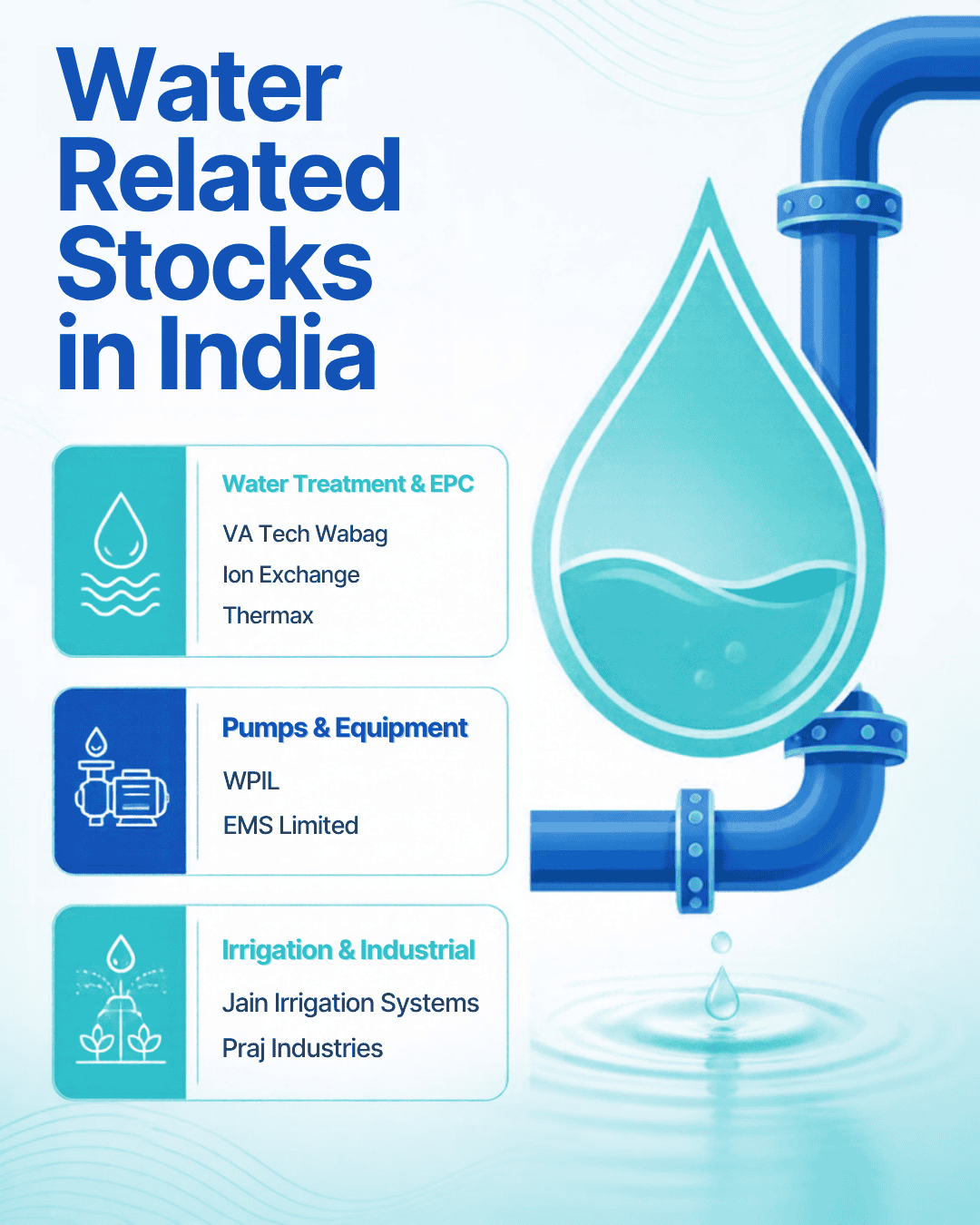
One thing I want you to notice from the table above: these companies don't sit in one neat sector. VA Tech Wabag and Ion Exchange are classified under water/environmental services, Thermax and Praj are industrial capital goods, WPIL makes pumps (also capital goods), EMS is a construction/EPC contractor, and Jain Irrigation sits closer to agri-inputs. That's the nature of a thematic investment — water touches infrastructure, industrials, agriculture, and even FMCG (through packaged drinking water brands), so there's no single "water sector" index classification on Indian exchanges the way there is for, say, banking or IT.
This also means water related stocks don't move together just because they share a theme — their fortunes depend on different end markets, whether that's government tender cycles, industrial capex, or farm incomes. If you're exploring this space, it helps to understand which part of the water value chain each company actually sits in, rather than treating "water stocks" as one homogeneous basket.
Related Articles
| Article | Link |
| Best Infrastructure Stocks in India | Read more |
| How to Open a Demat Account | Read more |
| Margin Trading Facility (MTF) Explained | Read more |
Frequently Asked Questions
Which water stocks can I look at in India?
Some of the major NSE-listed companies working across water treatment, infrastructure, and management include VA Tech Wabag, Ion Exchange (India), Thermax, WPIL, EMS Limited, Jain Irrigation Systems, and Praj Industries. Each participates in the water theme differently — from EPC and treatment plants to pumps and micro-irrigation — so it's worth understanding their individual business models rather than treating them as one group.
What are the best water sector stocks in India?
There's no single "best" water stock — it depends on what part of the water value chain you want exposure to (treatment EPC, pumps, chemicals, or irrigation) and your own risk assessment of each company's financials, order book, and execution track record. Always study the fundamentals — revenue growth, profit trends, debt levels, and valuation — before forming a view.
How do I invest in water related stocks?
You can invest in individual water-theme stocks through a demat and trading account, the same way you'd buy any other listed stock on the NSE or BSE. Some investors also look at mutual funds or thematic ETFs that include water and infrastructure companies as part of a diversified basket, which can help spread out company-specific risk.
Is water a good long-term investment theme in India?
India's water infrastructure needs are structurally large and backed by sustained government spending through programmes like the Jal Jeevan Mission and AMRUT 2.0. That said, "good long-term theme" doesn't mean every stock in it performs well — as the comparison table above shows, some companies in this space have seen profits decline even in a supportive policy environment. Thematic strength doesn't replace the need to evaluate each company on its own merits.
Are mineral water or packaged drinking water companies the same as water infrastructure stocks?
Not quite. Packaged drinking water and mineral water brands are consumer (FMCG) businesses selling a bottled product, while the companies covered in this article are involved in building and operating water treatment, supply, and irrigation infrastructure. Both fall loosely under the "water" umbrella, but they have very different business models, margins, and growth drivers.
What risks should I know before looking at water stocks?
Key risks include dependence on government tenders and budget cycles, long project execution timelines, working capital intensity, and exposure to raw material and site-execution cost overruns — all of which have shown up in the financials of some companies in the table above. It's worth reading quarterly results and management commentary closely rather than relying on the theme alone.
Conclusion
Water related stocks in India sit at an interesting crossroads of policy push, industrial demand, and agricultural need — but as we've seen, that doesn't mean uniform performance across the board. Some companies like VA Tech Wabag and WPIL have shown strong recent growth, while others like Ion Exchange and Praj Industries have faced real profitability pressure. If this theme interests you, the right approach is the same as with any sector: understand the individual business, track the numbers every quarter, and size your position according to your own risk appetite — not just the appeal of the theme.
Written by
Rupeezy TeamDid you like this blog?
1 person liked this blog.
The content on this blog is for educational purposes only and should not be considered investment advice. While we strive for accuracy, some information may contain errors or delays in updates.
Mentions of stocks or investment products are solely for informational purposes and do not constitute recommendations. Investors should conduct their own research before making any decisions.
Investing in financial markets are subject to market risks, and past performance does not guarantee future results. It is advisable to consult a qualified financial professional, review official documents, and verify information independently before making investment decisions.

Open Rupeezy account now. It is free and 100% secure.
Start Stock Investment





All Category