
Open a Free Demat Account !
₹0 AMC & Account Opening Fee
Best Auto Stocks in India 2026
 Last Updated: 06 October, 2026
 13 min read





00:00 / 00:00


Summary
|
If you have ever checked the NSE auto index on a red day and wondered why the whole sector seems to move together, you are not alone. Auto stocks in India — the companies that actually make the cars, two-wheelers and trucks you see on the road — are among the most closely tracked stocks on the market because the sector tells you a lot about consumer spending, rural income, and overall economic momentum in the country.
In this article, I am focusing specifically on auto OEMs (original equipment manufacturers) — the companies that design and sell finished vehicles, like passenger cars, two-wheelers and commercial vehicles. This is different from auto ancillary companies, which make the parts and components (batteries, tyres, forgings, electricals) that go into those vehicles. If you are looking for the parts-and-components side of the sector, we have covered that separately in our guide to top auto ancillary stocks in India. Here, we are looking only at the vehicle manufacturers themselves.

Auto Sector Outlook 2026
India's automobile industry had a genuinely strong FY26. According to the Society of Indian Automobile Manufacturers (SIAM), total vehicle wholesales touched a record 2.83 crore units in FY26, up 10.4% year-on-year, with every single segment — passenger vehicles, commercial vehicles, three-wheelers and two-wheelers — posting its highest-ever sales in a fiscal year. Two-wheelers alone grew 10.7% to 21.71 million units and continued to dominate the market with roughly 77% share of total volumes, while passenger vehicles grew 8% to 4.64 million units and commercial vehicles rose 12.6% to 1.08 million units.
Industry body IBEF attributes part of this momentum to recent tax cuts and lower interest rates, which made vehicle financing more affordable for buyers. Separately, IBEF projects India's broader automotive industry (including components) to be worth around US$300 billion. For a market tracker like you, this matters because auto OEM stocks tend to be a direct read on two things that are hard to measure otherwise — how confident rural and semi-urban India is feeling (tractors, two-wheelers), and how willing urban India is to spend on discretionary big-ticket purchases (passenger cars, SUVs). It's also worth knowing that the sector saw a major structural shift in October 2025, when Tata Motors completed a demerger of its passenger vehicle and commercial vehicle businesses into two separately listed companies — something we'll touch on in the profiles below.
Why Auto Stocks Move the Way They Do (and Why They're Sometimes "Down Today")
If you've searched "why are auto stocks falling" or "why are auto stocks down today," here's the honest, educational answer: auto manufacturing is a cyclical business. Vehicle demand is closely tied to consumer sentiment, fuel prices, interest rates (most vehicles are bought on loans), monsoon performance (which drives rural and tractor demand), and input costs like steel, aluminium and semiconductor chips. On top of that, OEMs regularly compete on discounts and new model launches, which can squeeze margins even when sales volumes look healthy. Add in company-specific triggers — a weak monthly sales number, an EV transition cost, an export tariff change, or a subdued quarterly result from one large player — and the whole auto index can swing in a single session, even if the underlying demand story hasn't actually changed. This is why investors often track monthly SIAM sales data and quarterly results closely rather than reacting to a single day's price move.
List of Top Auto Stocks in India (OEMs) — Comparison Table
| Company | Market Price (Rs.) | 52W High (Rs.) | 52W Low (Rs.) | Market Cap (Rs. Cr) | Revenue Growth | Profit Growth | P/E | Debt-to-Equity |
| Maruti Suzuki India Ltd | 11,532 | 17,372 | 11,304 | 3,62,569 | +34% (TTM) | -9% (TTM) | 25.3 | ~0 (debt-free) |
| Tata Motors Ltd (Commercial Vehicles) | 416.7 | 509 | 306 | 1,54,383 | Not independently verified* | Not independently verified* | 20.8 | Not independently verified* |
| Tata Motors Passenger Vehicles Ltd | ~284-289 | Not yet established (newly listed) | Not yet established (newly listed) | 1,04,413 | Not independently verified* | Not independently verified* | Not meaningful (newly demerged entity) | ~0.70 |
| Mahindra & Mahindra Ltd | 2,858 | 3,840 | 2,812 | 3,56,466 | +20.6% (TTM) | +31.9% (TTM) | 18.6 | 0.01 |
| Bajaj Auto Ltd | ~9,600 (approx.) | 12,470 | 8,491.5 | 2,76,040 | +64% (TTM) | +44% (TTM) | 23.6 | 0.58 |
| Eicher Motors Ltd | 7,022 | 8,233 | 6,439 | 1,92,755 | 21.8% (5Y CAGR) | 32.8% (5Y CAGR) | 33.1 | ~0 (debt-free) |
| Hero MotoCorp Ltd | ~5,090 (approx.) | 6,388.5 | 4,671.5 | 1,04,894 | +35% (TTM) | -17% (TTM) | 18.5 | ~0 (near debt-free) |
| TVS Motor Company Ltd | 4,004 | 4,485 | 3,228 | 1,90,222 | Not disclosed in source (5Y profit CAGR: 38.2%) | 38.2% (5Y CAGR) | 54.9 | 3.43 |
| Ashok Leyland Ltd | ~152 (approx.) | 215.42 | 134.21 | 88,390 | Not disclosed in source (5Y profit CAGR: 84.1%) | 84.1% (5Y CAGR) | 23.7 | 4.5 |
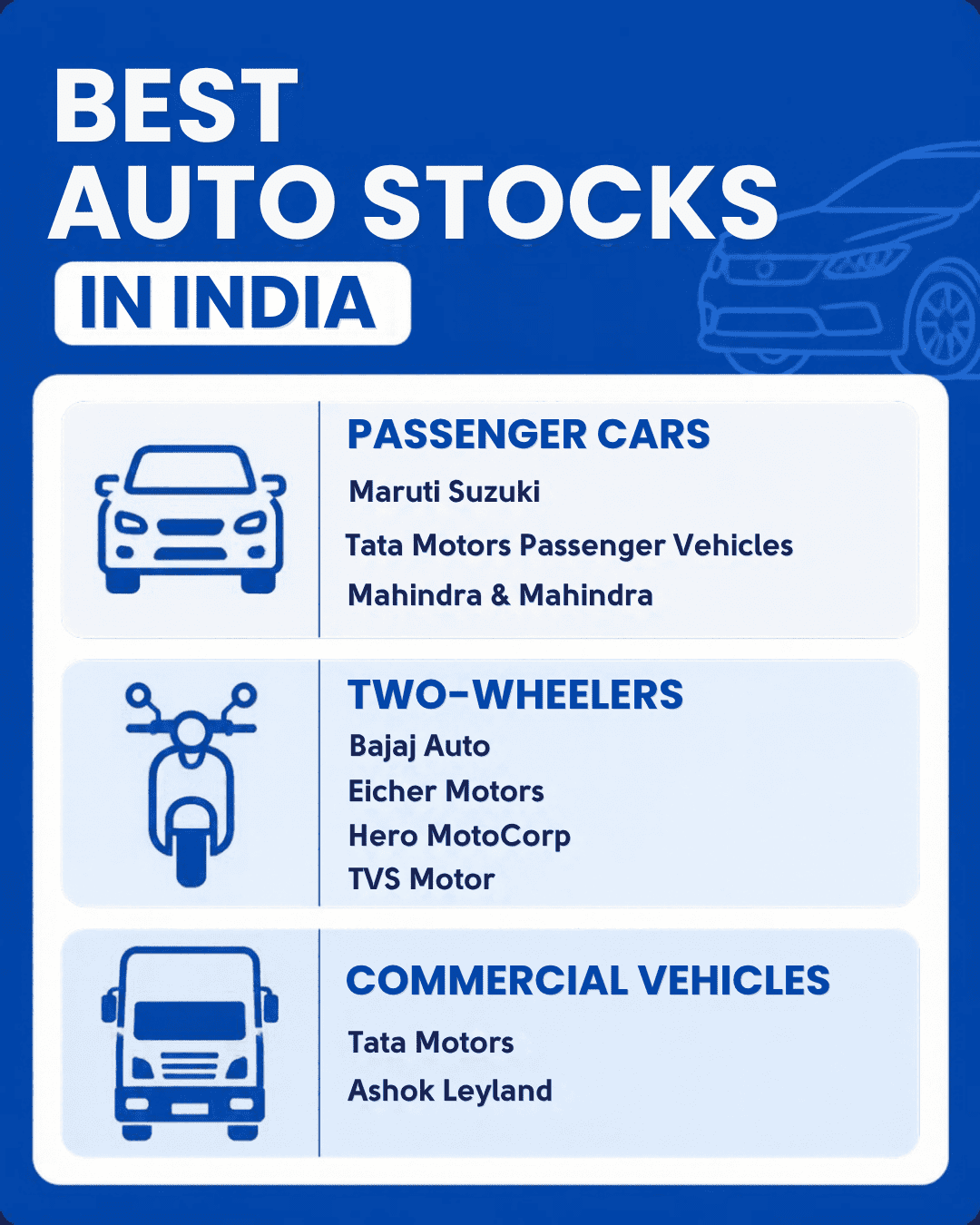
Data as of October 5, 2026. Sources: screener.in, tickertape.in, marketsmojo.com. *Tata Motors Ltd (commercial vehicles) and Tata Motors Passenger Vehicles Ltd were created through a demerger effective October 1, 2025, so like-for-like trailing growth figures for these two entities were not reliably available at the time of writing — please verify directly on screener.in before relying on them. Figures marked "approx." are derived estimates and should be cross-checked against a live terminal before use. Markets move daily — treat this table as a snapshot, not a live quote.
Auto OEM Company Profiles
Maruti Suzuki India Ltd
Maruti Suzuki remains India's largest passenger vehicle maker by volume, with a presence across small cars, SUVs and a growing CNG and export portfolio. What stands out in its numbers is the balance sheet — the company is essentially debt-free, which is unusual for a capital-intensive manufacturing business. Its revenue grew a strong 34% over the trailing twelve months, though profit growth was actually negative over the same period, a reminder that higher sales don't always translate into proportionately higher profit when input costs and competitive discounting are in play.
Tata Motors Ltd (Commercial Vehicles) & Tata Motors Passenger Vehicles Ltd
Tata Motors underwent a major restructuring in late 2025: the commercial vehicle business was demerged into a separately listed company (which has since been renamed Tata Motors Ltd), while the original listed entity was renamed Tata Motors Passenger Vehicles Ltd and now houses the passenger car, EV and Jaguar Land Rover businesses. This means investors tracking "Tata Motors" today need to be clear about which of the two stocks they mean — the commercial vehicle business (trucks, buses) trades with a market cap of roughly Rs. 1,54,383 Cr and a P/E of about 20.8, while the passenger-vehicle-and-JLR business trades at a market cap of roughly Rs. 1,04,413 Cr. Because the split is still recent, we'd recommend checking live, post-demerger financials before drawing conclusions from older consolidated data you might find elsewhere.
Mahindra & Mahindra Ltd
M&M is one of the more diversified names in this list — it straddles SUVs, tractors (where it is a domestic leader), commercial vehicles and a growing electric SUV lineup. Its profit grew close to 32% over the trailing year, comfortably outpacing its already-healthy 20.6% revenue growth, and its debt-to-equity ratio of just 0.01 shows how little leverage the core business carries. The tractor franchise in particular gives it a rural-demand lever that pure passenger-car makers don't have.
Bajaj Auto Ltd
Bajaj Auto is best known for its two-wheeler and three-wheeler lineup and a sizeable export business that spans Africa, Latin America and South Asia. Its trailing revenue growth of 64% and profit growth of 44% stand out even within this list, and a return on equity above 29% suggests the business converts its scale into profitability fairly efficiently. It also owns a stake in KTM, giving it a toehold in the premium motorcycle segment globally.
Eicher Motors Ltd
Eicher Motors is the parent of Royal Enfield, the mid-size motorcycle brand that has built a near cult following domestically and is now expanding exports. The company also holds a stake in VE Commercial Vehicles (VECV), a joint venture with Volvo Group that gives it exposure to trucks and buses as well. Eicher is debt-free and has delivered a 32.8% profit CAGR over five years, which partly explains why the stock trades at a premium P/E of around 33 compared to some peers.
Hero MotoCorp Ltd
Hero MotoCorp is the world's largest two-wheeler manufacturer by volume, with deep rural penetration in motorcycles and scooters. Its numbers over the past year are a useful lesson in reading growth data carefully — revenue rose a reported 35% on a trailing basis, but profit actually fell around 17% over the same period, which tells you margins came under pressure even as topline grew. The company carries almost no debt, giving it room to absorb this kind of margin cycle.
TVS Motor Company Ltd
TVS Motor spans motorcycles, scooters, three-wheelers and an expanding EV lineup (TVS iQube). Its five-year profit CAGR of 38.2% is among the strongest on this list, which is part of why it commands the highest P/E (around 55) of the OEMs covered here. Its debt-to-equity ratio of 3.43 looks high relative to peers, but this largely reflects the consolidation of TVS Credit, its vehicle-financing arm, rather than leverage in the core manufacturing business — a distinction worth knowing before comparing it directly to debt-free peers like Eicher or Hero.
Ashok Leyland Ltd
Ashok Leyland is India's second-largest commercial vehicle maker, with a strong presence in trucks and buses and a growing defence and exports business. Like TVS, its debt-to-equity ratio of around 4.5 is elevated mainly because of its NBFC subsidiary, Hinduja Leyland Finance, which finances vehicle purchases. The core business has delivered a five-year profit CAGR of over 84%, reflecting a strong cyclical upswing in commercial vehicle demand through this period.

Does "Largest" or "Most Popular" Mean "Best Investment"?
It's worth being direct about this: a company being the market leader in its segment — Maruti in passenger cars, Hero in two-wheelers, Ashok Leyland in trucks — does not automatically make its stock the "best" one to hold. Market leadership tells you about scale and brand strength, but valuation (how much you're paying for that business via its P/E), debt levels, and where the company sits in its growth or margin cycle all matter just as much. As you can see from the table above, some of the most recognisable brand names in this list have posted negative profit growth even while their revenue grew, and some smaller players have delivered sharper profit growth than the market leaders. This is exactly why we'd encourage you to treat this list as a starting point for your own research — comparing valuation, debt and growth trends across companies — rather than as a ranked recommendation. Nothing here is investment advice; it is educational information to help you evaluate the sector yourself, ideally alongside your financial advisor.
Related Articles
| Article | Link |
| Top Auto Ancillary Stocks in India 2026 | https://rupeezy.in/blog/auto-ancillary-stocks-india |
| Margin Trading Facility (MTF) Explained | https://rupeezy.in/margin-trading-facility |
| How to Open a Demat Account Online | https://rupeezy.in/blog/how-to-open-demat-account |
| How to Start Trading in the Stock Market: A Beginner's Guide | https://rupeezy.in/blog/how-to-start-trading |
Frequently Asked Questions
What are auto stocks in India?
Auto stocks are shares of companies involved in the automobile industry. This includes OEMs (original equipment manufacturers) that design and sell finished vehicles — like Maruti Suzuki, Tata Motors, Mahindra & Mahindra, Bajaj Auto, Eicher Motors, Hero MotoCorp, TVS Motor and Ashok Leyland — as well as auto ancillary companies that supply parts and components to these OEMs.
Why are auto stocks falling or down today?
Auto stocks are cyclical and tend to react quickly to news on monthly sales volumes, input costs (steel, aluminium, semiconductors), interest rate changes (since most vehicles are financed), and monsoon or rural income trends. A weak monthly sales print from a large OEM, a jump in commodity costs, or a cautious management commentary on margins can all pull the sector down in a single session, even without a change in the longer-term demand story. We'd suggest looking at monthly SIAM data and quarterly results over a longer window rather than reacting to single-day moves.
What is the difference between auto OEM stocks and auto ancillary stocks?
OEM stocks (covered in this article) are the companies that manufacture and sell complete, finished vehicles — cars, two-wheelers, trucks and buses. Auto ancillary stocks are the companies that supply components and parts — like batteries, tyres, forgings, bearings and electricals — that go into those vehicles. Many investors track both, since ancillary companies' order books are directly tied to OEM production volumes. You can read more in our dedicated piece on top auto ancillary stocks in India.
Which is the largest auto company in India by market cap?
As of early October 2026, Maruti Suzuki India Ltd and Mahindra & Mahindra Ltd are the two largest OEMs in this list by market capitalisation, both above Rs. 3.5 lakh crore. Market cap rankings shift regularly, so it's worth checking live data rather than relying on a fixed snapshot.
How can I start investing in auto sector stocks?
You can buy individual auto OEM stocks through a demat and trading account once you've done your own research on the company's fundamentals, valuation and debt levels. If you'd rather not pick individual stocks, sector or thematic mutual funds and ETFs focused on the auto/manufacturing theme are another way to get diversified exposure. If you don't already have a trading account, our guide on how to open a demat account is a good starting point.
Is it a good idea to only invest in the biggest auto stock, like Maruti or Hero?
Not necessarily. Being the largest or most recognisable company in a segment doesn't automatically make it the best-performing stock — valuation, debt levels and where the company sits in its margin or growth cycle all matter. This article is meant to help you compare companies on these factors yourself; it isn't a recommendation to buy any specific stock, and you should evaluate your own risk appetite or consult a financial advisor before investing.
Conclusion
India's auto OEM sector had a record FY26, and the companies in this list — spanning passenger cars, two-wheelers, tractors and commercial vehicles — each tell a slightly different part of that story through their revenue growth, profit trends, debt levels and valuations. Rather than chasing the biggest name or the most-talked-about stock, it's worth spending time comparing these fundamentals against your own investment goals and risk tolerance. And if you're also curious about the companies supplying parts to these very manufacturers, our auto ancillary stocks guide is a natural next read.
Written by
Rupeezy TeamDid you like this blog?
Be the first to like this blog.
The content on this blog is for educational purposes only and should not be considered investment advice. While we strive for accuracy, some information may contain errors or delays in updates.
Mentions of stocks or investment products are solely for informational purposes and do not constitute recommendations. Investors should conduct their own research before making any decisions.
Investing in financial markets are subject to market risks, and past performance does not guarantee future results. It is advisable to consult a qualified financial professional, review official documents, and verify information independently before making investment decisions.
Open Rupeezy account now. It is free and 100% secure.
Start Stock Investment




All Category