
Open a Free Demat Account !
₹0 AMC & Account Opening Fee
Best Telecom Stocks in India 2026
 Last Updated: 06 October, 2026
 12 min read




00:00 / 00:00


Summary
|
If you've recharged your phone, streamed a cricket match on mobile data, or used broadband at home, you've already paid one of India's telecom companies this month. That's the thing about this sector — it's one of the few businesses nearly every Indian interacts with daily, which makes it a sector worth understanding as an investor, not just a customer.
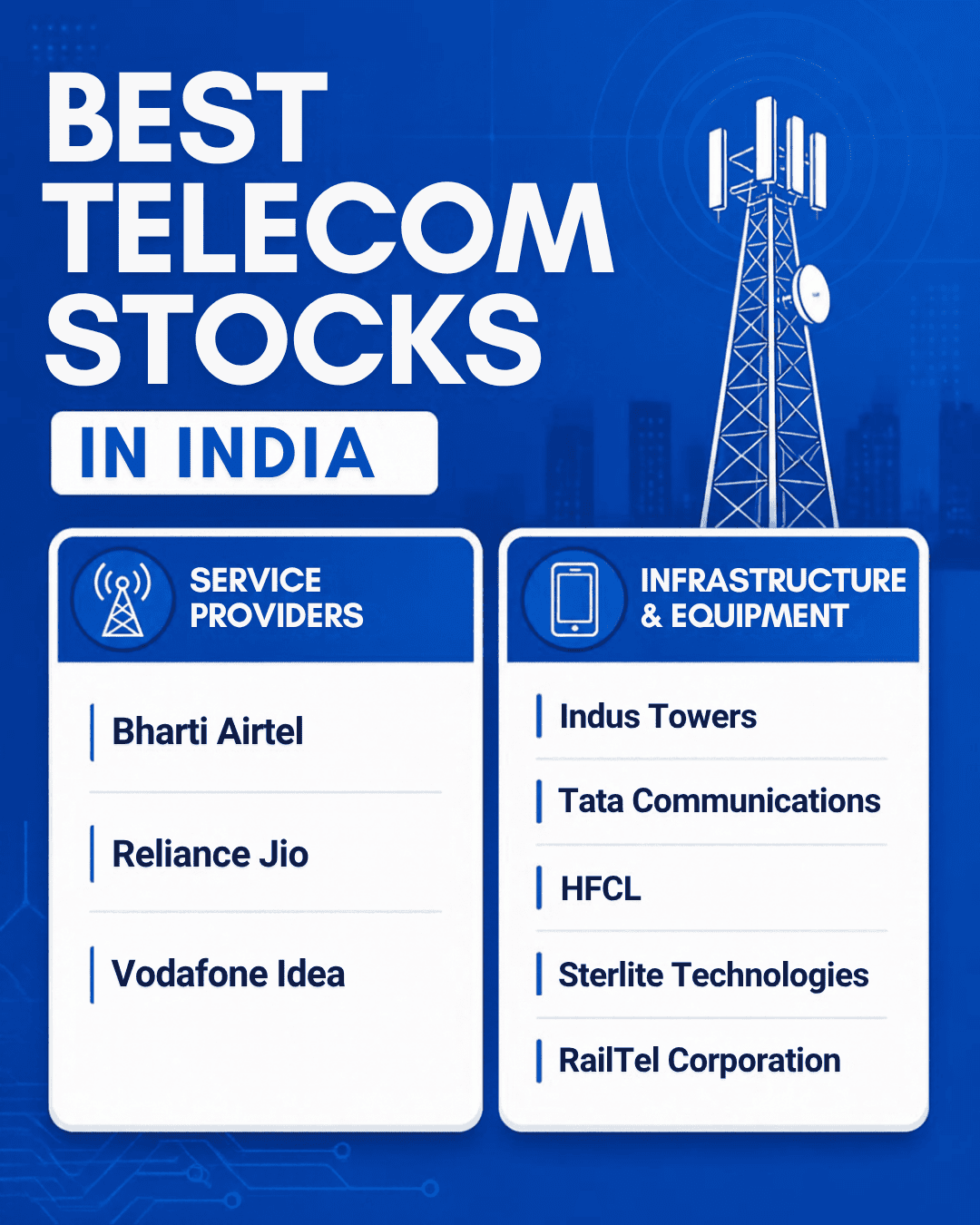
In this article, I'll walk you through the best telecom stocks in India across two distinct groups — the service providers you recognise from your monthly bill, and the infrastructure and equipment companies working quietly behind the scenes to keep networks running. We'll look at real numbers: market price, valuation, debt levels, and growth, so you can form your own view rather than relying on a bare list of tickers.

Telecom Sector Outlook 2026
India's telecom sector has gone through a major consolidation over the last decade, and what's left standing is a leaner, more profitable industry. According to the Telecom Regulatory Authority of India (TRAI), India had over 1.2 billion telecom subscribers as of recent data, with wireless data usage among the highest in the world on a per-user basis. The Department of Telecommunications and industry body COAI (Cellular Operators Association of India) have both pointed to rapid 5G rollout as the next big growth driver, with telcos having already deployed 5G across most major cities and are now pushing into tier-2 and tier-3 towns.
A few things are shaping the sector's direction into 2026 and beyond. First, tariff hikes: after years of brutal price wars, Indian telcos have raised tariffs multiple times since 2021, and this has meaningfully improved average revenue per user (ARPU) — a key profitability metric for telecom companies. Second, rural and semi-urban penetration is still rising, giving operators a long runway for subscriber growth. Third, the shift from voice to data and now to 5G-enabled use cases (IoT, enterprise connectivity, fixed wireless access) is opening new revenue lines beyond the traditional mobile recharge. IBEF (India Brand Equity Foundation) data has consistently flagged telecom as one of the fastest-growing sectors supporting India's broader digital economy ambitions, particularly as 5G, data centres, and fibre infrastructure get built out together.
That said, this is also a capital-intensive sector. Building towers, laying fibre, and buying spectrum require enormous upfront investment, which is why debt levels vary so sharply between companies — something we'll call out specifically for each stock below, since it tells you a lot about financial risk.
Best Telecom Stocks in India: Comparison Table
| Company | Market Price (Rs.) | 52W High (Rs.) | 52W Low (Rs.) | Market Cap (Rs. Cr) | Revenue Growth (YoY) | Profit Growth (YoY) | P/E | Debt-to-Equity |
| Bharti Airtel | 1,779.90 | 2,174.50 | 1,726.30 | 10,75,270 | ~28% | ~43% | 36.92 | 1.31 |
| Reliance Industries (Jio) | 1,186 | 1,611.80 | 1,160.80 | 16,05,500 | ~14.6% (Jio segment) | Not independently reported (Jio is a Reliance segment) | 17.90 | 0.39 |
| Vodafone Idea | 13.12 | 15.34 | 6.18 | 1,42,146 | Modest growth, still loss-making | Net loss-making | 3.70* | Negative equity |
| Indus Towers | 382.05 | 481.50 | 337.80 | 97,902 | ~4.6% | Declined ~2.6% QoQ | 13.80 | 0.39 |
| Tata Communications | 1,683 | 2,110 | 1,322.50 | 47,980 | ~7.3% | Margin pressure despite EBITDA growth | 53.36 | 3.14 |
| HFCL | 238 | 256.70 | 59.82 | 36,483 | ~21.6% | ~90.1% | 76.76 | 0.32 |
| Sterlite Technologies (STL) | 955.40 | 897.30** | 84.60 | 49,110 | Volatile; Q1 FY27 revenue Rs.1,922 Cr | Q1 FY27 profit Rs.197 Cr | 392.72 | 0.88 (approx.) |
| RailTel Corporation | 338.50 | 478.95 | 265.50 | 10,859 (approx.) | Steady multi-year growth | ~21% profit CAGR (5-yr) | 32.41 | 0.02 |
Data as of October 6, 2026. Figures sourced from stockanalysis.com, screener.in, tickertape.in, moneyworks4me.com, tatacommunications.com press releases, and other public financial data providers as cited in the internal linking notes below. *Vodafone Idea's P/E is not meaningful in the traditional sense given its history of large losses and negative net worth — treat this figure with caution. **Sterlite Technologies'. Sterlite Technologies' 52-week high as sourced (Rs.897.30) is below its current price of Rs.955.40 — likely a timing mismatch between sources; verify on your broker terminal before relying on this figure. RailTel figures have been corrected against a live quote as of October 6, 2026.
Telecom Service Providers: Company Profiles
Bharti Airtel
Bharti Airtel is India's most prominent pure-play telecom operator, offering mobile services, broadband, and enterprise connectivity across India and parts of Africa. The company's recent performance has been strong — consolidated revenue grew around 28% year-on-year with net profit up roughly 43%, helped by rising mobile ARPU (average revenue per user), which crossed Rs.250. A debt-to-equity ratio of around 1.31 reflects the capital-heavy nature of running a nationwide network, though this has been improving as the company deleverages. If you're looking for exposure to India's telecom turnaround story through an operator with a long track record, Airtel is usually the first name that comes up.
Reliance Industries (Jio)
Here's an important clarification: Jio itself is not separately listed on the stock exchange. Jio Platforms operates as a subsidiary of Reliance Industries, so if you want exposure to Jio's telecom business, Reliance Industries Ltd is the stock you'd actually buy. Jio's telecom revenue has grown at a healthy clip — reported up around 14.6% year-on-year in its latest full-year numbers — making it one of the largest contributors to Reliance's overall business alongside oil-to-chemicals and retail. Reliance's conservative debt-to-equity ratio of around 0.39 reflects the scale and diversified cash flows of the broader conglomerate, not Jio's telecom unit in isolation. Keep in mind that buying Reliance stock means you're also buying its retail and energy businesses, not a pure telecom bet.
Vodafone Idea
Vodafone Idea is the most high-risk, high-volatility name on this list. The company has struggled for years with a heavy debt burden, including substantial dues to the government from spectrum and adjusted gross revenue (AGR) liabilities, leading to negative net worth on its balance sheet. The stock has seen sharp price swings — up over 50% in the past year by some measures — largely on news flow around government relief, fundraising, and tariff hikes rather than core profitability. This is not a stock to approach the way you'd approach a stable, profitable company; if you're considering it, understand you're making a bet on a turnaround story with genuine uncertainty attached, not a steady compounder.

Telecom Infrastructure & Equipment: Company Profiles
Indus Towers
Indus Towers is India's largest independent telecom tower infrastructure company, leasing tower space to operators like Airtel, Jio, and Vodafone Idea rather than selling services directly to consumers. This business model gives it relatively predictable, contracted revenue, which is reflected in its comparatively low debt-to-equity ratio of around 0.39 and a reasonable P/E of about 13.8. Revenue growth has been modest (around 4-5% year-on-year), and recent profit has seen a slight sequential dip, which is worth watching if tenancy additions slow down. For investors who want telecom-adjacent exposure without direct subscriber-level risk, tower infrastructure is a different kind of bet than owning an operator.
Tata Communications
Tata Communications has transformed itself from a legacy long-distance carrier into a global enterprise connectivity and digital infrastructure player, with a growing data and digital portfolio business that's now outpacing its traditional voice business. Revenue crossed Rs.24,800 crore for the full year, up about 7.3%, with its digital portfolio growing faster at nearly 17% year-on-year. The company carries a higher debt-to-equity ratio of around 3.14, reflecting investment in data centres and subsea cable networks, though management has flagged improving net debt-to-EBITDA as a positive sign. Its valuation (P/E above 50) prices in expectations of continued digital and enterprise growth.
HFCL
HFCL manufactures optical fibre cables, telecom equipment, and network infrastructure products used by telecom operators and government network rollouts (including defence and railways). It's had a standout year — revenue grew around 21.6% and net profit nearly doubled, up over 90%, helped by strong order execution. Its debt-to-equity ratio of roughly 0.32 is comfortably low for a manufacturing-heavy business, though the stock's P/E of nearly 77 is elevated and has already priced in a lot of that growth after a sharp rally. This is a good example of a telecom equipment manufacturer rather than a service provider — a distinction worth keeping in mind.
Sterlite Technologies (STL)
STL is another optical fibre and network solutions company, supplying fibre cables and software-defined network products to telecom operators globally. Its quarterly numbers (Rs.1,922 crore revenue and Rs.197 crore profit for the latest quarter) show the business has stabilised after a rough multi-year patch, and the stock has had a dramatic recovery from multi-year lows. That said, a very high P/E (close to 390) signals the market is pricing in a strong future recovery rather than current earnings — worth approaching with caution and a clear understanding of the underlying business cycle in fibre optics.
RailTel Corporation of India
RailTel is a government-owned telecom infrastructure company that built and operates one of India's largest optic fibre networks along railway tracks, which it monetises through enterprise connectivity, data centre, and network services contracts — including Indian Railways' own requirements. It's almost debt-free, with a debt-to-equity ratio near zero, and has delivered consistent profit growth (roughly 21% CAGR over five years). A reasonable P/E of around 25 makes it one of the more conservatively valued names on this list, though as a PSU, growth tends to be steadier rather than explosive.
Telecom Service Providers vs. Telecom Infrastructure & Equipment Stocks: What's the Difference?
If you're new to the sector, this distinction matters more than it might seem. Telecom service providers — Bharti Airtel, Reliance Jio, and Vodafone Idea — are the companies you pay directly for your mobile and broadband connection. Their revenue depends on subscriber growth, ARPU, and tariff decisions, and their profitability is closely tied to how well they manage spectrum costs and network capex against what customers are willing to pay.
Telecom infrastructure and equipment companies — Indus Towers, Tata Communications, HFCL, Sterlite Technologies, and RailTel — sit one step removed from the end consumer. Tower companies like Indus Towers earn contracted rental income from operators. Fibre and equipment makers like HFCL and STL sell cables, routers, and network gear that operators and governments need to build out networks, including for 5G rollout. This means their fortunes are tied more to capex cycles and order books than to subscriber churn. As a reader trying to decide where to focus, it helps to ask: am I betting on how many people use telecom services (service providers), or on how much gets spent building the networks underneath them (infrastructure and equipment)? Both are legitimate ways to get exposure to India's telecom growth story, but the risk and return drivers are genuinely different.
Related Articles
| Article | Link |
| How to Open a Demat Account | Read more |
| How to Start Trading in the Stock Market | Read more |
| Margin Trading Facility (MTF) Explained | Read more |
| Best Infrastructure Stocks in India | Read more |
Frequently Asked Questions
What are the best telecom stocks in India?
Among telecom service providers, Bharti Airtel and Reliance Industries (parent of Jio) are the most widely tracked for their scale and profitability, while Vodafone Idea remains a higher-risk turnaround story. Among infrastructure and equipment names, Indus Towers, Tata Communications, HFCL, Sterlite Technologies, and RailTel Corporation are commonly studied options. "Best" depends on your risk appetite, time horizon, and whether you want exposure to service providers or infrastructure — there's no one-size-fits-all answer, so it's worth researching each company's fundamentals before deciding.
Is Jio a separately listed stock in India?
No. Jio Platforms is a subsidiary of Reliance Industries and does not have its own separate stock listing on the NSE or BSE. If you want exposure to Jio's telecom business, you would need to invest in Reliance Industries Ltd, keeping in mind that this also gives you exposure to Reliance's retail and energy businesses.
What are 5G telecom stocks in India?
There isn't a separate category of stocks exclusively for 5G — rather, existing telecom service providers (Bharti Airtel, Reliance Jio via Reliance Industries, Vodafone Idea) are the ones rolling out 5G networks to consumers, while infrastructure and equipment companies like Indus Towers, HFCL, and Sterlite Technologies supply the towers, fibre, and network gear that make 5G rollout possible. Both groups benefit from continued 5G investment, just through different parts of the value chain.
What is the difference between telecom equipment manufacturers and telecom service provider stocks?
Telecom service providers earn revenue directly from subscribers through recharges, broadband bills, and enterprise connectivity contracts. Telecom equipment manufacturers like HFCL and Sterlite Technologies instead sell the physical infrastructure — optical fibre cables, network hardware, and related products — that operators and governments need to build and expand telecom networks. Equipment makers' earnings tend to track capex cycles and order books, while service providers' earnings track subscriber growth and tariffs.
Why is debt-to-equity important when evaluating telecom stocks?
Telecom is a capital-intensive industry — building towers, laying fibre, and buying spectrum require large upfront investment, usually funded partly through debt. A high debt-to-equity ratio, like Vodafone Idea's negative net worth position or Tata Communications' leveraged balance sheet, signals higher financial risk and interest cost burden. A lower ratio, like RailTel's near-zero debt or Indus Towers' and Reliance Industries' comfortable levels, generally points to a more financially stable business, though it's just one metric among several you should look at.
Are telecom stocks a good long-term investment in India?
Telecom is a sector with strong structural tailwinds in India — rising data consumption, 5G rollout, and improving tariffs have helped several telecom companies post healthy profit growth recently. That said, like any sector, it carries risks including regulatory changes, intense competition, and in some cases heavy debt. Whether telecom stocks fit your portfolio depends on your own research, risk tolerance, and investment goals — this article is meant to inform that research, not to recommend any specific stock.
Conclusion
India's telecom sector sits at an interesting point — tariff hikes have improved profitability for operators, 5G rollout is driving fresh infrastructure spend, and rural penetration still has room to grow. Whether you're drawn to the scale of Bharti Airtel and Reliance Jio, the turnaround potential (and risk) in Vodafone Idea, or the steadier infrastructure and equipment plays like Indus Towers, Tata Communications, HFCL, Sterlite Technologies, and RailTel, the key is understanding what you're actually buying — a subscriber growth story or a capex-cycle story — and matching that to your own investment goals. As always, treat this as a starting point for your own due diligence, not a final answer.
Written by
Rupeezy TeamDid you like this blog?
Be the first to like this blog.
The content on this blog is for educational purposes only and should not be considered investment advice. While we strive for accuracy, some information may contain errors or delays in updates.
Mentions of stocks or investment products are solely for informational purposes and do not constitute recommendations. Investors should conduct their own research before making any decisions.
Investing in financial markets are subject to market risks, and past performance does not guarantee future results. It is advisable to consult a qualified financial professional, review official documents, and verify information independently before making investment decisions.
Open Rupeezy account now. It is free and 100% secure.
Start Stock Investment


All Category