
Open a Free Demat Account !
₹0 AMC & Account Opening Fee
Top Electronics Manufacturing Stocks in India 2026
 Last Updated: 06 October, 2026
 11 min read




00:00 / 00:00


Summary
|
If you've been tracking India's manufacturing story over the past few years, you've probably heard the term "China+1" more times than you can count. Global electronics brands are actively looking to diversify their supply chains away from China, and India — backed by the government's Production Linked Incentive (PLI) scheme — is positioning itself as a serious alternative. That shift has created a small but fast-growing group of listed companies that make, assemble, or manufacture electronics on behalf of global and domestic brands.
In this article, I'll walk you through the key electronics manufacturing stocks in India, explain exactly how each company participates in this value chain (because "electronics manufacturing" actually covers a few very different business models), and share their core fundamentals as of early October 2026. This is educational content to help you understand the space — not investment advice or a recommendation to buy or sell any stock.

Electronics Manufacturing Sector Outlook 2026
India's electronics manufacturing industry has grown from being a largely import-dependent sector to one of the government's priority areas for domestic value addition. According to IBEF (India Brand Equity Foundation), India's electronics production has grown substantially over the last decade, with mobile phone manufacturing alone now accounting for a large share of this output, and the government targeting electronics production worth hundreds of billions of dollars in the coming years as part of its broader manufacturing push.
A big part of this growth is the PLI (Production Linked Incentive) scheme for electronics, introduced by the Ministry of Electronics and Information Technology (MeitY) in 2020. The scheme offers financial incentives to companies that manufacture electronics domestically — mobile phones, specified electronic components, IT hardware, and more — instead of importing them. You can read the official scheme details on the MeitY website.
Layer on top of this the "China+1" strategy — where global brands like Apple, Samsung, and others are actively diversifying manufacturing locations beyond China — and you get a genuine structural tailwind for Indian contract manufacturers and component makers. That said, I want to be upfront with you: this is still a relatively small, niche part of the Indian market compared to sectors like banking or IT services. It's a theme worth understanding and tracking for the long term, not a space to chase for quick gains.
Electronics Manufacturing Stocks in India: Comparison Table
| Company | Market Price (Rs.) | 52W High (Rs.) | 52W Low (Rs.) | Market Cap (Rs. Cr) | Revenue Growth (YoY) | Profit Growth (YoY) | P/E | Debt-to-Equity |
| Dixon Technologies | 12,700 | 17,505 | 9,600 | 80,133 | +28% (FY26) | +33% (FY26) | ~55.7 | 0.30 |
| Amber Enterprises India | 6,557 | 8,974 | 5,400.5 | 24,652 | +22% (FY26) | +22% (FY26, adj. PAT) | ~171 | 0.71 |
| Syrma SGS Technology | 1,718.3 | 1,823 | 634.15 | 33,134 | +53% (TTM) | Not independently verified — see note | ~74.7 | ~0.12 |
| Kaynes Technology India | 3,394.8 | 7,705 | 2,995.85 | 22,821 | +33% (FY26) | +24% (FY26) | ~82.3 | 0.07 |
| PG Electroplast | 487 | 644.4 | 436.55 | 14,138 | +34% (TTM) | Not independently verified — see note | ~67–82 | 0.20 |
| Avalon Technologies | 2,373.3 | 2,424 | 777.3 | 15,130 | +50% (TTM) | Not independently verified — see note | ~134.1 | 0.29 |
| Centum Electronics | 4,679.1 | Not independently verified | Not independently verified | 6,941 | Volatile — see note | Volatile — see note | ~140.7 | 0.24 |
Data as of 1–5 October 2026. Market price, market cap, P/E, and debt-to-equity figures are sourced from Tickertape, IndMoney, Bajaj Broking, and Simply Wall St (see individual citations below) and can vary slightly between data providers depending on the exact pull time. P/E ratios for several of these companies are very high — this reflects their small earnings base and high growth expectations, not necessarily "cheapness" or "expense" in the traditional sense. Figures marked "not independently verified" could not be confirmed from a reliable recent source within this research pass; please verify current numbers on your preferred terminal before publishing or acting on them.
Electronics Manufacturing Companies in India: How Each One Actually Participates
Dixon Technologies
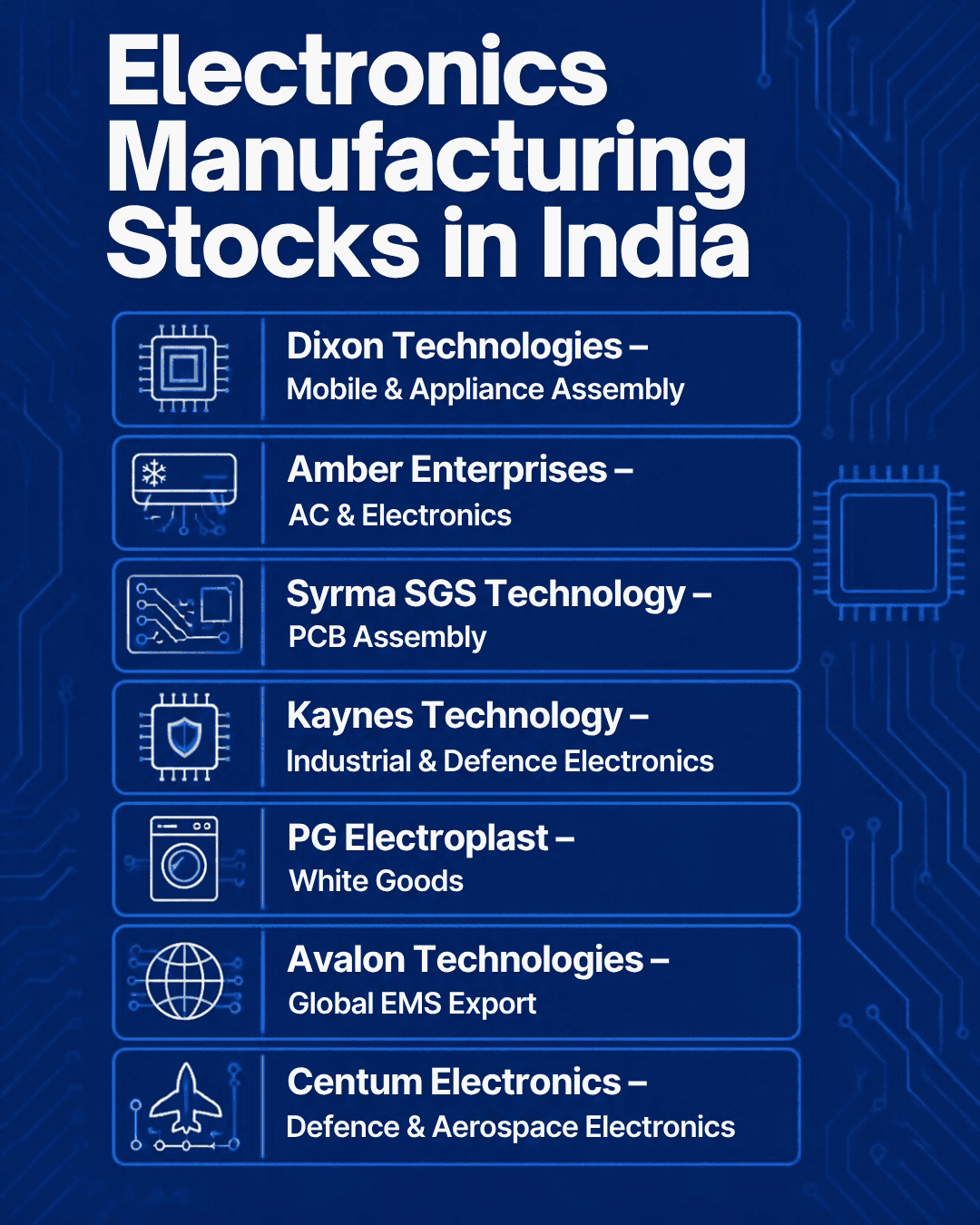
Dixon Technologies is India's largest electronics manufacturing services (EMS) company, and it works almost entirely on a contract manufacturing and ODM (Original Design Manufacturer) basis. In simple terms, Dixon makes finished electronics products — mobile phones, LED TVs, washing machines, and lighting products — on behalf of brands that don't manufacture in-house, including several large mobile phone companies. For FY26, Dixon reported consolidated revenue growth of around 28% YoY and profit after tax growth of around 33% YoY, reflecting the scale benefits of its mobile manufacturing business (source).
Amber Enterprises India
Amber Enterprises started out as an OEM/ODM manufacturer of room air conditioners for Indian consumer durable brands, but it has since built a dedicated Electronics Division that makes printed circuit board assemblies (PCBAs) and electronic controllers — the "brains" inside air conditioners, appliances, and other devices. It also has a Railway & Defence electronics arm. In FY26, Amber's Electronics Division revenue grew roughly 49% YoY to about Rs. 3,268 crore, significantly outpacing the company's overall ~22% revenue growth, which shows where its fastest expansion is coming from (source).
Syrma SGS Technology
Syrma SGS is a diversified EMS player that designs and manufactures PCB assemblies and electronic sub-systems for multiple end-industries at once — automotive, consumer durables, industrial, medical devices, railways, and IT. Unlike Dixon, which leans heavily on a few large consumer categories, Syrma's model is built around spreading manufacturing across many smaller industrial and automotive clients. Its revenue grew roughly 53% on a trailing-twelve-month basis, among the fastest in this group, aided by a near debt-free balance sheet with a debt-to-equity ratio of around 0.12 (source).
Kaynes Technology India
Kaynes Technology manufactures PCB assemblies and "box-build" electronic systems largely for industrial, automotive, aerospace & defence, and railways customers — it's one of the more technically complex, lower-volume/higher-value EMS businesses in this list. Kaynes is also building out an OSAT (semiconductor assembly and test) business, which is a step closer to chip-level manufacturing than pure EMS. FY26 revenue grew about 33% YoY to roughly Rs. 3,626 crore, while net profit grew about 24% YoY to around Rs. 364 crore — though it's worth noting that Q4 FY26 profit actually declined YoY, a reminder that EMS earnings can be lumpy quarter to quarter (source).
PG Electroplast
PG Electroplast primarily manufactures room air conditioners, washing machines, and plastic/electronic components for consumer durable brands, operating on an ODM basis similar to Dixon but focused specifically on white goods rather than mobile phones. Its revenue has grown around 34% on a trailing basis with a 3-year revenue CAGR near 35%, and it carries a conservative debt-to-equity ratio of around 0.20 (source).
Avalon Technologies
Avalon Technologies is a fully integrated EMS company offering PCB assembly, electromechanical assembly, and "box-build" manufacturing to a global customer base spanning industrial, clean energy, mobility, communication, and medical devices — it has a notably large export share compared to peers. Management raised FY26 revenue growth guidance to around 40%, and the company actually delivered roughly 50% TTM revenue growth, with a very low net-debt-to-equity ratio of around 0.04, among the most conservative balance sheets in this group (source).
Centum Electronics
Centum Electronics is more specialised and defence/aerospace-leaning than the others on this list — it designs and manufactures electronic sub-systems, communication equipment, and tactical systems, largely for defence, space, and aerospace clients, alongside some industrial and automotive electronics. This niche focus means its quarterly revenue and profit numbers can swing significantly depending on large defence/aerospace order timing — for instance, revenue fell sharply quarter-on-quarter from Rs. 347.89 crore in the March 2026 quarter to Rs. 206.46 crore in the June 2026 quarter, which is a useful reminder that order-book-driven businesses don't grow in a straight line (source).

Is Electronics Manufacturing a "Sector" or a "Theme"?
One thing I want you to take away from this article: electronics manufacturing in India isn't a clean, single "sector" the way banking or IT services are. It's more accurate to call it a thematic basket — a group of companies that share a common manufacturing capability (PCB assembly, box-build, contract manufacturing) but actually sell into very different end-markets: consumer electronics and appliances, automotive, industrial equipment, railways, and defence/aerospace.
That distinction matters because it means these companies don't all move together, and they aren't exposed to the same demand drivers. A slowdown in consumer appliance demand might hurt PG Electroplast or Amber's consumer-facing business, while leaving Kaynes' industrial and defence order book largely unaffected. When you're evaluating "electronics manufacturing stocks" as a group, it helps to think of them less like one sector and more like a collection of businesses connected by what they're good at building, not what they're selling into.
Related Articles
| Article | Link |
| Top Semiconductor Stocks in India | Read here |
| Best AI Stocks in India | Read here |
| How to Open a Demat Account | Read here |
| What is Margin Trading Facility (MTF) | Read here |
Frequently Asked Questions
What does EMS mean in stock market terms?
EMS stands for Electronics Manufacturing Services. In the stock market, "EMS stocks" or "EMS companies" refer to businesses that manufacture electronic products or components on behalf of other brands, rather than selling products under their own name. Dixon Technologies, Amber Enterprises, Syrma SGS, Kaynes Technology, and similar companies are examples of EMS businesses listed in India.
Is electronics manufacturing a good long-term investment theme?
Electronics manufacturing is a structural theme backed by government policy (the PLI scheme) and a global supply-chain shift ("China+1"), which gives it genuine long-term tailwinds. That said, this is educational information, not investment advice — many stocks in this space trade at high valuations (P/E ratios well above 50-100 in several cases) because the market is pricing in future growth, and you should do your own research or speak with a qualified advisor before making any investment decision.
What is the difference between EMS stocks and semiconductor stocks?
EMS companies assemble and manufacture finished electronic products or circuit boards using components (including chips) that are usually made elsewhere. Semiconductor companies, on the other hand, are involved in designing or fabricating the actual chips that go inside those products. Some EMS companies, like Kaynes Technology, are now expanding into semiconductor assembly and testing (OSAT), which blurs the line slightly, but broadly, EMS is "assembly and manufacturing" while semiconductors is "chip design and fabrication." You can read more in our semiconductor stocks article.
What is the PLI scheme and why does it matter for these stocks?
The Production Linked Incentive (PLI) scheme is a government initiative that offers financial incentives to companies for manufacturing specific electronics products in India, instead of importing them. It matters for EMS stocks because many of these companies have received PLI benefits for expanding domestic manufacturing capacity, which has helped drive the strong revenue growth you see in companies like Dixon and Amber over the past few years.
Why do electronics manufacturing stocks have such high P/E ratios?
Several EMS stocks in India trade at P/E ratios well above 50, and in some cases above 100-150. This generally happens when a company's current profit base is still small relative to the growth the market expects in future years — investors are pricing in future earnings, not just current ones. High P/E ratios also mean these stocks can be more volatile, since even small changes in growth expectations can move the price significantly.
Are all electronics manufacturing companies in India dependent on one industry?
No — and this is an important point. As covered above, these companies serve very different end-markets: consumer electronics and appliances (Dixon, PG Electroplast), room air conditioners and electronics (Amber), diversified industrial/automotive (Syrma SGS, Avalon), and defence/aerospace/railways (Kaynes, Centum). This is one of the reasons electronics manufacturing is better understood as a theme spanning multiple industries, rather than a single sector.
Conclusion
Electronics manufacturing stocks in India sit at an interesting intersection of government policy, global supply-chain shifts, and genuine execution risk. Companies like Dixon, Amber, Syrma SGS, Kaynes, PG Electroplast, Avalon, and Centum are all benefiting from the same broad PLI and "China+1" tailwinds, but they participate in very different ways — from mobile phone assembly to defence electronics — and carry very different valuations and balance sheet risks as a result. If this theme interests you, the right approach is to understand what each company actually manufactures and for whom, rather than treating them as one interchangeable basket. As always, treat this as a starting point for your own research, not a recommendation to buy or sell any of these stocks.
Written by
Rupeezy TeamDid you like this blog?
Be the first to like this blog.
The content on this blog is for educational purposes only and should not be considered investment advice. While we strive for accuracy, some information may contain errors or delays in updates.
Mentions of stocks or investment products are solely for informational purposes and do not constitute recommendations. Investors should conduct their own research before making any decisions.
Investing in financial markets are subject to market risks, and past performance does not guarantee future results. It is advisable to consult a qualified financial professional, review official documents, and verify information independently before making investment decisions.

Open Rupeezy account now. It is free and 100% secure.
Start Stock Investment





All Category