
Open a Free Demat Account !
₹0 AMC & Account Opening Fee
Stock Market vs Commodity Market: 10 Key Differences

 Last Updated: 18 September, 2026
 10 min read




00:00 / 00:00


Key Highlights
|

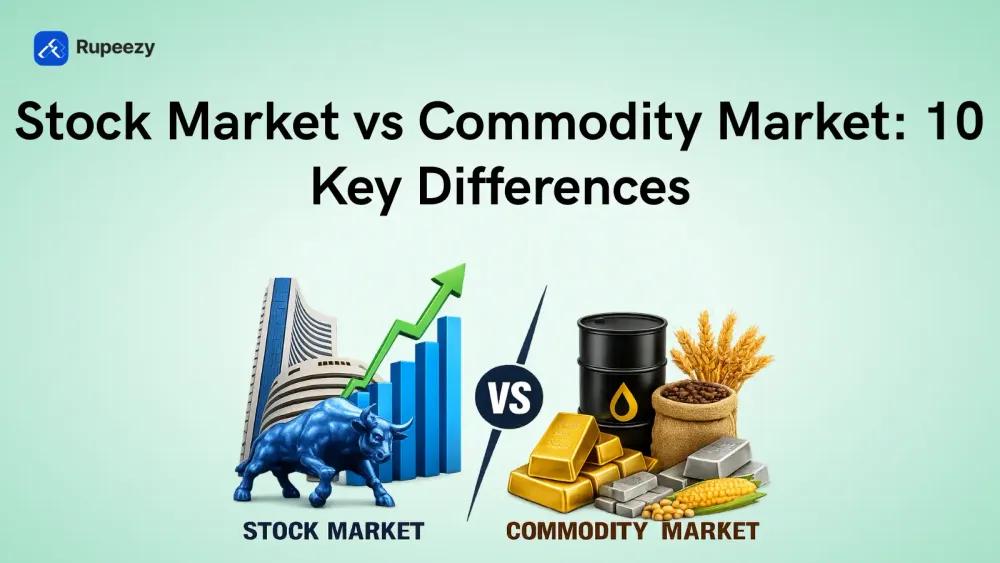
The difference between stock and commodity market comes down to a simple question: are you buying a piece of a business, or are you buying exposure to a physical raw material? In the commodity market, you focus on a raw material. In the stock market, you buy a share of a company.
This article walks through a full stock market comparison against commodities. This will help you with trading and making decisions that matter.
Stock Market vs Commodity Market: Full Comparison Table
Before getting into the details, here's the full stock market comparison against commodities, laid out across the 10 factors that actually matter when you're deciding where to put your money.
Factor | Stock Market | Commodity Market |
Nature of asset | Ownership stake in a company | Physical raw material or natural resource |
Contract expiration | No expiry, can hold indefinitely | Futures contracts expire on a set date |
Price drivers | Earnings, management, business growth | Supply, demand, weather, geopolitics |
Income | Dividends and voting rights possible | No dividends or ownership rights |
Investment horizon | Often long-term (years) | Usually short-term or hedging |
Volatility | Generally lower | Generally higher, amplified by leverage |
Trading instruments | Equities, mutual funds, ETFs | Futures and options, physical spot contracts |
Storage costs | None | Storage and carrying costs for physical goods |
Exchanges in India | ||
Economic purpose | Raises capital for business expansion | Supplies raw materials, hedges inflation |
Now let's actually unpack what each of these means in practice.
1. Nature of the Asset
This is the starting point for understanding equity vs commodity investing, and honestly, most confusion clears up once you get this one right. A stock is a legal claim on a company. When you buy Infosys shares, you own a tiny slice of Infosys. You will get a part in its profits, assets, and future. You benefit if the company grows and suffer if it shrinks.
A commodity, on the other hand, is a physical thing, or a contract tied to a physical thing. Gold, crude oil, wheat, cotton and natural gas. When you buy a gold futures contract, you're not buying a company that mines gold. You're buying exposure to the price of gold itself. There's no management team, no earnings call, no board of directors behind the asset. Just the raw material and whatever is happening to its global supply and demand.
2. Contract Expiration
Stocks don't expire. You can buy a share of a fundamentally sound company and hold it for thirty years if you want, collecting dividends and watching it compound, as long as the company stays listed and solvent. There's no clock ticking against you.
Commodities are a different story, at least in how most people actually trade them. Most commodity market activity happens through futures contracts, and futures always have an expiry date, monthly or quarterly, depending on the exchange.
If you're holding a crude oil or gold futures position and you don't square it off or roll it forward before expiry, it gets settled automatically, sometimes not on the terms you'd have chosen yourself. This single difference changes how actively you need to manage each type of position.
3. What Actually Drives the Price
Stock prices rise when the company beats the expectations of the markets. If a CEO resigns unexpectedly, the stock might fall. Sector trends, competitive positioning and debt levels all of it filters into the price over time. It's company-specific and somewhat predictable if you do the homework.
Commodity prices are not about any single company's earnings call. They move on to things far bigger than one business. Like a drought that wrecks a wheat harvest, an OPEC decision that tightens oil supply, or a geopolitical flashpoint that sends gold up as a safe haven.
This is one of the clearest ways to see the difference between stock and commodity market in action; one is bottom-up and company-driven, the other is top-down and macro-driven.
For investors tracking company and sector movements, a stock market heatmap can make it easier to compare performance across stocks and identify which parts of the market are gaining or losing momentum.
Investors comparing sector trends can also explore stock market sectors to understand how different industries are performing.
4. Income and Ownership Rights
Owning stock can put money in your pocket even if you never sell. Many companies pay dividends based on the class of shares; you may also get voting rights at annual general meetings.
Commodities offer none of this. There's no dividend on a barrel of oil sitting in a futures contract. Your only potential return comes from the price moving in your favor before you close the position. This is a meaningful distinction for anyone building a portfolio around steady income versus one built around price speculation.
5. Typical Investment Horizon
Stock investors, especially long-term ones, tend to think in years, sometimes decades. The whole thesis behind equity investing is giving a good business time to compound.
Commodity market participants usually operate on a much shorter clock. Between futures expiry dates and the volatility of raw material prices, most commodity trading is either short-term speculation or hedging. The idea is to gain quick gains rather than a long-term buy-and-hold approach.
6. Volatility and Risk
Stocks can certainly be volatile. But if you compare them with the commodities, they tend to be even more volatile. Futures contracts let you control a large position with a relatively small margin. This magnifies both gains and losses.
At the same time, the commodity prices can gap sharply on a single weather event or geopolitical headline, and you get a market that moves faster and harder than most equities do on an average day.
7. Trading Instruments Available
Stock market participants generally choose between individual equities, mutual funds, and ETFs, all of which represent ownership in one company or a basket of them.
Commodity market basics work differently. Here, the instruments are futures contracts, options on those futures, and in some cases, physical spot trading. Understanding commodity market basics means understanding that you're rarely taking physical delivery of gold bars or oil barrels; you're trading standardized contracts that track the price.
8. Storage and Carrying Costs
This one's easy to overlook. If you own stock, there's no warehouse involved. Your shares sit in a demat account, no physical storage required.
Commodities are a different animal. Physical gold needs a vault. Agricultural products need warehousing, which adds to the cost. Even in futures trading, these carrying costs get baked into contract pricing. This means any changes in the price will also impact the outcomes.
9. Market Regulation in India
Both markets fall under SEBI's oversight in India, but through different exchanges. Stocks trade on the NSE and BSE. Commodities trade primarily on the MCX and NCDEX. It wasn't always this way. Commodities were regulated separately by the Forward Markets Commission until 2015, when that function was merged into SEBI, bringing both markets under one regulatory roof.
10. Economic Purpose
Stocks exist to help companies raise capital, money that gets ploughed into expansion, hiring, research, and growth. When you buy shares, you're indirectly fueling that.
Commodities serve a different economic function entirely. They're the raw inputs that keep manufacturing and energy production running, and for many investors, they double as a hedge against inflation or a weakening currency, since raw material prices often rise when the value of money falls.
Which Market Should You Choose?
This is really the crux of any stock vs commodity trading decision, and the honest answer is that it depends on what you're trying to achieve.
If you're new to investing: Stocks are the more forgiving starting point. Lower volatility, simpler logic (you can research a company; you can't out-analyze a monsoon), and you don't need to think about leverage or contract expiry on day one.
If you want steady, long-term wealth building: Equities again. Dividends, compounding, and the ability to hold indefinitely make stocks better suited to long-horizon goals like retirement or wealth creation.
If you want to hedge against inflation or a weak rupee: Commodities, particularly gold, have historically played this role well. This is one of the few areas where equity vs commodity decisions clearly favor the commodity side.
If you're an experienced trader comfortable with leverage and short time frames: Commodity futures can offer sharp, fast opportunities, but they demand active management and a real understanding of margin and expiry risk.
If you want both: You don't have to pick one permanently. Plenty of investors hold a core equity portfolio for long-term growth and a smaller commodity allocation, often gold, for diversification and inflation protection. Getting the equity vs commodity split right usually comes down to your goals, time horizon, and appetite for volatility.
Getting the equity vs commodity split right usually comes down to your goals, time horizon, and appetite for volatility. A goal-based investing approach can help you choose investments based on specific financial goals, investment horizons, and risk levels.
For investors focused on long-term equity investing, a stock SIP can help build a stock portfolio by investing a fixed amount regularly.

Conclusion
The difference between stock and commodity market isn't complicated. Stocks are ownership in businesses, built for long-term growth and income. Commodities are physical raw materials, built for shorter-term trading, hedging, and inflation protection. They just serve different jobs in a portfolio, and understanding this stock market comparison is really about matching the tool to what you're actually trying to do with your money.
Whichever side of the stock vs commodity trading debate you lean toward, getting the commodity market basics and equity basics right before you put money in will save you a lot of trial and error.
Investors who want to put individual stock and commodity movements into the broader market context can also track today's market movement across major Indian indices and sectors.
If you're ready to explore either market, you can open a free account with Rupeezy. Start trading with confidence and build a better portfolio.
FAQs
1. What is the difference between stock market and commodity market?
The stock market involves buying ownership shares in companies. The commodity market involves trading physical raw materials like gold, oil, and agricultural products, usually through futures contracts. This is the foundation of any stock vs commodity trading decision.
2. Is gold a stock or a commodity?
Gold is a commodity. It's a physical raw material, not a company. You can trade it directly through MCX or indirectly through gold ETFs and sovereign gold bonds.
3. What are the top 3 commodities?
Gold, crude oil, and silver are the most widely traded commodities globally and in India, based on trading volume and investor interest.
4. Which market is better for beginners?
Stocks are a better market for beginners. This is mainly because they are ones with lower volatility, easier to understand, and require less capital to start.
5. Can I trade both markets on the same platform?
Yes, Many modern brokerages, including Rupeezy, offer access to both the markets. You can verify the details with your broker if they support futures contracts for commodities or not.
6. Do commodities have a higher risk than stocks?
Yes. High leverage in futures trading amplifies risk but also offers a chance of good returns.
Surbhi Bapna is a finance content writer at Rupeezy with more than six years of experience in the finance industry. She holds an MBA degree in Finance from the International Institute of Professional Studies. Surbhi is passionate about integrating finance into people’s daily lives through informative content. She brings in-depth expertise in stocks, personal finance, mutual funds, banking, and investments. Her experience, analytical insights, and commitment to financial research significantly contribute to Rupeezy's comprehensive financial content.
Did you like this blog?
Be the first to like this blog.
The content on this blog is for educational purposes only and should not be considered investment advice. While we strive for accuracy, some information may contain errors or delays in updates.
Mentions of stocks or investment products are solely for informational purposes and do not constitute recommendations. Investors should conduct their own research before making any decisions.
Investing in financial markets are subject to market risks, and past performance does not guarantee future results. It is advisable to consult a qualified financial professional, review official documents, and verify information independently before making investment decisions.
Open Rupeezy account now. It is free and 100% secure.
Start Stock Investment
All Category