

Open a Free Demat Account !
₹0 AMC & Account Opening Fee
Gold ETF vs Silver ETF: Which Makes Sense Before Diwali?

 Last Updated: 27 October, 2026
 7 min read




00:00 / 00:00


Key Highlights
|

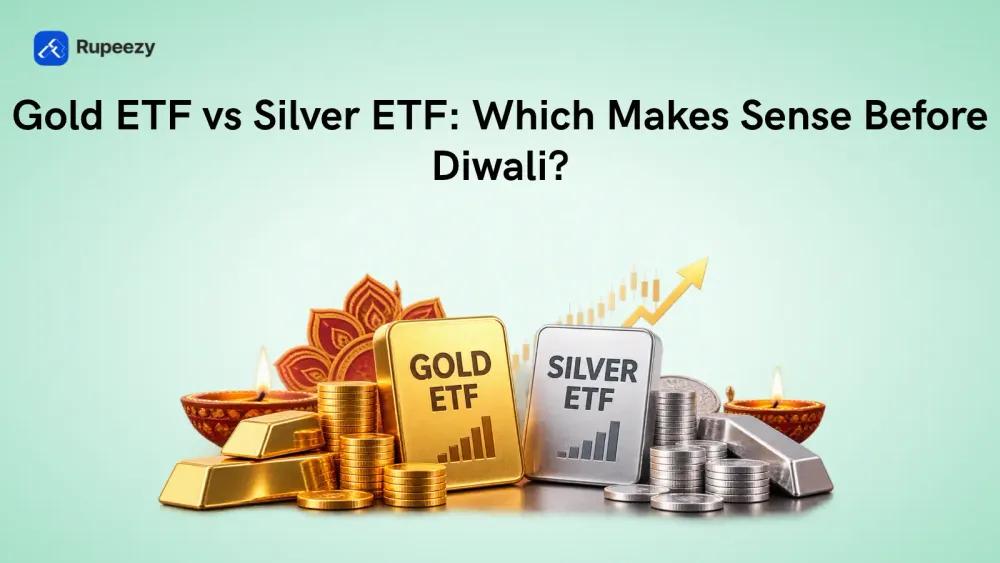
If you are comparing Gold ETF vs Silver ETF before Diwali, the biggest difference to understand is risk. Gold is generally steadier of the two, while silver can move much faster because industrial demand has a larger influence on its price.
That makes the choice more about your portfolio than the festival. Gold may suit investors looking for diversification and relatively lower volatility. Silver may appeal to those comfortable with bigger price swings and looking for exposure to industrial demand as well.
What Is the Difference Between a Gold ETF and Silver ETF?
A Gold ETF tracks the domestic price of gold, and a Silver ETF tracks the domestic price of silver. Both are exchange-traded funds, so you can buy and sell their units easily.
The fund follows the regulatory framework. SEBI has separate norms for each. The table below shares the details of the differences here.
Factor | Gold ETF | Silver ETF |
Underlying asset | Gold | Silver |
Price movement | Relatively steadier | Usually more volatile |
Main demand drivers | Investment, jewellery, central banks, safe-haven demand | Investment and industrial demand |
Industrial use | Lower | High |
Liquidity in India | Generally deeper | Varies more by scheme |
Portfolio role | Diversification and defensive exposure | Higher-risk precious-metal exposure |
Demat account | Usually required | Usually required |
Which Gives Better Returns: Gold ETF or Silver ETF?
Neither gold nor silver consistently gives better returns. Silver can outperform sharply during a strong commodity cycle, but the same volatility can lead to steeper corrections.
Recent performance shows why looking only at past returns can be misleading. Silver delivered stronger gains than gold during parts of 2025 and 2026. But you will see that gold worked out steadily by comparison.
Investor interest remains strong in both. In September 2026, Indian gold ETFs attracted around Rs. 4,451 crore, while silver ETFs received around Rs. 1,974 crore.
ETF returns will also differ slightly from the movement in the underlying metal because of expenses and tracking differences. So, the metal with the highest recent return is not automatically the better ETF for the next year.

Is Gold ETF Safer Than Silver ETF?
Gold ETFs are generally less volatile than silver ETFs. But both are linked to the market, and so there is risk involved as well.
Factor | Gold ETF | Silver ETF |
Price volatility | Usually lower | Usually higher |
Major demand source | Investment, jewellery, central banks | Investment plus industrial demand |
Industrial dependence | Limited | High |
Reaction to economic slowdown | Can still fluctuate, but usually less sharply | Can see stronger swings if industrial demand weakens |
Suitable for | Investors looking for relatively steadier precious-metal exposure | Investors comfortable with higher price movement |
This is why gold may be a better fit when the objective is relatively stable exposure to precious metals, while silver usually requires a higher tolerance for fluctuations.
Which Makes More Sense Before Diwali 2026?
Gold ETF is a better choice before Diwali to diversify. This can fit in the Diwali checklist for 2026 perfectly. Silver ETF may suit an investor who can tolerate sharper swings and wants exposure to both investment demand and industrial growth.
Diwali itself should not decide the investment. Precious metals have already seen large price movements in recent periods, so buying simply because the festive season has arrived can leave you too dependent on one entry price.
You can also invest in both. Gold and silver have different demand drivers and may not move at the same pace. Holding both can spread precious-metal exposure instead of making the entire allocation dependent on one metal.
If prices have risen sharply, investing in smaller amounts over time can also reduce the pressure of choosing one entry point.
Gold ETF vs Silver ETF: How Should You Choose?
The Gold ETF vs Silver ETF decision becomes easier when you look at a few practical factors.
1. Start With Your Reason for Investing
Gold may fit better if you want a diversifier or a defensive allocation. Silver may be more suitable when you are comfortable taking a higher-risk view on industrial and commodity demand.
The purpose matters because two investors buying the same ETF may have completely different reasons for owning it.
2. Check How Much Volatility You Can Handle
Silver can rise and fall faster than gold. A strong recent return may look attractive, but you should also be comfortable with the corrections that can follow.
If large short-term price movements are likely to make you exit early, you will see a steady market later on.
3. Count the Gold You Already Own
The investment in gold and silver remains significant. People invest quite a lot in jewellery and coins. But with time, there has been a change as well. People invest in gold and silver in digital forms as well. This makes it easy to store and ensures better trades on the same too.
4. Compare Liquidity and Tracking Error
Past returns should not be the only comparison. Check trading volumes, bid-ask spreads, expense ratios, and tracking errors before choosing a scheme.
ETF units can also trade at a premium or discount to their NAV, depending on market demand and liquidity. These factors become particularly useful when comparing two ETFs that track the same metal.
5. Decide Whether You Need One Metal or Both
You do not have to predict which metal will outperform next.
If gold and silver both serve a purpose in your portfolio, your precious-metal allocation can be divided between them according to your risk level and objective. This also avoids making the entire decision based on which metal performed better last year.
How Are Gold and Silver ETFs Taxed in India?
Gold and silver ETFs currently have the same broad capital-gains treatment for listed units.
Holding Period | Tax Treatment |
12 months or less | Short-term capital gain, generally taxed at the investor’s applicable slab rate |
More than 12 months | Long-term capital gain taxed at 12.5% without indexation |
The more-than-12-month holding period for listed units and the 12.5% long-term capital gains rate apply under the current tax framework.
Tax rules can change, so check the provisions applicable in the financial year in which you sell the units.
How Can You Invest in Gold or Silver ETFs?
Gold and silver ETFs trade on stock exchanges much like shares. You generally need a demat and trading account. Once you have the account, you can start investing.
Before investing, compare:
Expense ratio.
Tracking error.
Assets under management.
Trading liquidity.
Difference between market price and NAV.
A lower unit price does not make one ETF cheaper than another. Tracking quality, expenses, and trading liquidity give you a better picture of how efficiently the ETF works.
Gold ETF vs Silver ETF: Final Take
There is no fixed winner between gold and silver before Diwali.
Gold is generally better suited to investors looking for a steadier precious-metal allocation and diversification. Silver has stronger links with industrial demand and can see much larger price movements.
If your aim is diversification with relatively lower swings, a Gold ETF may fit better. If you are comfortable with larger price movements and want industrial-demand exposure, the Silver ETF may be worth considering.
Holding both is also possible when each has a clear place in your asset allocation. The better Diwali decision is the one that fits your portfolio, rather than simply following whichever metal has delivered the highest recent return.
Either way, you would need an account to start investing. This is where opening an account with Rupeezy can help you a lot. Get access to insights and details you need to build a good portfolio.
FAQs
1. Is Gold ETF Better Than Silver ETF for Beginners?
Gold ETF can be easier for beginners because gold prices are usually less volatile than silver. It may suit investors who want precious-metal exposure without taking very high price risk.
2. Is Silver ETF Good for Long-Term Investment?
It can be, but silver prices can move sharply. Silver ETF may suit investors who are comfortable with ups and downs and want exposure to long-term industrial demand as well.
3. Can I Invest in Both Gold ETF and Silver ETF?
Yes. You can invest in both. Gold and silver react to different factors, so holding both can help spread your precious-metal exposure.
4. Do Gold and Silver ETFs Require a Demat Account?
Yes, in most cases. The ETFs are traded on the stock exchange. This means you can easily buy and sell them online with ease.
5. Which Is More Volatile, Gold ETF or Silver ETF?
Silver ETF is usually more volatile. Silver prices are affected by both investment demand and industrial demand, which can lead to sharper price changes.
Surbhi Bapna is a finance content writer at Rupeezy with more than six years of experience in the finance industry. She holds an MBA degree in Finance from the International Institute of Professional Studies. Surbhi is passionate about integrating finance into people’s daily lives through informative content. She brings in-depth expertise in stocks, personal finance, mutual funds, banking, and investments. Her experience, analytical insights, and commitment to financial research significantly contribute to Rupeezy's comprehensive financial content.
Did you like this blog?
Be the first to like this blog.
The content on this blog is for educational purposes only and should not be considered investment advice. While we strive for accuracy, some information may contain errors or delays in updates.
Mentions of stocks or investment products are solely for informational purposes and do not constitute recommendations. Investors should conduct their own research before making any decisions.
Investing in financial markets are subject to market risks, and past performance does not guarantee future results. It is advisable to consult a qualified financial professional, review official documents, and verify information independently before making investment decisions.
All Category