
Open a Free Demat Account !
₹0 AMC & Account Opening Fee
What Is Tracking Error?

 Last Updated: 21 September, 2026
 6 min read




00:00 / 00:00


The moment you think about investing, you start evaluating multiple questions. Starting from the type of investment that you should consider to assess your risk appetite, to ensure that you meet your goals well. Also, people evaluate the top mutual fund they should invest in.
While most of the details are quite straightforward, there is one thing that becomes complex for analysis. This is the performance of the mutual fund. While most of the details can be explored from the mutual fund fact sheet, there is one thing that you need to analyse. It is known as the tracking error.
This is nothing but a simple metric that showcases the performance of the fund against the benchmark set. But have you even wondered why the tracking error in a mutual fund is so important? Well, read this guide to know what it is and also the tracking error formula.

What Is Tracking Error?
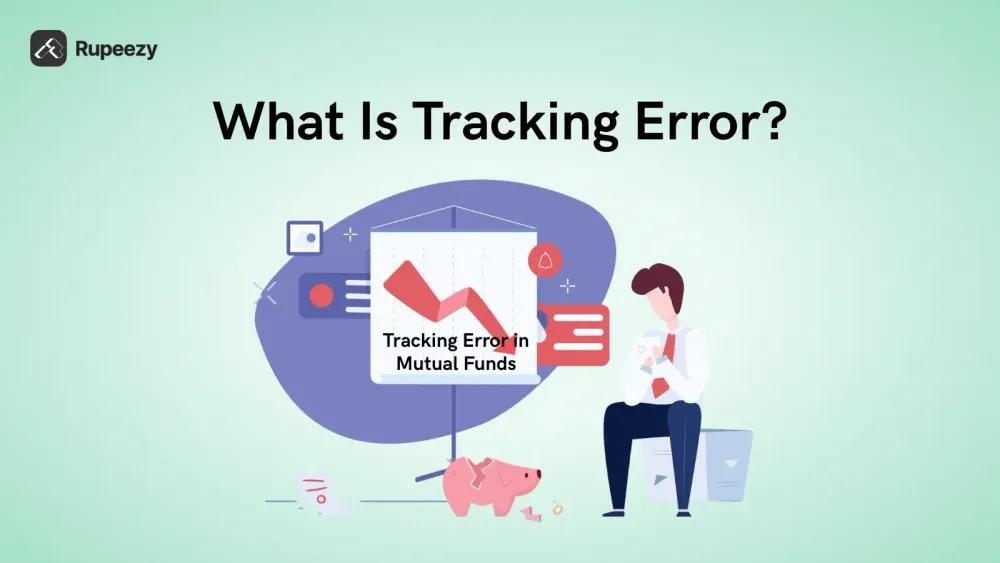
Tracking error is a measure that helps to evaluate the performance of the mutual funds. It shows how closely a mutual fund follows its benchmark index. It highlights the difference between the fund’s actual returns and the returns of the index. The index that is considered here is the one on the basis of which the fund is designed to track.
This concept is especially important for index funds and ETFs. It is because these are the funds where the main objective is to cover the benchmark as closely as possible.
A lower tracking error means the fund stays close to the index most of the time. A higher tracking error suggests wider or frequent deviations, which can impact expected performance for investors.
Key Features of Tracking Error
Tracking error has specific characteristics. It helps the investors access fund performance more clearly. This is quite important if you are a beginner. Some of the key features of the tracking error in mutual funds are as follows:
With the help of the tracking error, you can estimate the efficiency of how well the fund follows the benchmark.
Comparing actively managed and passively managed funds, it is more effective for the latter, one as index funds.
Using this, you can evaluate the impact of expenses, cash balance, and portfolio rebalancing delays.
This helps with the comparison of the index funds and sees which one is a better choice for investment.
By using this, you can even evaluate the potential risk, and it will help with better profiling.
Understanding these points helps investors select funds that align closely with their chosen index.
Tracking Error Formula
Tracking error is calculated by measuring how much a fund’s returns deviate from its benchmark over a period of time. The formula that is used for the calculation of the tracking error is as follows:
Tracking Error = Standard Deviation of the difference between fund returns and benchmark returns
In simple terms, you first find the return difference for each period. It can be daily, monthly, or yearly. Once you have the same, you will use it to measure how widely these differences fluctuate. A smaller variation means the fund tracks the index more closely. But the larger variation shows higher deviation.

Tracking Error Example
While the tracking error formula is simple to understand, it is important that you know the application as well. So, if you are looking at how the tracking error formula actually works, then the following examples can help you a great deal.
Scenario 1: Low Tracking Error
Suppose there is an index fund. It tracks the Nifty 50. Now, over the one year, the index fund has given a return of around 12%. At the same time, the fund has delivered a return of 11.8%.
If you see, the gap is really small, which is like 0.2%. This small and steady gap shows that the fund is closely following the benchmark. Such funds usually have lower costs and efficient rebalancing.
Scenario 2: High Tracking Error
Another fund tracks the same index. The Nifty 50 returns 12%, but this fund delivers 10.5%. The gap here is 1.5%. Now, the difference over here might look small, but it is considerable. And if you are seeing this difference frequently, then it is a sign of poor tracking. Reasons may include higher expenses, cash holding, or delayed portfolio changes.
The two situations show how the tracking error is actually used. By properly using and implementing it, you can invest in funds that are better and show proper returns as compared to the rest.
Investors can also explore stock market sectors to understand the sectors represented in different indices and compare broader sector-wise performance.
When comparing index funds, it can also be useful to understand how the underlying stocks and sectors are performing in the broader market. A stock market performance heatmap can help investors quickly visualise market-wide performance and identify which stocks or sectors are gaining or declining.
Why Tracking Error Matters for Investors
Tracking error helps investors understand how reliable an index fund really is. It is because when there is even a small deviation in the performance, it can impact your returns greatly. But as an investor, here are some points that justify the use of tracking error in mutual funds for investing:
Helps you invest in funds that are performing well and following the benchmark properly.
Supports you in avoiding investment in funds that are poor and can lead to negative returns.
Properly highlight the impact of the expenses and the fund efficiency to help decision-making.
Guide you to invest in a fund that can help with the wealth creation over time.
Conclusion
Tracking error may look like a small technical detail. But when it comes to investing, it plays a very important role that you should understand. Especially, if you are investing in index investing, then it is important that you evaluate the tracking error well. This will help you gain clarity, stability, and better long-term planning.
So, before investing, always compare tracking error along with expense ratio and fund size. This will allow you to build a low-cost portfolio that is not just focused but also offers you clarity of outcomes.
And if you want to invest with guidance and support, then open an account with Rupeezy. Explore all the tools and support you need to ensure that you make the right investment call. Generate wealth easily with proper analysis and understanding today.
FAQs
What is a good tracking error in a mutual fund?
A lower tracking error is generally better. For index funds, a tracking error below 1% is often seen as acceptable, though this can vary by index and market conditions.
Does high tracking error mean poor returns?
Not always. A fund can still deliver positive returns. But, if you use the tracking error while analysis, then the chances of investing wrong are reduced greatly.
Is tracking error important for active mutual funds?
Tracking error matters more for index funds and ETFs. But not for active funds. These funds are designed to ensure they perform better than their benchmarks.
Can tracking error change over time?
Yes. Tracking error can rise or fall based on expense changes, portfolio rebalancing, market volatility, and cash holdings within the fund.
Should tracking error be the only factor while choosing an index fund?
No. Tracking error should be reviewed along with expense ratio, assets under management, fund house credibility, and long-term consistency.
Surbhi Bapna is a finance content writer at Rupeezy with more than six years of experience in the finance industry. She holds an MBA degree in Finance from the International Institute of Professional Studies. Surbhi is passionate about integrating finance into people’s daily lives through informative content. She brings in-depth expertise in stocks, personal finance, mutual funds, banking, and investments. Her experience, analytical insights, and commitment to financial research significantly contribute to Rupeezy's comprehensive financial content.
Did you like this blog?
Be the first to like this blog.
The content on this blog is for educational purposes only and should not be considered investment advice. While we strive for accuracy, some information may contain errors or delays in updates.
Mentions of stocks or investment products are solely for informational purposes and do not constitute recommendations. Investors should conduct their own research before making any decisions.
Investing in financial markets are subject to market risks, and past performance does not guarantee future results. It is advisable to consult a qualified financial professional, review official documents, and verify information independently before making investment decisions.





All Category