

Open a Free Demat Account !
₹0 AMC & Account Opening Fee
FPIs Entering Commodity Derivatives: What It Means for Gold, Silver and MCX Traders

 Last Updated: 19 October, 2026
 8 min read




00:00 / 00:00


Key Highlights
|

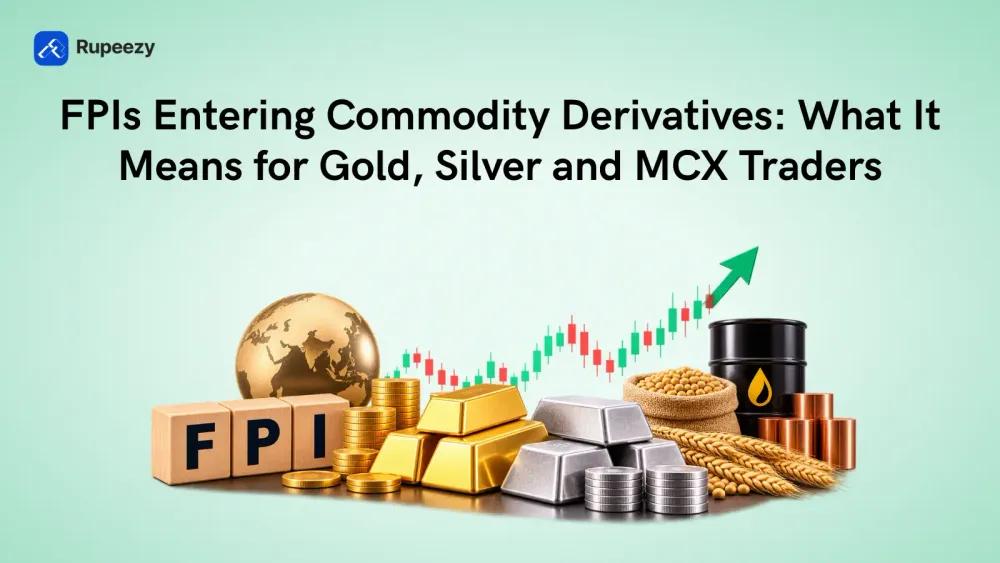
India’s commodity derivatives market is further opening to foreign institutional participation. The decision was taken on September 24, 2026. SEBI approved wider access for Foreign Portfolio Investors, or FPIs, to ETF derivatives.
The expanded framework includes non-agricultural index derivatives and non-cash-settled non-agricultural commodity contracts. This brings commodities such as gold, silver, crude oil, and natural gas further into the FPI trading universe.
For traders, the important question is not simply whether more foreign money will enter. It is how greater institutional participation could affect liquidity, price discovery, volatility, and trading activity on exchanges such as MCX.
Can FPIs Trade Commodity Derivatives in India?
Yes. FPIs have already been allowed to trade eligible exchange-traded commodity derivatives in India. SEBI has now widened the range of non-agricultural commodity derivative contracts available to them.
Earlier, FPI participation was mainly permitted in eligible cash-settled non-agricultural commodity derivative contracts and related indices. MCX also confirms that eligible Category I and Category II FPIs can participate in permitted cash-settled non-agricultural commodity contracts and indices.
1. Non-Agricultural Index Derivatives
FPIs can participate in non-agricultural commodity index derivatives irrespective of whether all underlying contracts are cash settled.
2. Non-Cash-Settled Commodity Derivatives
FPIs are also being allowed to participate in non-cash-settled non-agricultural commodity derivatives.
This is particularly important because contracts linked to commodities such as gold and silver can involve physical settlement.
3. Agricultural Commodities Remain Outside This Expansion
The wider framework focuses on non-agricultural commodities. It should not be interpreted as a general opening of agricultural commodity derivatives to FPIs.
Do You Know?SEBI’s wider FPI access was approved at its September 24, 2026 board meeting. The objective is to deepen liquidity in India’s commodity derivatives market. This follows SEBI’s August 11, 2026 consultation paper, which had sought public feedback on expanding FPI participation in exchange-traded commodity derivatives. |
Can FPIs Trade Gold and Silver Derivatives in India?
Yes. The widened framework allows FPI participation in eligible non-agricultural commodity derivatives. This includes contracts linked to gold and silver.
Gold and silver are classified as bullion commodities and are actively traded through derivative contracts in India.
The major change is that foreign investors can now access a wider set of contracts rather than being limited mainly by the earlier cash-settlement requirement. Reuters specifically reported gold and silver among the physically settled non-farm commodities covered by the expanded access.
However, FPIs cannot simply remain in these contracts until physical delivery.
How Will SEBI Avoid Physical Delivery to FPIs?
SEBI has created safeguards to prevent FPIs from entering the physical delivery process.
FPIs participating in non-cash-settled contracts must:
Exit before the tender period starts.
Not increase their positions from the T-3 day.
Have arrangements with their trading or clearing member for handling open positions.
Square off or transfer residual positions before delivery obligations arise.
The tender period begins three days before expiry.
This allows an FPI to gain exposure to commodity prices without necessarily having to take delivery of gold, silver or another physical commodity.
How Will FPI Participation Affect Gold and Silver Prices?
FPI participation may influence short-term trading activity and price discovery in gold and silver, but it is unlikely to determine their overall price direction.
Gold and silver are global commodities. Their prices depend on much larger factors such as interest rates, the US dollar, inflation, central-bank policies, industrial demand, and geopolitical developments.
What greater FPI participation may change is how efficiently these global developments are reflected in Indian commodity markets.
1. Liquidity Could Improve
More institutional participants means the possibility of more orders on both sides of the market.
When the liquidity is more, then it will offer:
Improve trading depth.
Reduce gaps between buyers and sellers.
Support larger transactions.
Make entry and exit easier in actively traded contracts.
Improving liquidity was one of the stated reasons behind SEBI’s decision.
2. Price Discovery Could Become More Efficient
Foreign institutional investors often participate across multiple international markets.
For example, an institutional investor may already be tracking global gold futures, US interest rates, and dollar movements. Now, say that the investor also participates in Indian commodity derivatives. Here, the global developments may get reflected more quickly in domestic contracts.
This can build better links between the two markets.
3. FPI Buying Does Not Always Mean Bullish Sentiment
This is important for retail traders. An FPI position is not necessarily a simple bet that gold or silver will rise or fall.
Institutions may use commodity derivatives for:
Hedging.
Portfolio diversification.
Spread trading.
Managing currency or commodity exposure.
Therefore, FPI activity should not be treated as a standalone buy or sell signal.
What Does FPI Entry Mean for MCX Traders?
For MCX traders, wider FPI participation could primarily affect liquidity, open interest, and market responsiveness. The base risks will still be there. SO, here is what you must understand as a trader in the market.
1. Trading Volumes Could Increase
If foreign institutions begin using eligible MCX contracts more actively, volumes may rise in commodities where they see strong hedging or trading opportunities.
Gold, silver, crude oil, and natural gas could be important contracts to monitor, as these commodities are closely linked to global markets.
2. Open Interest May Become More Important
Open interest measures the number of derivative positions that remain outstanding.
Traders commonly look at price and open interest together to understand how positions may be developing.
Price Movement | Open Interest | Possible Interpretation |
Rising | Rising | Fresh long positions may be entering |
Falling | Rising | Fresh short positions may be entering |
Rising | Falling | Short positions may be closing |
Falling | Falling | Long positions may be closing |
These are only broad interpretations. Institutional hedging and spread positions can complicate market positioning.
3. Global News Could Reflect Faster
Institutional traders often react quickly to:
Federal Reserve decisions.
US inflation data.
Dollar movements.
Geopolitical developments.
Global commodity inventories.
Central-bank gold purchases.
Greater foreign participation can potentially make Indian commodity contracts more responsive to these events.
Will FPI Participation Increase Volatility in Commodity Markets?
Not necessarily. Greater FPI participation can increase trading activity, but with no increase in volatility. But if liquidity is deeper, larger shocks will be absorbed more easily.
However, higher institutional participation does not remove volatility either. Gold and silver can still move sharply when there is a major change in domestic and global signs.
For traders, this means risk management is still the key aspect to consider.
What Should MCX Traders Track?
Rather than trying to predict what FPIs will do, traders can monitor:
Trading volumes.
Open interest.
Bid-ask spreads.
International commodity prices.
USD/INR movements.
Major global economic announcements.
SEBI and exchange circulars.
Changes in contract specifications and position limits.
The entry of another category of institutional participant can add information to the market, but it does not replace basic market analysis.
Why Is SEBI Allowing More FPI Participation in Commodity Derivatives?
SEBI’s main objective is to deepen liquidity and broaden participation in India’s commodity derivatives market. This change will help in the following ways:
1. Better Market Depth
More FPI participation can increase the number of active buyers and sellers in eligible commodity contracts. This means larger orders can be absorbed easily. It will be done with no sharp price changes. It can make it easier for traders to enter or exit positions.
2. Stronger Price Discovery
Commodity prices work better when different types of participants act in the market. FPIs often track international commodity prices, currencies, interest rates, and global economic developments. All of this can be reflected in the market more effectively.
3. Greater Global Integration
Gold, silver, crude oil, and several other commodities are commonly traded in India. All these are closely linked to international markets. The involvement of the FPI will strengthen the link between Indian contracts and global price movements.
4. Higher Institutional Participation
Institutional investors usually use derivatives for hedging, arbitrage, portfolio diversification, or managing exposure across different markets. This can bring more varied trading activity into the market. This will help in building a better portfolio.
In the long run, a broader institutional base can help make India’s commodity derivatives market more mature and competitive, offering better opportunities to all.
Conclusion
SEBI’s decision to broaden FPI access to commodity derivatives can attract more institutional participation in India’s commodity market, particularly in non-agricultural commodities such as gold and silver.
For MCX traders, the most visible changes may eventually appear in liquidity, volumes, open interest, and the speed at which global developments are reflected in domestic prices.
However, FPI participation alone does not make gold or silver bullish or bearish. Commodity prices will continue to depend on global demand, interest rates, currencies, supply conditions, and geopolitical events.
Traders should therefore use FPI activity as just one of the many viewpoints. Also, if you are looking to invest, explore Rupeezy. Use this to understand commodity markets, derivatives, and the factors that can influence your trading decisions.
FAQs
1. What Are FPI Commodity Derivatives?
FPI commodity derivatives refer to exchange-traded commodity futures, options, or related derivative contracts. These are the eligible Foreign Portfolio Investors who can trade under SEBI rules.
2. Can FPIs Trade Gold and Silver on MCX?
Yes. Eligible FPIs can participate in permitted non-agricultural commodity derivative contracts. This is as per the new decision made by SEBI.
3. Can FPIs Take Physical Delivery of Gold or Silver?
No. The expanded framework prevents the FPIs from reaching the delivery stage. They will need to exit the contract before the applicable time.
4. Will FPI Entry Push Gold Prices Higher?
Not necessarily. FPIs may take long, short, hedging, or arbitrage positions. Gold prices may or may not be affected by the same.
5. Should Traders Follow FPI Activity Before Trading Commodities?
Yes. Tracking the activity will actually be a good way to plan the trades. But this should not be the sole point that you should focus on when making the decision.
Surbhi Bapna is a finance content writer at Rupeezy with more than six years of experience in the finance industry. She holds an MBA degree in Finance from the International Institute of Professional Studies. Surbhi is passionate about integrating finance into people’s daily lives through informative content. She brings in-depth expertise in stocks, personal finance, mutual funds, banking, and investments. Her experience, analytical insights, and commitment to financial research significantly contribute to Rupeezy's comprehensive financial content.
Did you like this blog?
Be the first to like this blog.
The content on this blog is for educational purposes only and should not be considered investment advice. While we strive for accuracy, some information may contain errors or delays in updates.
Mentions of stocks or investment products are solely for informational purposes and do not constitute recommendations. Investors should conduct their own research before making any decisions.
Investing in financial markets are subject to market risks, and past performance does not guarantee future results. It is advisable to consult a qualified financial professional, review official documents, and verify information independently before making investment decisions.


All Category