

Open a Free Demat Account !
₹0 AMC & Account Opening Fee
Mahanadi Coalfields IPO Review: Good or Bad?

 Last Updated:
 19 min read




00:00 / 00:00


Quick summary
| ||
|---|---|---|
Is the Mahanadi Coalfields (MCL) IPO good or bad? On the numbers, it is one of the most profitable coal producers in India, with almost no debt and a long history of large dividends. It is also a business whose revenue and profit have slipped for two years, and the whole issue is a stake sale by its parent, Coal India. Whether that trade-off suits you depends on what you want from the share, so this Mahanadi Coalfields IPO review sets out the evidence instead of a one-word verdict.
We read the Red Herring Prospectus (RHP) of Mahanadi Coalfields Limited (MCL), dated 13 November 2026 and filed with SEBI, and pulled the figures that matter to an investor. Every number below comes from it unless we say otherwise. If the document is new to you, our guide to the red herring prospectus explains each section.
Investments in the securities market are subject to market risks. Read all the related documents carefully before investing. This article is for education and is not investment advice.
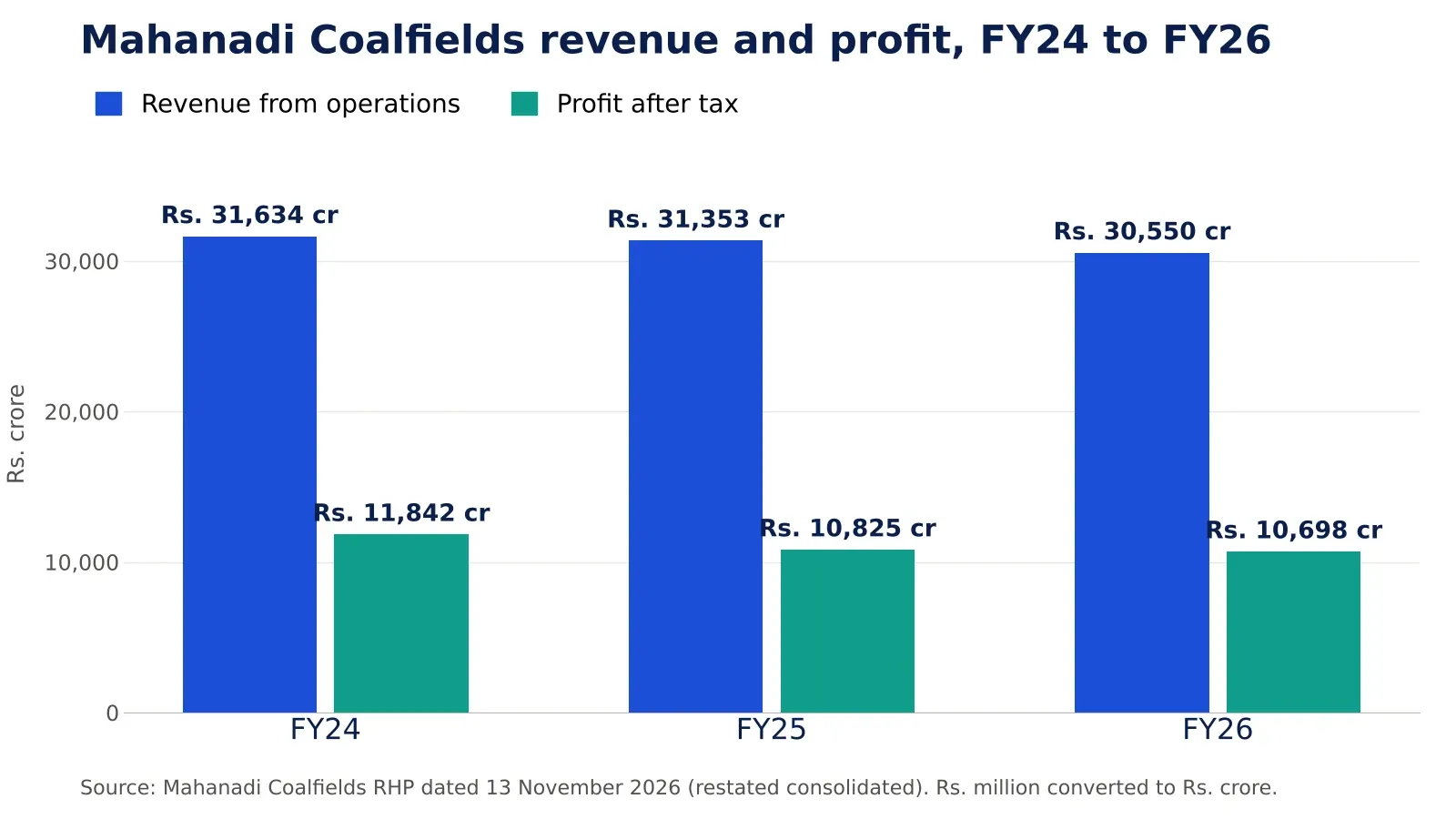
Mahanadi Coalfields revenue and profit after tax, FY24 to FY26. Source: RHP dated 13 November 2026; Rs. million converted to Rs. crore.

Mahanadi Coalfields IPO Details
Here are the terms to know before you bid. The share count, quotas and timetable come from the RHP. The RHP leaves the price band, lot size and offer value blank because they are announced separately, so those come from the company's price band advertisement of 16 November 2026. You can follow live details on the Mahanadi Coalfields IPO page on Rupeezy.
Detail | Mahanadi Coalfields IPO |
|---|---|
Issue type | Book-built; 100% offer for sale |
Fresh issue | None |
Seller | Coal India Limited (promoter) |
Total offer | Up to 66,18,36,300 shares |
Issue size | Up to Rs. 8,981.12 crore |
Face value | Rs. 2 per share |
Price band | Rs. 129 to Rs. 136 per share |
Lot size | 110 shares; minimum bid Rs. 14,960 at Rs. 136 |
Retail maximum | 13 lots, 1,430 shares, Rs. 1,94,480 at Rs. 136 |
Anchor bidding | 18 November 2026 |
Issue opens | 19 November 2026 |
Issue closes | 23 November 2026 (UPI mandate by 5:00 pm) |
Basis of allotment | On or about 25 November 2026 |
Refunds and share credit | On or about 26 November 2026 |
Listing | On or about 27 November 2026, on BSE and NSE |
Book running lead managers | SBI Capital Markets, Axis Capital, BOB Capital Markets, IDBI Capital Markets & Securities, IIFL Capital Services |
Registrar | KFin Technologies Limited |
Who gets what. After setting aside shares for employees and Coal India shareholders, the net offer is up to 56.26 crore shares.
Category | Share of offer | Shares |
|---|---|---|
Qualified institutional buyers | Not more than 50% of net offer | Up to about 28.13 crore |
Non-institutional investors | Not less than 15% of net offer | At least about 8.44 crore |
Retail investors | Not less than 35% of net offer | At least about 19.69 crore |
Coal India shareholders | Up to 10% of the offer | Up to 6,61,83,630 |
Eligible employees | Up to 5% of the offer | Up to 3,30,91,815 |
The retail portion works out to about 17.9 lakh minimum lots (our calculation). Part of the institutional portion can go to anchor investors before the issue opens.
Mahanadi Coalfields IPO shareholder quota
The shareholder quota is open to individuals and HUFs who held Coal India shares on the RHP date, 13 November 2026. Buying Coal India shares now does not qualify you. An eligible shareholder can bid for up to Rs. 2 lakh in this quota and can also bid in the retail or non-institutional category. The RHP says those bids will not be treated as multiple bids.
What Does Mahanadi Coalfields Do?
Mahanadi Coalfields mines and sells coal. It was incorporated on 3 April 1992, is based at Burla in Sambalpur, Odisha, and is a wholly owned subsidiary of Coal India with Miniratna Category I status. It produced 218.31 million tonnes (MT) in FY26, which was 21.0% of India's coal output and 28.4% of Coal India's output, according to the CRISIL report cited in the RHP.
Mines. It runs 17 mines: 14 opencast and 3 underground. Opencast mines gave 99.85% of FY26 production.
Product. Raw non-coking coal made up 97.41% of FY26 product sales. Washed coal from its 10 million tonne a year Ib Valley washery made up most of the rest.
Reserves. Audited reserves stood at 9,840.31 MT at 1 April 2026. That is about 45 years of output at the FY26 rate, or about 25 years if production keeps growing at 4.70% a year.
Customers. It sold to customers in 16 states in FY26. Power generators took 68.62% of product sales and captive power plants took 16.57%.
Mining method. Surface miners, which cut coal without explosives, handled 99.37% of FY26 production.
Transport. Railways carried 65.28% of total dispatch in FY26, up from 58.70% in FY24.
How its coal is priced. Most coal is sold under long-term fuel supply agreements (FSAs) at prices linked to Coal India's notified price. The rest is sold mainly through e-auctions, where the price moves with the market. FSAs gave 82.12% of FY26 product sales.
Price per tonne | FY24 | FY25 | FY26 | H1 FY27 |
|---|---|---|---|---|
FSA | Rs. 1,438.40 | Rs. 1,383.61 | Rs. 1,354.17 | Rs. 1,368.16 |
E-auction and others | Rs. 2,273.14 | Rs. 1,787.09 | Rs. 1,797.34 | Rs. 1,774.19 |
This table explains much of the revenue decline. The FSA price fell as more lower-grade coal was sold, and the e-auction price dropped sharply after FY24. Sales outside FSAs shrank from 22.54% of product sales in FY24 to 17.88% in FY26.
Who Owns Mahanadi Coalfields and Who Is Selling?
Coal India owns 100% of the company today and is the only seller. Because this is an offer for sale, the share count stays at 661.84 crore and the proceeds go to Coal India after issue expenses. Nothing is earmarked for new mines, equipment or debt. The stated aims are to complete the stake sale and gain the benefits of listing.
Coal India would hold about 90% after the issue (our calculation). Its average cost is Rs. 0.26 per share, adjusted for the share split. The RHP warns that share sales by major shareholders, including sales to meet minimum public shareholding rules, could weigh on the share price. We have also reviewed the IPOs of two other Coal India subsidiaries, Bharat Coking Coal and Central Mine Planning & Design Institute.

Mahanadi Coalfields Financials: High Margins, Falling Earnings
The company earns margins that few businesses reach, but the direction has been down. Revenue fell at 1.73% a year from FY24 to FY26, operating EBITDA fell at 6.86% a year and profit after tax fell at 4.95% a year, as reported in the RHP.
Rs. crore | FY24 | FY25 | FY26 | H1 FY27 |
|---|---|---|---|---|
Revenue from operations | 31,634.35 | 31,353.02 | 30,549.59 | 16,093.04 |
Other income | 1,955.99 | 1,675.63 | 3,349.69 | 1,014.79 |
Total income | 33,590.34 | 33,028.65 | 33,899.28 | 17,107.83 |
Operating EBITDA | 14,680.92 | 13,655.48 | 12,735.24 | 6,449.19 |
Operating EBITDA margin | 46.41% | 43.55% | 41.69% | 40.07% |
Profit after tax | 11,841.55 | 10,825.12 | 10,698.12 | 4,880.66 |
PAT margin (on total income) | 35.25% | 32.77% | 31.56% | 28.53% |
Earnings per share (Rs.) | 17.89 | 16.35 | 16.13 | 7.37 |
Return on net worth | 80.56% | 62.81% | 53.77% | 22.29%* |
Return on average capital employed | 107.04% | 83.17% | 73.26% | 30.44%* |
*Six-month figure, not annualised. H1 FY27 is the six months to 30 September 2026.
FY26 profit had help from one-off items
Other income doubled in FY26 to Rs. 3,349.69 crore. The RHP identifies two items as non-recurring: Rs. 1,163.92 crore of interest on income tax and other indirect tax refunds, and Rs. 695.38 crore of liabilities written back.
Rs. crore | FY25 | FY26 | Change |
|---|---|---|---|
Profit before tax | 14,161.56 | 14,361.41 | 1.41% |
Less: interest on tax refunds | 19.25 | 1,163.92 | - |
Less: liabilities written back | 154.16 | 695.38 | - |
Profit before tax excluding these | 13,988.15 | 12,502.11 | (10.62%) |
This is the single most useful adjustment in the document. Reported profit before tax rose slightly, while the underlying figure fell by about a tenth.
The latest six months look better, with a caveat
In H1 FY27, revenue rose 9.29% to Rs. 16,093.04 crore and profit after tax rose 6.71% to Rs. 4,880.66 crore. Dispatch rose 8.34% to 111.24 MT, but production fell 9.31% to 87.54 MT. The company met demand partly by drawing down stock, and inventories fell from Rs. 2,239.02 crore in March 2026 to Rs. 1,255.78 crore in September 2026. Production is usually lower in the first half because of the monsoon, so the full-year figure is the one to watch.
Cash Flow, Debt and Dividends
Rs. crore | FY24 | FY25 | FY26 | H1 FY27 |
|---|---|---|---|---|
Net cash from operations | 6,325.58 | 7,704.96 | 12,477.53 | 8,997.13 |
Capital expenditure | 3,839.80 | 2,907.52 | 2,929.61 | 1,187.12 |
Dividends declared | 8,600.00 | 8,750.00 | 8,400.00 | 1,850.00 |
Operating cash flow comfortably covers capital spending. FY26 was flattered by tax: the company received a net income tax inflow of Rs. 400.55 crore that year, against a net payment of Rs. 4,021.41 crore in FY25.
The balance sheet is strong. At 30 September 2026, cash and bank balances were Rs. 20,291.93 crore and borrowings were Rs. 2.76 crore. Some bank deposits are earmarked for specific purposes, and a further Rs. 3,300 crore interim dividend was declared after that date.
What this means for dividends. Dividends were 72.6%, 80.8% and 78.5% of profit in FY24, FY25 and FY26 (our calculation). On today's share count, the FY26 payout equals about Rs. 12.69 per share, or about 9.3% of the Rs. 136 upper band. That figure looks back, not forward. Government guidelines set a minimum dividend of 30% of profit or 4% of net worth, whichever is higher, unless an exemption applies. On FY26 numbers, the 30% floor would be about Rs. 4.85 per share, or about 3.6% at Rs. 136 (our calculation). IPO investors will not receive the Rs. 5,150 crore already declared since April 2026.
Mahanadi Coalfields IPO Valuation and Peer Comparison
Mahanadi Coalfields is priced close to its parent on earnings and well above it on book value. Here is what the band implies. The market value and the P/E on FY26 EPS match the company's price band advertisement; the other figures are our calculations from RHP data. If you want a refresher, see our guides to the P/E ratio and the P/B ratio.
Measure | At Rs. 129 | At Rs. 136 |
|---|---|---|
Market value | Rs. 85,376.88 crore | Rs. 90,009.74 crore |
P/E on FY26 EPS of Rs. 16.13 | 8.00 times | 8.43 times |
P/E on last 12 months' EPS of Rs. 16.59 | 7.78 times | 8.20 times |
P/E excluding non-recurring items (estimated EPS Rs. 14.07) | 9.17 times | 9.66 times |
P/B on September 2026 NAV of Rs. 33.84 | 3.81 times | 4.02 times |
P/B on NAV after the Rs. 4.99 interim dividend (Rs. 28.85) | 4.47 times | 4.71 times |
FY26 dividend yield (Rs. 12.69 per share) | 9.84% | 9.33% |
The estimated EPS removes the RHP's Rs. 1,859.30 crore of non-recurring items and applies the FY26 effective tax rate of 25.51%.
The RHP compares the company with these listed peers, using closing prices on 11 November 2026. Price to book is our calculation.
Company | P/E | P/B | Return on net worth |
|---|---|---|---|
Mahanadi Coalfields | 8.43 | 4.21 | 53.77% |
Coal India | 8.05 | 2.08 | 27.80% |
NMDC | 8.47 | 1.85 | 23.40% |
Bharat Coking Coal | Not meaningful | 2.54 | 2.07% |
PT Bukit Asam | 11.40 | 1.48 | 13.03% |
Yancoal Australia | 18.34 | 0.90 | 4.83% |
The RHP's peer average P/E is 11.57 times, but the two foreign companies lift that average. Coal India is the closest comparison, and its consolidated numbers already include Mahanadi Coalfields. MCL's higher price to book reflects its much higher return on net worth, which is also lifted by its habit of paying out most of its profit.
Strengths of the Mahanadi Coalfields IPO
Scale. It was India's largest single coal producer in FY26, with 21.0% of domestic output.
Long reserve life. Audited reserves cover about 45 years at the FY26 production rate.
Low-cost mining. The RHP, citing CRISIL, says it had the lowest production cost per tonne among Coal India's subsidiaries in FY26. Output per manshift was 30.34 tonnes.
High margins. The RHP reports the highest EBITDA, operating EBITDA and PAT margins among Indian peer coal producers in FY26.
Almost no debt. Borrowings were Rs. 2.76 crore against cash and bank balances of Rs. 20,291.93 crore at September 2026.
Contracted sales. Long-term FSAs gave 82.12% of FY26 product sales.
Demand outlook to the mid-2030s. CRISIL projects India's non-coking coal demand rising from 1,186 MT in FY26 to 1,564 MT in FY36.
Risks of the Mahanadi Coalfields IPO
Falling earnings. Profit after tax fell from Rs. 11,841.55 crore in FY24 to Rs. 10,698.12 crore in FY26, and operating EBITDA margin fell from 46.41% to 41.69%.
One product, one main customer group. Raw non-coking coal was 97.41% of FY26 product sales and thermal power generators took 68.62%.
Long-term demand. CRISIL expects non-coking coal demand may decline after FY36 as renewable energy grows. Under a net-zero pathway cited in the RHP, India's coal demand falls to about 161 MT by 2070.
Limited pricing power. Most prices follow Coal India's notified mechanism and government policy, so the company may not be able to pass on higher costs.
Lower-grade coal. A large part of its reserves is in the G10 to G14 grades, which sell at lower prices.
Customer concentration. The top 10 customers gave 55.94% of FY26 revenue, and government-owned power companies gave 44.81%.
Delayed payments. The RHP reports delays from Andhra Pradesh Power Generation Corporation and Andhra Pradesh Power Development Company, with balances of Rs. 1,929.88 crore and Rs. 502.16 crore at September 2026.
Contingent liabilities. These rose to Rs. 12,513.29 crore, or 55.86% of net worth, at September 2026 from 39.80% in March 2026. Income tax matters make up Rs. 8,074.83 crore.
Wage settlement. The last national coal wage agreement expired on 30 June 2026 and the new one is still being negotiated, with effect from 1 July 2026. The previous agreement raised wages by 19%.
Contractor dependence. The top 10 contractors accounted for 60.02% of FY26 contractual expenses.
Mine safety and approvals. The RHP records 13 fatal accident cases between April 2023 and September 2026. Expansion also depends on environmental and forest clearances and land acquisition.
Audit observation. Audit remarks in the RHP mention a forensic audit of coal sales realisation for 2008 to 2019 that reported a loss through manipulated entries. The company says it asked the forensic auditor to review the report, and the updated report is awaited.
Parent control. Coal India would keep about 90% after the issue (our calculation), and further stake sales could pressure the share price.
Mahanadi Coalfields IPO: Good or Bad?
There is no single answer, but the evidence falls into two clear columns.
What supports the case: scale, low costs, decades of reserves, very high returns, almost no debt and a record of paying out most of its profit. At the upper band, the price is about 8.4 times FY26 earnings, close to Coal India's 8.05 times.
What weighs against it: earnings have fallen for two years, FY26 profit contains non-recurring items, and the multiple rises to about 9.7 times once those are removed (our calculation). The company gets no money from the issue, and coal faces a long-term question that a low P/E may already be pricing in.
Who it may suit: investors who want exposure to a cash-generating coal producer, understand that dividends can change and can accept policy and energy-transition risk. Who may want to pass: those seeking fast earnings growth, those who avoid thermal coal, and those relying only on a listing-day gain. This is information, not a recommendation.
Questions to Settle Before You Bid
Are you buying for dividends, for a listing gain or for long-term growth? Each one calls for a different decision.
Would you still want the share if dividends dropped closer to the 30% minimum?
Do you prefer owning MCL directly, or Coal India, which already holds MCL along with its other subsidiaries?
Are you comfortable with a business that depends on thermal power for most of its sales?
Can you accept a loss on one lot of Rs. 14,960, or on 13 lots of Rs. 1,94,480?
If you held Coal India shares on 13 November 2026, have you checked whether you qualify for the shareholder quota?
Mahanadi Coalfields IPO GMP, Allotment and Listing Date
GMP. The grey market premium (GMP) is an unofficial price traded outside the exchanges. SEBI, BSE and NSE do not publish it, it can change several times a day and it does not guarantee the listing price. We do not quote a figure because we cannot verify one from an official source. Our explainer on the grey market premium shows how to read it.
Allotment. The basis of allotment is expected on or about 25 November 2026, with refunds and share credit on or about 26 November. KFin Technologies is the registrar. You can check your status on the Rupeezy IPO allotment status page. Our guide to IPO allotment and subscription status explains how the two differ.
Listing. The shares are expected to start trading on BSE and NSE on or about 27 November 2026. Read more about IPO listing time.
How to Apply for Mahanadi Coalfields IPO on Rupeezy
If you decide to bid, you can apply through Rupeezy. Our step-by-step guide on how to apply for an IPO covers the process in more detail.
Open a demat account. Open a free demat account with Rupeezy and finish the online KYC.
Keep a UPI ID ready. It must be linked to the bank account that holds your funds.
Go to the IPO section. Log in, open the IPO page and select Mahanadi Coalfields. Bidding runs from 19 November to 23 November 2026, between 10:00 am and 5:00 pm.
Choose your bid. Pick the number of lots (1 to 13 for retail investors) and a price within the band, or bid at the cut-off price. Our note on book building explains how the final price is set.
Approve the UPI mandate. Approve it by 5:00 pm on 23 November 2026. The amount is blocked in your account, not debited, until shares are allotted.
Track allotment. Check it on the Rupeezy IPO allotment status page after the basis of allotment is finalised.
Frequently Asked Questions
Is the Mahanadi Coalfields IPO good or bad?
The RHP shows FY26 profit after tax of Rs. 10,698.12 crore, a 31.56% margin on total income and almost no debt, and the band is 8.00 to 8.43 times FY26 earnings. It also shows two years of falling revenue and profit, Rs. 1,859.30 crore of non-recurring items in FY26 profit before tax and heavy dependence on thermal power. It suits investors who want cash generation and accept coal's long-term risk, and is a harder fit for those seeking growth. This is information, not a recommendation.
What is the Mahanadi Coalfields IPO price band and lot size?
The Mahanadi Coalfields IPO share price band is Rs. 129 to Rs. 136 per share and one lot is 110 shares, so the minimum bid is Rs. 14,960 at the upper band.
What is the Mahanadi Coalfields IPO date?
The issue opens on 19 November 2026 and closes on 23 November 2026. Anchor investors bid on 18 November 2026, and the UPI mandate must be approved by 5:00 pm on the closing day.
What is the MCL IPO issue size and who gets the money?
The issue is a 100% offer for sale of up to 66,18,36,300 shares, worth up to Rs. 8,981.12 crore. Coal India, the selling shareholder, receives the proceeds after issue expenses. Mahanadi Coalfields receives nothing.
What is the Mahanadi Coalfields IPO shareholder quota?
Up to 6,61,83,630 shares are reserved for individuals and HUFs who held Coal India shares on the RHP date, 13 November 2026. Each eligible shareholder can bid for up to Rs. 2 lakh in this quota and can also bid in the retail or non-institutional category without it being treated as a multiple bid.
What is the Mahanadi Coalfields IPO allotment date and listing date?
The basis of allotment is expected on or about 25 November 2026, refunds and share credit on or about 26 November 2026, and listing on BSE and NSE on or about 27 November 2026.
What is the Mahanadi Coalfields IPO GMP?
The grey market premium is an unofficial figure that SEBI, BSE and NSE do not publish, and it can change daily. We do not quote one because it cannot be verified from an official source, and it does not guarantee the listing price.
Is Mahanadi Coalfields profitable?
Yes. Restated profit after tax was Rs. 11,841.55 crore in FY24, Rs. 10,825.12 crore in FY25 and Rs. 10,698.12 crore in FY26, and Rs. 4,880.66 crore in the six months to September 2026. Profit has declined over the two full years shown.
How much can a retail investor bid for in the Mahanadi Coalfields IPO?
A retail investor can bid for up to 13 lots, which is 1,430 shares or Rs. 1,94,480 at Rs. 136, because the retail limit is Rs. 2 lakh. At least 35% of the net offer is reserved for retail investors.
How do I apply for the Mahanadi Coalfields IPO on Rupeezy?
Open a demat account with Rupeezy, log in, go to the IPO section, select Mahanadi Coalfields, choose your lots and price, and approve the UPI mandate. Rupeezy states zero fees on IPOs and free account opening.
Sources
Mahanadi Coalfields Limited, Red Herring Prospectus dated 13 November 2026, filed with SEBI. Source for the offer structure, timetable, financials, operating data, peer comparison, risk factors, contingent liabilities and dividend history.
Mahanadi Coalfields Limited, price band advertisement published on 16 November 2026. Source for the price band, lot size and offer value, which the RHP leaves blank.
Live IPO details: Mahanadi Coalfields IPO page on Rupeezy.
All data is as of 18 November 2026. Figures in Rs. crore are converted from the RHP's Rs. million figures and rounded. Post-issue shareholding, retail bid limits, price to earnings on last-12-month and adjusted EPS, price to book, dividend per share on the current share count, dividend yield, payout ratios and estimated EPS are our calculations from RHP data and the announced price band. The allotment, refund and listing dates are the indicative timetable in the RHP and may change.

Santhosh is a Research Analyst at Rupeezy who transforms complex market data into actionable insights for investors. With five years of financial industry experience and an MBA in Finance from Jain University, he specializes in evaluating stock market dynamics, mutual fund performance, and ETF trends. Driven by a deep passion for business analysis, Santhosh focuses heavily on company fundamentals to help readers make informed, data-backed financial decisions.
Did you like this blog?
Be the first to like this blog.
Disclaimer
Investments in the securities market are subject to market risk. Read all the related documents carefully before investing. Rupeezy (SEBI RA Registration: INH000013332) provides this content for informational purposes; any securities quoted are for educational display and not as a recommendation. All charts and graphs are based on independent research and reliable sources for the period mentioned within the specific data set. Sometimes we take graphs from external sources. This communication does not promise or assure any fixed, guaranteed, or indicative returns to any client. For our complete registered office address, Member ID, and full SEBI registration details, please refer to our official website.
The content on this blog is for educational purposes only and should not be considered investment advice. While we strive for accuracy, some information may contain errors or delays in updates.
Mentions of stocks or investment products are solely for informational purposes and do not constitute recommendations. Investors should conduct their own research before making any decisions.
Investing in financial markets are subject to market risks, and past performance does not guarantee future results. It is advisable to consult a qualified financial professional, review official documents, and verify information independently before making investment decisions.





All Category