
Open a Free Demat Account !
₹0 AMC & Account Opening Fee
FPI Outflows in India 2026: Reasons Behind Foreign Investor Selling

 Last Updated: 21 September, 2026
 4 min read




00:00 / 00:00


Summary
| ||
Foreign Portfolio Investors (FPIs) play a major role in the Indian stock market. Their investment activity influences market liquidity, benchmark indices, and overall investor sentiment. Investors closely following stocks market insights also monitor FPI trends to understand how foreign capital flows impact market direction.
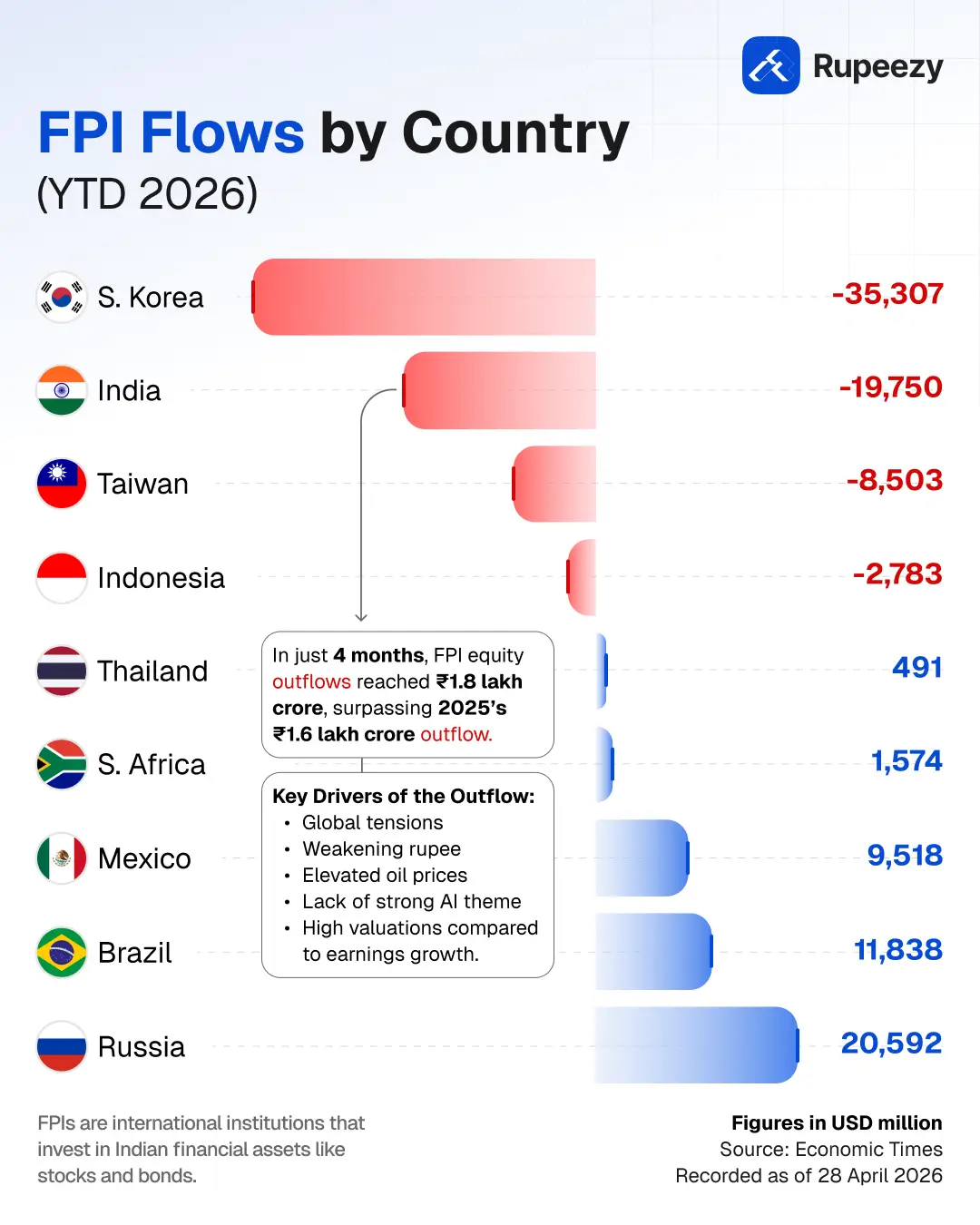
In 2026, India witnessed sharp FPI outflows of nearly $19.7 billion as of April 28, according to data reported by The Economic Times, making it one of the highest among major emerging markets.

India’s FPI Outflows Have Crossed FY25 Levels
The scale of foreign selling in 2026 has already exceeded previous levels. In just four months, FPI equity outflows reached nearly Rs 1.8 lakh crore, surpassing FY25’s total outflow of Rs 1.6 lakh crore.
This rise in foreign investor selling reflects concerns around global economic uncertainty, currency fluctuations, and high valuations in Indian equities.
What Are FPI Outflows?
FPI outflows occur when foreign investors sell Indian equities or bonds and move funds to other markets or safer assets. Large outflows can increase market volatility and pressure stock indices. The FPI outflows can increase volatility and weaken investor sentiment.
Reasons Behind FPI Outflows in India
Several factors have contributed to the ongoing FPI selling in Indian equities during 2026.
1. Global Economic Uncertainty
Rising geopolitical tensions, inflation concerns, and high global interest rates have pushed investors toward safer assets like US bonds and gold.
2. Weakening Indian Rupee
A weaker rupee reduces returns for foreign investors after currency conversion, leading some FPIs to reduce exposure to Indian equities.
3. High Crude Oil Prices
India’s dependence on oil imports increases inflation and economic pressure when crude prices rise, impacting investor confidence.
4. Expensive Market Valuations:
Indian equities continue to trade at relatively high valuations compared to several emerging markets, encouraging investors to shift funds elsewhere. Global investors have also preferred AI-focused technology markets, such as the US.

Impact on Indian Markets
FPI selling has increased short-term market volatility, especially in sectors with high foreign ownership such as banking and IT. However, strong domestic participation from retail investors, mutual fund SIP inflows, and Domestic Institutional Investors (DIIs) has helped Indian markets remain relatively resilient.
During periods of higher volatility, investors considering eligible MTF Stocks should also evaluate stock eligibility, funding costs, and the risks associated with leveraged
During periods of heightened FPI activity and market volatility, investors can use a stock market heatmap to quickly compare performance across sectors and individual stocks. This can help identify which areas of the market are showing relative strength or weakness as foreign capital flows change.positions.
For investors focused on long-term stock investing, a stock SIP can provide a disciplined way to invest a fixed amount regularly and stay invested through periods of market volatility.
Investors can also explore different stock market sectors to compare how FPI activity and broader market trends affect sector-wise performance.
Conclusion
The rise in FPI outflows in India during 2026 reflects global uncertainty, currency weakness, elevated crude oil prices, and concerns around market valuations. Despite short-term foreign selling, India’s long-term growth outlook remains supported by strong domestic participation, infrastructure growth, and rising consumption.
Future FPI trends will depend on global interest rates, corporate earnings growth, and investor confidence in emerging markets. Long-term investors often view such periods of volatility as part of broader market cycles rather than a structural weakness in the Indian economy.
Investors can also follow live share market updates to track Nifty, Sensex, and sector movements as foreign and domestic flows influence market sentiment.
Disclaimer: This article is for informational purposes only and should not be considered financial or investment advice. Investors should conduct their own research or consult a qualified financial advisor before making investment decisions.
Written by
Kusuma BSKusuma is a Financial Content Writer with over 4 years of experience creating high-quality, research-driven content on stocks, mutual funds, IPOs, personal finance, and investment strategies. She specializes in simplifying complex financial concepts into clear, engaging, and SEO-friendly content that helps readers make informed financial decisions. Her expertise includes writing educational guides, market insights, investment explainers, and fintech content tailored for both beginners and experienced investors. With a strong focus on accuracy, readability, and user intent, Kusuma is passionate about making finance accessible to everyone while delivering content that meets the highest editorial standards.
Did you like this blog?
Be the first to like this blog.
The content on this blog is for educational purposes only and should not be considered investment advice. While we strive for accuracy, some information may contain errors or delays in updates.
Mentions of stocks or investment products are solely for informational purposes and do not constitute recommendations. Investors should conduct their own research before making any decisions.
Investing in financial markets are subject to market risks, and past performance does not guarantee future results. It is advisable to consult a qualified financial professional, review official documents, and verify information independently before making investment decisions.

Open Rupeezy account now. It is free and 100% secure.
Start Stock Investment





All Category