
Open a Free Demat Account !
₹0 AMC & Account Opening Fee
How Heat Waves Are Driving India’s AC Market Growth?
 Last Updated: 21 September, 2026
 5 min read




00:00 / 00:00


Summary
| ||
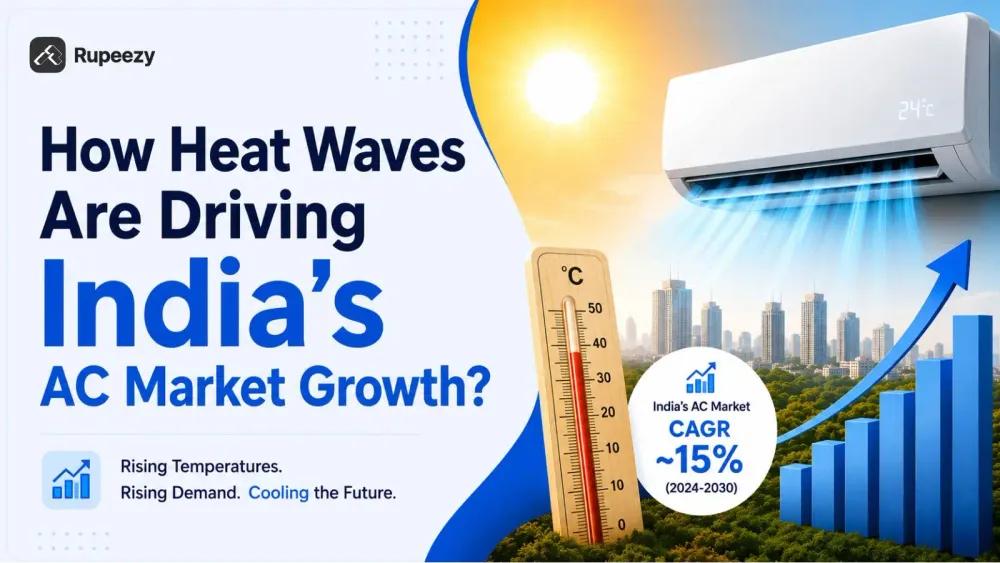
India’s extreme summer heat is no longer just a weather problem. It is rapidly reshaping consumer spending across the country. As heat waves become more frequent and temperatures remain elevated for longer periods, households are increasingly investing in cooling solutions to manage daily comfort and productivity.
This shift is fuelling rapid growth in the Indian AC Market, particularly across urban and emerging Tier-2 and Tier-3 cities.

Climate Change and AC Usage Are Increasing Across India
The rising frequency of extreme heat conditions has significantly changed consumer behaviour. Fans and coolers are becoming less effective during peak summer months, especially in urban areas where heat and humidity levels continue to increase.
It is increasingly visible as longer summers and rising urban heat levels accelerate household adoption of air conditioners across multiple income groups. Consumers are now prioritizing comfort, productivity, better sleep, and protection from extreme temperatures.
At the same time, rapid urbanisation and changing lifestyles are also driving stronger air conditioner demand in India. Apartment living, compact urban spaces, and rising disposable incomes are encouraging first-time AC purchases across the country.
Despite rising demand, household air-conditioner penetration in India remains below 10%, significantly lower than in countries such as China and the United States. This gap highlights the substantial long-term growth potential of India’s cooling appliance market.
Rising AC Demand in India Continues To Grow
The expansion of India’s room air-conditioner market has accelerated significantly over the last few years. In 2020, the market was valued at nearly $3 billion. Today, it has grown to approximately $6 billion and continues to expand steadily.
One of the biggest reasons behind this growth is the increasing affordability of air conditioners. Local manufacturing and PLI push are helping companies reduce production costs, allowing brands to offer products at more competitive prices.
India’s air conditioner market growth is also being driven by increased electricity access and improving purchasing power among middle-class households. As temperatures continue to rise, consumers are viewing air conditioners as long-term necessities rather than optional purchases.
India reportedly sold nearly 14 million AC units in 2025 alone, reflecting the scale of demand across the country.
Demand for inverter ACs and higher-rated energy-efficient models is also rising as consumers become more conscious of electricity bills. Bureau of Energy Efficiency (BEE) star ratings are increasingly influencing buying decisions, especially in urban markets.
Indian AC Market Growth Intensifies Brand Competition
The rapid growth of the Indian AC market has intensified competition among major appliance brands. Companies are aggressively competing to capture a larger share of one of India’s fastest-growing consumer durable markets.
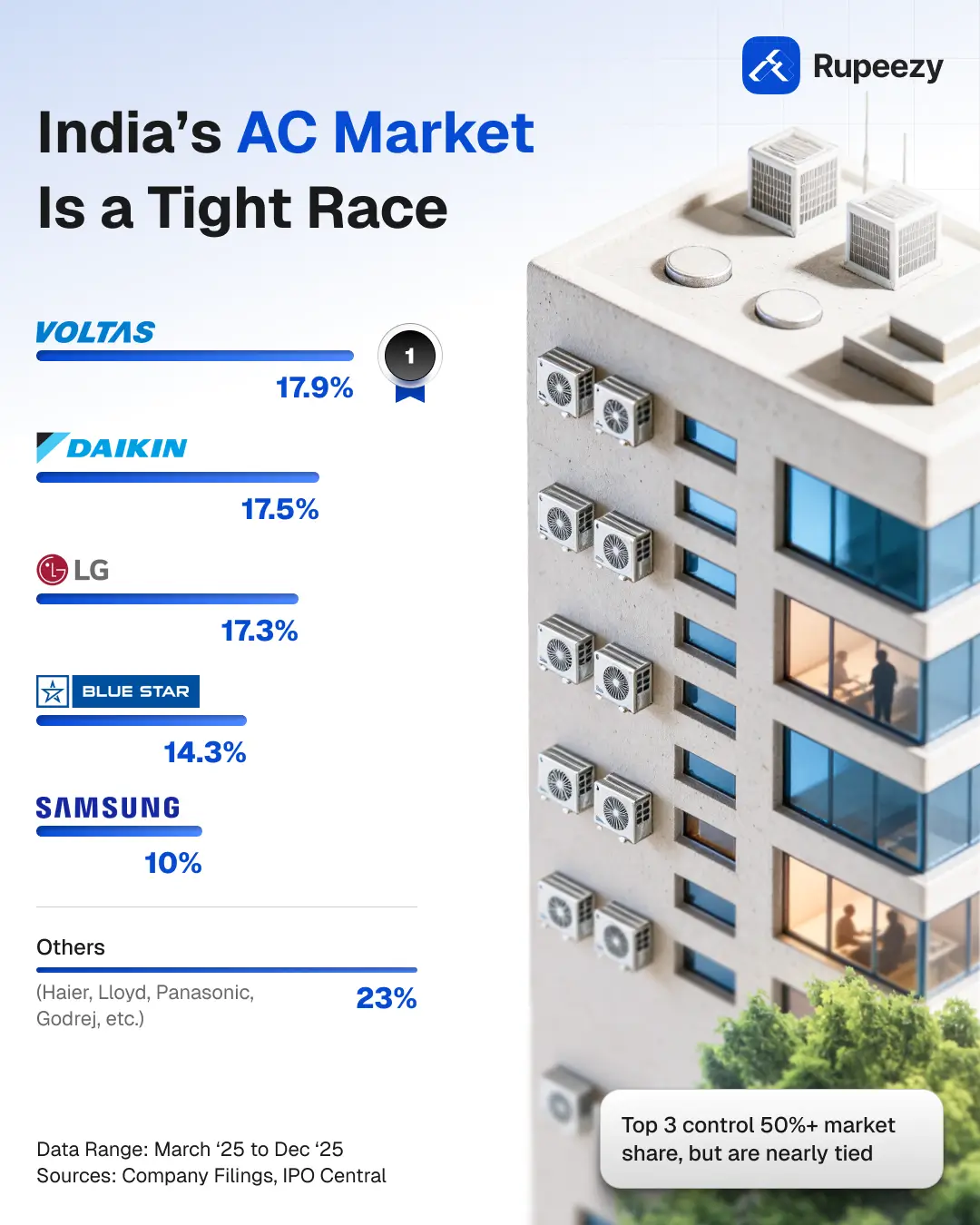
According to company filings and industry estimates, Voltas, Daikin India, and LG Electronics remain among the leading players in India’s room air-conditioner market. Other major brands such as Blue Star, Samsung, Haier, Panasonic, Lloyd, and Godrej are also expanding their presence through product innovation, local manufacturing, and wider distribution networks.
For investors looking to build long-term exposure to consumer durable stocks, a stock SIP can provide a disciplined way to invest a fixed amount regularly while managing market volatility.
Investors can also explore different industry sectors to understand how consumer durables and related businesses fit into the broader Indian stock market.
The infographic below highlights the current market-share positioning of major AC brands operating in India’s rapidly expanding cooling appliance market.
The industry’s long-term growth potential is attracting significant attention. Market projections suggest that the Indian AC industry could reach nearly $21 billion by 2034 if current demand trends continue.
Investors tracking the growth of the Indian AC industry can also consider eligible MTF Stocks, while evaluating stock eligibility, funding costs, seasonal volatility, and market risks.
For investors, the sector presents a combination of long-term structural growth and seasonal volatility. Rising incomes, low AC penetration, and urbanization support long-term demand, while raw material prices, electricity costs, and weather variability remain important industry risks. A goal-based investing approach can help investors evaluate whether AC-sector opportunities fit their financial goals, investment horizon, and risk tolerance.

Impact Of Heat Waves On AC Sales And Energy Consumption
The growing impact of heat waves on AC Sales clearly reflects how climate change is influencing consumer priorities. However, increasing AC adoption also raises concerns regarding electricity consumption and affordability.
As more households depend on air conditioners during summer, electricity bills are also expected to rise. This is increasing demand for energy-efficient appliances, inverter technology, and environmentally safer refrigerants that can help balance cooling needs with affordability.
The increasing demand for air conditioners also highlights the broader impact of climate change on everyday life. Consumers are adapting to changing environmental conditions, and businesses are responding to this shift through innovation and expansion.
Investors tracking the AC sector can also check the share market today to see how broader Nifty, Sensex, and market trends are influencing investor sentiment around consumer durable stocks.
Conclusion
The Indian AC market is no longer just selling a comfort appliance; it is providing an increasingly important household necessity during extreme summer conditions. As heat waves become more frequent and intense, the surge in demand is fundamentally reshaping the market landscape.
While the path ahead promises exponential growth, the industry's true success will be defined by its ability to innovate. Moving forward, the focus must shift toward scaling energy-efficient technologies that keep homes cool without placing an unsustainable burden on the national power grid or the environment.
Investors tracking the listed companies benefiting from India’s growing AC demand can use a stock market performance heatmap to quickly compare how relevant stocks and sectors are performing. This can help identify market trends and relative strength while analysing the sector.
Did you like this blog?
Be the first to like this blog.
The content on this blog is for educational purposes only and should not be considered investment advice. While we strive for accuracy, some information may contain errors or delays in updates.
Mentions of stocks or investment products are solely for informational purposes and do not constitute recommendations. Investors should conduct their own research before making any decisions.
Investing in financial markets are subject to market risks, and past performance does not guarantee future results. It is advisable to consult a qualified financial professional, review official documents, and verify information independently before making investment decisions.

Open Rupeezy account now. It is free and 100% secure.
Start Stock Investment





All Category