

Open a Free Demat Account !
₹0 AMC & Account Opening Fee
Company Demergers Explained: What Actually Happens to Your Shares

 Last Updated: 29 September, 2026
 8 min read




00:00 / 00:00


Key Highlights
|
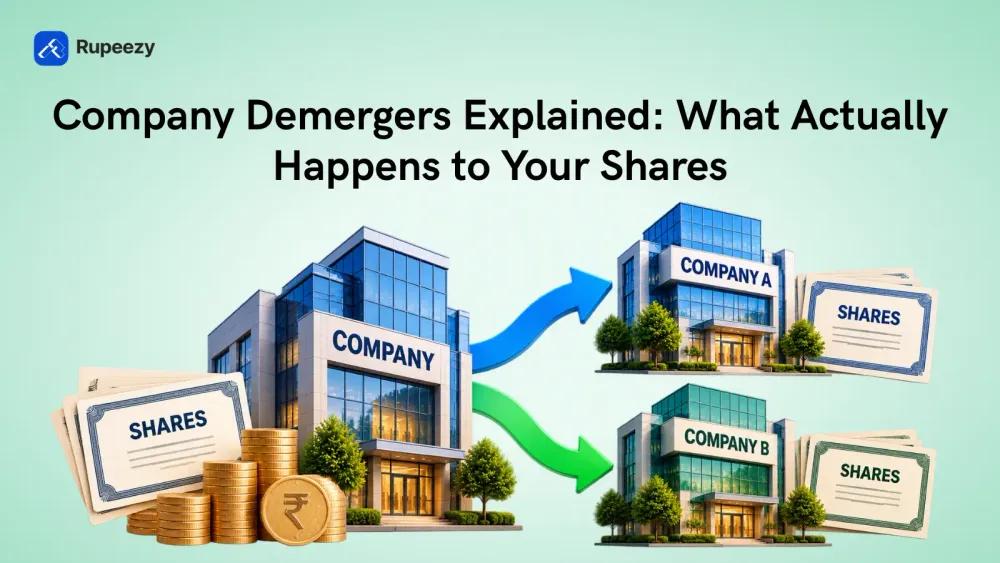
A company demerger separates one or more business undertakings from an existing company. It then transfers them to another entity. For shareholders, this can mean continuing to hold the existing shares on the one hand. But at the same time, they will get new shares for the company so created. This will be based on the entitlement ratio.
A demerger does not mean the investment value automatically doubles. The businesses that were earlier valued together are now separated. So, now there will be new market values. It will impact the share value, investment, and portfolios too. Read this guide to know what is a company demerger.

What Is a Company Demerger and How Does It Work?
A company demerger is a corporate restructuring in which an undertaking of an existing company is transferred to a resulting company. The business can then operate separately with the assets and liabilities transferred under the approved scheme.
In India, a demerger of stocks follows applicable corporate, regulatory, and tax provisions. Some of the things that you should know here in terms of working are:
1. Demerger Scheme Is Approved
The company prepares a scheme explaining which business is being separated, what assets and liabilities will move, and how shareholders will be treated.
The scheme then goes through the applicable shareholder, creditor, stock exchange, regulatory, and NCLT processes.
2. Business Is Transferred
Once the scheme becomes effective, the identified undertaking is transferred to the resulting company along with the assets and liabilities covered under the scheme.
This creates a clearer separation between the businesses that previously operated under one company.
3. Shares Are Allotted
How are demerger shares allotted?
Eligible shareholders receive shares according to the entitlement ratio. This is given in the approved scheme.
For example, say there is 1:1 entitlement ratio. It means an investor holding 200 eligible shares receives 200 shares of the resulting company. A 1:2 entitlement would mean one resulting-company share for every two eligible shares.
The shares are generally credited directly to the shareholder's demat account without requiring a separate application.
What Happens to Your Shares After a Demerger?
After a demerger, eligible shareholders can end up holding shares in both the demerged company and the resulting company. The exact number of resulting-company shares depends on the entitlement ratio announced under the scheme.
The additional shares should not be treated as free wealth. Part of the business previously represented by the original share has moved into another company.
Suppose you hold 100 shares worth Rs. 800 each before a demerger. Your market value is Rs. 80,000. If a major business is separated, the market can adjust the value of the original company to reflect the business that has moved out.
You may then own shares in two separate companies. Their combined market value will depend on how investors value both businesses after the restructuring.
1. Record Date vs Ex-Date
Basis | Record Date | Ex-Date |
Meaning | Date used to identify eligible shareholders. | Date from which shares trade without the entitlement. |
Purpose | Determines who qualifies for the share allotment. | Separates eligible and non-eligible trades. |
Investor impact | Shareholders meeting the eligibility conditions receive the entitlement. | Investors buying on or after this date generally do not receive it. |
Since Indian equity trades follow a T+1 settlement cycle, investors should check the official exchange corporate-action notice rather than relying only on the record date.
2. Share Credit vs Listing
Receiving the shares in a demat account and being able to trade them are not always the same event. The resulting company's shares may be allotted or credited before they are admitted to trading. Investors need to check the listing date separately.
Demerger vs Spin-Off in India: What Is the Difference?
A demerger in India has a defined legal and tax framework. But a spin-off is a broader term used for separating a business into an independent entity. Although both can result in separate businesses, their structure and shareholder treatment are not necessarily identical.
For investors comparing demerger vs spin-off India, the transaction scheme is more important than the label because it explains what is transferred and what shareholders receive.
Basis | Demerger | Spin-Off |
Meaning | An undertaking is transferred to a resulting company. | A business or subsidiary is separated into an independent entity. |
Indian framework | Covered by specific corporate and tax provisions. | Broader corporate restructuring term. |
Assets and liabilities | Transferred according to the approved scheme. | Depends on how the transaction is structured. |
Share entitlement | Determined under the demerger scheme. | Depends on the transaction structure. |
Tax treatment | Specific provisions apply if prescribed demerger conditions are met. | Depends on the legal structure used. |
This distinction matters because investors should not assume every business separation will follow the same share allotment or tax process.

How Did the Tata Motors Demerger Affect Shareholders?
The Tata Motors demerger case study provides a practical example of the same. Tata Motors separated its commercial vehicles business from its passenger vehicles-focused business. The scheme became effective on October 1, 2025. Here are the details to know:
1. What Was Separated?
The commercial vehicles undertaking was separated from the passenger vehicles-focused business. The restructuring allowed the businesses to operate as separately focused entities.
The passenger vehicles side included passenger vehicles, electric vehicles, Jaguar Land Rover, and related investments.
2. How Many Shares Did Investors Receive?
The entitlement ratio was 1:1. Eligible shareholders received one share of the resulting commercial vehicles company for every one eligible Tata Motors share held.
An investor holding 500 eligible shares, for example, received 500 shares under the demerger.
3. What Were the Important Dates?
The demerger involved different dates for the scheme becoming effective, determining eligible shareholders, and beginning exchange trading.
Event | Date/Details |
Demerger effective date | October 1, 2025 |
Record date | October 14, 2025 |
Share entitlement | 1:1 |
Resulting CV company listing | November 12, 2025 |
This is why investors should not treat the demerger announcement, record date, share allotment, and listing as a single event.
How Does Tax Work on Demerger Shares?
The tax on demerger shares requires the original acquisition cost to be allocated between the demerged company and the resulting company. Investors cannot use the full original purchase cost for both holdings when calculating future capital gains.
Under Section 49(2C) of the Income Tax Act, the cost attributable to shares of the resulting company is determined using the prescribed proportion linked to the net book value of assets transferred.
Under Section 49(2D), the cost of the original shares is reduced by the amount allocated to the resulting company.
1. How Is the Cost Divided?
Suppose an investor originally purchased shares for Rs. 2,00,000 and the applicable cost allocation communicated for the demerger is 30% to the resulting company.
Holding | Cost Allocation | Acquisition Cost |
Demerged company | 70% | Rs. 1,40,000 |
Resulting company | 30% | Rs. 60,000 |
Total | 100% | Rs. 2,00,000 |
The total acquisition cost remains Rs. 2,00,000. It has simply been divided between the two holdings.
Investors should use the official cost-allocation communication issued for the demerger rather than estimating the split themselves.
2. What Happens to the Holding Period?
For shares received in a qualifying demerger, the period for which the investor held the original shares is generally included when determining the holding period of the resulting-company shares.
The allocated acquisition cost and applicable holding period become relevant when shares of either company are eventually sold.
Conclusion
A company demerger separates a business from an existing company and can leave eligible shareholders holding shares in both the demerged and resulting companies. The entitlement ratio determines the number of new shares, while the record date and ex-date determine eligibility.
For investors, receiving additional shares is only one part of the process. It is equally important to understand what business has moved, how debt and assets have been divided, when the resulting shares will list, and how the original acquisition cost will be allocated.
With Rupeezy, investors can research listed companies and find further details. This can help with better investing and portfolio management.
FAQs
1. Do I Need to Apply for Shares After a Demerger?
No. Eligible shareholders generally receive the shares directly in their demat accounts based on the entitlement ratio.
2. Do I Lose My Existing Shares After a Demerger?
Generally, no. The existing holding continues according to the scheme, while eligible investors may also receive shares of the resulting company.
3. Are Demerger Shares Free?
No. The separated business was already part of the original company. Its value and the original acquisition cost are divided between the two holdings.
4. Can I Sell Demerger Shares Immediately?
Not always. Shares can generally be traded only after the resulting company is listed and admitted to trading on the stock exchanges.
5. Does a Demerger Guarantee Higher Returns?
No. After the demerger, the market values both companies independently based on their financial performance, growth prospects, risks, and market conditions.
Surbhi Bapna is a finance content writer at Rupeezy with more than six years of experience in the finance industry. She holds an MBA degree in Finance from the International Institute of Professional Studies. Surbhi is passionate about integrating finance into people’s daily lives through informative content. She brings in-depth expertise in stocks, personal finance, mutual funds, banking, and investments. Her experience, analytical insights, and commitment to financial research significantly contribute to Rupeezy's comprehensive financial content.
Did you like this blog?
Be the first to like this blog.
The content on this blog is for educational purposes only and should not be considered investment advice. While we strive for accuracy, some information may contain errors or delays in updates.
Mentions of stocks or investment products are solely for informational purposes and do not constitute recommendations. Investors should conduct their own research before making any decisions.
Investing in financial markets are subject to market risks, and past performance does not guarantee future results. It is advisable to consult a qualified financial professional, review official documents, and verify information independently before making investment decisions.
Open Rupeezy account now. It is free and 100% secure.
Start Stock Investment


All Category