

Open a Free Demat Account !
₹0 AMC & Account Opening Fee
GIFT City Cracks Asia-Pacific's Top 15 Financial Hubs: What It Means for Indian Investors

 Last Updated: 29 September, 2026
 8 min read




00:00 / 00:00


Key Highlights
|
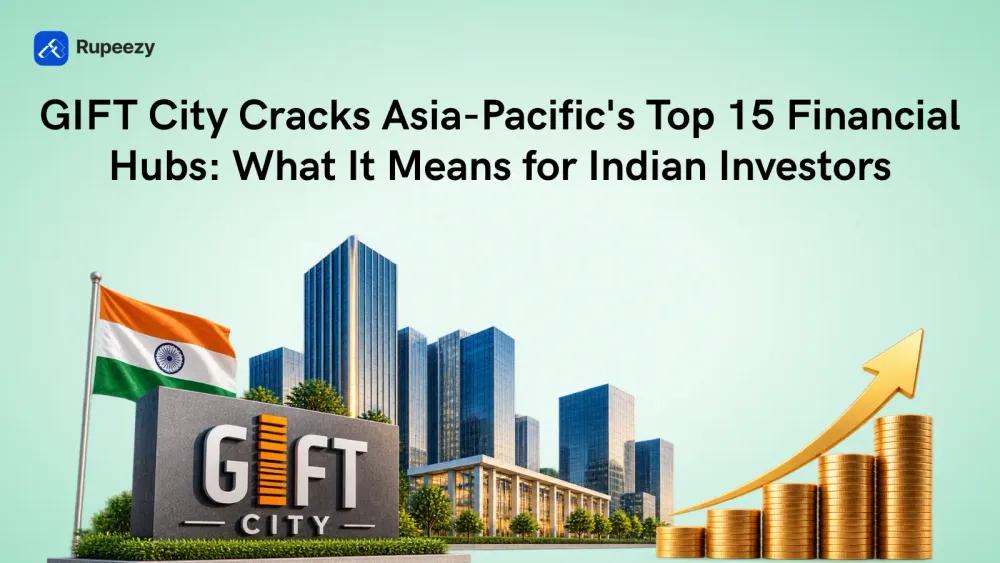
GIFT City has taken a significant step to become an international financial hub. In the latest Global Financial Centres Index, GIFT City moved from 46th to 37th globally. It has now entered the top 15 financial centres in the Asia-Pacific region. It is the only Indian financial centre in this regional group.
For Indian investors, the ranking itself does not change investment rules or create a new product. What it does show is the growing scale and global relevance of India's first International Financial Services Centre.
As more banks, exchanges, fund managers and financial institutions build operations there, GIFT City IFSC investment is key to analyse. So, read this guide for details.


What Is the Latest GIFT City Global Financial Centres Index Ranking?
The Global Financial Centres Index is also known as GFCI. It evaluates financial centres based on areas such as business environment, human capital, infrastructure, financial sector development and reputation.
The September 2026 GFCI 40 brought a sharp improvement for GIFT City.
Metric | GFCI 39 | GFCI 40 |
Global ranking | 46th | 37th |
FinTech ranking | 29th | 26th |
Asia-Pacific position | Outside top 15 | Top 15 |
The latest GIFT City Global Financial Centres Index position is particularly notable because GIFT City is still much younger than established Asian financial centres such as Singapore and Hong Kong.
GFCI 40 also included GIFT City among 15 financial centres expected to become more significant over the next two to three years, based on responses to its survey.
Why Is GIFT City Moving Up the Global Rankings?
GIFT City's rise is not linked to one development alone. The financial hub has expanded across banking, capital markets, fund management, insurance and FinTech. The reasons to know are:
1. Growth of the GIFT IFSC Ecosystem
More banks, fund managers, insurers, exchanges and other financial institutions are operating within GIFT IFSC. This growing ecosystem has increased its role in international financial services and contributed to its improved GIFT City Global Financial Centres Index ranking.
2. Unified Financial Regulation
Financial services within the IFSC are regulated by the International Financial Services Centres Authority, or IFSCA. It provides a unified regulatory framework. This is for financial products, services and institutions operating within the IFSC.
3. Easier Access to Global Markets
It supports cross-border financial activity. Transactions and investment products can be denominated in foreign currencies. Eligible resident Indians can also make permitted GIFT City IFSC investment through routes such as the Liberalised Remittance Scheme.
This structure is also creating more options for investors looking to invest in US stocks from India through GIFT City and access other international securities.
4. Tax Support for the IFSC Ecosystem
The 2026 Union Budget further strengthened it. The tax deduction period was increased from 10 years to 20 consecutive years out of a 25-year period. Eligible business income after this period is subject to a concessional 15% tax rate.
What Does GIFT City IFSC Investment Mean for Indian Investors?
For a retail investor, the biggest change is access. GIFT City creates an India-based international financial ecosystem through which investors can access permitted overseas products and markets.
Depending on the intermediary and applicable regulations, investors may find access to:
International equities and ETFs.
Global mutual funds and other fund structures.
Dollar-denominated alternative investment funds.
Portfolio management products.
International exchange-traded products.
Foreign currency banking facilities for permitted transactions.
Resident individuals can also maintain specified foreign currency accounts with IFSC Banking Units for transactions permitted under the RBI's Liberalised Remittance Scheme.
This does not remove foreign investment rules. Investors still need to comply with LRS limits, taxation, KYC requirements and the rules applicable to the particular investment.

Can You Invest in US Stocks From India Through GIFT City?
Yes, there are routes that allow eligible Indian investors to access international markets. This is mainly through the GIFT City ecosystem using the following routes:
Route | How It Works | What Investors Can Access |
NSE IFSC Receipts | Receipts represent selected US-listed shares and can be accessed by eligible investors under the LRS framework. | Selected US company stocks, including Apple, Alphabet, Amazon, Microsoft, Meta and Tesla. |
India INX Global Access | Investors use intermediaries operating through GIFT City to access international exchanges. | Global equities, ETFs, and other permitted international asset classes, depending on the platform. |
Interest in these routes has been growing. The traded value on India INX's Global Access Provider platform reached around $1.74 billion in the June 2026 quarter through June 26, an increase of more than 80% quarter on quarter, according to Financial Express.
So, investors looking to invest in US stocks from India GIFT City routes now have more options than a few years ago. However, availability differs by broker, platform and product.
What Are the GIFT City Tax Benefits?
Tax has been one of the key incentives behind GIFT City's growth. However, the benefits that you should know are as follows:
1. 100% Deduction for Eligible IFSC Units
Eligible IFSC units can claim a 100% deduction on qualifying income for 20 consecutive years out of a 25-year period. This was extended from the earlier 10-year window.
2. 15% Tax After the Deduction Period
This is after the deduction period ends. The eligible income from an IFSC business is taxed at a concessional rate of 15%.
3. Separate Rules for Investors
Certain securities and transactions on recognised IFSC exchanges have specific tax treatment. These rules can also differ for resident and non-resident investors.
Key Point GIFT City tax benefits do not make every investment tax-free. The final tax treatment depends on what you invest in and the tax rules applicable to that investment. |
What Is the IFSC Unclaimed Deposits Scheme?
As banking activity grows in GIFT City, IFSCA has also started developing rules for deposits that remain unclaimed.
In July 2026, IFSCA released a draft IFSC Depositor Education and Awareness Fund. This is also known as the IDEA Fund Scheme. Under this, deposits and other eligible amounts that remain unclaimed or inoperative for 10 years or more would be transferred to a dedicated fund.
But this does not remove the depositor's claim. If an eligible claim is made later, the Banking Unit would pay the depositor and seek reimbursement from the fund.
The IFSC unclaimed deposits scheme was released as a draft for consultation, so investors should distinguish it from the final notified framework.
GIFT City vs Singapore: How Do the Two Financial Hubs Compare?
Singapore remains one of the world's largest and most established financial centres. The GIFT City is a much younger hub.
Factor | GIFT City | Singapore |
GFCI 40 global position | 37th | 4th |
Market maturity | Emerging international financial centre | Established global financial centre |
Primary regulator | IFSCA | Monetary Authority of Singapore |
Key advantage for Indian investors | India-based gateway to international finance | Large, mature international financial ecosystem |
Connection with Indian regulations | Operates within India's IFSC framework | Separate foreign jurisdiction |
Therefore, the GIFT City vs Singapore comparison is better viewed as an emerging hub versus an established one.
What Should Indian Investors Watch Next?
GIFT City's higher ranking is important, but investors should focus on how the ecosystem develops from here.
More global funds, banks and brokers entering GIFT IFSC.
New investment products becoming available to Indian investors.
Growth in trading volumes and market participation.
Changes in IFSCA, LRS and overseas investment rules.
Currency risk when investing in foreign assets.
Tax treatment of different GIFT City investments.
Costs, liquidity and eligibility rules for each product.
Conclusion
GIFT City's rise to 37th globally and Asia-Pacific's top 15 reflects the growth of India's international financial ecosystem. For investors, this means more routes to explore global equities and funds.
The GIFT City IFSC investment options are expanding now. This means you should now know the product, costs, tax rules and risks. This is where Rupeezy helps investors. You can stay informed about markets and investment opportunities, so you can research your options before making a decision.
FAQs
1. What Is GIFT City's Latest Global Ranking?
GIFT City ranks 37th globally in GFCI 40. It is up from 46th in the previous edition. It has also entered the top 15 financial centres in Asia-Pacific.
2. Can Indian Residents Invest Through GIFT City?
Yes. Resident Indians can access permitted investments through GIFT IFSC subject to RBI, IFSCA, LRS and other applicable regulations.
3. Can I Buy US Stocks Through GIFT City?
Eligible investors can access US stocks and other international securities through certain GIFT City-based platforms and intermediaries. The exact products available depend on the provider and applicable regulations.
4. Are Investments Through GIFT City Tax-Free?
Not automatically. GIFT City offers significant tax incentives, but many apply to qualifying IFSC entities or specific transactions. Indian resident investors need to check the tax treatment of the individual product.
5. Is GIFT City Bigger Than Singapore as a Financial Hub?
No. Singapore remains substantially larger and ranks fourth globally in GFCI 40. GIFT City is an emerging international financial centre that has moved rapidly up the rankings and is becoming an important India-based gateway for cross-border finance.
Surbhi Bapna is a finance content writer at Rupeezy with more than six years of experience in the finance industry. She holds an MBA degree in Finance from the International Institute of Professional Studies. Surbhi is passionate about integrating finance into people’s daily lives through informative content. She brings in-depth expertise in stocks, personal finance, mutual funds, banking, and investments. Her experience, analytical insights, and commitment to financial research significantly contribute to Rupeezy's comprehensive financial content.
Did you like this blog?
Be the first to like this blog.
The content on this blog is for educational purposes only and should not be considered investment advice. While we strive for accuracy, some information may contain errors or delays in updates.
Mentions of stocks or investment products are solely for informational purposes and do not constitute recommendations. Investors should conduct their own research before making any decisions.
Investing in financial markets are subject to market risks, and past performance does not guarantee future results. It is advisable to consult a qualified financial professional, review official documents, and verify information independently before making investment decisions.





All Category