

Open a Free Demat Account !
₹0 AMC & Account Opening Fee
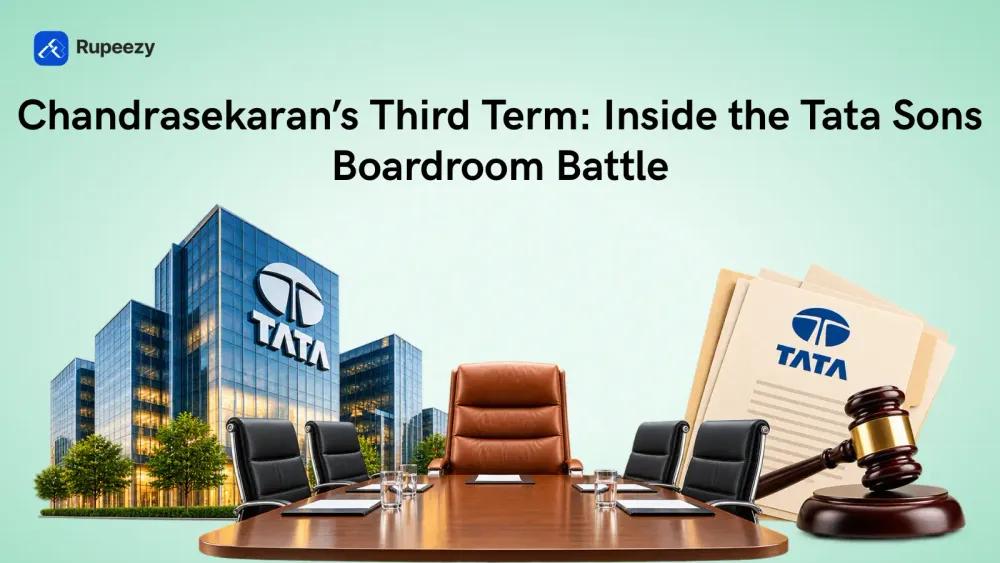
Chandrasekaran’s Third Term: Inside the Tata Sons Boardroom Battle

 Last Updated: 29 September, 2026
 6 min read




00:00 / 00:00


Key Highlights
|


N Chandrasekaran was preparing to leave the chairman’s office at Tata Sons. Then, within weeks, the situation changed.
On September 17, 2026, the Tata Sons board approved another five-year term for him. The vote was 4:1. Chandrasekaran’s current tenure runs until February 20, 2027, so the new tenure would be his third term as chairman.
But that vote did not close the succession discussion. Noel Tata voted against the proposal, and Tata Trusts later questioned whether the resolution was valid under Tata Sons’ Articles of Association.
That is what makes the Tata Sons Chandrasekaran succession story unusual. There is a board decision on one side and an objection from the company’s controlling shareholder on the other.
How Did Chandrasekaran Go From Leaving to Staying?
Until August, Tata Sons appeared to have a change in leadership. Chandrasekaran had informed the board on August 12 that he would not seek another term. Tata Trusts accepted his decision. Post this, the process of finding a successor was expected to begin.
The direction changed after Tata Sons’ Nomination and Remuneration Committee asked him to reconsider. Chandrasekaran agreed, bringing the matter back before the board.
On September 17, four directors supported another term. Noel Tata was the only director to vote against it.
The disagreement that followed was not simply about whether Chandrasekaran should stay. It was about whether that 4:1 vote was enough.
Why Does Noel Tata’s Vote Matter?
Tata Trusts owns about 66% of Tata Sons and has nominee directors on the Tata Sons board. At present, those nominees are Noel Tata and Venu Srinivasan. Both voted in different directions.
This split is central to the Tata Trusts vs Tata Sons dispute.
Under Article 121 of Tata Sons’ Articles of Association, certain board matters need the affirmative vote of a majority of Tata Trusts’ nominee directors.
Tata Trusts’ argument is straightforward. There are two nominee directors, and only one voted in favor. In its view, the required majority was therefore missing.
It has also rejected the argument that a casting vote can resolve the issue.
Tata Sons has taken a different view of how the Articles apply. So, despite the board voting 4:1, the validity of the decision remains disputed.

What Does This Tell Us About Tata Sons’ Governance?
Tata Sons is the main holding company of the Tata Group. Its board makes decisions linked to leadership, asset allocation, and others.
But Tata Sons does not have a conventional ownership structure. Tata Trusts owns roughly two-thirds of the company and has specific rights under its Articles.
That means a simple board majority may not always settle a major matter.
The current disagreement is therefore a useful corporate governance India case study. It shows how board powers, shareholder rights, and company-specific rules can overlap.
For anyone trying to understand how holding company boards work, Tata Sons also shows why the Articles of Association matter. They can determine not only who gets a seat at the table, but also whose approval is needed for particular decisions.
Where Does the Tata Sons Listing Fit In?
There is another issue sitting behind the boardroom disagreement: whether Tata Sons should eventually list.
The Reserve Bank of India classified Tata Sons as an upper-layer NBFC in 2022. Tata Sons later sought to surrender its Core Investment Company registration.
Tata Trusts does not want listing to become the default answer. It has asked Tata Sons to explore other routes available under the regulatory framework.
There is another shareholder to consider too.
The Shapoorji Pallonji Group owns around 18.4% of Tata Sons. In September, details also emerged around a proposal to monetize part of its Tata Sons holding and raise at least Rs. 25,000 crore.
This makes the listing discussion important for more than regulatory compliance. It is also linked to shareholder liquidity and the value locked inside Tata Sons.
What Does Chandrasekaran’s Record Look Like?
Chandrasekaran took charge of Tata Sons in 2017. His tenure has included some of the group’s biggest recent moves, from bringing Air India back into the Tata fold to investments in electronics, digital businesses, and newer industries.
The numbers also show why the next phase will not be simple.
Tata Sons reported consolidated net sales of around Rs. 6.49 lakh crore in FY26, up 16.8%. However, consolidated net profit declined 35.7% to Rs. 17,923.4 crore. Losses from businesses such as Air India and Tata Digital affected overall profitability.
So the Tata Sons chairman term debate is taking place when the group is managing both large expansion plans and pressure from some newer businesses.
What Should Investors Watch Now?
For investors in Tata Group companies, the boardroom disagreement itself does not automatically change the investment case for individual listed businesses.
The first issue is whether Chandrasekaran’s new term is formally settled or continues to face opposition. The second is whether the disagreement begins affecting major decisions at Tata Sons.
The listing question is another area to track. Any change in Tata Sons’ ownership structure could have implications for its shareholders and potentially change how the holding company operates.
Investors should also watch whether the two sides reach an internal resolution or whether the interpretation of the Articles eventually moves into a formal legal process.
Conclusion
The Tata Sons Chandrasekaran succession issue is still not fully settled. The Tata Sons board has approved Chandrasekaran’s third term, while Tata Trusts has questioned whether the resolution meets the company’s governance requirements.
For investors, the key developments to track are the final outcome of the reappointment and see how it will impact their investments.
Want to keep track of Tata Group stocks and other market developments? Explore market updates, company information, and investing tools on Rupeezy. Get all the support you need to invest right.
FAQs
1. Is Chandrasekaran Getting a Third Term at Tata Sons?
The Tata Sons board has approved another five-year term beginning after February 20, 2027. Tata Trusts has challenged the validity of that approval.
2. Why Did Noel Tata Vote Against the Proposal?
Noel Tata opposed the reappointment. Tata Trusts says the resolution did not receive the level of support required from its nominee directors under Tata Sons’ Articles.
3. Who Owns Tata Sons?
Tata Trusts collectively owns about 66% of Tata Sons. The Shapoorji Pallonji Group is another major shareholder, with roughly 18.4%.
4. Why Is Tata Sons Listing Being Discussed?
Its classification as an upper-layer NBFC has created regulatory questions around listing. Tata Trusts has asked the company to explore alternatives rather than treating listing as the only route.
5. Does the Dispute Directly Affect Tata Group Stocks?
There is no automatic direct impact. Investors can instead track whether the dispute affects group strategy, capital allocation, leadership decisions, or the future structure of Tata Sons.
Surbhi Bapna is a finance content writer at Rupeezy with more than six years of experience in the finance industry. She holds an MBA degree in Finance from the International Institute of Professional Studies. Surbhi is passionate about integrating finance into people’s daily lives through informative content. She brings in-depth expertise in stocks, personal finance, mutual funds, banking, and investments. Her experience, analytical insights, and commitment to financial research significantly contribute to Rupeezy's comprehensive financial content.
Did you like this blog?
Be the first to like this blog.
The content on this blog is for educational purposes only and should not be considered investment advice. While we strive for accuracy, some information may contain errors or delays in updates.
Mentions of stocks or investment products are solely for informational purposes and do not constitute recommendations. Investors should conduct their own research before making any decisions.
Investing in financial markets are subject to market risks, and past performance does not guarantee future results. It is advisable to consult a qualified financial professional, review official documents, and verify information independently before making investment decisions.



All Category