
Open a Free Demat Account !
₹0 AMC & Account Opening Fee
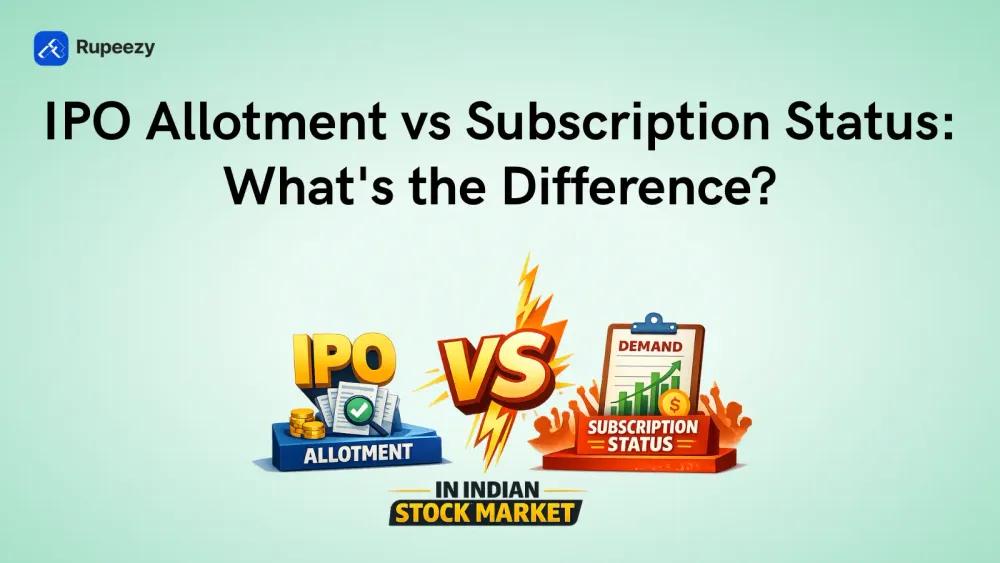
IPO Allotment vs Subscription Status: What's the Difference?

 Last Updated: 18 September, 2026
 9 min read




00:00 / 00:00


Key Highlights
|

Anyone who has applied for an IPO in India has probably checked two very different numbers at two very different points in the process. First comes the subscription figure, the one that tells you an issue got bid for 40 times over, or barely scraped past 1x. Then, a few days later, comes the allotment status, the one you refresh nervously on the registrar's website to see if your application actually landed you any shares.
These two numbers get confused all the time, partly because they sound similar and partly because a strong subscription number naturally makes you hope for a strong allotment outcome. They are not the same thing, though, and understanding the gap between them will save you a lot of unnecessary anxiety during IPO season.
Here's how each one works, how they connect, and what you should actually be watching for at each stage.
What Is IPO Subscription Status?
Subscription status is a running scoreboard of demand while the issue is still open for bidding. It tells you how many shares have been applied for compared to how many are actually on offer, expressed as a multiple. An IPO subscribed 5 times, often written as 5x, means investors bid for five times more shares than the company put up for sale.
This number is tracked separately for each investor category, and the categories matter a lot. Qualified Institutional Buyers, or QIBs, get 50% of a typical mainboard book-built issue and include mutual funds, insurance companies, banks, and foreign portfolio investors.
Non-institutional investors, often called HNIs or NIIs, usually get 15%. Retail individual investors get the remaining 35%. Each of these figures updates in near real time on the NSE and BSE websites during the bidding window, which usually runs three to five working days.
Subscription status is useful because it's a live read on sentiment. QIB demand in particular gets watched closely, since institutional investors typically apply only after digging into the company's financials and valuation, so heavy QIB interest is often read as a vote of confidence.
But it's worth remembering that a hot subscription number reflects demand, not quality. Plenty of oversubscribed IPOs have gone on to list flat or below the issue price, and some undersubscribed ones have surprised on the upside.
While IPO subscription data reflects demand for a specific issue, investors can also check today's market movement to understand the broader market sentiment across major indices and sectors.
While IPO subscription data can show investor demand for a particular issue, it is also useful to look at the broader market before assessing sentiment. A stock market performance heatmap can help you quickly compare how different stocks and sectors are performing.
Investors can also explore stock market sectors to compare sector-wise performance and understand broader market trends alongside IPO demand.
What Is IPO Allotment Status?
Allotment status is the outcome, not the demand. Once the subscription window closes, the registrar, usually a firm like KFin Technologies, Link Intime, or Bigshare, finalises exactly who gets how many shares and reconciles this against SEBI's ICDR Regulations. This is called the basis of allotment.
If an issue is undersubscribed or subscribed close to 1x in a category, most applicants get the shares they applied for. Once demand crosses that mark, especially in the retail category, allotment shifts to a computerised lottery system.
If retail demand for a lot-sized IPO comes in at 20x, roughly one in twenty retail applicants ends up getting a lot, regardless of how early or how large their bid was, so long as they bid at or above the cut-off price. This is why two people who applied for the exact same number of shares can get completely different outcomes.
Once the basis of allotment is finalised, successful applicants see shares credited to their demat account, and unsuccessful ones get their blocked ASBA funds released automatically, without needing to request a refund.
Subscription vs Allotment: Side by Side
Aspect | Subscription Status | Allotment Status |
What it measures | Total demand while bidding is open | Whether you personally received shares |
Timing | Updates live during the 3 to 5 day bidding window | Finalised after the issue closes, typically the next working day |
Where to check | NSE and BSE websites, broker apps | Registrar's website, NSE, BSE, using PAN, application number, or demat ID |
What determines it | How many shares investors bid for across categories | SEBI's allotment rules, category-wise demand, and a lottery for oversubscribed retail bids |
What it tells you | Market sentiment and demand strength | The actual result of your specific application |
Can you influence it | No, once you've bid, you're part of the total | No, once demand crosses the cutoff, it's a lottery, not first come first served |
How the Two Connect: A Quick Walkthrough
Say a mainboard IPO opens on a Monday and closes on Wednesday. Through those three days, subscription numbers build up category by category, often with retail filling up first and institutional demand arriving heavily on the final day, since QIBs typically wait to see how the book is shaping up before committing.
Once bidding closes Wednesday evening, the registrar gets to work. Under SEBI's T+3 framework, which has been mandatory for all mainboard issues since December 2023, the basis of allotment is usually finalised the very next working day.
Shares get credited to successful applicants' demat accounts the day after that, refunds go out to unsuccessful ones on the same timeline, and the stock lists on the exchange on the third working day after closure.
What used to take six working days under the older T+6 system now wraps up in three, which means far less time sitting around waiting to find out where you stand.
Where and How to Check Each One
If you are an investor who is looking to check the details, here is how you can do the same:
For Subscription Status
The NSE and BSE websites publish live, category-wise numbers throughout the bidding window, and most broker platforms mirror this data as well, so you don't need to check the exchange directly. Just search for the specific IPO name on either exchange's IPO page.
For Allotment Status
For allotment status, once it's out, you'll need your PAN, demat ID, or application number. You can check this directly on the registrar's website, whether that's KFin Technologies, Link Intime, or another SEBI-registered registrar for that particular issue, or through the NSE and BSE allotment status pages, which usually work off the same underlying data.
You can also check it directly on Rupeezy, where both live subscription figures and allotment status are available alongside the rest of your IPO applications, so you're not hunting across multiple registrar sites during a busy IPO week.
A Few Things Worth Knowing
A high subscription multiple does not guarantee you'll get shares, particularly in the retail category, where the lottery system means even a 100x subscribed IPO leaves the door open, just a narrow one, for random selection.
Bidding early doesn't improve your odds either, since allotment for oversubscribed categories has nothing to do with when you applied, only whether your bid was included in the final pool at or above the cut-off price.
It also helps to apply through a single demat account rather than splitting the same PAN across multiple applications, since SEBI rules typically allow only one application per PAN in an IPO, and duplicate applications under the same PAN can get rejected entirely rather than improving your odds.
Conclusion
Subscription status and allotment status sit at two different points on the IPO timeline and answer two different questions. One tells you how much demand an issue attracted while bidding was still open. The other tells you, once the dust has settled, whether that demand worked out in your favour.
Watching subscription numbers can help you read market sentiment and gauge how competitive a retail lottery might get, but it's the allotment result that actually decides whether shares land in your demat account.
With SEBI's T+3 timeline now standard, you don't have to wait long to find out either way, and you can track both stages of the process, from live subscription data to final allotment status, right inside Rupeezy without switching between different registrar sites.
FAQs
1. Does a high subscription number mean I'll definitely get IPO allotment?
No. A high subscription number only tells you demand exceeded supply, it doesn't guarantee your specific application was selected. In oversubscribed retail categories, allotment is decided through a computerised lottery, so even a heavily subscribed IPO leaves outcomes down to chance for individual applicants.
2. How many days after IPO closing does allotment happen?
Under SEBI's T+3 rule, mandatory since December 2023, the basis of allotment is typically finalised the working day right after the issue closes. Shares are credited and refunds processed shortly after, with listing happening on the third working day from closure.
3. Can I check IPO allotment status without a registrar login?
Yes. Most registrars, along with the NSE and BSE, let you check allotment status using just your PAN, demat ID, or application number, without needing to create a separate login. You can also check it through your broker's app, including Rupeezy, once results are out.
4. Why did I not get allotment even though I applied on Day 1?
Applying early doesn't improve your allotment chances once a category is oversubscribed. Retail allotment in an oversubscribed IPO is decided by lottery, not by when you applied, so timing your bid early only matters for avoiding last-minute technical issues, not for improving your odds.
5. What happens to my money if I don't get IPO allotment?
If you applied through ASBA, your funds were only ever blocked in your bank account, never debited. Once allotment is finalised and you haven't received shares, the blocked amount is automatically released back to your account, typically within a day or two under the current T+3 timeline, with no separate refund request needed.
Surbhi Bapna is a finance content writer at Rupeezy with more than six years of experience in the finance industry. She holds an MBA degree in Finance from the International Institute of Professional Studies. Surbhi is passionate about integrating finance into people’s daily lives through informative content. She brings in-depth expertise in stocks, personal finance, mutual funds, banking, and investments. Her experience, analytical insights, and commitment to financial research significantly contribute to Rupeezy's comprehensive financial content.
Did you like this blog?
Be the first to like this blog.
The content on this blog is for educational purposes only and should not be considered investment advice. While we strive for accuracy, some information may contain errors or delays in updates.
Mentions of stocks or investment products are solely for informational purposes and do not constitute recommendations. Investors should conduct their own research before making any decisions.
Investing in financial markets are subject to market risks, and past performance does not guarantee future results. It is advisable to consult a qualified financial professional, review official documents, and verify information independently before making investment decisions.

Open Rupeezy account now. It is free and 100% secure.
Start Stock Investment



All Category