How to Invest in US Stocks from India in 2026: A Step-by-Step Guide
by Surbhi Bapna
Surbhi Bapna is a finance content writer at Rupeezy with more than six years of experience in the finance industry. She holds an MBA degree in Finance from the International Institute of Professional Studies. Surbhi is passionate about integrating finance into people’s daily lives through informative content. She brings in-depth expertise in stocks, personal finance, mutual funds, banking, and investments. Her experience, analytical insights, and commitment to financial research significantly contribute to Rupeezy's comprehensive financial content.
Last Updated: 21 September, 20267 min read
00:00 / 00:00
Investing is no longer limited by geography. In 2026, Indian investors are increasingly looking beyond domestic markets to diversify their portfolios and tap into global growth. The US stock market is one of the places where you will find giants like Apple, Microsoft, and Tesla to invest in.
This is one of the reasons why Indian investors are looking for ways to invest here, as this will allow them access to the world’s largest and most innovative businesses. But the question here is, how can you start investing in the US stock market from India?
This is where you must know the key guidelines, policies, and even the process to get started. So, let us explore the correct answer to how to invest in US stocks from India here in this guide.
What Does It Mean to Invest in US Stocks from India?
Investing in US stocks means buying shares of companies listed on American stock exchanges such as the New York Stock Exchange and the NASDAQ. These stocks are priced in US dollars and follow US market rules.
Indian residents can invest legally under the Liberalised Remittance Scheme. This is issued by the Reserve Bank of India (RBI), which is the apex financial regulatory authority in India. Under this scheme, you can remit up to USD 250,000 per financial year for overseas investments.
In simple terms, you convert Rupees into dollars. This should be done through an authorized bank or investment platform. Once done, you can purchase shares of global companies directly.
How to Invest in the US Stock Market from India
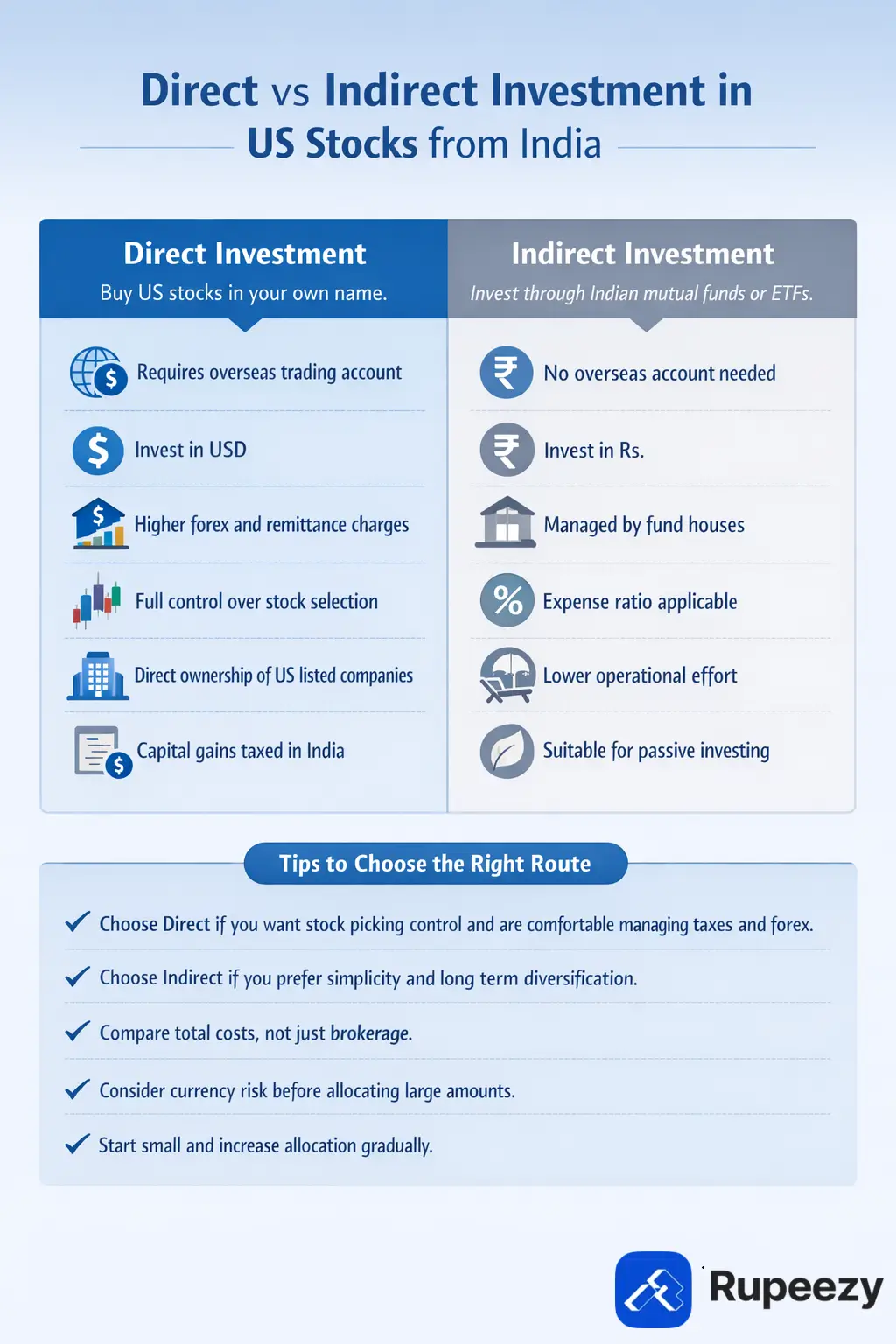
Yes, you can invest in the US stock market from India in 2026. That is the first thing that you must know. Now, the next step is understanding the routes. So, basically, two ways can help you invest in US stocks from India. These are:
Direct investment in US stocks
Indirect investment through Indian mutual funds or ETFs
Now, let us understand both of these in a proper manner here.
Before choosing between direct US stocks, international ETFs, or mutual funds, investors should consider their financial goals, investment horizon, and risk tolerance. Goal-based investment planning can help investors choose suitable international investment options based on their specific financial objectives.
1. Direct Investment in US Stocks
Direct investing means you buy shares of U.S.-listed companies in your own name. These companies trade on exchanges such as the New York Stock Exchange and the NASDAQ.
You will need an overseas trading account.
Option A: Through an Indian Broker
Many Indian brokers have partnerships with US brokerage firms. This means if you have an account with them, you can invest directly in U.S. stocks. Now, to do this, you will need to know the following things:
Share the documents, and this will be handled in India only.
Keep your funding as per the LRS rules.
Pay the charges and fees.
Follow the rules and guidance, and start investing.
This route is convenient, especially if you prefer dealing with an India-based platform. However, charges can be slightly higher.
Option B: Directly with a Foreign Broker
You can open an account directly with global brokers. Some of the notable names in the field are the brokers such as Interactive Brokers or Charles Schwab. While the rest of the things will remain the same, there will be some minor changes, like:
You deal directly with the international broker.
Wire transfer charges may apply.
Minimum deposit requirements may exist.
Access a wider market that offers better wealth creation at times.
This route suits experienced investors. These are the ones who are comfortable managing international compliance and transfers.
2. Indirect Investment in US Stocks
Indirect investment means you do not buy US shares in your own name. This is where you invest in other Indian financial products, and these are ones that hold US stocks or track US indices. This can be anything like mutual funds or even ETFs. The best thing here is that you invest Rupees only.
Here are the main indirect options available in 2026:
Investment Option
How It Works
Currency Involved
Account Required
Suitable For
US Focused Mutual Funds
Indian mutual funds invest in US companies or global indices
INR
Regular Demat or Mutual Fund account
Long-term investors who prefer professional management
International ETFs Listed in India
Indian ETFs track indices like the S&P 500 or the NASDAQ 100
INR
Demat account
Investors who want low-cost passive exposure
US ETFs via Broker
Buy U.S.-listed ETFs directly through an international platform
USD
Overseas trading account
Investors are comfortable with global investing
Direct vs Indirect Investment in US Stocks from IndiaTaxation and Charges When You Invest in US Stocks
When you invest in US stocks from India, multiple layers of charges apply. These include taxes and charges that can add to your overall cost and impact your profits. These are as follows:
Charge Type
Simple Explanation
TCS under LRS
5% TCS on remittance above Rs. 7 lakh in a financial year under the rules of the Reserve Bank of India. You can claim it while filing ITR.
Dividend Tax
25% tax is deducted in the US on dividends. You can claim a foreign tax credit in India.
Capital Gains Tax
No tax in the US. You pay tax on profits as per your income slab.
Bank Charges
Processing and conversion charges.
Other Fees
The fee charged by your broker when you buy or sell shares.
Investing in US stocks from India can improve diversification and give access to global leaders. At the same time, there are practical risks you should understand before allocating funds abroad. Here is a clear view of both sides.
For investors who also maintain an Indian equity portfolio, MTF for eligible Indian stocks can provide additional buying capacity by allowing eligible shares to be purchased with only a portion of the trade value upfront, subject to applicable margin requirements, interest, stock eligibility, and other charges.
Before investing in overseas stocks, investors can also monitor broader market trends and identify which stocks and sectors are leading or lagging through a market heatmap. This can provide a quick visual overview of market performance when comparing different investment opportunities.
Investors can explore stock market sectors to compare sector-wise opportunities in India alongside their international investments.
Exposure to innovation-driven sectors like technology and biotech.
Dollar based investment that may hedge long-term rupee depreciation.
Fractional shares allow small starting amounts.
Wider range of global investment opportunities.
Risks
Currency risk due to USD INR fluctuations.
Dividend tax in the US and capital gains tax in India.
Forex conversion and remittance charges.
Platform and other charges.
Market volatility in global markets.
Mandatory disclosure of foreign assets in the Income Tax Return.
Investors can also track today's market movement to understand how broader Nifty, Sensex, and sector trends compare with global market conditions before making investment decisions.
Conclusion
Investing in US stocks from India in 2026 is simple. But this is only when you understand the routes, charges, and the process that you need to follow. At the same time, you need to invest with the help of the right broker and partner on your side. This is where Rupeezy can help you a great deal. Register today and start your investing journey.
FAQs
Can I legally invest in US stocks from India?
Yes. Indian residents can invest under the Liberalised Remittance Scheme up to USD 250,000 per financial year.
What is the minimum amount required to invest in US stocks?
There is no minimum amount required. It is basically based on your risk appetite and financial planning.
Is dividend income from US stocks taxable?
Yes. The US deducts 25% tax on dividends. You can claim a foreign tax credit while filing your Income Tax Return in India.
Do I need to open a US bank account?
No. You can remit funds from your Indian bank account under LRS and invest them.
Are US stock profits taxable in India?
Yes. Capital gains and dividends are taxable in India. Dividends from US stocks are taxed in India as per your applicable income tax slab rate. Long term capital gains, if held for more than 24 months, are taxed at 12.5% without indexation or 20% with indexation. Short term gains are taxed at your slab rate.
Surbhi Bapna is a finance content writer at Rupeezy with more than six years of experience in the finance industry. She holds an MBA degree in Finance from the International Institute of Professional Studies. Surbhi is passionate about integrating finance into people’s daily lives through informative content. She brings in-depth expertise in stocks, personal finance, mutual funds, banking, and investments. Her experience, analytical insights, and commitment to financial research significantly contribute to Rupeezy's comprehensive financial content.
The content on this blog is for educational purposes only and should not be considered investment advice. While we strive for accuracy, some information may contain errors or delays in updates.
Mentions of stocks or investment products are solely for informational purposes and do not constitute recommendations. Investors should conduct their own research before making any decisions.
Investing in financial markets are subject to market risks, and past performance does not guarantee future results. It is advisable to consult a qualified financial professional, review official documents, and verify information independently before making investment decisions.
Want to invest in stocks?
Open Rupeezy account now. It is free and 100% secure.



 Last Updated: 21 September, 2026
 7 min read