
Open a Free Demat Account !
₹0 AMC & Account Opening Fee
MCX vs ETF vs Mutual Fund: Which Is Better?

 Last Updated: 17 September, 2026
 8 min read




00:00 / 00:00


Key Highlights
|

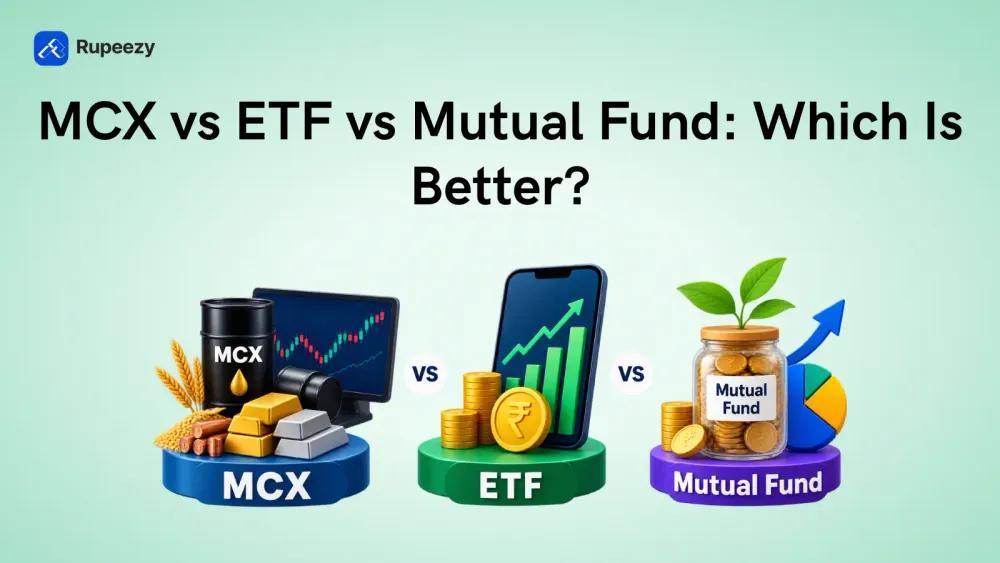
The main difference in MCX vs ETF vs mutual fund is how you participate in the market. MCX allows you to trade commodity derivatives. ETFs let you invest in an asset or index through exchange-listed units. The mutual funds give you access to a professionally managed portfolio.
All three are great options, but the risk and return capability of the same differ greatly. A mutual fund is the safest of all these and is considered suited for beginners as well. But that is not it. There is more that you should know.
Here is a detailed investment comparison to understand how each option works.
MCX vs ETF vs Mutual Fund: Key Differences
Basis | MCX | ETF | Mutual Fund |
What is it? | Commodity derivatives exchange | Exchange-traded investment fund | Pooled investment fund |
How do you participate? | Trade futures and options | Buy and sell ETF units | Invest through lump sum or SIP |
Main exposure | Commodities | Indices, commodities, sectors, bonds, etc. | Equity, debt, hybrid, gold, and other assets |
Trading | During exchange hours | During exchange hours | Transactions take place at applicable NAV |
Pricing | Market price of derivative contract | Live market price | NAV |
Leverage | Available in derivatives | Generally no | No |
Risk | High | Depends on underlying asset | Depends on fund category |
Diversification | Low when trading one commodity | Depends on ETF | Usually higher |
Demat account | Required for exchange trading | Required | Not compulsory for most mutual funds |
SIP | No | Possible through some brokers | Widely available |
Suitable for | Experienced traders | Self-directed investors | Beginners and long-term investors |
What Is MCX?
MCX is also know as Multi Commodity Exchange of India. It is an exchange where market participants trade commodity derivative contracts.
Under this, you do not directly buy the asset but still invest in it. Some of the major commodities traded on MCX include:
Gold
Silver
Crude oil
Natural gas
Copper
Zinc
Aluminium
Lead
MCX is mainly used for commodity trading, hedging, and speculation. Since derivatives involve margins and price movements can be sharp, trading on MCX requires proper knowledge and risk management.
For example, a trader expecting gold prices to rise may take a position in a gold futures contract. You will gain benefits when the prices move in sync with what you expect.
What Is an ETF?
An Exchange Traded Fund or ETF is an investment fund whose units are listed and traded on the stock exchange. These usually track some index or an underlying asset. Depending on the ETF, this could be the Nifty 50 or any other. Some of the common ones are the sectoral index, bonds, gold, silver, or an international index.
You can buy and sell the ETFs online during the market hours. One of the most common options here is the commodity ETF. It provides an easier route for investors who want exposure to certain commodities without directly trading futures or holding the physical asset. Gold ETFs and silver ETFs are common examples in India.
Investors interested in sector-focused ETFs can also explore different stock market sectors to understand the industries and sectors available for market exposure.
ETFs are generally preferred by investors who want passive exposure, relatively low costs, and the flexibility to trade units on an exchange.
What Is a Mutual Fund?
A mutual fund is a pool of money where the fund collected from many investors is invested in a basket of assets. The portfolio may include stocks, bonds, money market securities, gold-related instruments, or a combination of assets.
Common types include:
Equity funds
Debt funds
Hybrid funds
International funds
Mutual funds are particularly useful for investors who want professional management by fund managers. You can invest at once, which is called lumpsum investment. There is an option of SIP as well, where you invest a fixed amount every month.
MCX vs ETF: What Is the Difference?
The MCX vs ETF comparison becomes important when an investor wants exposure to commodities such as gold or silver.
MCX gives you exposure through derivative contracts, while an ETF allows you to invest through exchange-listed fund units.
Factor | MCX | ETF |
Approach | Trading | Investing |
Instrument | Futures and options | ETF units |
Leverage | Available | Generally not available |
Holding period | Usually short to medium term | Can be held long term |
Risk | Higher | Depends on underlying asset |
Margin requirement | Yes | No derivative margin |
Complexity | Higher | Relatively simple |
Suitable for | Active traders | Investors |
MCX may be useful for experienced traders who understand commodity prices, leverage, margins, and derivatives.
ETFs are simpler for investors who want exposure without actively managing derivative contracts.
ETF vs Mutual Fund: What Is the Difference?
The ETF vs mutual fund comparison is different because both are investment products.
The major difference is how they are bought, priced, and managed.
Factor | ETF | Mutual Fund |
Purchase | Through stock exchange | Through AMC, distributor, or investment platform |
Price | Changes throughout market hours | Applicable NAV |
Demat account | Required | Usually optional |
Management | Mostly passive | Active or passive |
SIP | Depends on platform | Easily available |
Expense ratio | Generally lower | Depends on scheme |
Trading flexibility | Higher | Lower |
Professional management | Limited in passive ETFs | Available in actively managed funds |
ETFs may suit investors who want low-cost and market-linked investing. Also, these are the people who are comfortable using a demat account.
Mutual funds may suit investors who prefer SIPs, professional management, and a wider choice of investment strategies.
Commodity ETF vs MCX: Which Is Better for Commodity Investing?
For commodity investing, the choice between MCX and a commodity ETF depends largely on whether your objective is trading or investing.
Suppose you want exposure to gold.
Through MCX, you can trade gold futures and options. Your position may involve margin requirements, expiry dates, and higher short-term volatility.
Through a gold ETF, you can simply purchase units and hold them in your demat account. There is no need to manage futures expiry or maintain derivative margins.
Therefore, a commodity ETF may be more suitable for investors seeking longer-term exposure. MCX may be more suitable for experienced traders seeking to trade short-term commodity price movements.
MCX vs ETF vs Mutual Fund: Risk Comparison
Risk differs considerably across these options.
MCX: Commodity derivatives can experience sharp price movements. Leverage can increase both profits and losses. Traders also need to manage margins and contract expiry.
ETF: Risk depends on the asset being tracked. An equity ETF carries equity market risk, while a gold ETF is affected by gold prices. ETFs can also have tracking error and liquidity risk.
Mutual Fund: Risk depends on the fund category. Equity funds generally carry higher market risk than debt funds, while hybrid funds spread investments across asset classes.
This makes it important to compare products within the same asset category rather than assuming one option is always safer.
MCX vs ETF vs Mutual Fund: Cost Comparison
Costs can affect your overall returns.
MCX traders may pay brokerage, exchange transaction charges, taxes, and other applicable charges on their trades. Frequent trading can increase overall transaction costs.
ETF investors generally pay brokerage and other exchange-related charges when buying or selling units. ETFs also have an expense ratio.
Mutual funds charge an expense ratio for managing the scheme. Some schemes may also charge an exit load when units are redeemed within a specified period.
Investors should compare the complete cost structure rather than looking at one charge alone.
MCX vs ETF vs Mutual Fund: Liquidity Comparison
Liquidity determines how easily you can enter or exit an investment.
MCX liquidity varies by commodity and contract. Popular contracts such as gold and crude oil may have active trading, while some contracts may see lower participation.
ETF liquidity depends on trading volumes and the liquidity of the underlying securities. Low-volume ETFs may have wider bid-ask spreads.
Mutual fund units are generally purchased or redeemed with the fund house at the applicable NAV, subject to the scheme's rules.
MCX vs ETF vs Mutual Fund: Which Should You Choose?
Your choice should depend on your objective rather than which option appears to offer the highest returns.
If You Want To | Option to Consider |
Actively trade commodities | MCX |
Trade commodity futures and options | MCX |
Invest passively in an index | ETF |
Get gold or silver exposure without physical ownership | Commodity ETF |
Invest regularly through SIP | Mutual Fund |
Get professional fund management | Mutual Fund |
Build a diversified long-term portfolio | Mutual Fund |
Buy and sell fund units during market hours | ETF |
MCX can suit traders with knowledge of commodity derivatives and risk management.
ETFs can suit investors who want low-cost and direct market exposure without selecting individual securities.
Mutual funds can suit investors who want diversification, SIPs, professional management, and a more hands-off investment approach.
Investors who want to follow how the broader market is moving can also use live market updates to track current Nifty, Sensex, and sector-wise trends while evaluating market-linked investments.
Conclusion
The MCX vs ETF vs mutual fund comparison comes down to your purpose. MCX is mainly designed for active commodity derivatives trading, ETFs provide a simple way to invest in an index or asset, and mutual funds offer professionally managed and diversified portfolios. For commodity investing, MCX may suit experienced traders, while a commodity ETF can be simpler for long-term investors. Compare your risk tolerance, investment horizon, costs, and financial goals before choosing.
Either way, you can invest in these with Rupeezy, where you will get guidance, support, and the right tools to plan better.
FAQs
1. What is the main difference between MCX, ETF, and mutual fund?
MCX is an exchange for commodity derivatives trading. ETFs are exchange-listed investment funds, while mutual funds pool investor money into professionally managed portfolios.
2. Which is better, MCX or ETF?
In an MCX vs ETF comparison, MCX may suit experienced commodity traders, while ETFs may suit investors looking for simpler, longer-term market or commodity exposure.
3. Is a commodity ETF suitable for beginners?
A commodity ETF can be easier for beginners to understand than commodity futures because it does not require managing derivative margins or contract expiry.
4. What is the main difference between ETF and mutual fund?
In ETF vs mutual fund, ETFs trade throughout market hours at market prices, while mutual fund transactions take place at the applicable NAV. Mutual funds also offer easier access to SIPs.
5. Can mutual funds invest in commodities?
Mutual funds can provide commodity-related exposure through permitted instruments and schemes, such as gold funds. Investors should check the scheme's investment objective and portfolio before investing.
Surbhi Bapna is a finance content writer at Rupeezy with more than six years of experience in the finance industry. She holds an MBA degree in Finance from the International Institute of Professional Studies. Surbhi is passionate about integrating finance into people’s daily lives through informative content. She brings in-depth expertise in stocks, personal finance, mutual funds, banking, and investments. Her experience, analytical insights, and commitment to financial research significantly contribute to Rupeezy's comprehensive financial content.
Did you like this blog?
Be the first to like this blog.
Investments in securities market are subject to market risks, read all the related documents carefully before investing . Rupeezy (SEBI RA Registration: INH000013332) provides this content for informational purposes; any securities quoted are for educational display and not as a recommendation. All charts and graphs are based on independent research and reliable sources for the period mentioned within the specific data set. Sometimes we take graphs from external sources. This communication does not promise or assure any fixed, guaranteed, or indicative returns to any client. For our complete registered office address, Member ID, and full SEBI registration details, please refer to our official website.
The content on this blog is for educational purposes only and should not be considered investment advice. While we strive for accuracy, some information may contain errors or delays in updates.
Mentions of stocks or investment products are solely for informational purposes and do not constitute recommendations. Investors should conduct their own research before making any decisions.
Investing in financial markets are subject to market risks, and past performance does not guarantee future results. It is advisable to consult a qualified financial professional, review official documents, and verify information independently before making investment decisions.
All Category