
Open a Free Demat Account !
₹0 AMC & Account Opening Fee
Shipbuilding in India: Can It Ever Catch China?

 Last Updated: 09 October, 2026
 7 min read





00:00 / 00:00


Summary
|
A Very Large Cheque
Every year, India writes a very large cheque to companies abroad. About $75 billion goes to foreign shipping lines for carrying goods across the sea. That is the estimate of a former senior official of the ports and shipping ministry.
The reason is simple. India owns few ships. The head of the Shipping Corporation of India says ships under foreign flags carry about 94% of India’s overseas cargo.
India now wants more of that money to stay at home. The plan starts with one big step: build the ships in India.
Who Builds the World’s Ships?
Before asking if India can do it, look at who does it today.
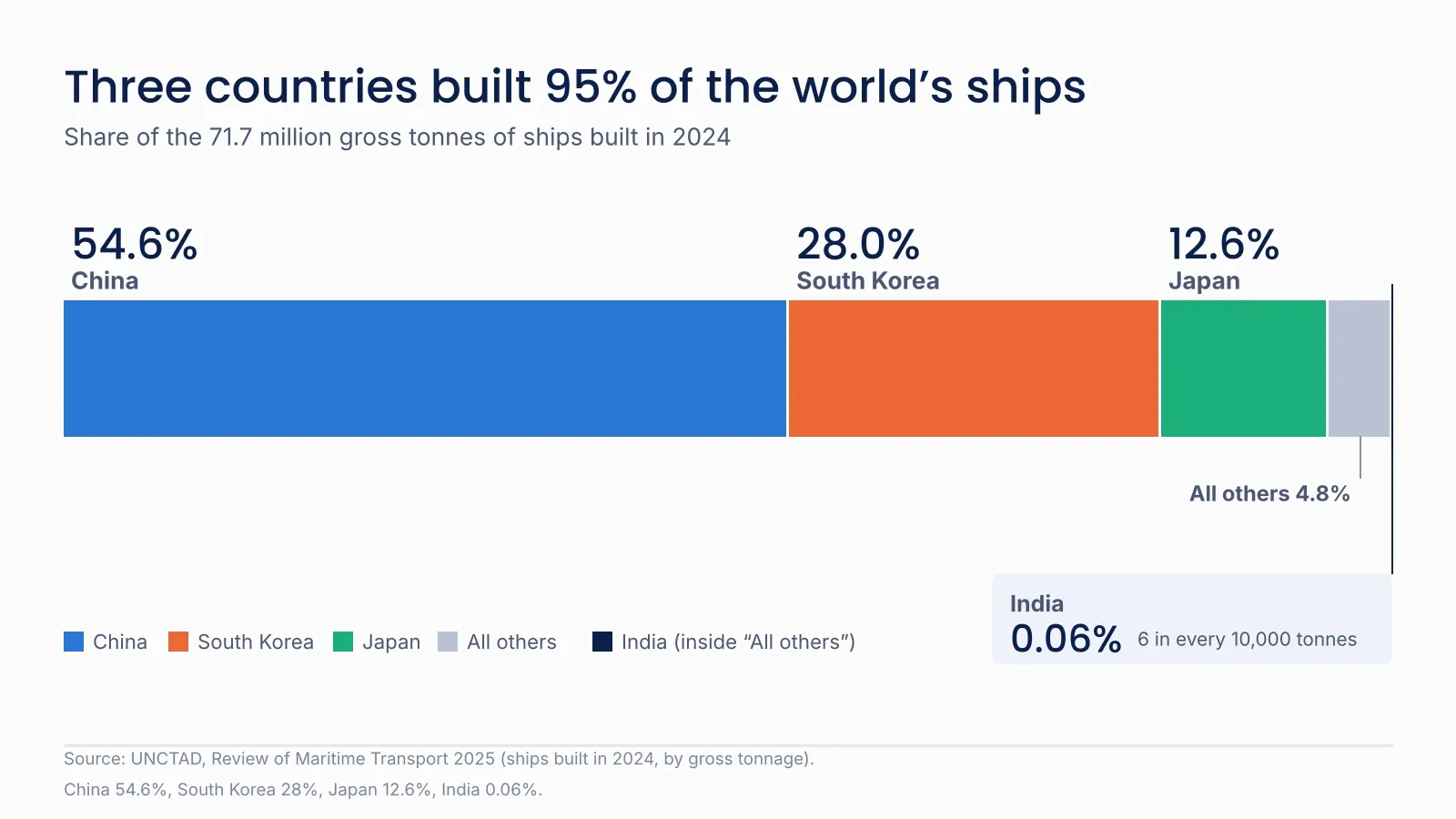
In 2024, yards across the world built 71.7 million gross tonnes of ships. A gross tonne is just a way to measure a ship’s size. UNCTAD, the United Nations trade body, counted who built them. China built 54.6%. South Korea built 28%. Japan built 12.6%.
Add those up and three countries built about 95% of the world’s ships. Everyone else shared the last 5%. India’s share was 0.06%.
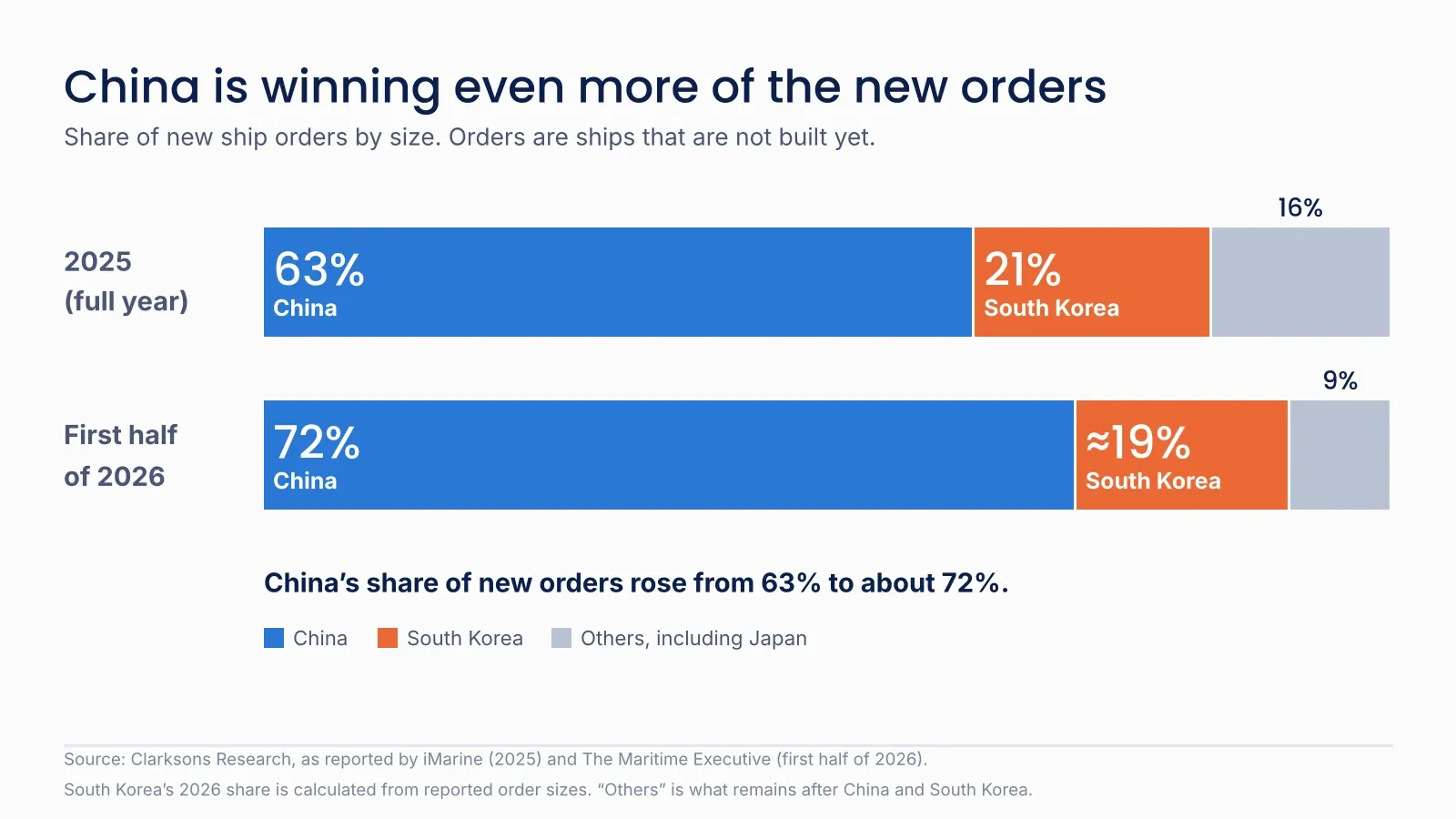
The lead is growing, too. Look at new orders, meaning ships not yet built. China won about 63% of them in 2025 and about 72% in the first half of 2026, according to Clarksons, a shipping research firm. South Korea’s share was about 21% in 2025 and about 19% in early 2026.
How the Crown Kept Moving
Shipbuilding did not always belong to Asia. For many years, Europe led it. Then the centre moved to Japan, then to South Korea, and finally to China.
The reason is cost. Making ships needs big yards, skilled workers, steel, machines, many suppliers and a lot of money. When wages and production costs rose in the older shipbuilding countries, places with lower costs, bigger factories and strong supplier networks gained the edge.
Japan built that edge first. South Korea followed. China is now the world’s largest shipbuilding hub. India wants to follow the same path.
Why India, and Why Now?
India already has some of the pieces: a long coastline, busy ports, a strong steel industry and a large engineering base. What is missing is the link between them, which is big, competitive shipyards.
In September 2025, the government approved a Rs. 69,725 crore package. It has three parts. Rs. 24,736 crore helps shipbuilders pay for new ships. Rs. 25,000 crore goes into a fund for long-term loans. Rs. 19,989 crore builds capacity, including new shipbuilding clusters.
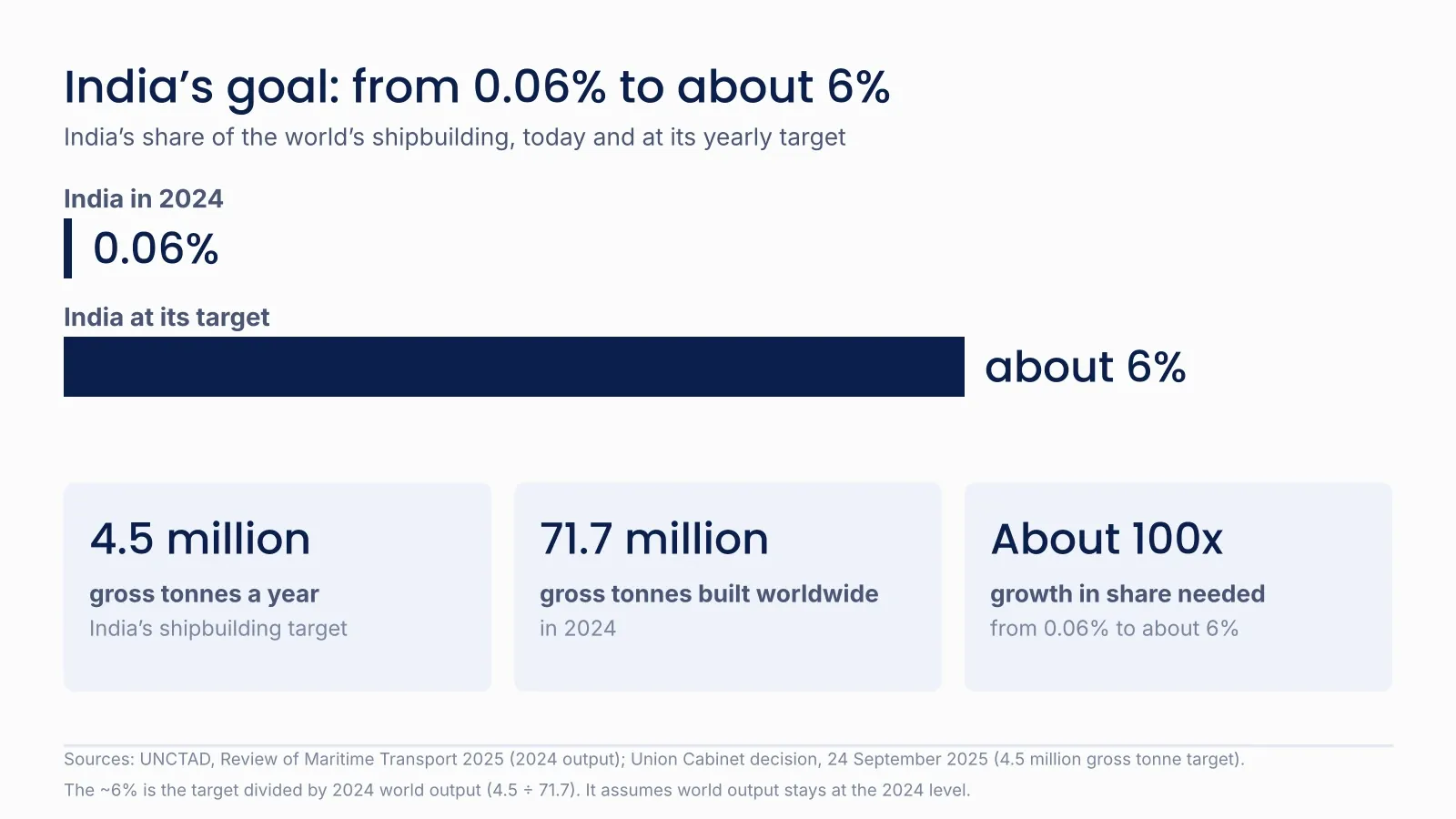
The goal is to build 4.5 million gross tonnes of ships a year. Compared with the world’s 2024 output, that is about 6%. India’s share in 2024 was 0.06%, so the goal is roughly 100 times today’s share.
Who Will Buy the Ships?
A shipyard with no customers is an empty shed. So the government is also working on demand.
A new rule gives first pick to ships built, flagged and owned in India when government and state-run companies hire ships. Government agencies are also pooling their future needs into a plan for more than 400 vessels, so yards can see orders ahead of time.
Experts say results will take time. Most Indian owners buy second-hand foreign ships, and Indian yards have not recently built tankers, gas carriers or bulk carriers.
Help From South Korea
Large commercial ships need skills and experience that Indian yards are still building. This is where South Korea comes in.
HD Hyundai plans a shipyard at Thoothukudi in Tamil Nadu. It would build about 2.5 million gross tonnes a year, and the investment is estimated at about $4 billion. That one yard would cover more than half of India’s 4.5 million target. It is still in the planning stage. An agreement with Tamil Nadu partners was signed in April 2026, and detailed studies are under way.
Samsung Heavy Industries has taken a lighter path. It has not announced a yard of its own. In September 2025 it signed an agreement with Swan Defence and Heavy Industries, whose yard is at Pipavav in Gujarat. The two will work together on ship designs, production methods and local sourcing, for ships such as tankers, gas carriers and container ships.
This matters because India does not have to invent every skill from zero. It can learn from firms that have done this for decades.
Indian Companies Join In
Mazagon Dock is known for warships and submarines. The market for civilian ships is much bigger, so it is looking there too. In September 2026 it signed agreements to lead new shipyard clusters at Dighi in Maharashtra and Dugarajapatnam in Andhra Pradesh. It plans to invest about Rs. 15,000 crore in each, and each yard is planned for about 1.2 million gross tonnes a year.
A big yard also needs steel, machinery and electrical equipment. That gives small local suppliers new work.
News needs a careful read, too. On 9 October 2026, Cochin Shipyard said reports of “40 new orders” had misread a minister’s remark. Those orders were already in its books.
The Hard Part
China has big yards, deep supplier networks, a skilled workforce and customers all over the world. To close the gap, India must build ships at a competitive price, deliver them on time and meet international standards.
Most of the new yards are still agreements and plans. A shipyard takes years to build. If India succeeds, much of the money it now sends abroad could stay in the country. Nobody can say yet whether it will.
What to Watch Next
Whether Thoothukudi, Dighi and Dugarajapatnam move from agreements to construction.
Whether Indian owners place new orders with Indian yards.
Whether India’s share of global shipbuilding rises above 0.06% in UNCTAD’s next report.
Frequently Asked Questions
Which country builds the most ships?
China. In 2024 it built 54.6% of the world’s ships by gross tonnes, ahead of South Korea at 28% and Japan at 12.6%, according to UNCTAD.
What is India’s share of global shipbuilding?
India built 0.06% of the world’s ships in 2024, according to UNCTAD. Its target of 4.5 million gross tonnes a year would be about 6% of that year’s world output.
Why does India want to build more ships?
India pays about $75 billion a year to foreign shipping lines, and foreign-flagged ships carry about 94% of its overseas cargo. Building ships at home could keep more of that money in India.
How much money has the government set aside for shipbuilding?
The Union Cabinet approved Rs. 69,725 crore in September 2025. It covers help for shipbuilders, a Rs. 25,000 crore maritime fund and new shipbuilding clusters.
Which companies plan new shipyards in India?
HD Hyundai plans a yard at Thoothukudi, and Mazagon Dock plans yards at Dighi and Dugarajapatnam. Samsung Heavy Industries has a design and production partnership with Swan Defence. All are at the agreement or planning stage.
Sources
UNCTAD, Review of Maritime Transport 2025 (shipbuilding shares, 2024)
Union Cabinet decision, 24 September 2025 (Rs. 69,725 crore package)
Shipping Corporation of India chairman, Marex, October 2025 (foreign-flag share of cargo)
iMarine on Clarksons data, 2025 orders and The Maritime Executive on Clarksons data, first half of 2026
India Sea Trade News, HD Hyundai Thoothukudi, The Week, Mazagon Dock and Swan Defence and Samsung press release (NSE)
This article is for information only. It is not a recommendation to buy or sell any stock. Figures are from the sources above and may change.

Santhosh is a Research Analyst at Rupeezy who transforms complex market data into actionable insights for investors. With five years of financial industry experience and an MBA in Finance from Jain University, he specializes in evaluating stock market dynamics, mutual fund performance, and ETF trends. Driven by a deep passion for business analysis, Santhosh focuses heavily on company fundamentals to help readers make informed, data-backed financial decisions.
Did you like this blog?
Be the first to like this blog.
The content on this blog is for educational purposes only and should not be considered investment advice. While we strive for accuracy, some information may contain errors or delays in updates.
Mentions of stocks or investment products are solely for informational purposes and do not constitute recommendations. Investors should conduct their own research before making any decisions.
Investing in financial markets are subject to market risks, and past performance does not guarantee future results. It is advisable to consult a qualified financial professional, review official documents, and verify information independently before making investment decisions.







All Category