
Open a Free Demat Account !
₹0 AMC & Account Opening Fee
Jio Platforms IPO Review: Is the Jio IPO Good or Bad?

 Last Updated: 14 October, 2026
 12 min read




00:00 / 00:00


Quick summary
| ||
Is the Jio Platforms IPO good or bad? Going by the filing, it is a large, profitable and still-growing business, with Rs. 70,781 crore of borrowings and a close rival. The honest answer on the IPO itself has to wait for the price, which has not been set. Until then, this article shows what the company's own papers say.
We read the company's Draft Red Herring Prospectus (DRHP), dated 19 June 2026, and the telecom regulator's latest customer data. Every number below comes from the DRHP or TRAI unless we name another source. If the document is new to you, our guide to the red herring prospectus explains what each part tells you. For the timeline and background of the issue, see our Reliance Jio IPO explainer.
Investments in the securities market are subject to market risks. Read all the related documents carefully before investing. This article is for education and is not investment advice.

Jio Platforms IPO Details
Here is what is known today and what is not. The DRHP is a draft, so the price, dates and issue size are blank in it.
Detail | Jio Platforms IPO |
Issue type | Fresh issue of up to 27,00,00,000 new equity shares of face value Rs. 10 each (DRHP) |
Offer for sale | None. No existing shareholder is selling (DRHP) |
Open date | 21 October 2026 as per media reports. The official date is yet to be announced |
Price band | Not announced. It will be in the RHP |
Issue size in rupees | Not final. It depends on the price band |
Valuation | Not finalised. Media estimates differ, and the company has not confirmed any of them |
Lot size and minimum investment | Not announced |
Listing | BSE and NSE. The listing date will follow the allotment schedule |
Media reports, citing Bloomberg, mention a price band of Rs. 1,065 to Rs. 1,119 and a valuation near Rs. 10.3 lakh crore. The company has not confirmed either number, so please treat them as unverified. We will update this page after the RHP is filed.
What Does Jio Platforms Do?
Jio Platforms runs Reliance Jio, India's biggest mobile network by customers. The DRHP presents it as one digital services business, and most of its work is in India.
For everyday users: mobile and home internet, entertainment, cloud gaming, smart home devices and AI assistants.
For businesses: internet lines, cloud services, IoT, managed Wi-Fi, private 5G, security and AI tools.
Jio Market Share: How Far Ahead Is Jio of Airtel?
The telecom regulator TRAI published customer numbers for the end of August 2026. Out of 129.34 crore mobile customers, Jio had 50.84 crore and Airtel had 49.16 crore.
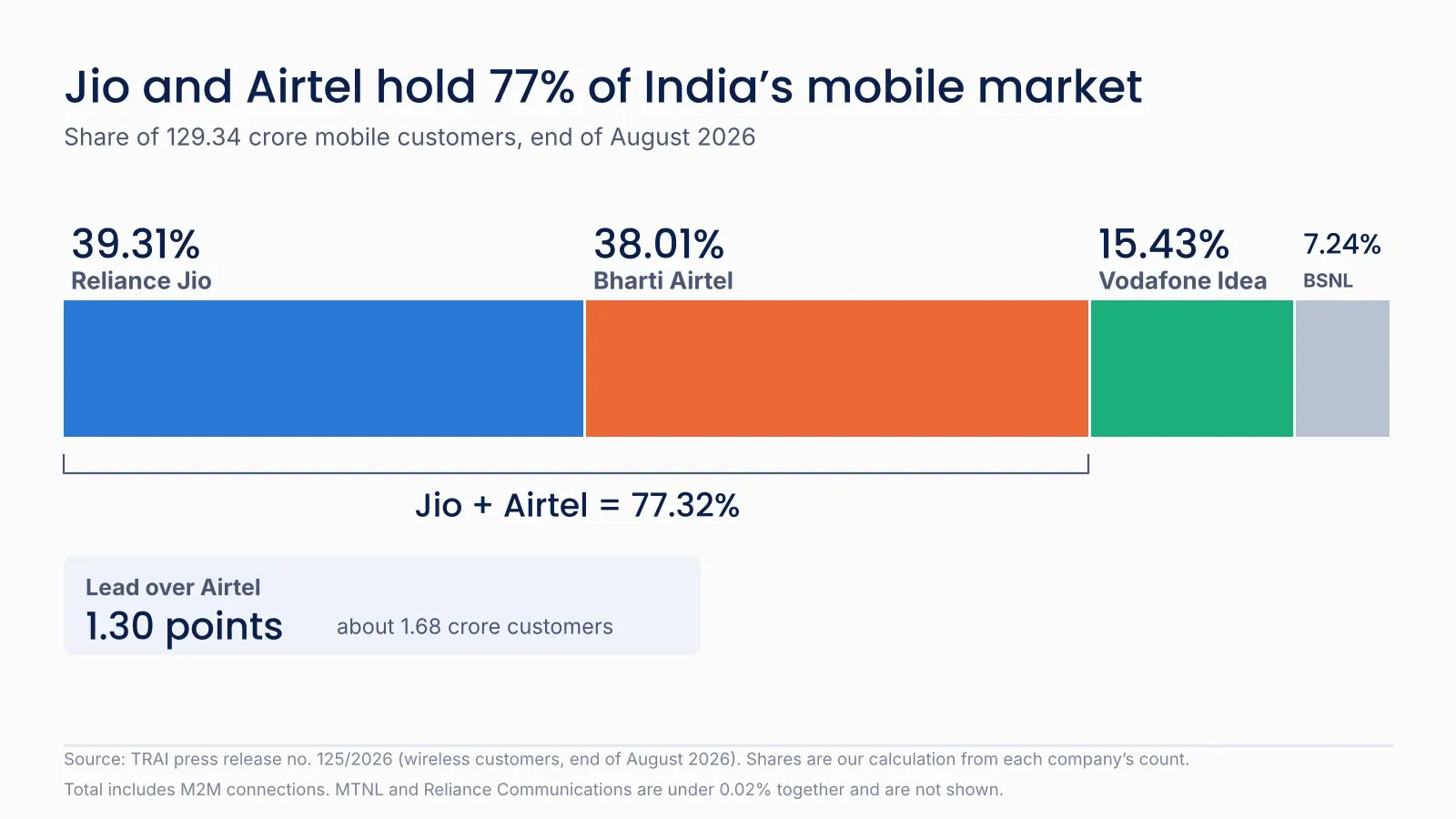
India's mobile market share, end of August 2026. Source: TRAI press release no. 125/2026; shares are our calculation.
Jio and Airtel together hold about 77% of the market. Jio leads Airtel by only 1.30 points, which is about 1.68 crore customers. Vodafone Idea has 15.43% and BSNL has 7.24%.
Company | Customers | Share | Added in August |
Reliance Jio | 50.84 crore | 39.31% | 24.0 lakh |
Bharti Airtel | 49.16 crore | 38.01% | 21.1 lakh |
Vodafone Idea | 19.96 crore | 15.43% | 5.1 lakh |
BSNL | 9.37 crore | 7.24% | 4.9 lakh |
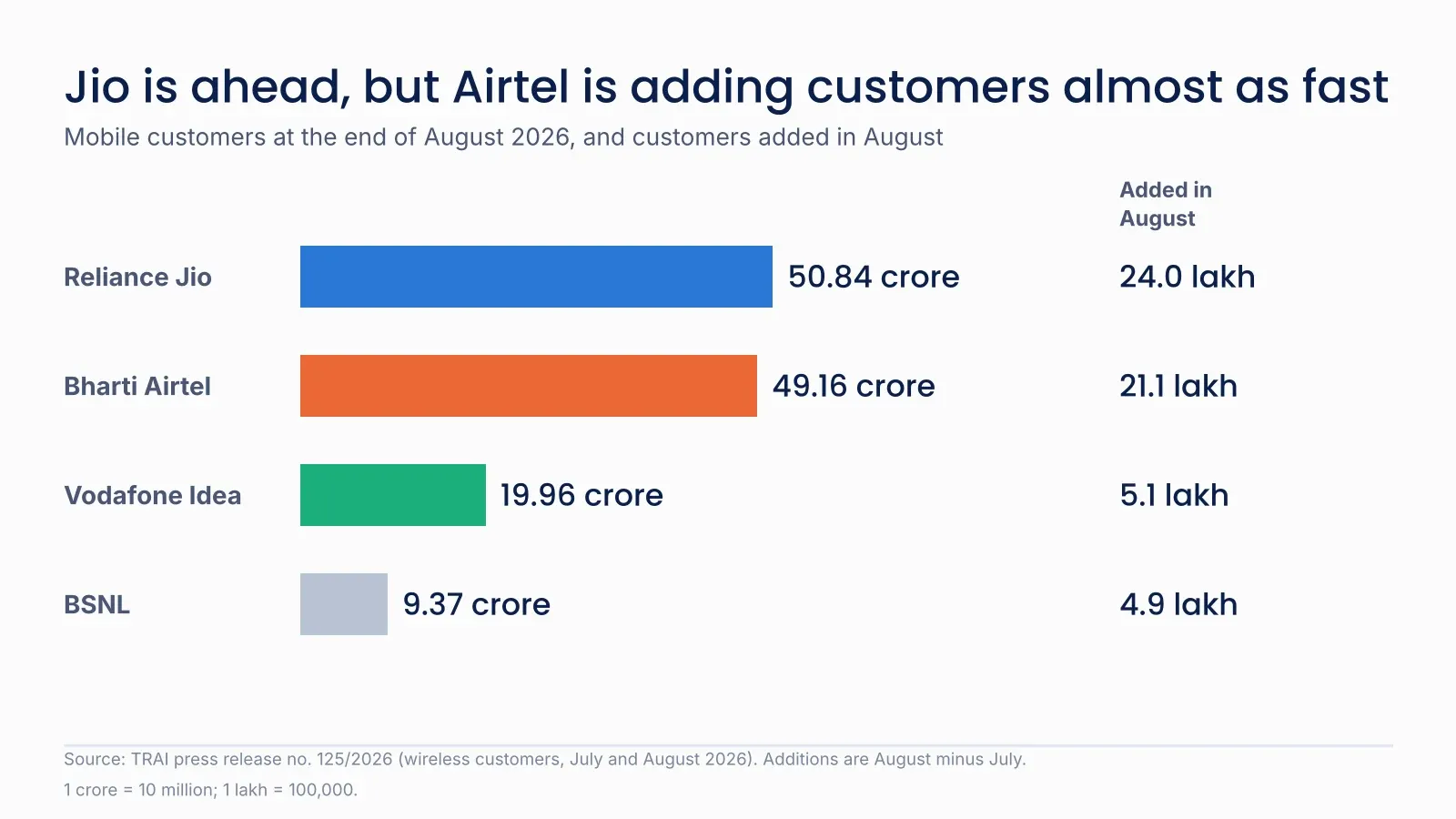
Mobile customers at the end of August 2026, and customers added during August. Source: TRAI press release no. 125/2026.
Jio added the most customers in August, but Airtel added about 88% as many. The lead is real, yet it is not wide. TRAI's customer count includes machine-to-machine connections, and the shares are our calculation from each company's number.

Jio Platforms Financial Analysis
The DRHP gives three years of numbers. All figures are in Rs. crore, converted from the DRHP's Rs. million figures.
Item (Rs. crore) | FY24 | FY25 | FY26 |
Revenue from operations | 1,09,558 | 1,28,218 | 1,46,885 |
Operating profit before interest, tax and depreciation (EBITDA) | 54,959 | 64,170 | 76,255 |
EBITDA margin | 50.16% | 50.05% | 51.91% |
Profit after tax | 21,423 | 26,109 | 30,049 |
Net worth | 2,77,866 | 3,04,022 | 3,34,013 |
Total borrowings | 54,349 | 73,060 | 70,781 |
Profit per share (basic, Rs.) | 23.96 | 29.21 | 33.63 |
Return on average net worth | 8.02% | 8.97% | 9.42% |
Return on average capital employed | 12.83% | 12.50% | 10.76% |
Net leverage (times) | 0.88 | 0.71 | 0.36 |
Growth is steady, not explosive. In FY26, revenue grew about 14.6% and profit about 15.1%. In FY25, they grew about 17.0% and 21.9%.
Margins are very high. About Rs. 52 of every Rs. 100 of revenue was left as operating profit in FY26.
Debt is down from FY25. Borrowings fell from Rs. 73,060 crore to Rs. 70,781 crore. The DRHP's net leverage measure, which compares debt after cash with earnings, fell from 0.88 times to 0.36 times in two years.
Returns are modest. Return on average net worth is 9.42% because Jio holds a very large pile of assets. Return on capital employed slipped from 12.83% to 10.76%.
What the DRHP Says About Jio's Customers
These are Reliance Jio Infocomm's numbers, the main Jio subsidiary, from the DRHP's key performance table.
Measure | FY24 | FY25 | FY26 |
Total customers | 48.18 crore | 48.82 crore | 52.44 crore |
Average revenue per customer a month, last quarter (Rs.) | 181.7 | 206.2 | 214.0 |
Data used (billion GB) | 148.5 | 184.5 | 241.4 |
Data used per customer a month, last quarter (GB) | 28.7 | 33.6 | 42.3 |
Customers leaving each month, last quarter | 1.52% | 1.81% | 1.67% |
More data, more money per customer. Average revenue per customer rose from Rs. 181.7 to Rs. 214.0 in two years, and data use per customer rose from 28.7 GB to 42.3 GB.
Customers leave every month. The DRHP shows 1.67% leaving each month in FY26. On 52.44 crore customers, that is roughly 88 lakh people a month. This is our calculation, and some of them are replaced by new customers.
Do not mix the numbers. The DRHP's 52.44 crore customers (as at the end of FY26) and TRAI's 50.84 crore mobile customers (August 2026) are different counts on different dates.
The average revenue per customer is the DRHP's own measure for Reliance Jio Infocomm. Other companies work theirs out differently, so do not compare it with a rival's figure.
Who Owns Jio Platforms Today?
Owner | Share before the IPO |
Reliance Industries Limited (promoter) | 66.43% |
Jaadhu Holdings LLC (Meta group) | 9.98% |
Google International LLC | 7.73% |
Public Investment Fund | 2.31% |
Omicron Asia Holdings II (KKR group) | 2.31% |
VEPF VII AIV I (Vista group) | 2.31% |
Because the issue has only new shares, the money goes into the company. Reliance's share will fall once the new shares are issued. The DRHP also has a part of the issue for eligible Reliance Industries shareholders and eligible employees. The exact split by investor type is in the final prospectus.
Objects of the Jio Platforms IPO
The DRHP gives two uses for the money:
Repay some borrowings of Reliance Jio Infocomm Limited. For scale, Jio Platforms' total borrowings were Rs. 70,781 crore at the end of FY26. The risk section puts fund-based borrowings of the company and its subsidiaries at Rs. 71,529 crore. How much will go to repayment is not given yet.
General corporate purposes.
Both amounts are blank in the DRHP because the issue size is not set. Please check the RHP for the split before you apply.
Strengths of Jio Platforms
Largest customer base in India: 52.44 crore customers at the end of FY26, and the top share of mobile customers in August 2026.
High margins for three years: EBITDA margin stayed at about 50% or more from FY24 to FY26.
Customers use more data: 42.3 GB a month per customer in FY26, against 28.7 GB in FY24.
Debt is lighter against earnings: net leverage of 0.36 times, down from 0.88 times.
Large global investors on the register: Meta, Google, PIF, KKR and Vista hold shares before the IPO.
Risks of Jio Platforms IPO
The DRHP lists many risks. These are the ones that matter most, with what the numbers show.
Risk | What the numbers show |
Customers leaving | 1.52% a month in FY24, 1.81% in FY25 and 1.67% in FY26 (DRHP) |
Airtel is close | Jio's lead over Airtel is 1.30 points, and Airtel added 21.1 lakh customers in August against Jio's 24.0 lakh (TRAI) |
Uneven customer growth | Total customers rose by 0.64 crore in FY25 and by 3.62 crore in FY26 (DRHP) |
Borrowings | Rs. 70,781 crore at the end of FY26, up from Rs. 54,349 crore in FY24. Some loan terms need lenders' consent for certain moves |
Heavy spending | Cash spent on investing was Rs. 56,588 crore in FY24, Rs. 63,726 crore in FY25 and Rs. 43,591 crore in FY26 |
Licences and airwaves | A licence that is not renewed, or airwaves (spectrum) that are not won, can hurt the business |
Link with the Reliance Group | Jio works closely with its parent and group companies, and shares the Jio brand |
Rule changes | TRAI and the Department of Telecommunications can change rules, fees or licence terms |
First-time listing | There is no trading history, so the market price after listing can differ from the issue price |
Where a risk has no number, the DRHP summary does not give one, and we have not made one up.
Is Jio Platforms IPO Good or Bad?
Neither label fits yet. The business looks strong, and the price is not known. Here is the case on both sides.
What the numbers support | What still needs proof |
Revenue and profit grew about 15% in FY26 on a very large base | The price band and the valuation are not out, so the value for money is unknown |
Operating margins have stayed above 50% for three years | Return on net worth is only 9.42%, and return on capital employed has slipped |
Debt compared with earnings has fallen sharply | Borrowings are still Rs. 70,781 crore |
Largest share of mobile customers in India | Airtel is only 1.30 points behind and adds customers nearly as fast |
Customers use more data and pay more each month | 1.67% of customers leave every month |
How to Judge the Price When It Comes
When the price band is announced, divide the price by FY26 profit per share of Rs. 33.63 to get a rough price-to-earnings ratio. That profit per share is based on shares before the IPO, so it will change after the new shares are added. Our guide to the price to earnings ratio shows how to read the result. A great company can still be a costly IPO.
Questions to Settle Before You Bid
What is the final price band, and how many times its yearly profit is that price?
How much of the money goes to repaying borrowings, and how much to general needs?
Do you want to hold this for years, or are you chasing a quick listing gain? They need different risk appetites.
How big a part of your savings would this one IPO be, and can you accept a loss?
Have you read the risk factors in the final prospectus yourself, not only summaries?
You will see grey market premium (GMP) numbers quoted for this IPO. We do not use them. GMP is an unofficial sentiment signal, and our explainer on what grey market premium means shows why it can mislead.
How to Apply for Jio Platforms IPO on Rupeezy
Rupeezy is a stockbroker and earns from other services if you become a client. That has no bearing on the analysis above. The Jio Platforms IPO will show on the Rupeezy IPO page only after the company confirms its dates.
Open a demat account. Open a demat account with Rupeezy and finish the online KYC.
Keep a UPI ID ready. It must be linked to the bank account that holds your funds.
Go to the IPO section. Log in, open the IPO page and select Jio Platforms once the issue opens.
Choose your bid. Pick the number of lots and a price within the band, or bid at the cut-off price.
Approve the UPI mandate. The amount is blocked in your account, not debited, until shares are allotted.
Track allotment. Check it on the Rupeezy IPO allotment status page once the allotment date is announced.
New to this? Our guide to applying for an IPO online covers the process in more detail.
Frequently Asked Questions
Is the Jio Platforms IPO good or bad?
The DRHP shows a very large, profitable business with falling debt relative to earnings. Whether the IPO is a good buy depends on the price, which is not final yet. Compare the final price band with FY26 profit per share of Rs. 33.63 before you decide.
When does the Jio Platforms IPO open?
Media reports say the IPO opens on 21 October 2026. The company has not officially announced the date yet. We will update this page when the RHP is filed.
What is the Jio IPO valuation?
The valuation is not finalised. It will depend on the final price band, which the company has not announced. Media numbers are estimates, not company statements.
Is the Jio Platforms IPO a fresh issue or an offer for sale?
It is a fresh issue of up to 27 crore new shares of Rs. 10 face value each. No existing shareholder is selling, so all the money goes to the company.
What will Jio do with the IPO money?
The DRHP lists two uses: repaying some borrowings of its subsidiary Reliance Jio Infocomm Limited, and general corporate purposes. The amount for each is not given yet.
How much profit does Jio Platforms make?
In FY26, Jio Platforms made a profit after tax of Rs. 30,049 crore on revenue of Rs. 1,46,885 crore, according to the DRHP. That is up from Rs. 26,109 crore in FY25.
Sources
Jio Platforms Limited, Draft Red Herring Prospectus (June 2026): abridged DRHP on the SEBI website and the full DRHP on the company website. Source for the issue structure, shareholding, financials, customer measures and objects of the issue.
TRAI press release no. 125/2026, telecom subscription data for August 2026. Market shares are our calculation.
Media reports on the open date, price band and valuation: NewsBytes, 9 October 2026 (citing Bloomberg) and The Sunday Guardian, 10 October 2026. These are not official announcements.
All data is as of 14 October 2026. Dates, price and valuation are subject to the final prospectus. Figures in Rs. crore are converted from the DRHP's Rs. million figures and rounded. Growth rates, market shares and the monthly customers-leaving estimate are our calculations.

Santhosh is a Research Analyst at Rupeezy who transforms complex market data into actionable insights for investors. With five years of financial industry experience and an MBA in Finance from Jain University, he specializes in evaluating stock market dynamics, mutual fund performance, and ETF trends. Driven by a deep passion for business analysis, Santhosh focuses heavily on company fundamentals to help readers make informed, data-backed financial decisions.
Did you like this blog?
Be the first to like this blog.
The content on this blog is for educational purposes only and should not be considered investment advice. While we strive for accuracy, some information may contain errors or delays in updates.
Mentions of stocks or investment products are solely for informational purposes and do not constitute recommendations. Investors should conduct their own research before making any decisions.
Investing in financial markets are subject to market risks, and past performance does not guarantee future results. It is advisable to consult a qualified financial professional, review official documents, and verify information independently before making investment decisions.



All Category