

Open a Free Demat Account !
₹0 AMC & Account Opening Fee
Is E85 Fuel Cheaper Than Petrol?
 Last Updated: 25 August, 2026
 5 min read




00:00 / 00:00


Summary
|
A fuel that costs less than petrol sounds like a win, but is it really that simple?
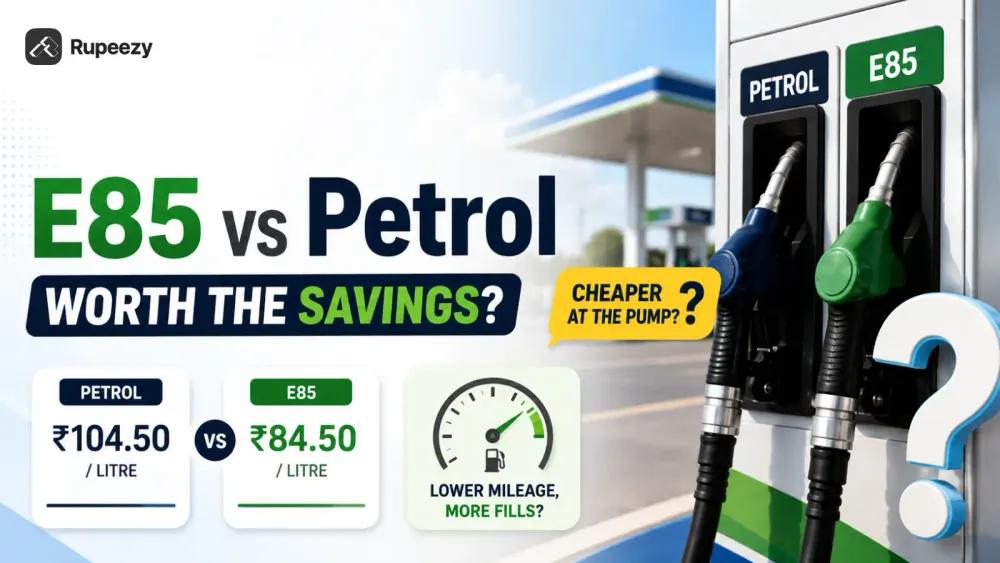
That is exactly the promise being made by E85 fuel, India's latest ethanol-based fuel blend. With E85 priced at around Rs 82 per liter in Delhi, nearly Rs 20 cheaper than regular petrol, it sounds like an easy way to save money.
But there is a catch.
Many drivers are now asking whether the lower price actually translates into lower running costs. If E85 burns faster and delivers lower mileage, does the discount really matter?
As India expands its ethanol blending programme and rolls out more E85 fuel stations, understanding the true cost of this fuel has become more important than ever.


What is E85 Fuel?
The name E85 refers to a fuel blend that contains approximately 85% ethanol and 15% petrol.
Ethanol is a biofuel produced from crops such as sugarcane, maize, and rice. Unlike conventional petrol, it is renewable and can be produced domestically, reducing dependence on imported crude oil.
However, E85 fuel is not meant for regular petrol vehicles. It can only be used in specially designed flex fuel vehicles that are engineered to handle higher ethanol concentrations.
Why Is E85 Fuel Cheaper Than Petrol?
The government has introduced E85 fuel at a lower price to encourage adoption and compensate users for ethanol's lower energy content.
At launch, E85 was priced at approximately Rs 82.12 per liter, making it nearly Rs 20 cheaper than conventional petrol.
The larger goal goes beyond consumer savings. Higher ethanol blending can help:
Reduce crude oil imports
Save foreign exchange
Support Indian farmers
Promote domestically produced fuel
This is one of the key reasons ethanol blending in India has become a major policy focus in recent years.
Why Does E85 Fuel Offer Lower Mileage Than Petrol?
This is where the E85 vs petrol debate becomes interesting.
E85 has a lower energy density than petrol. This means each litre of fuel delivers less energy, which can lead to higher fuel consumption and lower mileage.
Industry studies and automotive experts suggest that vehicles running on E85 may experience:
Fuel Type | Fuel Efficiency |
|---|---|
Petrol | Higher |
E85 Fuel | 20-30% Lower (approx.) |
In simple terms, you may spend less money while filling the tank, but you may also visit the fuel station more frequently.
That means the real question is not
How much does E85 cost?
Instead, it is:
How much does it cost to drive one kilometer?

What Are The Benefits Of E85 Fuel?
Despite concerns about mileage, E85 fuel offers several advantages.
Reduced Dependence On Oil Imports
India imports a significant portion of its crude oil requirements. Greater use of ethanol fuel can reduce this dependence and improve energy security.
Support For Farmers
Ethanol production creates additional demand for agricultural feedstocks, generating new income opportunities for farmers.
Cleaner Combustion
Ethanol burns cleaner than conventional petrol and can help reduce certain vehicle emissions.
High Octane Rating
Ethanol has a high octane rating, which can improve engine performance in flex fuel vehicles designed specifically for E85.
Does E85 Fuel Production Use Too Much Water?
One of the biggest criticisms of ethanol fuel production is water consumption.
You may have heard claims that producing one liter of ethanol requires around 10,000 liters of water. While this figure is often quoted, the reality is more complex.
Water usage in ethanol production depends largely on the crop used to produce the fuel. Various reports estimate:
Rice-based ethanol can require around 10,790 liters of water per liter of ethanol.
Maize-based ethanol may require around 4,670 liters.
Sugarcane-based ethanol typically requires significantly less, with estimates ranging around 3,630 liters.
The concern is not just the amount of water used, but where the crops are grown.
Water-intensive farming in already water-stressed regions remains a major challenge for the long-term growth of ethanol fuel production.
What Is Next For E85 Fuel In India?
India has already achieved significant progress in ethanol blending. The rollout of E85 fuel marks the next phase of this strategy.
The government plans to expand E85 fuel stations across the country. The rollout began with 48 retail outlets and is expected to reach around 500 outlets by the end of 2026. The network could further expand to nearly 5,000 outlets by the end of 2027.
Automobile manufacturers are also responding to this shift. Companies such as Hero Motocorp, and Maruti Suzuki have already introduced or announced flex fuel vehicles capable of running on higher ethanol blends.
Investors tracking automobile companies benefiting from the shift toward flex-fuel vehicles can also evaluate eligible MTF Stocks. Before using margin, investors should consider the stock's eligibility, liquidity, applicable interest costs, and market risks.
As investors track automobile companies benefiting from the shift toward flex-fuel vehicles, a stock market performance heatmap can help compare sector and stock performance and identify broader market trends.
Conclusion
E85 fuel offers a compelling promise: lower fuel prices, reduced oil imports, and greater support for India's agricultural economy.
However, the lower price at the pump does not automatically mean lower running costs. Reduced fuel efficiency, vehicle compatibility requirements, and concerns around water usage remain important factors to consider.
For now, E85 fuel is best viewed as an alternative fuel option rather than a complete replacement for petrol. As more flex fuel vehicles and fuel stations become available, their true impact on consumers and the environment will become clearer.
The real question is no longer whether E85 fuel is cheaper than petrol, it is whether the savings are enough to outweigh the trade-offs.
Did you like this blog?
1 person liked this blog.
The content on this blog is for educational purposes only and should not be considered investment advice. While we strive for accuracy, some information may contain errors or delays in updates.
Mentions of stocks or investment products are solely for informational purposes and do not constitute recommendations. Investors should conduct their own research before making any decisions.
Investing in financial markets are subject to market risks, and past performance does not guarantee future results. It is advisable to consult a qualified financial professional, review official documents, and verify information independently before making investment decisions.





All Category