
Open a Free Demat Account !
₹0 AMC & Account Opening Fee
What is Goal-Based Investing: How to Achieve Your Financial Goals by Investing With Purpose
 Last Updated: 31 July, 2026
 9 min read




00:00 / 00:00


Every investor I've ever spoken with has the same starting point: a number in a mutual fund statement that doesn't mean much on its own. It's only when that number gets attached to something real — your daughter's college fees, the down payment on your first home, the retirement you actually want to enjoy — that investing stops feeling like a chore and starts feeling like progress. That's the entire idea behind goal-based investing, and it's the reason we built a calculator for it. In this guide, I'll walk you through what goal-based investing means, how the maths behind it actually works, and how you can set up your own plan today.

What is goal-based investing?
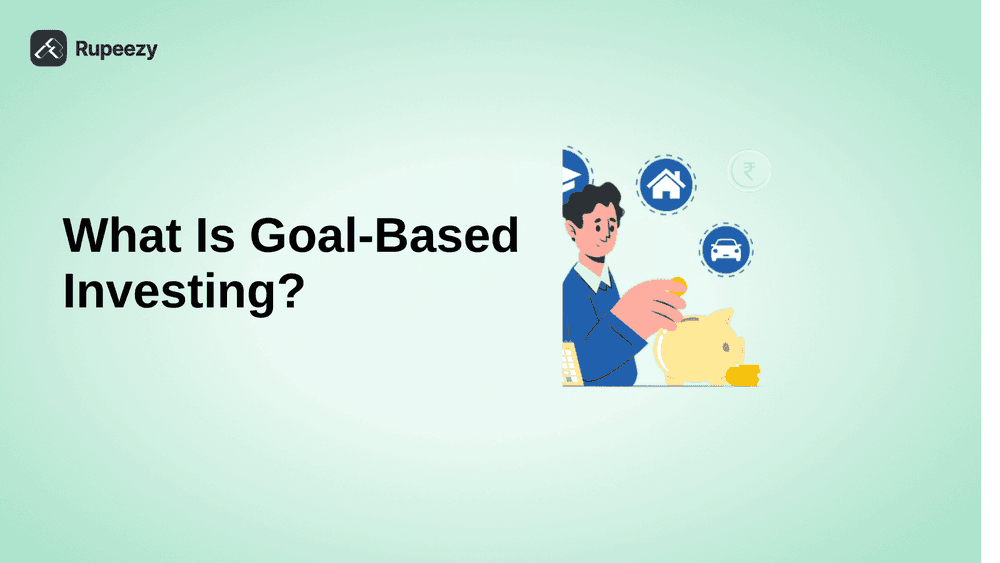
Goal-based investing is an approach where you invest for a specific, named outcome — with a fixed amount and a fixed timeline — instead of investing generically and hoping it adds up to "enough" someday. Every rupee you put in is tagged to a purpose: a house, a wedding, your child's education, your retirement. The Association of Mutual Funds in India (AMFI) describes this approach as one of the most effective ways to bring discipline into SIP investing, precisely because it replaces a vague question ("Am I saving enough?") with a specific one ("Do I have Rs. 30 lakh by 2041?").
You can think of it as the difference between wandering in a general direction and following a route with a destination pinned on the map. Both involve movement. Only one tells you if you're going to arrive on time.
Why goal-based investing works better than investing on autopilot
Most people who invest without a goal do one of two things: they either invest too little because there's no target to measure against, or they panic-sell during a market dip because there's no long-term anchor holding them steady. Goal-based investing fixes both problems at once.
- It gives your risk-taking a purpose. A goal 20 years away can absorb more equity risk than a goal 2 years away — so your money mix is decided by your timeline, not by market noise or a friend's stock tip.
- It makes "enough" measurable. Instead of guessing, you know exactly how much monthly SIP gets you to your number, so you can course-correct early instead of discovering a shortfall at the finish line.
- It keeps you invested when markets get volatile. When your SIP is tied to your child's education 12 years from now, a bad quarter in the market matters a lot less than it would if you were investing with no end point in sight.
- It reflects where Indian regulation is heading. SEBI's newer mutual fund framework — including lifecycle-style funds — has been built specifically to support goal-based, horizon-linked investing, which tells you this isn't a fringe idea; it's becoming the industry standard.
How goal-based investing works: the four-step framework
Strip away the jargon and goal-based investing comes down to four decisions, in this order.
1. Name the goal and put a number on it
"Retirement" isn't a goal you can plan for. "Rs. 2 crore by the time I turn 60" is. Be specific about the amount in today's terms, and if the goal is far away, account for inflation — a car that costs Rs. 10 lakh today will cost meaningfully more in 10 years.
2. Fix the time horizon
How many years or months do you have? This single number decides almost everything else — the instruments you can safely use, and how much risk you can afford to take.
3. Match the goal to the right kind of fund
This is where most first-time investors go wrong: they use the same fund for a 2-year goal and a 20-year goal. Your time horizon should decide your asset mix, not your mood.
| Time horizon | Typical goal examples | Where it usually makes sense to invest |
|---|---|---|
| Under 3 years | Vacation, gadget, emergency fund top-up | Debt funds, short-duration funds, fixed deposits |
| 3–7 years | Car, wedding, home down payment | Hybrid or balanced funds, a mix of debt and equity |
| 7+ years | Child's education, retirement, long-term wealth creation | Equity-oriented mutual funds, index funds |
This is illustrative, not investment advice — your own risk appetite and financial situation should decide your actual asset mix.
4. Automate the SIP and review, don't abandon
Once the amount, timeline, and fund mix are set, the discipline comes from automation — a fixed SIP date every month removes the decision fatigue of "should I invest this month." Review the goal once or twice a year, top it up if you're falling behind, and resist the urge to redeem it early for an unrelated expense.

What the numbers actually look like
Numbers make this concrete, so here's what a monthly SIP looks like for four common goals, assuming you start today. These are illustrative calculations based on standard compounding — actual returns will vary, and mutual fund returns are never guaranteed.
| Goal | Target amount | Time horizon | Assumed return | Monthly SIP needed | You invest | Estimated gain |
|---|---|---|---|---|---|---|
| Child's higher education | Rs. 30,00,000 | 15 years | 12% p.a. | Rs. 5,946 | Rs. 10,70,205 | Rs. 19,29,795 |
| Retirement corpus | Rs. 2,00,00,000 | 25 years | 12% p.a. | Rs. 10,539 | Rs. 31,61,830 | Rs. 1,68,38,170 |
| Home down payment | Rs. 15,00,000 | 5 years | 10% p.a. | Rs. 19,210 | Rs. 11,52,629 | Rs. 3,47,371 |
| Dream wedding | Rs. 10,00,000 | 7 years | 11% p.a. | Rs. 7,884 | Rs. 6,62,214 | Rs. 3,37,786 |
Look at the retirement row for a second. The gap between what you invest (Rs. 31.6 lakh) and what you end up with (Rs. 2 crore) is almost entirely the result of time and compounding — not of picking a "hot" fund. That's the real argument for starting a goal-based SIP now rather than waiting for the "right" market moment. We've written a deeper explainer on how compounding actually works in a SIP if you want to see the mechanics.
How to start goal-based investing on Rupeezy
We built the Goal-Based Investment tool on Rupeezy so you don't have to run these calculations by hand. Here's what it does:
- Pick a goal category — Home, Vacation, Gadgets, Car, Education, Wedding, or a Custom goal of your own.
- Enter your target amount and completion timeline, and add a lump sum today if you have one to put in.
- The tool shows you the exact monthly SIP required, along with a suggested mutual fund basket matched to your goal — options like Safe Path, Steady Move, Growth Booster, or Reach Faster, depending on how much risk you're comfortable taking.
- You get a year-by-year growth projection so you can see your corpus build up against your total investment, not just a single end number.
- There's no extra cost for using Goals, no lock-in period, you can top up anytime, and you can track up to 5 goals at once.
If you haven't tried it yet, it's worth five minutes: open the Goal-Based Investment calculator and run the numbers on whatever you're saving for right now.
Once you know what to invest in, the next step is picking the fund itself — our guide on the different types of mutual funds in India is a good place to understand your options, and if you're setting up your first SIP, this step-by-step guide to investing in a SIP covers the process end to end.
Mistakes that quietly derail goal-based investing
- Ignoring inflation. A goal amount fixed in today's rupees without adjusting for future inflation will fall short. Build in a buffer, especially for goals more than 10 years away.
- Using one fund for every goal. A 2-year goal and a 20-year goal have almost nothing in common. Mixing them into the same investment means one of the two is mismatched with the wrong risk level.
- Redeeming early for something unrelated. The whole point of tagging a SIP to a goal is that it stops being "spare money." Dipping into your child's education fund for a vacation defeats the purpose.
- Never reviewing. Income changes, goals change, markets move. A goal you set three years ago deserves a check-in, not a "set and forget."
- Waiting for a lump sum instead of starting small. Our own numbers above show that a modest, consistent SIP started today usually beats waiting to invest a larger amount later — the years you wait are the years compounding needed the most.
Frequently asked questions
Does goal-based investing on Rupeezy cost anything extra?
No. There's no additional fee for using the Goals feature — it runs on top of your regular mutual fund investments.
Is there a lock-in period for a goal?
No. You can redeem any part of your investment, whether it's tagged to a goal or not, at any time — though redeeming early usually works against the goal you set it up for.
Can I invest more than my planned SIP for a goal?
Yes. You can top up a goal at any time to reach it faster than originally planned.
What happens if I change my SIP amount midway?
You can change or cancel your SIP anytime, but it's generally not advisable — doing so changes your goal's fund mix and can throw off your original timeline.
How many goals can I track at once?
You can run up to 5 active goals at the same time, each with its own timeline, target amount, and suggested fund basket.
The bottom line
Goal-based investing isn't a trick or a product feature — it's a reframing. Instead of asking "how do I invest," you ask "what am I investing for," and every decision after that — the amount, the fund, the timeline — falls out of that one answer. If you've been investing without a clear destination, this is a good week to change that. Set up your first goal on Rupeezy and see exactly what it takes to get there.
Mutual fund investments are subject to market risk. Read all scheme-related documents carefully. The calculations and return assumptions in this article are illustrative projections only and not investment advice — actual returns are not guaranteed and will vary with market conditions.
Written by
Rupeezy TeamDid you like this blog?
Be the first to like this blog.
The content on this blog is for educational purposes only and should not be considered investment advice. While we strive for accuracy, some information may contain errors or delays in updates.
Mentions of stocks or investment products are solely for informational purposes and do not constitute recommendations. Investors should conduct their own research before making any decisions.
Investing in financial markets are subject to market risks, and past performance does not guarantee future results. It is advisable to consult a qualified financial professional, review official documents, and verify information independently before making investment decisions.





All Category