
Top Solar Power Countries in the World

 Last Updated: 12 June, 2026
 7 min read




00:00 / 00:00


Summary
China continues to lead global solar energy growth, accounting for the largest share of solar capacity additions and generation worldwide.
The United States, European Union, and India recorded strong solar expansion, with solar increasingly meeting new electricity demand.
India achieved record solar installations in 2025, while the EU saw wind and solar generation surpass fossil fuels for the first time.
Brazil and Japan continued to strengthen their solar sectors, with solar playing a growing role in their electricity mix.
Falling costs, supportive policies, and investments in energy storage are expected to drive further solar adoption across major economies.

Top Solar Power Countries in the World : Who’s Leading the Solar Race?
Solar energy has become one of the fastest-growing sources of electricity worldwide, helping countries reduce dependence on fossil fuels, improve energy security, and achieve climate goals. Advances in solar technology, falling installation costs, and supportive government policies have accelerated solar adoption across both developed and emerging economies.
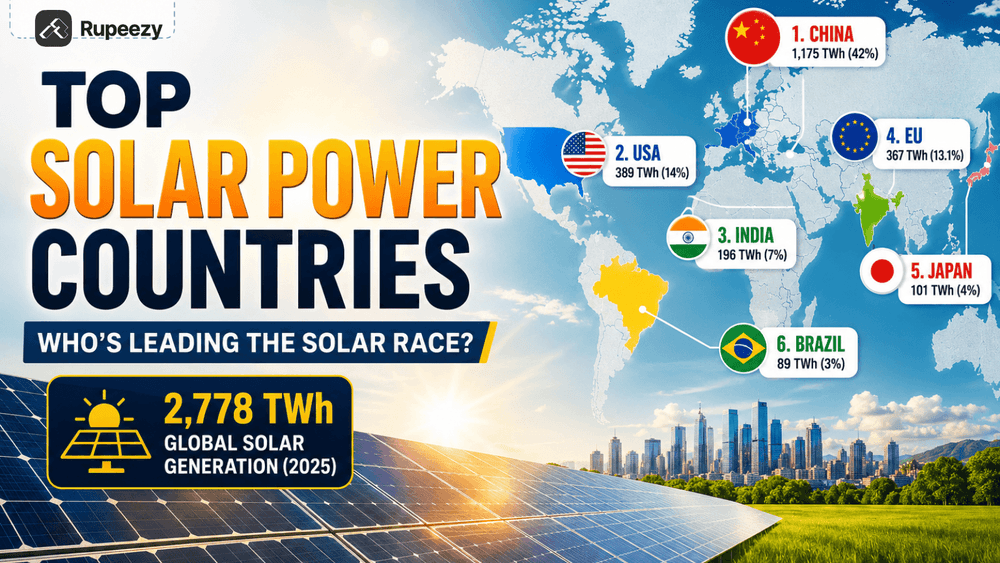
Country | Electricity Generated (TWh) | Share of Global Generation (%) |
China | 1,175 | 42% |
United States | 389 | 14% |
India | 196 | 7% |
Japan | 101 | 4% |
Germany | 90 | 3% |
Brazil | 89 | 3% |
Spain | 63 | 2% |
Others | 675 | 24% |
Total Global | 2,778 | 100% |
Today, several countries are leading the global solar transition through large-scale capacity additions, rising electricity generation, and increasing contributions to national power demand. This article explores the top solar generation countries and examines how solar energy is shaping their electricity mix and clean energy future.
Top solar generation countries
China
Installed Solar Capacity (2025): 378 GW of new solar capacity was added in 2025, accounting for 58% of global solar installations.
Solar Generation (2025): 1,175 TWh, up 40% (+336 TWh) from the previous year. China contributed more than half of the global increase in solar generation for the third consecutive year.
Role in Electricity Demand: Solar power supplied approximately 11% of China's total electricity demand (10,573 TWh) in 2025 and accounted for around 67% of the country's additional electricity demand growth during the year.
China's solar sector continues to expand at an unprecedented pace, supported by large-scale deployments and strong policy support. With solar generation growing at an average annual rate of 35% over the last five years, the country is expected to remain the driving force behind global solar energy growth.
United States
Solar Generation (2025): Solar generation increased by 85 TWh (+28%) in 2025, making it the second-largest increase globally. Solar's share of US electricity generation reached 8.6%, up 1.7 percentage points from the previous year.
Role in Electricity Demand: US electricity demand grew by 131 TWh (+3%) in 2025. Solar alone met 65% of this demand growth, while wind and solar together accounted for 74% of the increase in electricity demand.
Energy Storage and Grid Development: Battery Energy Storage System (BESS) installations exceeded 57 GWh in 2025, a 29% year-on-year increase. California expanded its battery storage capacity to 17 GW, while Texas surpassed 15 GW, supporting greater integration of solar power into the grid.
Strong growth in data centres and rising electricity demand are expected to drive further renewable energy expansion. Despite policy shifts favouring fossil fuel development, solar continues to gain market share and remains a key contributor to the US clean energy transition.
European Union (EU)
Annual Solar Additions (2025): The EU added over 65 GW of new solar capacity in 2025, with installations nearly equally split between utility-scale solar farms and rooftop systems.
Solar Generation (2025): Solar generation reached 367 TWh, increasing by 60 TWh (+20%) from the previous year. Solar output has more than doubled since 2021, rising from 163 TWh to 367 TWh.
Role in Electricity Demand: Solar supplied 13.1% of EU electricity generation in 2025, significantly above the global average of 8.7% and ahead of both the US (8.6%) and China (11.1%). Combined wind and solar generation accounted for 30% of total EU electricity generation, exceeding fossil fuel generation for the first time.
Rapid solar deployment continues to drive the EU's clean energy transition. Supported by both utility-scale and rooftop installations, solar has become one of the fastest-growing electricity sources in the region and is playing a key role in reducing dependence on fossil fuels and lowering emissions.
India
Annual Solar Additions (2025): India added a record 38 GW (AC) of solar capacity in 2025, a 54% increase from 2024. For the first time, the country installed more solar capacity than the United States.
Solar Generation (2025): Solar generation reached 196 TWh, increasing by 53 TWh (+37%), the third-largest increase globally. Solar output has more than doubled since 2022, rising from 96 TWh to 196 TWh.
Role in Electricity Demand: Solar accounted for 9.4% of India's electricity generation in 2025, up from 5.3% in 2022. Renewable generation grew by 98 TWh, twice the increase in electricity demand, helping reduce coal generation by 44 TWh (-2.9%).
Solar has become India's largest source of clean electricity, overtaking hydropower for the first time. With over 250 GW of renewable capacity installed and a target of 500 GW of non-fossil energy capacity by 2030, India is expected to remain one of the world's fastest-growing solar markets.For those interested in the investment side of the sector, our guide on Best Solar Energy Stocks in India explores companies that could benefit from the country's clean energy transition.
Russia
Solar and Wind Contribution (2025): Solar and wind remained minimally developed in Russia, accounting for less than 1% of total electricity generation. Neither solar nor wind generation recorded any significant growth in 2025.
Clean Energy Generation (2025): Clean power contributed 36% of Russia's electricity mix, primarily from nuclear (18%) and hydropower (17%), while fossil fuels continued to dominate generation at 64%.
Role in Electricity Demand: Russia's electricity demand declined by 17 TWh (-1.4%) in 2025, largely due to unusually warm winter temperatures. The reduction in demand led to lower fossil fuel generation, particularly gas-fired power.
Russia has yet to meaningfully participate in the global renewable energy transition. With no growth in solar or wind generation in 2025 and no recent renewable energy auctions since 2021, clean energy expansion remains limited compared to major markets such as China, the EU, and India.
Japan
Solar Generation (2025): Solar generation increased by 4.4 TWh (+4.5%) in 2025, with solar accounting for 9.8% of Japan's electricity mix, nearly triple its share of 3.4% in 2015.
Role in Electricity Demand: Japan's electricity demand grew by 13.4 TWh (+1.3%) in 2025. Clean generation increased by 18.3 TWh, more than meeting the rise in demand, with solar contributing significantly to this growth.
Renewable Energy Development: While Japan is the world's fourth-largest solar generator, wind power remains underdeveloped, contributing only 1.3% of electricity generation despite the country's strong offshore wind potential.
Japan continues to expand its solar capacity as part of its energy transition and energy security strategy. With heavy reliance on imported coal and gas, further growth in solar and offshore wind is expected to reduce fossil fuel dependence and support long-term decarbonization goals.
Brazil
Annual Solar Additions (2025): Brazil added 10 GW (AC) of solar capacity in 2025, reinforcing its position as one of the world's leading solar markets.
Solar Generation (2025): Solar generation reached 89 TWh, increasing by 17 TWh (+24%) from the previous year. Brazil recorded the world's fourth-largest increase in solar generation in 2025.
Role in Electricity Demand: Solar generation surpassed fossil fuel generation for the first time in 2025. Solar's share of the electricity mix rose from 2.6% in 2021 to 11.8% in 2025, while wind and solar together accounted for 27% of total electricity generation.
Brazil's solar sector continues to grow rapidly as the country diversifies beyond hydropower. With abundant solar resources and increasing renewable investments, solar is expected to play a larger role in enhancing energy security and supporting Brazil's low-carbon electricity system.
Conclusion
The rapid growth of solar energy is transforming electricity systems around the world. Countries such as China, the United States, the European Union, India, Japan, and Brazil are demonstrating how solar power can meet rising electricity demand while reducing reliance on fossil fuels. As installation costs continue to decline and energy storage technologies improve, solar power is expected to play an even greater role in the global energy transition. The continued expansion of solar generation will be crucial for enhancing energy security, reducing emissions, and building a more sustainable electricity future.

Written by
Kusuma BSKusuma is a Financial Content Writer with over 4 years of experience creating high-quality, research-driven content on stocks, mutual funds, IPOs, personal finance, and investment strategies. She specializes in simplifying complex financial concepts into clear, engaging, and SEO-friendly content that helps readers make informed financial decisions. Her expertise includes writing educational guides, market insights, investment explainers, and fintech content tailored for both beginners and experienced investors. With a strong focus on accuracy, readability, and user intent, Kusuma is passionate about making finance accessible to everyone while delivering content that meets the highest editorial standards.
Did you like this blog?
Be the first to like this blog.
The content on this blog is for educational purposes only and should not be considered investment advice. While we strive for accuracy, some information may contain errors or delays in updates.
Mentions of stocks or investment products are solely for informational purposes and do not constitute recommendations. Investors should conduct their own research before making any decisions.
Investing in financial markets are subject to market risks, and past performance does not guarantee future results. It is advisable to consult a qualified financial professional, review official documents, and verify information independently before making investment decisions.
Open Rupeezy account now. It is free and 100% secure.
Start Stock Investment





All Category