
Open a Free Demat Account !
₹0 AMC & Account Opening Fee
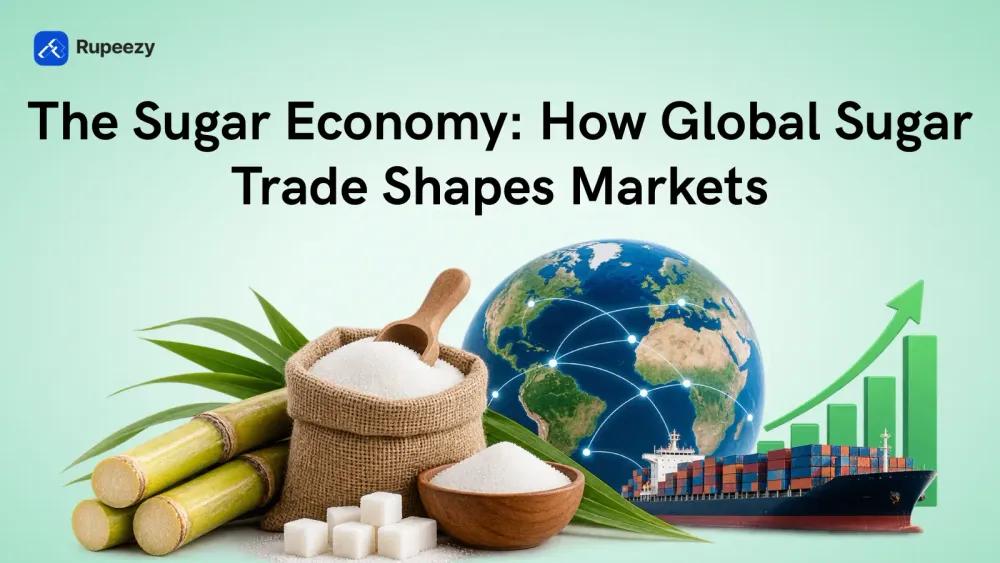
The Sugar Economy: How Global Sugar Trade Shapes Markets

 Last Updated: 17 September, 2026
 9 min read




00:00 / 00:00


Key Highlights
|
Sugar is one of the key products in households. But if you check the sugar economy, it has recently been affected by ethanol. The use of ethanol as fuel is a key influencer which has led to a rise in the price of sugar. At the same time, ethanol stocks are seeing a wide surge.
This piece walks through how sugar actually gets priced globally, why India's crop matters so much, and how all of that ends up showing up on your stock screener.

What Is the Sugar Economy, Really?
At its simplest, the sugar economy is the whole chain that runs from a farmer's cane field to the packet on your kitchen shelf, and increasingly, to the ethanol tank of a car. Growing, crushing, refining, trading, exporting, blending into fuel; it's all one connected system now, which is part of why the sector has gotten more interesting to track.
Two things make sugar different from most other farm commodities.
One, it's grown by a relatively small number of large producing countries, so a bad monsoon in one place can move prices everywhere.
Two, a growing share of cane doesn't even become sugar anymore. It gets converted into ethanol instead, which means fuel policy and sugar policy are now tangled together in a way they weren't a decade ago.
How Global Sugar Prices Actually Move
Sugar prices had a rough start to 2026. The benchmark ICE No.11 contract sank to around 14 cents a pound, a level not seen in about five years, mostly because Brazil, Thailand and India were all expected to harvest bumper crops at the same time. Too much supply, not enough reason for prices to hold up.
That changed through the middle of the year. By early September, sugar was trading closer to 18 cents a pound, up close to 20% in just a month and about 16% higher than a year earlier. Weather worries around Brazil's Center-South belt, tighter-than-expected Indian ethanol diversion numbers, and a weaker surplus estimate all played a part.
This back-and-forth is basically the whole game. Global production sits somewhere around 185 million tonnes a year, and even a small miss on any big producer's crop is enough to swing prices double digits.
Country | 2026/27 Output (est.) | Why It Matters |
Brazil | 42.5 million tonnes | The world's largest producer, and its crop size usually decides which way prices move. |
India | 33.6 million tonnes | Second-largest producer, with a big enough domestic market that exports rise and fall with local supply. |
Thailand | 9.5 million tonnes | Southeast Asia's main exporter, sensitive to monsoon and irrigation conditions each season. |
European Union | 14.4 million tonnes | Produces mostly from sugar beet, largely for its own market. |
China | 12.7 million tonnes | Growing output, but still a large net importer overall. |
Source: The information here is taken from the report published.
India's Place in the Sugar Economy
India is the world's second-biggest sugar producer, and honestly, one of the more complicated ones to predict. Output for the 2026/27 season is expected to land around 33.6 million tonnes, but the real number that traders watch closely is how much cane mills choose to send toward ethanol instead of sugar.
A few things are worth knowing about how this works on the ground:
The government sets a Fair and Remunerative Price (FRP) for cane every year. This means that the farmers know the floor price before they even plant. For 2025/26, that was raised to Rs. 3,550 per tonne.
Mills can divert cane juice or B-heavy molasses to ethanol production. This is possible even when they wish to do so instead of crystallising it into sugar. It pulls supply out of the sugar market and into the fuel tank.
Export policy changes almost every season. When domestic stocks look comfortable, the government opens up exports; when prices at home start climbing, exports usually get restricted again.
Ending stocks for the current marketing year are projected at around 6.5 million tonnes, noticeably higher than last year, which gives mills a bit more room to manoeuvre.
Sugar Prices and Sugar Company Stocks
This is the part most investors actually care about. Sugar company stocks tend to track two things closely: what sugar sells for, and how much of a mill's output is going into ethanol, which usually carries better margins than plain sugar these days.
You can see this play out almost in real time. Just this week, most of the companies in the sugar production have seen fluctuations.
None of that happened because demand for sugar suddenly exploded. It happened because sugar company stocks are unusually sensitive to policy chatter, government pricing signals, and export headlines, often more than to the actual sugar price itself on any given day.
Investors can also explore different stock market sectors to compare sugar-related businesses with other industry sectors and understand broader sector trends.
Company | Share Price (Rs.) | Market Cap (Rs. Cr) |
711.55 | 15,002.26 | |
777.70 | 13,596.70 | |
276.10 | 5,925.21 | |
447.80 | 3,645.91 | |
25.15 | 5,370.18 | |
22.77 | 5,405.30 | |
127.52 | 836.48 |
Note: Prices and market caps above are recent snapshots and will have moved by the time you're reading this. Always check live data before acting on it. The data is as of 8 September 2026.
Sugar Stocks Investment Outlook
So, where does that leave anyone actually thinking about buying in? The sugar stocks investment outlook right now is mixed, leaning cautiously positive. But all this really depends on which lever you're betting on.
Ethanol economics: Companies with a bigger share of ethanol-linked revenue tend to have steadier margins. This is because ethanol pricing is more predictable than open-market sugar prices.
Global price cycle: The recent bounce off five-year lows helps, but if Brazil's next crop comes in large, prices could soften again.
Government policy: MSP hikes, export quotas and FRP changes can move stock prices faster than actual earnings do. It cuts both ways for investors.
Balance sheet quality: Sugar has historically been a debt-heavy and cyclical business. The companies that have cleaned up their balance sheets tend to handle downturns better.
None of this means the sugar stocks investment outlook is a straightforward buy signal. It's more than the setup has improved from where it was a year ago, and the sector rewards people who track policy news closely rather than those who buy and forget. For investors looking to build exposure to sugar stocks over the long term, a stock SIP can provide a disciplined way to invest a fixed amount regularly rather than relying on short-term sector movements.
Sugarcane Economy Trends Worth Watching
Zoom out from stock prices for a second and the broader sugarcane economy trends tell an interesting story on their own.
Ethanol blending keeps climbing, and India's push toward higher blending targets means less cane ends up as sugar over time, structurally.
Water use is becoming a bigger political issue. Sugarcane is thirsty, and states are starting to rethink how much acreage they can sustainably dedicate to it.
Yield improvements matter more than acreage now. A lot of the recent output growth has come from better cane varieties and irrigation, not just planting more land.
Climate variability, especially uneven monsoons and heat waves during the crushing season, is becoming a bigger swing factor for year-to-year output than it used to be.
These sugarcane economy trends don't move fast enough to trade on a day-to-day basis, but they shape where the whole sector is headed over the next five to ten years, and they're worth keeping half an eye on if you're holding these stocks for the long run.
Risks to Keep in Mind
A large Brazilian crop next season could push global prices back down quickly, since Brazil alone accounts for close to a quarter of world output.
Indian export and MSP policy can change with little warning, which makes near-term price forecasting genuinely difficult.
Ethanol economics depend partly on crude oil prices and government procurement rates, both of which are outside any single company's control.
Sugar stocks have a history of sharp rallies followed by equally sharp corrections once the policy news cycle cools off.
Conclusion
The sugar economy isn't just about what you pay for a kilo at the store. It's a tangle of weather, farm policy, fuel targets and global trade flows, and that tangle is exactly why sugar stocks can move so sharply on what looks like small news. If you're tracking this sector, watch the crop numbers out of Brazil and India, keep an eye on ethanol diversion data, and don't assume a rally in the stock means the underlying business has actually gotten better overnight.
With Rupeezy, you can track sugar stocks, follow sector news, and invest through a single platform. Open a Demat and trading account with Rupeezy to get started.
FAQs
1. What is the sugar economy?
It's the full chain around sugar production and trade. This covers cane farming, milling, refining, export markets and increasingly ethanol production, since a growing share of cane now goes toward fuel rather than sugar.
2. Why did global sugar prices rise in 2026?
Prices bounced off a five-year low near 14 cents a pound after weather concerns in Brazil, lower-than-expected Indian ethanol diversion, and a shrinking global surplus estimate all pushed prices back up toward 18 cents a pound by September.
3. Why do sugar company stocks move so much on policy news?
Because government decisions on MSP, export quotas and ethanol pricing directly affect how much sugar mills can sell and at what margin. That's why sugar company stocks tend to jump on even rumours of a policy change.
4. Is the sugar stocks investment outlook positive right now?
The sugar stocks investment outlook is cautiously positive. Prices have recovered from their lows and ethanol economics are helping margins, but the sector remains cyclical and sensitive to both Brazil's crop size and Indian government policy.
5. How does ethanol blending affect the sugarcane economy?
As more cane gets diverted to ethanol instead of sugar, less raw sugar reaches the market. This is one of the bigger sugarcane economy trends right now, and it can support prices over time while also making company earnings more dependent on ethanol pricing policy than on the sugar market alone.
Surbhi Bapna is a finance content writer at Rupeezy with more than six years of experience in the finance industry. She holds an MBA degree in Finance from the International Institute of Professional Studies. Surbhi is passionate about integrating finance into people’s daily lives through informative content. She brings in-depth expertise in stocks, personal finance, mutual funds, banking, and investments. Her experience, analytical insights, and commitment to financial research significantly contribute to Rupeezy's comprehensive financial content.
Did you like this blog?
1 person liked this blog.
The content on this blog is for educational purposes only and should not be considered investment advice. While we strive for accuracy, some information may contain errors or delays in updates.
Mentions of stocks or investment products are solely for informational purposes and do not constitute recommendations. Investors should conduct their own research before making any decisions.
Investing in financial markets are subject to market risks, and past performance does not guarantee future results. It is advisable to consult a qualified financial professional, review official documents, and verify information independently before making investment decisions.



All Category