
Open a Free Demat Account !
₹0 AMC & Account Opening Fee
Countries with the Highest Bauxite Reserves in the World (2026)

 Last Updated: 25 August, 2026
 6 min read





00:00 / 00:00


Summary
| ||
Many of the products we use every day depend on raw materials that most people rarely think about. From transportation and electronics to packaging and industrial equipment, industries around the world rely on a steady supply of minerals and metals to keep production moving.
One such resource is bauxite. While it may not receive as much attention as oil, gold, or copper, it plays an important role in the global economy. Recent developments in the bauxite market have drawn attention to the countries that control the world's largest reserves and the impact their decisions could have on global supply chains.
Let's take a closer look at where the world's bauxite reserves are located and why the market is paying attention.

What Is Bauxite?
Bauxite is the primary raw material used to produce alumina, which is then refined into aluminum. This makes bauxite the foundation of the aluminum value chain.
The relationship between these materials is straightforward:
Approximately 4 tons of dried bauxite are required to produce 2 tons of alumina.
Those 2 tons of alumina can then be used to produce 1 ton of aluminum.
This means that any disruption in bauxite supply can eventually affect alumina production and aluminum manufacturing.
Aluminum is widely used because of its versatility and importance in industrial applications. As a result, the availability of bauxite remains a key factor for manufacturers and commodity markets worldwide.
Which Countries Have the Highest Bauxite Reserves?
According to the U.S. Geological Survey (USGS) Mineral Commodity Summaries 2026, global bauxite reserves are estimated at 29,000 million tons.
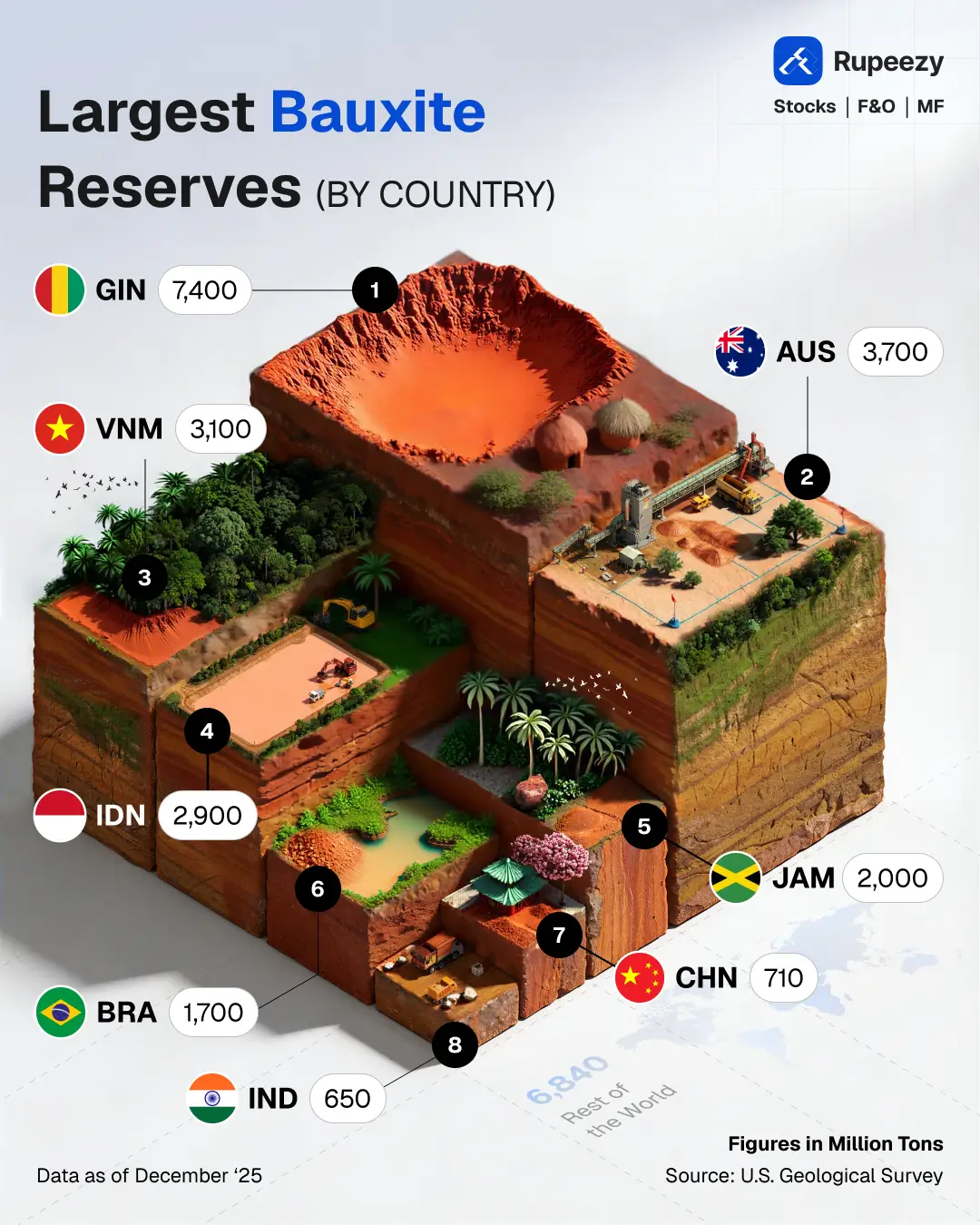
Together, these countries account for a major share of the world's known bauxite reserves.
Which Countries Produced the Most Bauxite?
Reserves indicate how much bauxite is available underground, but production data shows how much is actually being mined.
According to USGS estimates, global bauxite mine production reached approximately 440 million tons in 2025.
Country | Production (Million Tons) |
Guinea | 150 |
Australia | 97 |
China | 87 |
Brazil | 33 |
India | 25 |
Indonesia | 10 |
Jamaica | 6.2 |
Saudi Arabia | 5.7 |
Russia | 5.7 |
Kazakhstan | 4.8 |
Turkey | 3.8 |
Vietnam | 3.8 |
Other Countries | 8 |
World Total | 440 |
The production data highlights Guinea's dominant position in the global bauxite market. In 2025, the country produced an estimated 150 million tons of bauxite, making it the world's largest producer while also holding the largest reserve base.
However, Guinea's bauxite industry has faced challenges despite its strong production capabilities. A period of oversupply in the global market put pressure on bauxite prices, affecting the industry's profitability. In response, the Guinean Government has taken steps to manage supply and support the domestic mining sector.
Recent export-curb measures are aimed at stabilizing prices and improving market conditions for producers. By limiting export volumes, the government hopes to reduce oversupply and support a healthier pricing environment for the country's bauxite industry.
Because Guinea controls more than one-quarter of global bauxite reserves and remains the world's largest producer, these policy decisions are being closely watched by commodity markets, manufacturers, and aluminum producers around the world.
How Much Alumina Was Produced Globally in 2025?
Bauxite mining is only the first step in the aluminum production process. After mining, bauxite is refined into alumina, which is then processed into aluminum.
Global alumina refinery production was estimated at 150 million tons in 2025.
China remained the largest alumina producer with an estimated 93 million tons of production. Other significant producers included:
Australia – 17 million tons
Brazil – 11 million tons
India – 8.2 million tons
Russia – 2.9 million tons
United Arab Emirates – 2.3 million tons
The alumina sector plays a critical role because even if bauxite reserves are abundant, adequate refining capacity is necessary to transform the raw ore into usable material for aluminum production.
What Factors Are Influencing the Global Bauxite Market?
Several factors influence the global bauxite market, including:
Mining Activity: Changes in bauxite production levels can affect global supply availability.
Refining Capacity: The ability to convert bauxite into alumina plays a key role in the aluminum supply chain.
Government Policies: Mining regulations, licensing decisions, and export policies can impact market conditions.
International Trade Flows: Changes in exports and imports can influence the availability of bauxite across regions.
Infrastructure and Refinery Projects: Investments in mines, transportation networks, and alumina refineries can affect future supply and production capacity.
Concentration of Reserves: Since a large share of global reserves and production is concentrated in a few countries, developments in these regions are closely watched by manufacturers and commodity markets.
Investors tracking commodity-linked sectors can use a market heatmap to quickly compare stock performance across sectors and identify which industries are gaining or losing momentum.
Could Supply Constraints Affect Aluminum Prices?
The global aluminum industry depends heavily on a reliable supply of bauxite and alumina.
When major suppliers take measures that could limit exports or reduce production, market participants naturally pay attention. Lower supply volumes can tighten market conditions and potentially increase costs for industries that depend on aluminum.
Since aluminum is used in:
Cars and transportation equipment
Electronics and consumer devices
Packaging materials
Industrial manufacturing
Construction-related products
changes in the bauxite market can create ripple effects across multiple sectors.
While the long-term impact remains uncertain, developments in major producing countries are likely to remain under close watch.
Why Are Countries Looking to Secure Bauxite Supply?
Bauxite reserves are concentrated in a relatively small number of countries, while aluminum demand comes from economies around the world.
This makes access to reliable bauxite and alumina supplies strategically important for major manufacturing nations. As global demand for aluminum continues, countries and companies are increasingly focused on securing long-term access to raw materials and refining capacity.
As a result, developments in major bauxite-producing countries can have implications far beyond the mining sector itself.
How Are Global Bauxite Resources Distributed Across Regions?
While reserves are estimated at 29,000 million tons, total global bauxite resources are significantly larger.
According to the USGS, global resources are estimated to range between 55,000 million and 75,000 million tons.
The distribution of these resources is as follows:
Africa – 32%
Oceania – 23%
South America and the Caribbean – 21%
Asia – 18%
Other regions – 6%
This distribution highlights the global nature of the resource base while also showing the importance of Africa within the industry.
Conclusion
Many of the resources that support modern life often go unnoticed until supply becomes a concern. Bauxite is one such resource.
As the foundation of aluminum production, it plays an important role in industries ranging from manufacturing and transportation to packaging and electronics. With an estimated 29,000 million tons of global reserves concentrated among a handful of countries, the bauxite industry remains an important area to watch.
Written by
Kusuma BSKusuma is a Financial Content Writer with over 4 years of experience creating high-quality, research-driven content on stocks, mutual funds, IPOs, personal finance, and investment strategies. She specializes in simplifying complex financial concepts into clear, engaging, and SEO-friendly content that helps readers make informed financial decisions. Her expertise includes writing educational guides, market insights, investment explainers, and fintech content tailored for both beginners and experienced investors. With a strong focus on accuracy, readability, and user intent, Kusuma is passionate about making finance accessible to everyone while delivering content that meets the highest editorial standards.
Did you like this blog?
Be the first to like this blog.
The content on this blog is for educational purposes only and should not be considered investment advice. While we strive for accuracy, some information may contain errors or delays in updates.
Mentions of stocks or investment products are solely for informational purposes and do not constitute recommendations. Investors should conduct their own research before making any decisions.
Investing in financial markets are subject to market risks, and past performance does not guarantee future results. It is advisable to consult a qualified financial professional, review official documents, and verify information independently before making investment decisions.



All Category