

Open a Free Demat Account !
₹0 AMC & Account Opening Fee
Zetwerk IPO Review: Is It Good or Bad? (RHP Analysis)

 Last Updated: 15 October, 2026
 18 min read




00:00 / 00:00


Quick summary
| ||
Is the Zetwerk IPO good or bad? Going by the numbers, it is a large, fast-growing manufacturing platform with a big order book that is still losing money and burning cash, and whose price cannot be judged on a P/E ratio because there are no profits to divide by. Whether that is acceptable depends on how much risk you can carry, so the rest of this article shows you the evidence instead of a one-word verdict.
We read the abridged prospectus that Zetwerk filed with SEBI for its Red Herring Prospectus (RHP), dated 11 October 2026, and pulled the figures that matter for an investor. You may have searched for the Zetwerk DRHP; the draft has since been replaced by the RHP, so we use the later document. Every number below comes from it unless we name another source. If the document itself is new to you, our guide to the red herring prospectus explains each section.
Investments in the securities market are subject to market risks. Read all the related documents carefully before investing. This article is for education and is not investment advice.

Zetwerk IPO Details
Here are the terms you need before you bid. The abridged prospectus on SEBI's site still leaves the price band, lot size and bidding dates blank, so we took them from media reports on the company's announcement and from broker IPO pages. Check them against the final price band advertisement and your bid form before you apply.
Detail | Zetwerk IPO |
Issue type | Book-built; fresh issue plus offer for sale |
Fresh issue | Up to Rs. 2,830 crore |
Offer for sale | Up to 14,45,25,036 shares (about Rs. 2,182 crore at Rs. 151) |
Total issue size | About Rs. 5,012 crore at the upper band (our calculation) |
Face value | Rs. 1 per share |
Listing | BSE and NSE; NSE is the designated stock exchange |
Anchor bidding | 14 October 2026 (media report) |
Bidding opens / closes | 15 October 2026 / 19 October 2026 (media report); UPI mandate cut-off 5:00 pm on the last day |
Allotment | 21 October 2026 (tentative) |
Refund and demat credit | 22 October 2026 (tentative) |
Listing date | 23 October 2026 (tentative) |
Price band | Rs. 143 to Rs. 151 per share (media report) |
Lot size | 99 shares |
Minimum bid | Rs. 14,949 at Rs. 151 |
Maximum for retail investors | 13 lots (1,287 shares), Rs. 1,94,337 at Rs. 151 |
Quota | Qualified institutional buyers (QIBs) not less than 75%; non-institutional investors not more than 15%; retail investors not more than 10% of the net offer |
Employee reservation | Up to 7,00,000 shares |
Registrar | KFin Technologies Limited |
Lead managers | Kotak Mahindra Capital, Morgan Stanley, Goldman Sachs, Avendus, JM Financial, HSBC and Pantomath |
One detail shapes how you read the whole offer. Zetwerk does not meet the profitability test for a mainboard IPO, so it is using Regulation 6(2) of the SEBI ICDR rules. Under that route at least 75% of the net offer must go to QIBs, and retail investors get at most 10%. That means a smaller retail share than in most IPOs you may have bid for, and allotment can be harder to win.
What Does Zetwerk Do?
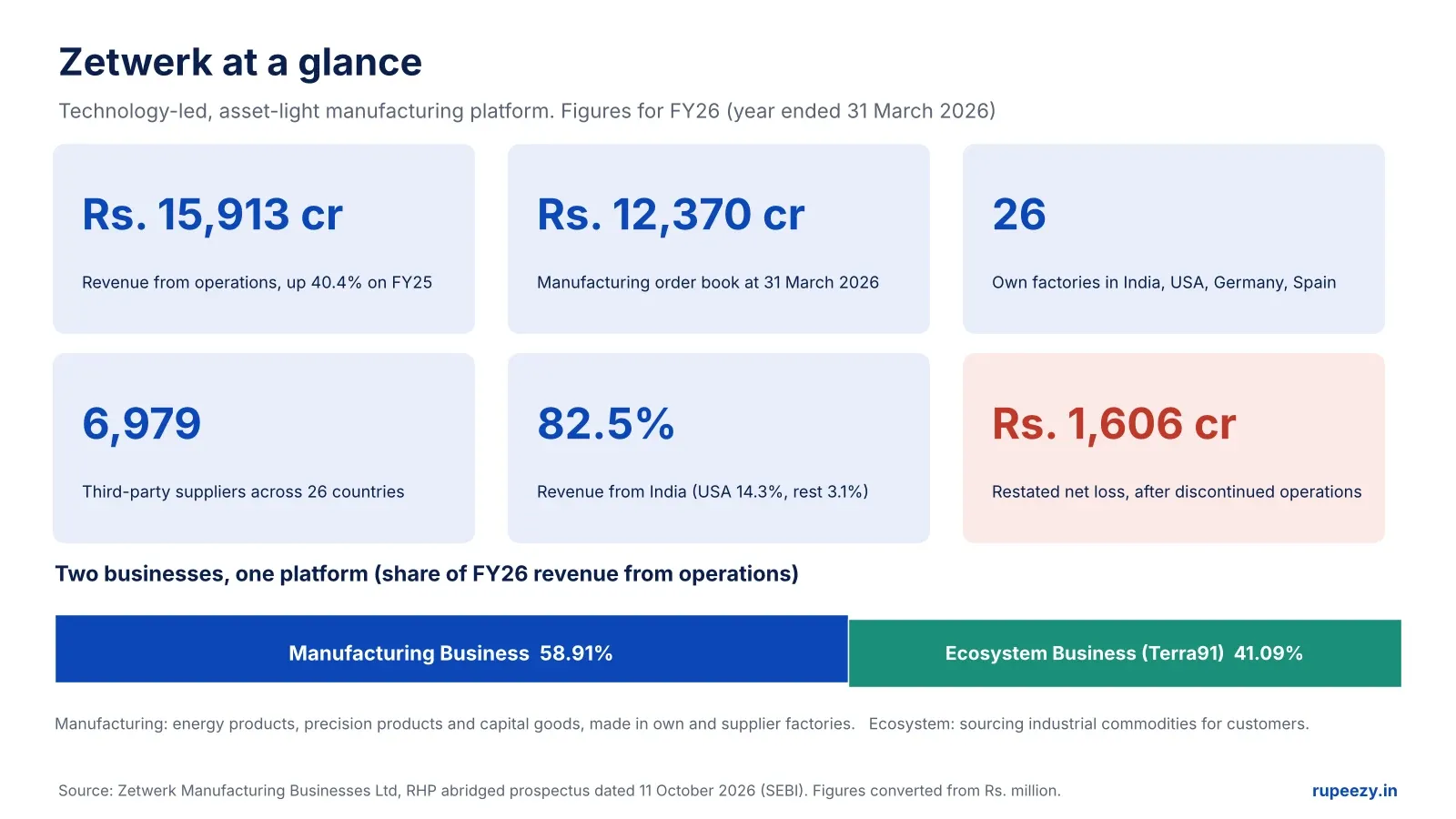
Zetwerk describes itself as a technology-led, asset-light manufacturing platform, or a "universal factory". A customer, such as a power developer or an industrial company, places an order for a product. Zetwerk then produces it in one of its own factories or hands it to a supplier from its network, and manages quality and delivery through its software platform, Zetwerk OS.
The company reports two segments:
Manufacturing Business: energy products, precision products and capital goods. This segment brought in Rs. 9,374.68 crore in FY26, 58.91% of revenue from operations.
Ecosystem Business: sourcing industrial commodities for customers, including through its Terra91 unit. Zetwerk acts as principal here, so the sales count as revenue. It brought in Rs. 6,538.65 crore, or 41.09%.
The network is large. The company runs 26 own facilities in India, the USA, Germany and Spain, and works with 6,979 third-party suppliers across 26 countries. India gave 82.54% of FY26 revenue, the USA 14.33% and the rest of the world 3.13%.
Who Owns Zetwerk and Who Is Selling?
The two founders, Amrit Pratik Acharya (chief executive) and Srinath Ramakkrushnan (chief operating officer), hold 15.86% together before the offer: 7.51% and 8.35%. Another promoter group entity, Creovate, holds 2.18%. Venture and growth investors hold most of the rest, led by Peak XV (9.11%), Greenoaks (8.59%) and Accel (7.72%). The company has 150 public shareholders today.
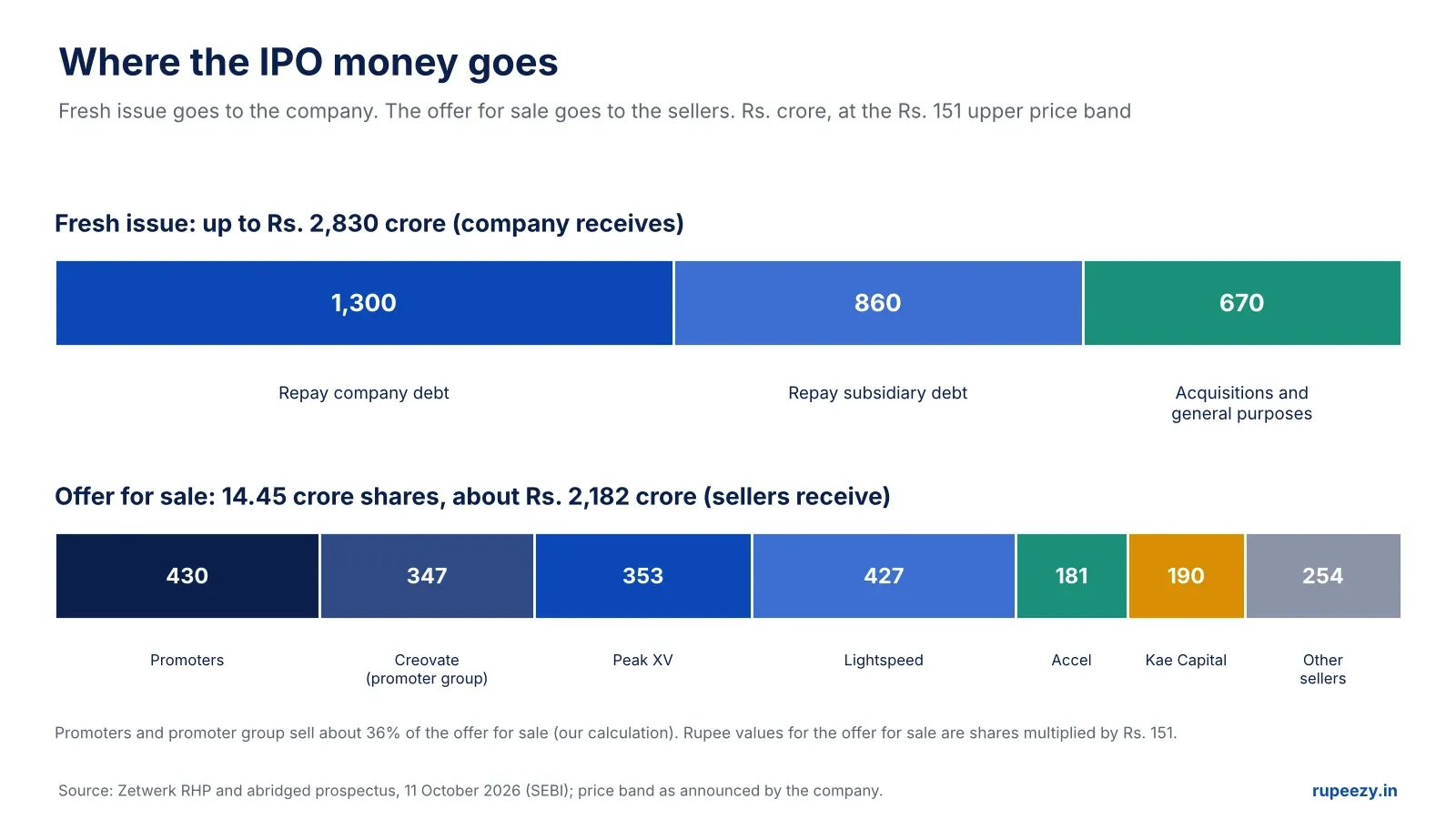
Almost half of this offer is existing shareholders cashing out. Each founder is selling 1,42,30,672 shares and Creovate 2,29,74,820 shares. Peak XV entities are selling 2,34,09,399 shares, the Lightspeed entities 2,82,72,686, Accel 1,20,16,622 and Kae Capital 1,25,70,262. The founders and Creovate together account for about 36% of the shares in the OFS (our calculation). A seller exiting is not a warning sign on its own, since early investors have held for years, but it is why the OFS money never reaches the company.

Zetwerk Financials: Growth With Losses
All figures are restated consolidated numbers in Rs. crore, converted from the RHP's Rs. million figures, for the years ended 31 March. Revenue and EBITDA are for continuing operations unless we say otherwise.
Metric (Rs. crore) | FY24 | FY25 | FY26 |
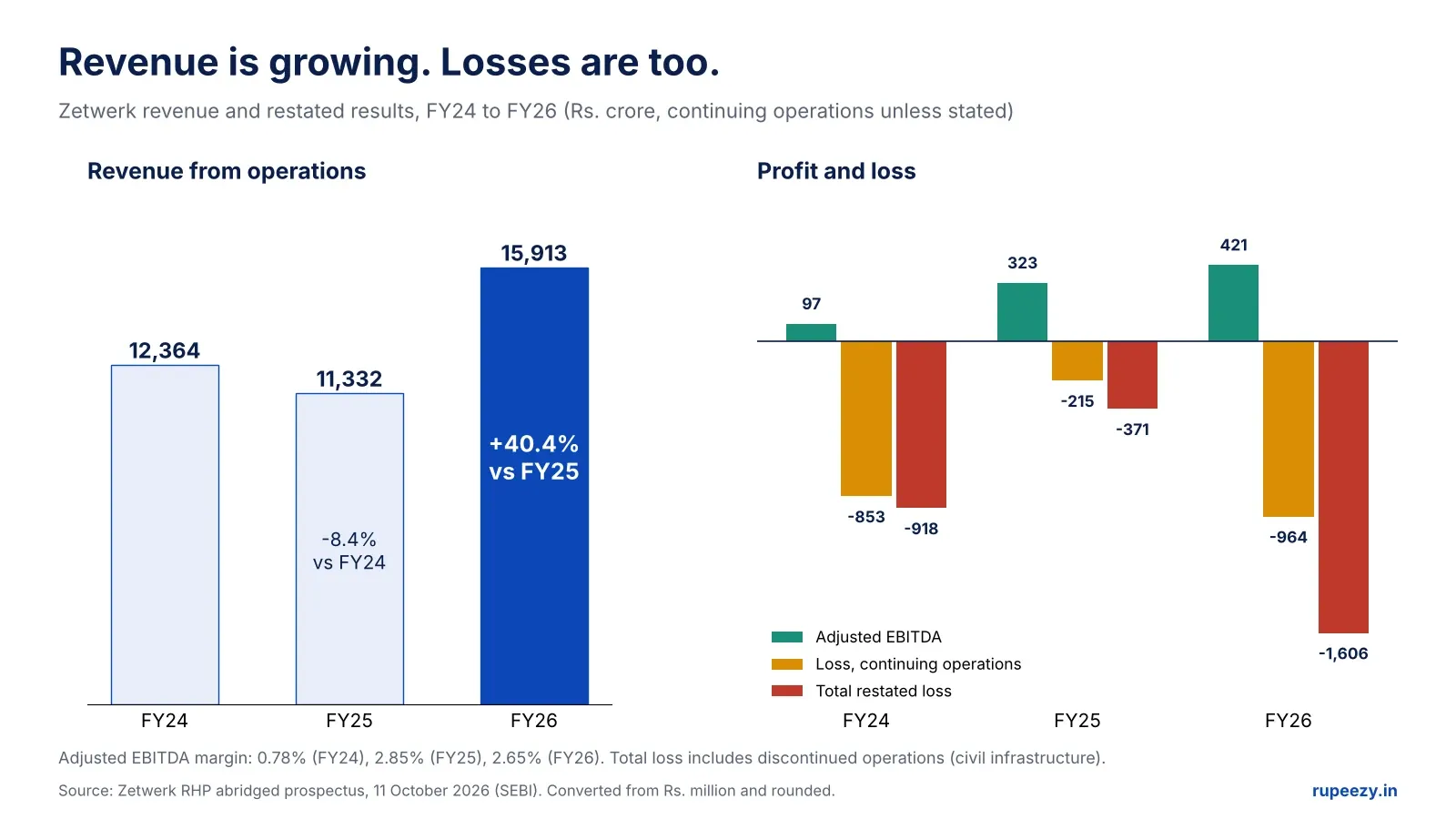
Revenue from operations | 12,364.37 | 11,331.86 | 15,913.32 |
Revenue growth | n/a | -8.35% | +40.43% |
Adjusted EBITDA | 97.03 | 322.59 | 421.34 |
Adjusted EBITDA margin | 0.78% | 2.85% | 2.65% |
EBITDA (reported) | -293.54 | 293.33 | -353.53 |
Loss from continuing operations | -852.53 | -215.07 | -964.39 |
Total restated loss (after discontinued operations) | -917.95 | -370.71 | -1,606.17 |
Net worth | 4,065.31 | 4,418.59 | 4,691.21 |
Total borrowings | 1,232.10 | 1,746.55 | 1,936.16 |
Return on net worth | -21.00% | -4.76% | -21.11% |
Basic EPS, continuing operations (Rs.) | -4.86 | -1.17 | -6.69 |
Three things stand out. First, growth is real but uneven: revenue fell 8.35% in FY25 before rising 40.43% in FY26. The first quarter of FY27 (April to June 2026) was Rs. 4,117.88 crore against Rs. 2,649.44 crore a year earlier, up 55.42%.
Second, the company reports an "adjusted EBITDA" that is positive in every year, but reported EBITDA was negative in FY24 and FY26. The gap between the two is made of items the company chooses to exclude, so when you compare Zetwerk with other firms, look at the loss lines, which include everything. Adding the three restated totals gives losses of about Rs. 2,895 crore over FY24 to FY26 (our calculation).
Third, the FY26 loss differs between continuing operations (Rs. 964.39 crore) and the total (Rs. 1,606.17 crore) by about Rs. 642 crore. That gap is the result from discontinued operations, our calculation from the RHP's two lines; media reports link part of it to the civil infrastructure business that the company wound down in FY26. Read the RHP's notes on discontinued operations before you decide how much of it will repeat. The loss narrowed in the June 2026 quarter, to Rs. 732.98 crore from Rs. 1,368.47 crore a year earlier, but it is still a loss.
Cash Flow: The Business Uses Cash
For a company that makes and delivers goods, cash flow tells you what the profit line cannot. Zetwerk's operations used cash in each of the three years:
Cash flow (Rs. crore) | FY24 | FY25 | FY26 |
From operating activities | -281.54 | -386.29 | -681.53 |
From investing activities | -621.90 | -147.92 | -394.13 |
From financing activities | 763.22 | 150.64 | 1,789.31 |
Operations consumed about Rs. 1,349 crore over three years (our calculation), and financing, meaning new money from investors and lenders, filled the gap. FY26 financing was Rs. 1,789.31 crore. An IPO is another round of financing, so ask whether the business is close to funding itself. The RHP does not say it is.
Order Book, Segments and Customers
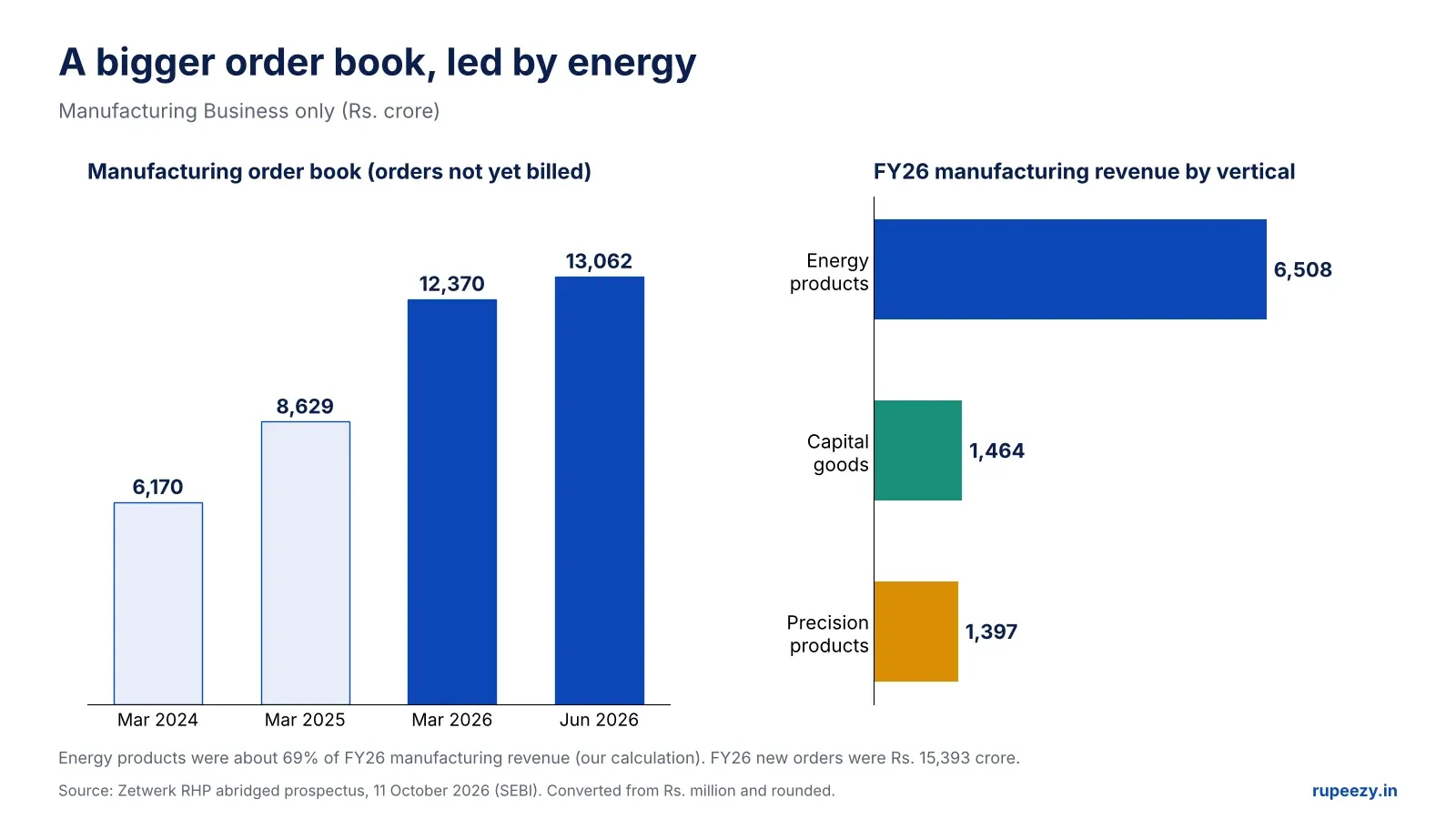
The strongest number in the document is the manufacturing order book, which is work already ordered but not yet delivered. It grew from Rs. 6,169.75 crore at March 2024 to Rs. 8,628.98 crore at March 2025 and Rs. 12,370.01 crore at March 2026, then Rs. 13,062.40 crore at June 2026. New orders reached Rs. 15,393.35 crore in FY26. The March 2026 order book is about 1.3 times FY26 manufacturing revenue (our calculation), which gives some visibility on near-term sales.
Within manufacturing in FY26, energy products brought Rs. 6,507.57 crore, capital goods Rs. 1,464.40 crore and precision products Rs. 1,397.19 crore. Manufacturing EBITDA margin was 5.68%, 6.40% and 6.03% in FY24, FY25 and FY26, so the segment is steady while the whole company loses money. Gross margin was 12.13% in FY26.
Concentration is a second thing to check. The top five customers gave 26.87% of FY26 revenue and the top ten 35.90%. On the supply side, the top ten suppliers took 38.18% of expenses. The RHP also notes that customers place orders without firm long-term purchase commitments, so the order book is not a guarantee of future revenue.
Market Size From the Industry Report
The RHP quotes a report by Redseer, which the company commissioned and paid for. Treat its projections as the company's own case, not independent research. Redseer puts India's procurement of durable goods at Rs. 17.37 trillion in FY26, rising to Rs. 37.54 to 42.57 trillion by FY31. For manufacturing platforms such as Zetwerk, it sizes the opportunity at Rs. 10.26 to 12.57 trillion in FY26 and Rs. 17.68 to 20.00 trillion by FY31. The size of the market is not the question for this IPO; whether Zetwerk can turn its share of it into profit is.
How Zetwerk Will Use the IPO Money
Of the fresh issue of up to Rs. 2,830 crore:
Object of the issue | Amount (Rs. crore) | Share of fresh issue |
Repay borrowings of the company | 1,300 | 45.9% |
Repay borrowings of nine subsidiaries | 860 | 30.4% |
Acquisitions not yet identified and general corporate purposes (balance, before offer expenses) | about 670 | about 23.7% |
So about Rs. 2,160 crore, 76.3% of the fresh issue, goes to repaying debt (our calculation of the share). That lowers interest costs but does not by itself add a factory or an order. The remaining money is for unidentified acquisitions and general corporate purposes, which together can be at most 35% of gross proceeds, with each capped at 25%. CARE Ratings will monitor how the money is used. One reconciliation note: the Rs. 2,160 crore repayment is larger than the summary "total borrowings" figure of Rs. 1,942 crore at June 2026, probably because the summary uses a narrower definition, so check the RHP's capital structure section for the exact scope.
Can You Judge the Price?
Normally you would compare the price with earnings through the price-to-earnings (P/E) ratio. Zetwerk has losses, so P/E is not meaningful. The RHP also lists no listed company as a direct comparable, so we cannot give you a peer table either.
The one yardstick we can compute is price against book value. At the Rs. 151 upper band, the price is about 4.8 times the FY26 net asset value per share of Rs. 31.26, and about 5.8 times the June 2026 figure of Rs. 25.85 (our calculations). Book value falls when a company makes losses, which is why the second number is higher. Market value estimates in the media differ by source, from about Rs. 22,750 crore to Rs. 25,580 crore at the upper band, so we do not give you one number. Compute it yourself from the final share count in the RHP, and remember the grey market premium is unofficial: our explainer on the grey market premium shows why it is not a signal you should rely on.
Strengths of the Zetwerk IPO
Scale: Rs. 15,913 crore of FY26 revenue puts it among the larger manufacturers to list in recent years.
Order visibility: A manufacturing order book of Rs. 13,062 crore at June 2026, about 1.4 times FY26 manufacturing revenue (our calculation).
Momentum: Revenue grew 40.43% in FY26 and 55.42% in the June 2026 quarter, and losses narrowed in that quarter.
Wide base: 26 own factories and 6,979 suppliers across 26 countries, with demand from renewables, oil and gas, electronics and defence.
Debt repayment: About 76% of the fresh issue reduces borrowings, which should ease interest costs.
Seven banks: A large group of lead managers is running the issue, though that does not lower business risk.
Risks of the Zetwerk IPO
Risk | What the RHP says |
Continuing losses | The company has made losses in the periods shown and may not become profitable. |
Operating cash burn | Operations used Rs. 681.53 crore in FY26 and the company has relied on financing. |
Third-party suppliers | It relies on outside suppliers for much of its output; the top ten are 38.18% of expenses. |
Customer concentration | The top ten customers are 35.90% of FY26 revenue, and demand depends on sectors such as renewables, oil and gas, electronics and defence. |
Geography | India gave 82.54% of revenue and the USA 14.33%, so trade and policy changes in those markets matter. |
Auditor remarks | The RHP records emphasis of matter or modifications in auditors' reports; read them in full. |
Quality commitments | Customers set quality and performance requirements, and failures can lead to penalties. |
No firm purchase commitments | Customers can change or cancel orders, so the order book is not a promise. |
Litigation | Against the company: 5 criminal, 30 tax and 12 statutory or regulatory cases. Against subsidiaries: 13 criminal, 38 tax and 7 statutory cases. |
Retail share | Retail investors get at most 10% of the net offer, so allotment may be hard. |
Zetwerk IPO: Good or Bad?
There is no single answer. This table sets out what points each way.
Question | Points to good | Points to bad |
Growth | Revenue up 40.43% in FY26 and 55.42% in the June 2026 quarter | Revenue fell 8.35% in FY25, so growth has been uneven |
Profit | Adjusted EBITDA positive in all three years | Net loss every year; Rs. 1,606 crore restated loss in FY26 |
Cash | Financing is available and the loss narrowed in Q1 FY27 | Operations used cash in all three years |
Orders | Order book of Rs. 13,062 crore at June 2026 | No firm long-term commitments from customers |
Use of money | About 76% of the fresh issue repays debt | Almost half the offer is an OFS; the company gets none of it |
Price | Cannot be called expensive on earnings, because there are none | No P/E and no listed peer; about 4.8 to 5.8 times book value |
Allotment | Large institutional demand can support listing | Retail quota is at most 10% |
If you want a business that already earns profits, this one does not fit yet. If you are willing to back a large platform on the strength of its order book and a narrowing loss, and you can sit with the risks above, it is the type of bet some investors make with a small slice of their money. Only you can decide that.
Questions to Settle Before You Bid
Can you hold for several years if the company keeps losing money, or do you need a quick listing gain?
Have you read the auditors' emphasis of matter and the discontinued operations note in the RHP?
How much of your portfolio would one lot at Rs. 14,949 or 13 lots at Rs. 1,94,337 be, and can you accept a total loss on it?
Do you understand that the 10% retail quota can leave many applicants without an allotment?
Have you confirmed the final price band and dates on the exchange websites?
How to Apply for Zetwerk IPO on Rupeezy
If you decide to bid, you can apply through Rupeezy. Rupeezy's IPO page states "Zero fees on IPOs. Free account opening," so there is no charge for applying. That is a fact about our pricing, not a reason to bid. Rupeezy is a stockbroker and earns from other services if you become a client, which has no bearing on the analysis above.
Open a demat account. Open a free demat account with Rupeezy and finish the online KYC.
Keep a UPI ID ready. It must be linked to the bank account that holds your funds.
Go to the IPO section. Log in, open the IPO page and select Zetwerk. Bidding is reported to be open on 15, 16 and 19 October; check the live window in the app.
Choose your bid. Pick the number of lots (1 to 13 for retail investors) and a price within the band, or bid at the cut-off price.
Approve the UPI mandate. The amount is blocked in your account, not debited, until shares are allotted.
Track allotment. Allotment is expected on 21 October. Check it on the Rupeezy IPO allotment status page, the KFin Technologies website, BSE or NSE. Unallotted money is unblocked on 22 October.
New to this? Our step-by-step guide to applying for an IPO online covers the process.
Apply for Zetwerk IPO | Open a free demat account
Frequently Asked Questions
Is the Zetwerk IPO good or bad?
The RHP shows revenue up 40.43% in FY26 and a manufacturing order book of Rs. 13,062 crore at June 2026, but also a restated FY26 loss of Rs. 1,606 crore and negative operating cash flow in all three years. It suits investors who accept loss-making, high-risk companies; it does not suit those who want current profits. This is information, not a recommendation.
What is the Zetwerk IPO price band and lot size?
Media reports and broker IPO pages give a price band of Rs. 143 to Rs. 151 per share and a lot size of 99 shares, so the minimum bid is Rs. 14,949 at the upper band. The abridged prospectus on SEBI's site leaves these blank, so confirm them on the exchange websites before you bid.
When does the Zetwerk IPO open and close?
Reports say anchor bidding on 14 October 2026, with the public issue open from 15 October to 19 October 2026. Allotment is expected on 21 October and listing on 23 October. These dates are tentative and come from media reports.
How big is the Zetwerk IPO?
The issue has a fresh issue of up to Rs. 2,830 crore and an offer for sale of up to 14,45,25,036 shares, about Rs. 2,182 crore at Rs. 151. The total is about Rs. 5,012 crore at the upper band (our calculation).
How will Zetwerk use the IPO money?
About Rs. 2,160 crore of the fresh issue will repay borrowings of the company (Rs. 1,300 crore) and nine subsidiaries (Rs. 860 crore). The balance of about Rs. 670 crore is for unidentified acquisitions and general corporate purposes. The OFS money goes to the selling shareholders.
Is Zetwerk profitable?
No. The restated total loss was Rs. 917.95 crore in FY24, Rs. 370.71 crore in FY25 and Rs. 1,606.17 crore in FY26. The company reports a positive adjusted EBITDA, but reported EBITDA was negative in FY24 and FY26.
How much can a retail investor bid for in the Zetwerk IPO?
A retail investor can bid for up to 13 lots, which is 1,287 shares or Rs. 1,94,337 at Rs. 151. Retail investors can get at most 10% of the net offer, because the issue is made under Regulation 6(2) of the SEBI ICDR rules.
How do I apply for the Zetwerk IPO on Rupeezy?
Open a demat account with Rupeezy, log in, go to the IPO section, select Zetwerk, choose your lots and price, and approve the UPI mandate. Rupeezy states zero fees on IPOs and free account opening.
Sources
Zetwerk Manufacturing Businesses Limited, abridged prospectus of the Red Herring Prospectus dated 11 October 2026, hosted by SEBI: sebi.gov.in. Source for financials, cash flow, segments, customers, ownership, selling shareholders, objects of the issue, risk factors and litigation.
Zetwerk Manufacturing Businesses Limited, Red Herring Prospectus: company investor relations page.
Redseer industry report, as cited in the RHP. Commissioned by the company.
Price band, lot size and bidding dates: media reports (YourStory, NewsBytes, 12 October 2026 onward) and broker IPO pages, because the SEBI-hosted abridged prospectus leaves them blank. Confirm against the final price band advertisement.
All data is as of 14 October 2026. Figures in Rs. crore are converted from the RHP's Rs. million figures and rounded. Totals, shares of the offer, book value multiples, order book ratios and cumulative figures are our calculations from RHP data. Market value estimates vary by source and are not shown as a single figure.

Santhosh is a Research Analyst at Rupeezy who transforms complex market data into actionable insights for investors. With five years of financial industry experience and an MBA in Finance from Jain University, he specializes in evaluating stock market dynamics, mutual fund performance, and ETF trends. Driven by a deep passion for business analysis, Santhosh focuses heavily on company fundamentals to help readers make informed, data-backed financial decisions.
Did you like this blog?
Be the first to like this blog.
Disclaimer
Investments in the securities market are subject to market risks. Read all the related documents carefully before investing. Rupeezy (SEBI RA Registration: INH000013332) provides this content for informational purposes; any securities quoted are for educational display and not as a recommendation. All charts and graphs are based on independent research and reliable sources for the period mentioned within the specific data set. Sometimes we take graphs from external sources. This communication does not promise or assure any fixed, guaranteed, or indicative returns to any client. For our complete registered office address, Member ID, and full SEBI registration details, please refer to our official website.
The content on this blog is for educational purposes only and should not be considered investment advice. While we strive for accuracy, some information may contain errors or delays in updates.
Mentions of stocks or investment products are solely for informational purposes and do not constitute recommendations. Investors should conduct their own research before making any decisions.
Investing in financial markets are subject to market risks, and past performance does not guarantee future results. It is advisable to consult a qualified financial professional, review official documents, and verify information independently before making investment decisions.



All Category