
Open a Free Demat Account !
₹0 AMC & Account Opening Fee
How Mutual Fund Distributor Earnings Really Work in India

 Last Updated: 07 September, 2026
 9 min read





00:00 / 00:00


Summary
|
How Mutual Fund Distributor Earnings Really Work in India
In 2026, becoming a Mutual Fund Distributor has emerged as a significant career opportunity for many individuals. By March 2026, the Assets Under Management (AUM) of India's mutual fund industry had surpassed Rs. 73 lakh crore, while monthly SIP inflows reached a record high of Rs. 32,000 crore. On social media, people often discuss "passive income" and "trail income running into crores"; however, the real question remains how much can a Mutual Fund Distributor actually earn? In this blog, we will explain in simple terms how MFD income works, what a trail commission entails, the amount of AUM required to generate a monthly income of Rs. 1 lakh, and the ground realities of this business in 2026.
Who is a Mutual Fund Distributor ?
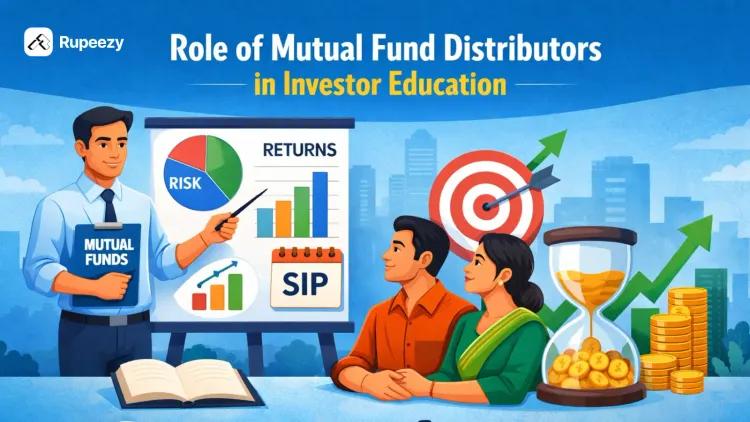
A Mutual Fund Distributor (MFD) is an individual who assists investors in selecting the right mutual funds and investing in them. Simply put, an MFD acts as a bridge between investors and mutual fund companies. When an investor invests in a mutual fund through a distributor, the distributor receives a commission from the AMC (Asset Management Company). In most cases, MFDs do not charge direct fees to their clients.
Mutual Fund Distributor vs Investment Advisor (RIA)
Feature | Mutual Fund Distributor (MFD) | Investment Advisor (RIA) |
Income Source | AMC Commission | Client Fees |
Works On | Regular Plans | Direct Plans |
Regulation | AMFI + SEBI | SEBI RIA Rules |
Main Role | Mutual Fund Distribution | Financial Advice |
Important Terms Every Beginner Must Understand
Term | Simple Meaning | Example |
AMC (Asset Management Company) | A mutual fund company that manages investors' money. | Examples : SBI Mutual Fund, HDFC Mutual Fund, ICICI Prudential Mutual Fund |
AUM (Assets Under Management) | Total money invested through the distributor | If 10 investors invest Rs. 5 lakh each: 10 × 500,000 = 5,000,000. Total AUM = Rs. 50 lakh. |
SIP (Systematic Investment Plan) | How to Invest a Fixed Amount Every Month | Example: Investing Rs. 5,000 every month in a mutual fund. |
Trail Commission | Recurring income received by an investor as long as they remain invested. | If a trail commission of 0.80% is received on an investment of Rs. 10 lakhs: 1,000,000 × 0.80% = 8,000. Annual commission = Rs. 8,000. |
TER (Total Expense Ratio) | Annual expense of managing mutual funds | The AMC also pays distributor commissions out of this very expense. |
Regular Plan | A mutual fund plan that includes distributor commission. | An MFD's income primarily comes from this source. |
Direct Plan | Mutual fund plan without a distributor | The TER is lower in this because there is no commission. |
How Mutual Fund Distributor Income Works in 2026 ?
Mutual Fund Distribution has evolved into a business where income gradually builds up in a recurring form. Previously, distributors relied primarily on upfront commissions; however, the industry has now shifted towards a trail-based income model. Listed below are all the major avenues through which Mutual Fund Distributors (MFDs) generate income.
1. Trail Commission :
Trail Commission is currently the most important component of an MFD's income.
What is a Trail Commission?
When an investor invests in a mutual fund through you, the AMC (Asset Management Company) pays you a fixed percentage as commission every year, for as long as the investor remains invested. This is known as a Trail Commission.
Trail Commission Formula : Trail Income = AUM×Trail Commission Rate
Example : Assume:
Client investment = Rs. 10 Lakhs
Trail commission = 0.80%
Calculation : 1,000,000 × 0.80% = 8,000
2. Upfront Commission :
Previously, Mutual Fund Distributors used to earn significant income from upfront commissions; however, following SEBI regulations, this practice has now become quite limited.
What is the Upfront Commission?
When a new investment is received, the AMC pays a one-time commission to the distributor.
Example : Assume:
Client investment = Rs. 5 Lakhs
Upfront commission = 0.20%
Calculation : 500,000 × 0.20% = 1,000
Result : One-time income = Rs. 1,000
3. Recurring Income from SIPs :
The SIP (Systematic Investment Plan) is considered the most powerful growth engine of the MFD business.
How is income generated from SIPs?
When clients make monthly SIP investments:
The AUM (Assets Under Management) grows continuously.
Trail income increases automatically.
Long-term recurring income is generated.
Example : Let's assume:
New SIP business generated every month = Rs. 3 Lakhs
Annual SIP Flow : 300,000 × 12 = 3,600,000
Result : Annual SIP inflow = Rs. 36 Lakhs
If a distributor consistently adds new SIPs, their AUM begins to grow rapidly within a few years.
4. Income Growth Driven by Market Appreciation :
Mutual Fund Distributors do not earn solely from acquiring new clients; their income also grows as a result of market appreciation.
How does this work?
If the stock market rises:
The value of the client's portfolio increases.
The Total Assets Under Management (AUM) expands.
The trail commission also increases.
Example : Let's assume:
Current AUM = Rs. 2 Crores
Market Returns = 12%
New AUM : 20,000,000 × 1.12 = 22,400,000
Result : New AUM = Rs. 2.24 Crores
This means that income can increase even without adding any new clients.
Since market performance can directly affect the value of client portfolios and AUM, MFDs can also track today’s market movement to understand broader Nifty, Sensex, and sector trends.
5. AMC Incentives and Bonus Income :
Many AMCs also offer additional incentives to distributors.
Common Incentives
SIP target incentives
B-30 city incentives
Women investor onboarding incentives
business growth rewards
6. Different commissions for different fund categories
Each mutual fund category has a different commission structure.
Fund Category | Average Trail Commission |
Equity Funds | 0.50% – 1.50% |
Hybrid Funds | 0.40% – 0.80% |
Debt Funds | 0.20% – 0.60% |
Liquid Funds | 0.05% – 0.20% |
7. Cross-Selling Financial Products :
Today, many distributors are not limited solely to mutual funds.
They also sell additional financial products.
Additional Products:
Health Insurance
Life Insurance
Bonds
PMS (Portfolio Management Services)
Fixed Income Products
These products also generate extra commission income for distributors.
8. Referral-Based Business Growth :
A significant portion of the income of experienced MFDs (Mutual Fund Distributors) comes from referrals.
How does the Referral Model help?
New clients are acquired easily
Trust is established quickly
Marketing costs are reduced
SIP conversion rates improve
In the long run, referral business becomes the most powerful source of growth.
9. Income Growth through Digital Platforms :
In 2026, many Mutual Fund Distributors are acquiring clients by utilizing:
Instagram
YouTube
WhatsApp
LinkedIn
Personal websites
SEBI & Industry Changes Impacting MFD Income in 2026
Focus on the Trail-Based Income Model : In 2026, SEBI is placing a greater emphasis on long-term investing and investor retention. Consequently, upfront commissions have declined, and the trail-based recurring income model has gained significant importance. Distributors must now focus on SIPs (Systematic Investment Plans) and long-term clients to ensure a stable income stream.
TER and Commission Transparency : Today, investors are increasingly comparing Direct vs. Regular Plans, as well as the TER (Total Expense Ratio). SEBI has made the commission structure more transparent; as a result, Mutual Fund Distributors (MFDs) are now required to provide not merely sales services, but also proper guidance and comprehensive service.
Growth Opportunities in B-30 Cities : The mutual fund industry is expanding rapidly across Tier-2, Tier-3, and B-30 cities. Asset Management Companies (AMCs) are offering additional incentives for onboarding new investors. This has significantly enhanced growth opportunities for new distributors entering the field.
Growing Focus on Women Investors : In 2026, the participation of women investors is witnessing rapid growth. Many AMCs are offering extra incentives specifically for onboarding women investors, making this segment a major opportunity for MFDs.
Stricter Compliance Regulations : Distributors are now required to strictly adhere to and properly maintain KYC, GST compliance, and commission disclosure protocols. This has rendered the industry more professional and transparent than ever before.
Biggest Factors That Decide Mutual Fund Distributor Income
Assets Under Management (AUM) : AUM is the most significant factor determining an MFD's income. The higher the client investment and total AUM, the greater the trail commission income generated.
SIP Retention Ratio: The long-term continuation of SIPs is crucial for generating recurring income. Distributors whose clients remain invested for extended periods enjoy a more stable stream of trail income.
A goal-based investment planning approach can help MFDs align SIPs and mutual fund recommendations with an investor’s specific financial goals, investment horizon, and risk profile.
Client Trust & Referrals : Mutual fund distribution is an entirely trust-based business. Satisfied clients frequently provide referrals, enabling the acquisition of new clients at a lower cost and accelerating business growth.
City Category & Market Reach : In 2026, Tier-2, Tier-3, and B-30 cities are emerging as major hubs for mutual fund growth. These regions offer lower competition and abundant growth opportunities.
Equity vs. Debt Fund Mix : Equity mutual funds generally yield higher trail commissions, and investors tend to remain invested in them for longer durations. Consequently, an equity-focused AUM contributes significantly to long-term income growth.
Technology & Digital Adoption : Today, many successful MFDs leverage CRM software, WhatsApp automation, online onboarding, and digital reporting tools. This enhances client servicing and facilitates the efficient scaling of the business.
Conclusion
In 2026, Mutual Fund Distribution emerged as a career path offering strong recurring income; however, success in this field does not happen overnight. In this business, income is built gradually through the growth of SIPs, client trust, and long-term relationships. Only those distributors who focus on consistency, investor education, and client retention are able to generate a stable and scalable income over the long term.
FAQs
Q1. How much can a Mutual Fund Distributor earn in 2026?
Income depends entirely on AUM, the SIP book, and client retention. Initial earnings are modest but grow over time.
Q2. What is trail commission?
Trail commission is the recurring income that a distributor continues to receive as long as the investor remains invested.
Q3. How do Mutual Fund Distributors make money?
MFDs primarily generate income through trail commissions, SIP business, and AMC incentives.
Q4. How much AUM is needed for a monthly income of Rs. 1 lakh?
Based on average commission rates, an AUM of approximately Rs. 15-16 crore may be required.
Q5. Is Mutual Fund Distribution profitable in 2026?
Yes, but it is a long-term business where consistency and client trust are of paramount importance.

Anupam Shukla is a finance content writer and an NISM-certified research analyst with over Seven years of trading experience. With a passion for the stock market, he simplifies complex financial concepts, making investing and trading easier for everyone. His expertise helps readers stay ahead in the ever-changing world of finance, empowering them to make smarter money moves.
Did you like this blog?
Be the first to like this blog.
Investments in the securities market are subject to market risks. Read all the related documents carefully before investing. Rupeezy (SEBI RA Registration: INH000013332) provides this content for informational purposes; any securities quoted are for educational display and not as a recommendation. All charts and graphs are based on independent research and reliable sources for the period mentioned within the specific data set. Sometimes we take graphs from external sources. This communication does not promise or assure any fixed, guaranteed, or indicative returns to any client. For our complete registered office address, Member ID, and full SEBI registration details, please refer to our official website.
The content on this blog is for educational purposes only and should not be considered investment advice. While we strive for accuracy, some information may contain errors or delays in updates.
Mentions of stocks or investment products are solely for informational purposes and do not constitute recommendations. Investors should conduct their own research before making any decisions.
Investing in financial markets are subject to market risks, and past performance does not guarantee future results. It is advisable to consult a qualified financial professional, review official documents, and verify information independently before making investment decisions.

100% commission sharing for one year, Rs. 0 registration fee, and earn Rs. 2 Lakhs+ per month from home.
Explore Now




All Category