
Difference Between IPO, FPO, and OFS

 Last Updated: 12 June, 2026
 8 min read




00:00 / 00:00


Key Highlights
|

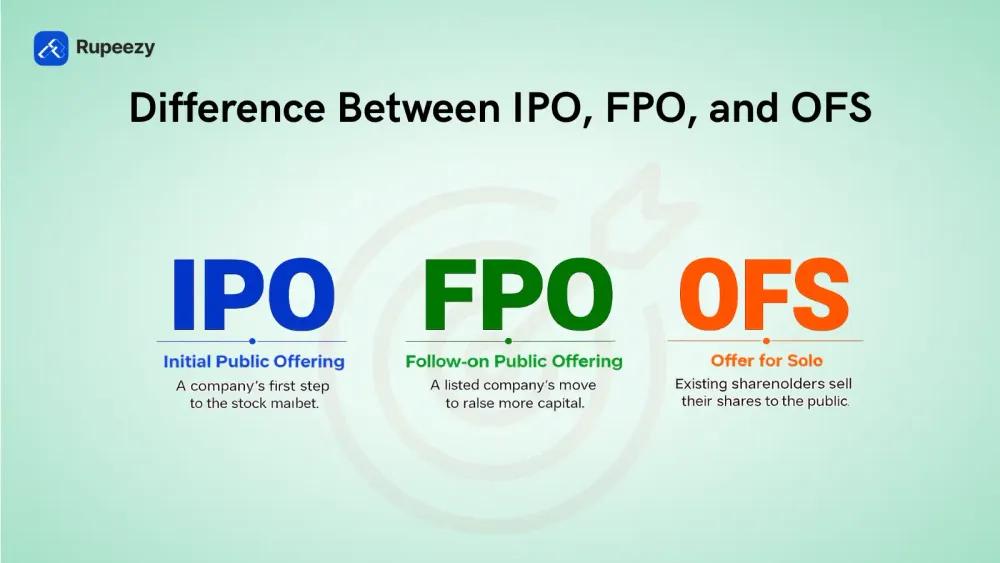
IPO, FPO, and OFS are all types of stock offerings that companies use to gain investment from the public. These aim to help the companies with expansion, growth, or even pay off the debts. But when it comes to their working, there are some minute differences that you should know of.
Among these, the most common is the Initial Public Offering (IPO), which is the first-time issue of shares. FPO and OFS are used, but these are not so common in the market. But as an investor, knowing the difference will help you to plan your investment better.
So, read this guide to explore IPO vs FPO vs OFS in detail. Know their meaning and how they differ from one another.
IPO Vs FPO Vs OFS: Quick Comparison
Before we actually move to the deep details, let us quickly look at the key differences between the three. The table below shares the difference between IPO, FPO, OFS in detail.
Parameter | IPO | FPO | OFS |
Full Form | Initial Public Offering | Follow-on Public Offering | Offer for Sale |
Company Status | Unlisted company | Listed company | Listed company |
Purpose | Raise capital and get listed | Raise additional capital after listing | Allow existing shareholders to sell shares |
Who Sells Shares? | Company and sometimes existing investors | Company | Promoters or major shareholders |
Who Receives The Money? | Primarily the company | Company | Selling shareholders |
New Shares Created? | Yes | Usually | No |
Impact On Share Capital | Leads to a positive rise. | Creates an added value | No change |
Ownership Dilution | Yes for the company owner | Yes for all the existing holders and owners too | No |
Stock Exchange Listing | Creates listing | Already listed | Already listed |
Main Objective | Fund growth and expansion | Raise fresh funds | Reduce promoter stake or unlock value |
Investor Focus | Growth potential | Business expansion plans | Shareholder stake sale |
IPO Meaning: What Is An Initial Public Offering?
An IPO means Initial Public Offering. It is the first public issue of shares by a company. Through an IPO, a private company becomes a publicly traded company. It is the process by which shares become available for investors to buy on a stock exchange.
If you see, IPO is one of the key milestones in the growth of a company. It allows the company to get access to funds that can be invested in growth, expansion, or even for debt repayment.
When investors apply for an IPO, they are investing in a company that has never been listed before. This can create significant growth opportunities if the business performs well after listing. At the same time, investors may face higher uncertainty because there is limited trading history available for analysis.
Many well-known Indian companies have entered the stock market through IPOs, and this is why it is still the most prominent route.

FPO Meaning: What Is A Follow-On Public Offering?
An FPO is known as a Follow-on Public Offering. It is a share issue launched by a company that is already listed on a stock exchange. The company uses FPO when it is looking to raise some additional funds after the IPO has already been launched.
Companies may choose an FPO when they are looking for additional funds to meet their growth or expansion needs. This is a strategic move and is a sign of confidence of the management in the future prospects of the company.
Unlike an IPO, investors already have access to the company's financial performance, stock price history, and market reputation. This allows them to make a more informed investment decision.
There are chances that the ownership might get diluted with FPO, but the overall benefits of the IPO stand way better. Overall, FPO can offer investors an opportunity to invest in a company that is already growing well and gains benefits.
OFS Meaning: What Is An Offer For Sale?
An OFS, or Offer for Sale, is a mechanism through which promoters or large shareholders sell their existing shares to public investors. Unlike an IPO or FPO, the company itself does not issue new shares and does not receive any funds from the transaction.
The OFS route was introduced to make large share sales more transparent and efficient. It is commonly used when promoters want to reduce their stake or meet some of the regulatory requirements. The idea here is to unlock a part of their investment.
Since no new shares are created, the total share capital of the company remains unchanged. This means there is no dilution of ownership for the existing shareholders. For investors, OFS can provide you with access to the existing shares of the company through the stock exchange platform.
Key Difference Between Offerings: IPO vs FPO vs OFS
As an investor, all three are great options for you. These allow you to invest in the company and hold partial ownership, which is great. But on a broader level, there are some of the differences that you should be mindful of when it comes to investing.
So, here are the key FPO vs IPO vs OFS difference points that you should consider while investing.
1. Purpose Of The Offering
The biggest difference between IPO, FPO, and OFS lies in their objective.
An IPO helps a private company raise capital and enter the stock market for the first time. An FPO helps a listed company raise additional funds after listing. An OFS allows existing shareholders to sell part of their holdings without raising capital for the company.
2. Source Of Shares
The source of shares differs significantly across all three offerings.
In an IPO, shares are generally issued by the company. In an FPO, additional shares are usually issued by the company again. In an OFS, existing shares owned by promoters or institutional investors are sold to the public.
3. Impact On Existing Shareholders
IPOs and FPOs increase the total number of outstanding shares. This, in turn, will reduce the ownership percentage of each of the shareholders.
An OFS does not create new shares. As a result, the overall share count remains unchanged, and there is no dilution of ownership.
4. Flow Of Funds
Understanding where the money goes is important for investors.
In both IPOs and FPOs, the company generally receives the proceeds and uses them for business purposes. In an OFS, the money goes directly to the shareholders selling their stake.
5. Company Stage
An IPO is only available for companies that are not yet listed. Once a company is publicly traded, it can choose to raise additional funds. This can be through an FPO or it can allow shareholders to sell shares through an OFS.
This distinction makes company maturity one of the easiest ways to identify the type of offering.
IPO, FPO, Or OFS: Which Is Better For Investors?
No single offering is automatically better than the others. The right choice depends on various factors like:
The company's fundamentals
Current and future valuation
Growth prospects
Goal of the offering
An IPO will offer you exposure to a new company and will be good if you are looking for long-term growth. But there is high uncertainty as well.
FPOs are great if you want to invest in shares of a company with a good standing in the market. These are still fresh shares but backed by deep insights and market trust.
OFS opportunities can be attractive when strong companies offer shares at reasonable valuations. This is good when you are looking for additional funds, but with no ownership dilution. For investors, this is a great opportunity to buy shares at a great rate.
Rather than focusing only on the type of offering, investors should evaluate the company's financial strength, business model, competitive position, and long-term growth potential.
Conclusion
Understanding the difference between IPO, FPO, and OFS is essential for anyone investing in the stock market. While all three are types of stock offerings, the keys with which these are offered are different. As an investor, you must know this, as this will help you to invest better and earn good returns.
Also, you would need insights to ensure that you are moving in the right direction. This is where platforms like Rupeezy can help you. So, open a demat account and start trading with confidence.
FAQs
1. Which Is Better, OFS Or Fresh Issue?
A fresh issue helps the company raise funds for growth. The OFS allows existing shareholders to sell their stake. The better option depends on the company's purpose and valuation.
2. Which Is Better, FPO Or IPO?
An IPO offers access to a company before listing, while an FPO involves an already listed company. FPOs generally provide more historical data for analysis.
3. Are OFS And IPO The Same?
No. An IPO is a company's first public share offering. An OFS is the sale of existing shares by promoters or major shareholders of a listed company.
4. Can FPO Shares Be Sold?
Yes. Once allotted, these are credited to the demat account. The FPO shares can be sold on the stock exchange like any other listed share.
5. Is Buying IPOs A Good Strategy?
IPOs can generate good returns, but success is not guaranteed. As an investor, you should check all the details like company fundamentals, process, policies, or even market standing.
The content on this blog is for educational purposes only and should not be considered investment advice. While we strive for accuracy, some information may contain errors or delays in updates.
Mentions of stocks or investment products are solely for informational purposes and do not constitute recommendations. Investors should conduct their own research before making any decisions.
Investing in financial markets are subject to market risks, and past performance does not guarantee future results. It is advisable to consult a qualified financial professional, review official documents, and verify information independently before making investment decisions.
Investments in securities market are subject to market risks, read all the related documents carefully before investing . Rupeezy (SEBI RA Registration: INH000013332) provides this content for informational purposes; any securities quoted are for educational display and not as a recommendation. All charts and graphs are based on independent research and reliable sources for the period mentioned within the specific data set. Sometimes we take graphs from external sources. This communication does not promise or assure any fixed, guaranteed, or indicative returns to any client. For our complete registered office address, Member ID, and full SEBI registration details, please refer to our official website.

Open Rupeezy account now. It is free and 100% secure.
Start Stock Investment





All Category