
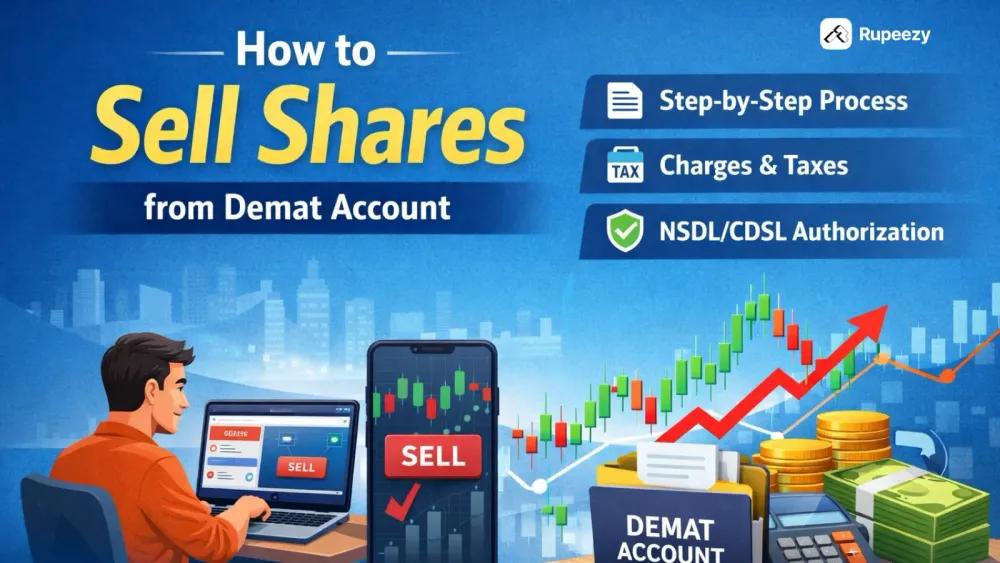
How to Sell Shares from Demat Account

 Last Updated: 26 August, 2026
 13 min read




00:00 / 00:00


Summary :
|
Today, investing in the stock market in India has become easier than ever. By 2026, more than 210 million demat accounts will be activated in the country, which clearly shows that millions of new investors are entering the market every year. But one question comes to many people's mind - "How to sell shares from a demat account?" If you are also starting to invest, there is no need to panic. I will explain to you in simple language how to sell shares from a demat account, what role the broker plays in this, and how to get the money after selling the shares. After this guide, you will be able to confidently understand the entire process.

What is a Demat Account and How It Stores Shares ?
If you want to start investing in the stock market, it's important to first understand a Demat Account. Demat stands for Dematerialized Account. This means that your purchased shares are no longer stored in paper form, but in digital or electronic form. You can understand it this way: just as your money is stored digitally in a bank account, a Demat account is a digital locker for storing your shares. Suppose you purchased 20 shares of a company. Now, you won't receive these shares in the form of a physical certificate. Instead, they will be credited directly to your Demat account.
This is why buying and selling shares today has become easier and faster than ever before.
Who stores shares in India?
Now comes an important question: where are your shares safe?
In India, depositories are responsible for safekeeping. These institutions electronically record and secure all investor shares. There are two main depositories operating in India.
NSDL (National Securities Depository Limited) : It is one of India's first and largest depositories, safeguarding the shares of millions of investors.
CDSL (Central Depository Services Limited) : It is the second largest depository, managing millions of Demat accounts in India.
How the Stock Market System Works
The entire process of buying and selling shares takes place through three main institutions.
Component | Role |
Stock Exchange (NSE / BSE) | where shares are bought and sold |
Broker (like Rupeezy) | Provides investors with a trading platform |
Depository (NSDL / CDSL) | Keeps investors' shares safe |
This means that when you buy shares:
The order is placed through the broker's platform.
The trade takes place on the stock exchange.
The purchased shares are held securely in your Demat account through a depository.
Understand how a Demat Account works with an example.
Suppose you opened a Demat account through a broker like Rupeezy and purchased 10 shares of a company.
The entire process goes like this :
You placed an order to buy shares on Rupeezy's trading platform.
Your order was executed on the NSE or BSE.
Those shares were credited to your Demat account in the next settlement cycle.
Now, when you decide to sell these shares, the Demat account will be debited and the money will be credited to your trading account.
Role of a Broker in Selling Shares From a Demat Account
Why is a Stock broker necessary?
Many new investors think they can sell shares directly from their Demat account, but this is not the case. The main purpose of a Demat account is to keep your shares safe. To buy or sell shares, you always need a broker's trading platform. A broker acts as a connection between you and the stock exchange (NSE or BSE). When you place a sell order, the broker transmits the order to the exchange, and the trade is executed when a buyer is found.
What facilities does a stockbroker offer to investors?
When you open an account with a broker, you not only get access to trading facilities but also many essential tools.
Broker facility | Its advantage |
Trading Platform | From where you can buy and sell shares |
Market Access | Access to exchanges like NSE and BSE |
Portfolio Tracking | You can view all your investments in one place. |
Order Execution | Sends your buy and sell orders to the exchange |
Things to Check Before Selling Shares From Demat Account
Before deciding to sell shares, it's wise to check a few important things. This will help you execute your trade smoothly and avoid any mistakes or delays.
Are the shares available in your holdings?
First, it's important to check that the shares you want to sell are in your holdings section. When you purchase delivery shares, they are credited to your Demat account after settlement. Only those shares that are available in your holdings can be sold.
Check the Settlement Status
If you recently purchased shares, keep in mind that they can only be sold after settlement. India currently has a T+1 settlement cycle, meaning shares are fully settled in your Demat account by the next trading day of the trade.
Observe Market Hours
Equity shares can generally only be sold during stock market hours.
Market Session | Timing |
Pre-open session | 9:00 AM – 9:15 AM |
Normal trading session | 9:15 AM – 3:30 PM |
If you want to place an order after the market closes, RupeeG also offers the facility of After Market Order (AMO), which gets executed on the next trading day.
Understand the difference between Delivery and Intraday Shares
Before selling shares, it is important to understand what type of trade you are making.
Trade Type | Meaning |
Delivery | Shares are stored in the Demat account and you can sell them any day |
Intraday | Shares are bought and sold on the same day and are not held in demat. |
Decide on your order type in advance.
When placing a sell order, also decide whether you will use a market order or a limit order.
Market order : Sells immediately at the current market price.
Limit order : Sells only at the price you set.
Be aware of charges and taxes.
Certain charges, such as brokerage, STT, GST, and DP charges, may apply when selling shares. Therefore, it's best to understand the potential charges before placing a trade.

How to Sell Shares From Demat Account
Step 1: Login to Rupeezy App or Rupeezy Flow Web Platform
First, you need to log in to the Rupeezy App or Flow Web Trading Platform.
The login process is simple:
Open the App or Flow Web Platform
Enter your mobile number
Perform OTP verification
Finally, enter your MPIN
After entering the MPIN, you are taken directly to the trading dashboard.
Step 2: Go to the Positions Section
After logging in, you'll see the Positions option in your dashboard.
Click on Positions.
Then select the Holdings tab.
The Holdings section will display all your delivery shares held in your Demat account.
Here, you'll see some important information for each stock:
Information | Meaning |
Stock Name | The company whose share is |
Quantity | How many shares do you have? |
Avg Price | What price did you buy it at? |
Current Price | Market price now |
P&L | Profit or Loss |
If you had purchased eligible shares through MTF for eligible stocks, the applicable MTF terms and repayment requirements should be considered before placing a sell order, including any applicable interest and other charges.
Step 3: Select Share in Holdings
Now click on the stock you want to sell.
After clicking, the Sell option will appear.
Clicking on the Sell option will open the order window.
Step 4: Fill Sell Order Details
Now you have to fill in some details to place the order.
Field | what to do |
Quantity | How many shares to sell |
Product Type | Holding must be selected |
Order Type | Market or Limit |
Price | In case of limit order |
If you choose a Market Order, the share is sold immediately at the current market price.
If you choose a Limit Order, the share will be sold at the price you set.
Step 5: You can also sell shares from the watchlist.
You can also sell your holding stocks from the watchlist.
Open the Watchlist
Click on the stock item.
Select Holding under Product Type.
Place a Sell Order.
Step 6: Authorization Process (DDPI / TPIN)
When selling shares, the broker needs permission to debit shares from your demat account.
Rupeezy's demat accounts are linked to NSDL depositories, and DDPI (Demat Debit and Pledge Instruction) can be enabled here.
If DDPI is active, then:
Shares can be debited as soon as a sell order is placed.
Other OTP verification is not required.
This makes the selling process fast and seamless.
If another broker uses CDSL, the process may be different.
Some brokers' demat accounts are linked to CDSL. In such cases, TPIN authorization is included in the selling process.
Step-by-step process:
Place a sell order
The system will redirect you to the CDSL authorization page
Enter the TPIN
Complete the OTP verification
Shares are debited from the demat account
NSDL vs CDSL Authorization
Feature | NSDL (DDPI) | CDSL (TPIN) |
Authorization | One-time DDPI setup | TPIN on every sell order |
Verification | No repeated verification needed | OTP verification required each time |
Process | Faster and smoother | Includes an additional authorization step |
What Happens After You Sell Shares
Once your sell order is executed on the stock exchange (NSE/BSE), a structured settlement process begins. This process involves debiting the shares from your demat account and crediting the sale proceeds to your trading account.
Shares are debited from your Demat Account :
As soon as your sell order matches the buyer's order and is executed, the required number of shares is debited from your Demat account. These shares are then transferred to the buyer's Demat account through the clearing system.
Funds are credited to the Trading Account :
After the trade is executed, the selling amount of the shares is credited to your broker's trading account. You can later transfer or withdraw this amount to your linked bank account.
Settlement Cycle - T+1 System :
The T+1 settlement cycle applies to the equity market in India. This means that the settlement process is completed by the next trading day after the trade is executed.
Step | What Happens |
Trade Day (T) | Sell ??order is executed on the stock exchange |
Next Trading Day (T+1) | Shares transfer and funds settlement is completed |
When can funds be withdrawn?
After settlement is complete, funds typically appear as a usable balance in your trading account. You can then request a withdrawal from your broker platform to your bank account.
If you're using the Rupeezy platform, there's an additional feature called Instant Payout.
With this feature, you can:
Request an instant withdrawal from your trading account.
Funds can be credited to your bank account within approximately 15–20 minutes (depending on bank processing).
This feature is especially useful for investors who want quick access to funds, without having to wait until the next day.
Charges When Selling Shares From Demat Account
When you sell shares, you incur not only brokerage charges but also exchange and government charges. The table below lists all the important charges that typically apply when selling equity shares.
Charge Type | Description | Example / Typical Rate |
Brokerage | The fee charged by the broker for executing the trade | Rs. 20 or 0.1% per order (whichever is lower) |
Securities Transaction Tax (STT) | Government tax levied on equity delivery trade | About 0.1% on the sell side |
Exchange Transaction Charges | Fees charged by NSE/BSE for processing trades | at approximately 0.003%-0.004% turnover |
SEBI Charges | Regulatory fees charged by market regulator SEBI | Approximately Rs. 10 per crore turnover |
GST | 18% GST on Brokerage + transaction charges + SEBI charges | 18% applicable |
Stamp Duty | State government tax that is applicable on the transaction | Applicable on Buy side (rate state dependent) |
Clearing Charges | Fees charged by the clearing corporation for the settlement process | Many brokers have zero or minimal |
DP Charges (Depository Participant Charges) | Charges levied on debiting shares from Demat account | Approximately Rs. 29.50 per sell transaction (including GST) |
Tax on Selling Shares in India
When you sell shares and make a profit, you're subject to Capital Gains Tax. This tax depends on how long you held the shares. Tax on listed equity shares is divided into two categories Short-Term Capital Gain (STCG) and Long-Term Capital Gain (LTCG).
Short Term Capital Gain (STCG) :
If you sell the listed shares within 12 months of purchase, then the profit on it is considered as Short Term Capital Gain.
Criteria | Details |
Holding Period | less than 12 months |
Tax Rate | 20% + applicable surcharge + 4% cess |
Example : If you bought shares for Rs. 50,000 and sold them for Rs. 60,000, the profit would be Rs. 10,000. This profit would be subject to a 20% STCG tax.
Long Term Capital Gain (LTCG) :
If you sell shares after holding them for more than 12 months, the profit is called Long Term Capital Gain.
Criteria | Details |
Holding Period | More than 12 months |
Exemption Limit | Gains up to Rs. 1.25 lakh tax-free |
Tax Rate | 12.5% ??tax + cess on gains above Rs. 1.25 lakh |
Example : If you made a profit of Rs. 200,000 on selling shares:
First Rs. 125,000 - No Tax
Remaining Rs. 75,000 - 12.5% ??LTCG tax
Common Mistakes Investors Make While Selling Shares
When new investors sell shares for the first time, they often make certain mistakes that can impact their overall returns. Understanding these mistakes in advance can help you make better investment decisions.
Selling Shares in a Market Panic :
Sometimes, investors panic when the market suddenly declines and sell shares in a hurry. However, short-term volatility is a normal part of the stock market. Therefore, panic selling without proper analysis can lead to losses.
Ignoring Charges and Taxes :
Many investors calculate profits based solely on the opening price and the selling price, but ignore brokerage, STT, GST, DP charges, and capital gains tax. These charges can reduce your final profit, so it's important to estimate them before trading.
Misusing Market Orders Instead of Limit Orders :
Using market orders in low-liquidity stocks may result in a lower price than you expected. In such a situation, it's safer to use a limit order.
Lack of a Clear Exit Strategy :
Many investors buy shares but don't decide when to sell them. A good investment strategy should always include a target price and stop-loss.
Selling Long-Term Investments Too Early :
Sometimes investors sell shares even with a small profit, while shares of strong companies can deliver better returns over the long term. Therefore, before selling any stock, it's important to evaluate the company's fundamentals and long-term potential.
Before deciding when to sell a stock, investors can also use a stock market heatmap to compare market performance and identify stocks showing relative strength or weakness. This can provide additional context when reviewing a stock’s recent performance before making an exit decision.
Conclusion
Selling shares from a Demat account has become quite easy these days; you just need to understand the correct process. If you keep the steps, charges, and tax rules in mind while trading, the selling process is smooth. Features like the simple interface and fast payouts on the Rupeezy platform make it even easier. Therefore, have a clear strategy in place when investing and sell shares wisely to ensure you get the best returns on your investments.
FAQs
Q1. Can I sell shares directly from a demat account?
No, a demat account only stores shares. To sell shares, you must place an order through the broker's trading platform.
Q2. How long does it take to receive money after selling shares?
India currently has a T+1 settlement cycle, so funds typically arrive in the trading account by the next trading day.
Q3. Can I sell shares anytime during the day?
You can sell shares during stock market hours (9:15 AM – 3:30 PM). An AMO (After Market Order) can also be placed after the market closes.
Q4. What is the difference between a market order and a limit order when selling shares?
In a market order, the shares are sold immediately at the current market price, whereas in a limit order, you place a sell order at your specified price.
Q5. What charges apply when selling shares?
Some charges like brokerage, STT, exchange charges, GST and DP charges may apply when selling shares.
The content on this blog is for educational purposes only and should not be considered investment advice. While we strive for accuracy, some information may contain errors or delays in updates.
Mentions of stocks or investment products are solely for informational purposes and do not constitute recommendations. Investors should conduct their own research before making any decisions.
Investing in financial markets are subject to market risks, and past performance does not guarantee future results. It is advisable to consult a qualified financial professional, review official documents, and verify information independently before making investment decisions.
Open Rupeezy account now. It is free and 100% secure.
Start Stock Investment


All Category