
Difference Between Takeover and Buyback

 Last Updated: 18 August, 2026
 6 min read




00:00 / 00:00


Key Highlights
|

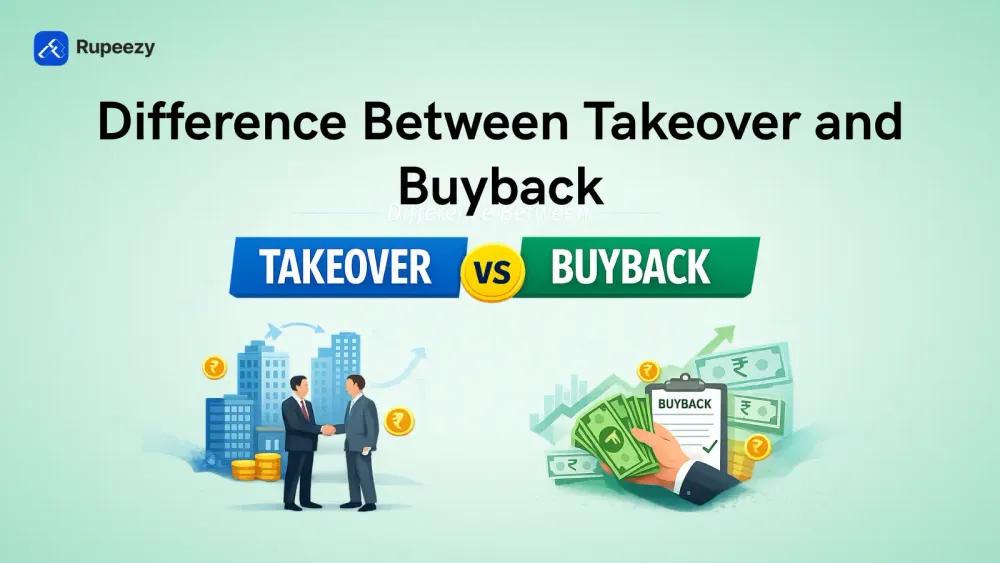
As an investor, you own the shares of a company. When you sell these shares or stocks back to the company, this is called the buyback process. But if a company purchases the shares of another company with ownership transfer as well, this is known as the takeover. While both involve shares and can affect stock prices, they are very different in purpose and execution.
This is why it becomes really important for everyone to understand the difference between a takeover and buyback. This will be very helpful in evaluating these events and how they will impact your investments or future returns.
In this guide, let us understand the takeover vs buyback meaning. Let us explore their features and what each means for you as an investor.
Difference Between Takeover and Buyback
Basis | Takeover | Buyback |
Meaning | One company acquires control of another company. | A company purchases its own shares from existing shareholders. |
Objective | Gain ownership, market share, or business expansion. | Return surplus cash and improve shareholder value. |
Ownership | Control shifts to the acquiring company. | Ownership remains with the existing shareholders who do not sell their shares. |
Shares Involved | Shares of the target company are acquired. | The company buys back its own shares. |
Number of Shares | Outstanding shares usually remain unchanged. | Outstanding shares reduce after the buyback. |
Impact on EPS | Depends on business performance after acquisition. | Earnings per share generally increase due to fewer shares. |
Cash Usage | Used to acquire another company. | Used to repurchase the company's own shares. |
Decision Maker | Acquiring company and target company. | Company's board of directors with regulatory approval. |
Purpose for Investors | May provide an exit opportunity at a premium. | Gives shareholders the option to sell shares back to the company. |
What Is a Takeover?
A takeover is a corporate action. It is one where one company acquires a controlling stake in another company. After the acquisition, the acquiring company gains ownership. This also includes the transfer of management control to the target company as well.
Features of a Takeover
Involves acquiring a controlling stake in another company.
Transfers ownership and management control to the acquiring company.
Can be friendly or hostile.
Helps companies expand into new markets or industries.
May involve cash, shares, or a combination of both as payment.
Requires compliance with regulatory and legal requirements.
Benefits of a Takeover
Accelerates business growth.
Increases market share.
Helps with the customer base expansion.
Provides access to new products, technology, and talent.
Better cost and operations to lead.
Strengthens the company's competitive position.
Disadvantages of a Takeover
Requires significant capital investment.
Integration of operations can be challenging.
May lead to cultural clashes between companies.
Can face regulatory approvals and delays.
Risk of overpaying for the target company.
Increased financial and operational risks for the second company.

What Is a Buyback?
A buyback is also known as a share buyback or share repurchase. It is a simple process where the company buys back its own shares from its shareholders. This is where the ownership is transferred to the company as it is. This reduces the number of outstanding shares and increases the ownership percentage of the remaining shareholders.
Features of a Buyback
The company repurchases its own shares from shareholders.
Reduces the total number of outstanding shares.
Can be conducted through a tender offer or the open market.
Uses the company's surplus cash or reserves.
Increases the ownership percentage of remaining shareholders.
Regulated by market authorities and company laws.
Benefits of a Buyback
Improves earnings per share (EPS).
Supports the company's share price.
Returns surplus cash to shareholders.
Signals management's confidence in the business.
Increases the ownership stake of remaining shareholders.
Improves financial ratios such as EPS and ROE.
Disadvantages of a Buyback
Reduces the company's cash reserves.
May limit funds available for future expansion.
Benefits are only for shareholders who participate or continue holding shares.
Can be viewed as short-term financial management if not backed by strong fundamentals.
May increase financial risk if funded through debt.
Does not guarantee a long-term increase in the share price.
Takeover vs Buyback: What's Best for the Investor?
Buyback and takeover are the two most common corporate share purchase plans that are used by companies. While the reasons to exercise both are similar, the impact on the company would be different. Both of these are approved by the SEBI.
A takeover is suitable for companies looking to expand their business. This is their opportunity to enter new markets. Also, the buyback is an opportunity to get more control in the hands of the company. This is good when you are looking to reduce the number of outstanding shares.
Now, when you are an investor, here is what you should know:
Takeover usually do not impact your shareholding. Your shares are transferred to another company. There can be a change in valuation based on the terms of the takeover. You can sell the shares in the market if you wish to do the same.
Buyback is the process of no longer holding the shares of the company. This impacts your portfolio, and you would no longer be holding any shares or the forthcoming profits.
If you continue holding shares after evaluating a corporate action, a margin trading facility (MTF) can allow you to buy eligible shares by paying only a portion of the total trade value upfront, subject to applicable terms and charges.
For investors, the better corporate action depends on the company's financial health, long-term strategy, and the potential impact on future growth and returns.
Conclusion
Takeover and buyback are two important corporate actions. But if you actually evaluate these two, you will see that these are different in nature and will impact you as an investor uniquely. Knowing the impacts and the effects on your portfolio will help you to plan better.
Understanding the difference between takeover and buyback enables investors to interpret corporate announcements more effectively and make informed investment decisions. Stay updated on such corporate actions with Rupeezy to build a stronger investment strategy.
FAQs
1. What is the difference between takeover and buyback?
A takeover is when a company takes over or purchases the shares of another company, and also the ownership as well. A buyback involves a company repurchasing its own shares from existing shareholders.
2. Does a buyback change the ownership of a company?
No. A buyback does not change the company's control or management. It only reduces the number of outstanding shares and increases the ownership percentage of remaining shareholders.
3. Is a takeover good for shareholders?
A takeover can be good for shareholders as they will still have the shares and will gain from a better market as well. They can also get a premium over the market price for their shares, or if the acquisition creates long-term value.
4. Why do companies announce share buybacks?
Companies announce buybacks to return surplus cash to shareholders. This helps to reduce the outstanding shares and will also be helpful in improving the earnings per share.
5. Which is better for investors: a takeover or a buyback?
It depends on the company's objectives and financial position. A successful takeover can help with better future growth and will also support your investment portfolio as well.
The content on this blog is for educational purposes only and should not be considered investment advice. While we strive for accuracy, some information may contain errors or delays in updates.
Mentions of stocks or investment products are solely for informational purposes and do not constitute recommendations. Investors should conduct their own research before making any decisions.
Investing in financial markets are subject to market risks, and past performance does not guarantee future results. It is advisable to consult a qualified financial professional, review official documents, and verify information independently before making investment decisions.
Investments in securities market are subject to market risks, read all the related documents carefully before investing. Rupeezy (SEBI RA Registration: INH000013332) provides this content for informational purposes; any securities quoted are for educational display and not as a recommendation. All charts and graphs are based on independent research and reliable sources for the period mentioned within the specific data set. Sometimes we take graphs from external sources. This communication does not promise or assure any fixed, guaranteed, or indicative returns to any client. For our complete registered office address, Member ID, and full SEBI registration details, please refer to our official website.
Open Rupeezy account now. It is free and 100% secure.
Start Stock Investment
All Category