
What Is Buyback of Shares?

 Last Updated: 18 August, 2026
 9 min read




00:00 / 00:00


Key Highlights
|

Share buyback is a simple process where the company asks the shareholders to sell their shares back to the company. While this might sound like a really simple process, the key here is to understand the reason why this might be happening. Also, knowing the complete share buyback process can help you analyze whether this is a good decision or not.
At the same time, many people think that when companies call for a share buyback, this becomes a mandatory obligation for shareholders to follow. Well, this is not completely true, as there is a complete process in place that is considered.
So, read this guide to know everything, starting from the stock buyback meaning to the benefits. Also, understand how buyback vs dividend actually work in a real-life situation.
About Share Buyback
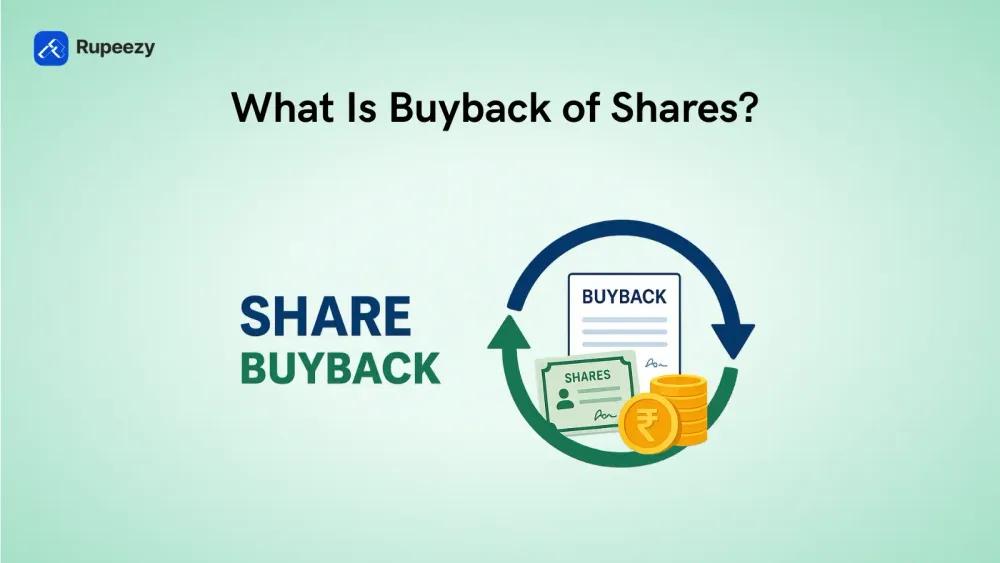
A share buyback, also known as a stock buyback, is a corporate action in which a company buys back its own shares from shareholders. In the simplest terms, it is the process by which the company purchases its shares back from the shareholders.
The shares are then held in the treasury or are cancelled. This is usually done when the company feels that its share price is being undervalued in the market. By buying the shares back, the company aims to bring the share value back to stability. This is a sign that the management has trust in the future growth prospects of the company.
To understand the stock buyback meaning better, here is a quick example for you.
Suppose a company has 10 crore outstanding shares. Now, the company decides to buy back 1 crore shares. Once the buyback is completed, there will be 9 crore shares in circulation. As a result, each remaining share represents a slightly larger ownership stake in the company.
Why Companies Announce Share Buyback?
This is one of the common questions that people have when they come across any buyback announcement. Well, while there can be multiple reasons why a company might do this, there are a few which are more common in nature.
The common reasons for the launch of the corporate buyback program by any company are as follows:
Shares are trading below their perceived intrinsic value.
Surplus cash is available on the company's balance sheet.
Improvement in earnings per share (EPS) is a key objective.
Better value for the existing shareholders.
Reduced share dilution by ESOPs.
Shows a deep trust in future growth.
Managing cash flows.
Better results in financial ratios like EPS or ROE.
Limited or restricted opportunities in the recent period.
Capital structure optimization becomes a strategic priority.
How Share Buyback Works?
Now that you know the share buyback meaning, you must also know how it works. The steps to know are:
1. Board Approves the Buyback
The approval is the sign to get started. It is where the board finalises the price and process. It also confirms the number of shares to be repurchased.
2. Buyback Announcement Is Made
This is done once the company gets approval. This will include all the details, including the date, price, lot size, and any conditions associated.
3. Shareholders Become Eligible
The announcement is key information here. This helps to find the shareholders who are eligible for the buyback scheme. Not all will be in this category, so a proper analysis is key here.
4. Shareholders Submit Their Shares
All the candidates who fall in the category and are willing to tender their shares, they can do so. This should be done in the time allotted, as a delayed process can get rejected.
5. Company Accepts and Purchases Shares
The company reviews the shares submitted by shareholders and accepts them according to the applicable rules. Once accepted, the company pays the shareholders for the purchased shares.
6. Repurchased Shares Are Extinguished
Usually, the shares which are repurchased are cancelled. The aim is to reduce the overall number of shares and help the company achieve better value.
7. Buyback Process Is Completed
The company publishes the final results of the buyback. This will highlight the details and the updated EPS for people to know the future insights.
How Is Share Buyback Price Determined?
As a shareholder, you must understand how the price is finalized. While usually people think it's the market price, there are a few methods used. These are:
1. Discounted Cash Flow (DCF) Method
It finds the present value of the shares. This is based on future cash flows. The idea is to know the worth based on future growth potential.
2. Book Value Method
It first finds the net assets after liabilities of the company. This is then divided by total outstanding shares to reach the price per share.
3. Comparable Company Method
It is a method where the value is compared with other similar small businesses. It uses the Price-to-Earnings (P/E) ratio and the Price-to-Book (P/B) ratio generally.
4. Market Price Method
This method considers the current market price and recent trading history of the stock. There can be a premium in the price as well.
The company checks all the factors before selecting one of these for better value.
Regulatory Guidelines for Share Buybacks
Share buybacks in India are regulated by SEBI and the Companies Act, 2013. This is to protect the interests of the company and shareholders. The key rules are:
Should be confirmed and authorized by the company's Articles of Association.
Only upto 25% of the paid-up equity capital can be bought back in a financial year.
Small buybacks can be approved in a board resolution.
Larger buybacks need proper shareholder approval through a special resolution.
The debt-to-equity ratio after buyback should be max at 2:1.
Only fully paid-up shares can be bought back.
Every detail of the buyback should be shared.
Buyback shares must be cancelled as per the final proposal shared at the time suggested.
Similar kind of share issuance during the same period is not allowed.
Buyback Shares Benefits
Share buybacks can benefit both the company and its shareholders when executed for the right reasons. Some of the key buyback shares benefits include:
Higher earnings per share (EPS) due to fewer shares outstanding.
Larger ownership stake for existing shareholders.
There can be an increase in the share price due to low supply.
Improved use of the cash reserves by the company.
A sign of management confidence in the future of the company.
Supports flexibility to manage more tasks.
Potential long-term value creation for remaining shareholders.
Increased attractiveness of the stock to investors.
If a buyback makes an eligible stock attractive to investors, they can also consider a Margin Trading Facility to buy shares by paying only a portion of the trade value upfront. However, investors should consider the applicable interest costs, stock eligibility, liquidity, and market risks before using MTF.
Buyback Impact on Stock Price
Many people focus on exploring the impact of share buyback. This is valuable for the shareholders as there is a direct link with growth and income. Some of the impacts to know are:
Improved Investor Confidence: A buyback announcement can signal that management believes the stock is undervalued and expects stronger future performance.
Reduced Share Supply: Since the company repurchases and cancels shares, there are now fewer shares. Now difference in supply and demand impacts prices here.
Higher Earnings Per Share (EPS): The company’s earnings are now distributed among fewer shares. This increases the EPS, which is good for shareholders.
Better Financial Ratios: These ratios are the ones that help determine the performance of the company. An improvement in the ratios is helpful for the company.
Short-Term Price Support: The company's active purchase of shares can increase demand. This can help boost the company greatly.
Potential Long-Term Value Creation: If the company repurchases shares at a good valuation and is one that is growing, it becomes a good proposition for investors.
However, not every buyback leads to a rise in stock prices. This is largely dependent on the company and how well it manages the working, funds, and plans for the future.
Buyback vs Dividend
Many people confuse buybacks and dividends in terms of which is better. Here is a quick buyback vs dividend for you.
Factor | Share Buyback | Dividend |
Meaning | Company repurchases its own shares from shareholders. | Company distributes a portion of its profits to shareholders. |
Form of Return | Shareholders receive money only if they participate in the buyback. | Eligible shareholders receive cash dividends as per the schedule. |
Impact on Share Count | Lower number of outstanding shares. | No impact on the number of shares. |
Impact on EPS | Increases the EPS. | No direct impact on EPS. |
Investor Choice | Participation is voluntary. | No shareholder action needed. |
Market Perception | Sign of future growth and confidence. | Shows better earnings and profits. |
Long-Term Impact | Can increase the ownership percentage of remaining shareholders. | Provides regular income to shareholders. |
Conclusion
A share buyback is one of the ways companies return value to shareholders while bringing the value of the shares in the market. While there are various reasons why a company might go for a buyback, it is important to note that they are mainly linked to growth.
This is why knowing the terms and aspects of the share market is important for you as a shareholder. As an investor, you should look for a platform that can give you better insights into investing. Consider Rupeezy. Get the support and details you need here easily. Start investing with confidence that can push you ahead.
FAQs
1. Is Share Buyback A Good Thing?
A share buyback is generally considered positive. This is because it increases the EPS and is a sign of confidence in the future growth. But the overall impact and outcome are based mostly on the management.
2. Do Stocks Go Up After Buyback?
Stocks often react positively to buyback announcements. This is mainly because the outstanding shares are reduced and there is a rise in investor sentiment. But again, there is no guarantee for a rise.
3. Should I Sell My Shares During A Buyback?
There is no one-size-fits-all answer. Investors should compare the buyback price with the current market price first. If there is no compulsion, take decision based on analysis.
4. Can I Refuse Share Buyback?
Yes. Participation in a share buyback is voluntary. The choice is based on the shareholder, until there is a condition linked.
5. Who Owns The Shares After A Share Buyback?
The repurchased shares are usually cancelled. The aim is to help with reducing outstanding and better valuation.
The content on this blog is for educational purposes only and should not be considered investment advice. While we strive for accuracy, some information may contain errors or delays in updates.
Mentions of stocks or investment products are solely for informational purposes and do not constitute recommendations. Investors should conduct their own research before making any decisions.
Investing in financial markets are subject to market risks, and past performance does not guarantee future results. It is advisable to consult a qualified financial professional, review official documents, and verify information independently before making investment decisions.
Investments in securities market are subject to market risks, read all the related documents carefully before investing . Rupeezy (SEBI RA Registration: INH000013332) provides this content for informational purposes; any securities quoted are for educational display and not as a recommendation. All charts and graphs are based on independent research and reliable sources for the period mentioned within the specific data set. Sometimes we take graphs from external sources. This communication does not promise or assure any fixed, guaranteed, or indicative returns to any client. For our complete registered office address, Member ID, and full SEBI registration details, please refer to our official website.
Open Rupeezy account now. It is free and 100% secure.
Start Stock Investment
All Category