
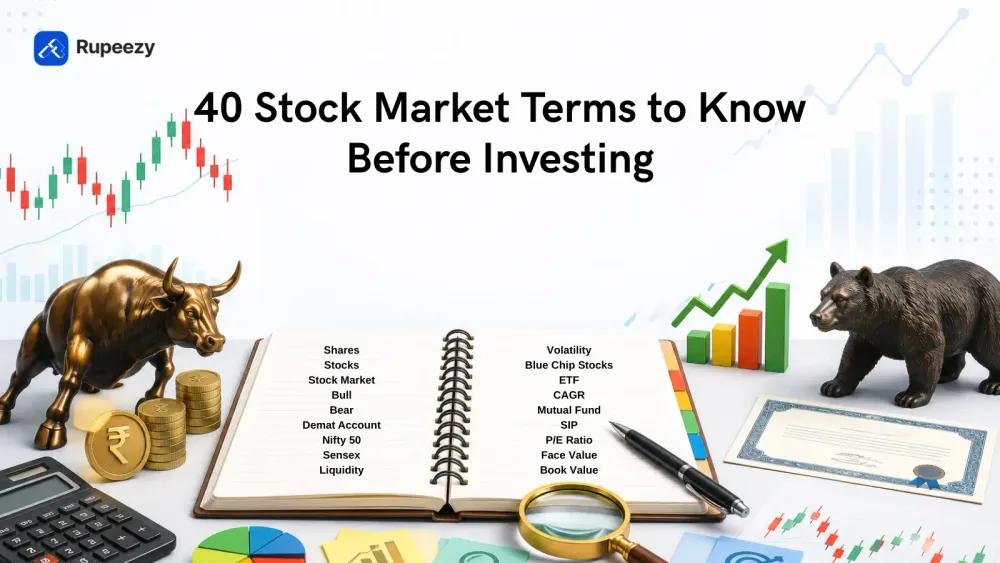
40 Stock Market Terms to Know Before Investing

 Last Updated: 02 June, 2026
 9 min read




00:00 / 00:00


Key Highlights
|

Investing in the stock market becomes much easier when you understand the language used in it. Many beginners often feel confused when they first enter the market. They hear terms like market cap, IPO, dividend, or anything else, and suddenly, trading starts to feel a bit complicated.
But the reality is, this happens because you do not really understand the meaning of the basic stock market terms. So, in this guide lets explore the most common terms that you should know.
Why Learning Stock Market Terms Is Important
Many people who enter the stock market think that they will learn everything while doing. While this is a good idea, it can impact your trading a lot. You need to know the basic terms and concepts to ensure that you understand what you are doing.
Knowing investment terms every beginner should know can help you:
Understand the market movements better.
Know the stocks well.
Help with analysis and trading plans.
Support with planning.
Drive confidence in investing.
40 Important Stock Market Terms Explained
If you are a new trader in the market who is looking to learn trading, then knowing some basic terms can help you. To help you with the same, the top trading terminology is explained simply in the guide here. This simple share market learning guide will help you to trade better and take calls that can help with wealth creation over time.
So, here are the key terms that you should be aware of:
1. Stock
A stock represents ownership in a company. When you buy the stocks of the company, you get partial ownership in the company. This will offer you financial benefits, but also risks as well.
2. Share
A share is a single unit of ownership in a company. Companies divide ownership into shares so investors can buy small portions of the business through stock exchanges.
3. Stock Exchange
A stock exchange is a regulated marketplace. It is the place where you buy and sell shares. In India, there are two such places, which are:
4. IPO
IPO is the short form for the Initial Public Offering. It is the simple process where a company planning to go public offers its shares to the people. This is the first time public listing.
5. Market Capitalisation
It refers to the total value of the company’s outstanding shares in the market. It is calculated by multiplying the current share price by the total number of shares issued. It is of two types. The free-float only considers shares available for public trading, while the full market cap includes all company shares.
6. Bull Market
It is the phase marked by a continuous rise in share prices. This is the phase that is usually reflected by strong investor confidence, good economic conditions, and better participation in the market.
7. Bear Market
It is the phase where the share prices see a continue downfall. It is usually marked by weak market performance, low investor confidence, and lower participation.
8. Dividend
It is the portion of the profit of the company that is distributed to the shareholders. It is paid at regular intervals and is usually a percent or fixed value paid for shares held. Dividends can be yearly, quarterly, or six monthly.
9. Portfolio
It is the basis of the assets that an investor holds. This can include various investment assets. These are the shares, bonds, mutual funds, and others.
10. Demat Account
The demat account is the place where all the shares and securities are held electronically. There is no need for physical certificates. It is mandatory for investors who want to buy or sell shares in India.
11. Trading Account
A trading account is used to place buy and sell orders in the stock market. It is the link between your demat account and the stock exchange.
12. Broker
A broker is a registered intermediary or platform. This is the one that helps the investors to trade in the market. As an investor, you will also get guidance, support, and tools with the help of the broker.
13. Sensex
The BSE SENSEX is the benchmark stock market index of the Bombay Stock Exchange. It tracks the performance of 30 large and financially strong companies in India.
14. Nifty 50
The NIFTY 50 is the benchmark index of the National Stock Exchange. It represents the performance of 50 major companies across multiple sectors in India.
15. Volatility
It shows how much and how quickly stock prices move over time. Higher volatility means there are high price fluctuations. This also marks an increase in the risk level as well.
16. Liquidity
Liquidity refers to how easily an investment can be bought or sold. This is also linked with the price as well. When there is high liquidity, trading becomes easier.
17. Blue Chip Stocks
Blue chip stocks belong to large, financially stable, and well-established companies with strong reputations. These companies have consistent performance and a good history.
18. Penny Stocks
Penny stocks are low-priced shares of small companies. These are the companies that generally trade at very low market prices. They are highly risky as they offer low liquidity and price volatility.
19. Equity
Equity represents ownership in a company through shares. Equity investors have the opportunity to participate in profits as well as the risks of the company. This is based on the shares held.
20. Debt Market
The debt market is where fixed-income securities are traded. These are the options, such as bonds, treasury bills, and government securities are traded. Investors earn returns in the form of interest.
21. Mutual Fund
A Mutual Fund pools money from multiple investors and invests it across multiple securities. These can be stocks, bonds, or other assets. The overall fund is placed under professional fund management for diversification and growth.
22. SIP
SIP stands for the Systematic Investment Plan. It allows investors to invest in the mutual funds in easy installments. You need to pay a fixed amount every month, and there is no need for lumpsum amount. It is perfect for beginners.
23. ETF
ETF stands for Exchange Traded Fund. It is a market-traded investment fund. It tracks indices, commodities, or sectors. These can be bought and sold in the market.
24. CAGR
CAGR stands for Compound Annual Growth Rate. It measures the average annual growth rate of an investment over a specific period. This also considers the effect of compounding returns.
25. P/E Ratio
It is one of the most common performance ratios. The Price-to-Earnings ratio compares a company’s current share price with its earnings per share. It shows if a company is undervalued or overvalued.
26. Earnings Per Share
Earnings Per Share is known as EPS. It shows the amount of profit that a company earns from its outstanding shares. The higher EPS means the company is working better and is more profitable now.
27. Face Value
Face value is the original value of a share. This is the value that is assigned by the company during the issuance.
28. Book Value
Book value represents the company’s net asset value. You gain this after subtracting liabilities from total assets. It helps investors estimate the company’s fundamental financial worth.
29. Bonus Shares
Bonus shares are additional shares issued by a company to existing shareholders. These are shared with no extra cost. These shares are distributed from the company’s accumulated reserves or profits.
30. Rights Issue
A rights issue allows existing shareholders to buy additional company shares. These shares are offered at a discounted rate.
31. Stop Loss
A stop loss is a risk management tool. This allows you to set a price level that will make the shares be sold on their own with no intervention. It reduces the losses.
32. Intraday Trading
Intraday trading involves buying and selling shares within the same trading session. You do not hold any shares overnight. The trader gains from the short-term price movements and needs consistent following.
33. Delivery Trading
Delivery trading involves purchasing shares and holding them beyond one trading day. This is usually used when the target is building wealth over time.
34. Capital Gain
A capital gain is the profit earned when you sell your investment. It is calculated by finding the difference between the purchase and the selling price after accounting for applicable expenses or taxes.
35. Short Selling
Short selling is a trading strategy. It is one where the investors sell the borrowed shares while expecting that the prices may fall later when they can repurchase the same. The trade-off will help to make the profits.
36. Circuit Limit
Circuit limits are price movement restrictions imposed by stock exchanges to control extreme volatility and prevent sudden, sharp rises or falls in stock prices during trading.
37. Market Order
A market order is an instruction to buy or sell a stock. It follows the guidance of the best price that you mark based on the market price. This is done without waiting for a specific price target.
38. Limit Order
A limit order allows investors to buy or sell shares at a predetermined price. This means your order will be processed only when the market reaches the price level that was mentioned.
39. Diversification
Diversification is the practice of spreading investments across different asset classes, sectors, or securities. This is mainly done to reduce overall investment risk and improve portfolio stability.
40. Risk Appetite
Risk appetite refers to the amount of financial risk an investor is comfortable taking. It is based on factors like age, goals, income, investment experience, and financial situation.

Conclusion
Knowing the stock market terms is a good way to start investing and trading. This will allow you to know the details well and will help you with better planning as well. For those who are beginners, this is a very important stage. So, if you are planning to start investing and trading, visit Rupeezy. Explore the different options and choices to start trading better.
FAQs
1. What are the most important stock market terms beginners should know?
There are various terms in the stock market that you should know. Some of these are the stocks, IPO, stop loss, capital gain, intraday, and diversification.
2. Why should beginners learn stock market terminology?
Learning stock market terms can help beginners to start trading better. They can make informed decisions and ensure better outcomes.
3. What is the difference between trading and investing?
Trading mainly focuses on short-term buying and selling for quick profits. Investing is done with the aim of long-term profit creation.
4. How can beginners start learning about the stock market?
There are various ways to learn about the stock market. You can check websites, news, books, and even follow insights online.
5. What mistakes should beginners avoid while investing?
The mistakes that the beginners should avoid are investing without research or analysis. Following emotional trading is also a mistake. These should be avoided.
The content on this blog is for educational purposes only and should not be considered investment advice. While we strive for accuracy, some information may contain errors or delays in updates.
Mentions of stocks or investment products are solely for informational purposes and do not constitute recommendations. Investors should conduct their own research before making any decisions.
Investing in financial markets are subject to market risks, and past performance does not guarantee future results. It is advisable to consult a qualified financial professional, review official documents, and verify information independently before making investment decisions.
Investments in securities market are subject to market risks, read all the related documents carefully before investing . Rupeezy (SEBI RA Registration: INH000013332) provides this content for informational purposes; any securities quoted are for educational display and not as a recommendation. All charts and graphs are based on independent research and reliable sources for the period mentioned within the specific data set. Sometimes we take graphs from external sources. This communication does not promise or assure any fixed, guaranteed, or indicative returns to any client. For our complete registered office address, Member ID, and full SEBI registration details, please refer to our official website.

Open Rupeezy account now. It is free and 100% secure.
Start Stock Investment


All Category