
Global Index vs Indian Index

 Last Updated: 18 August, 2026
 8 min read




00:00 / 00:00


Key Highlights
|

If you have ever wondered why news channels discuss both the Nifty 50 and the S&P 500, the answer is simple. They measure different markets.
An Indian index shows how the Indian stock market is performing. On the other hand, a global index reflects the performance of companies listed in international markets. Both help you understand the market, but there are some differences.
Knowing the difference between global and Indian index becomes important as more Indian investors are exploring international investments alongside domestic stocks. Whether you are following the Sensex for Indian market updates or keeping an eye on the Nasdaq for global technology stocks, understanding what these indices represent can help you interpret market movements better.
In this guide, we'll explain how global and Indian indices differ, their importance, and which one deserves your attention as an investor.
Difference Between Global Index and Indian Index
Basis | Global Index | Indian Index |
Meaning | Tracks the performance of companies listed in international markets or multiple countries. | Tracks the performance of companies listed on Indian stock exchanges. |
Market Covered | Global or country-specific international markets | Indian stock market |
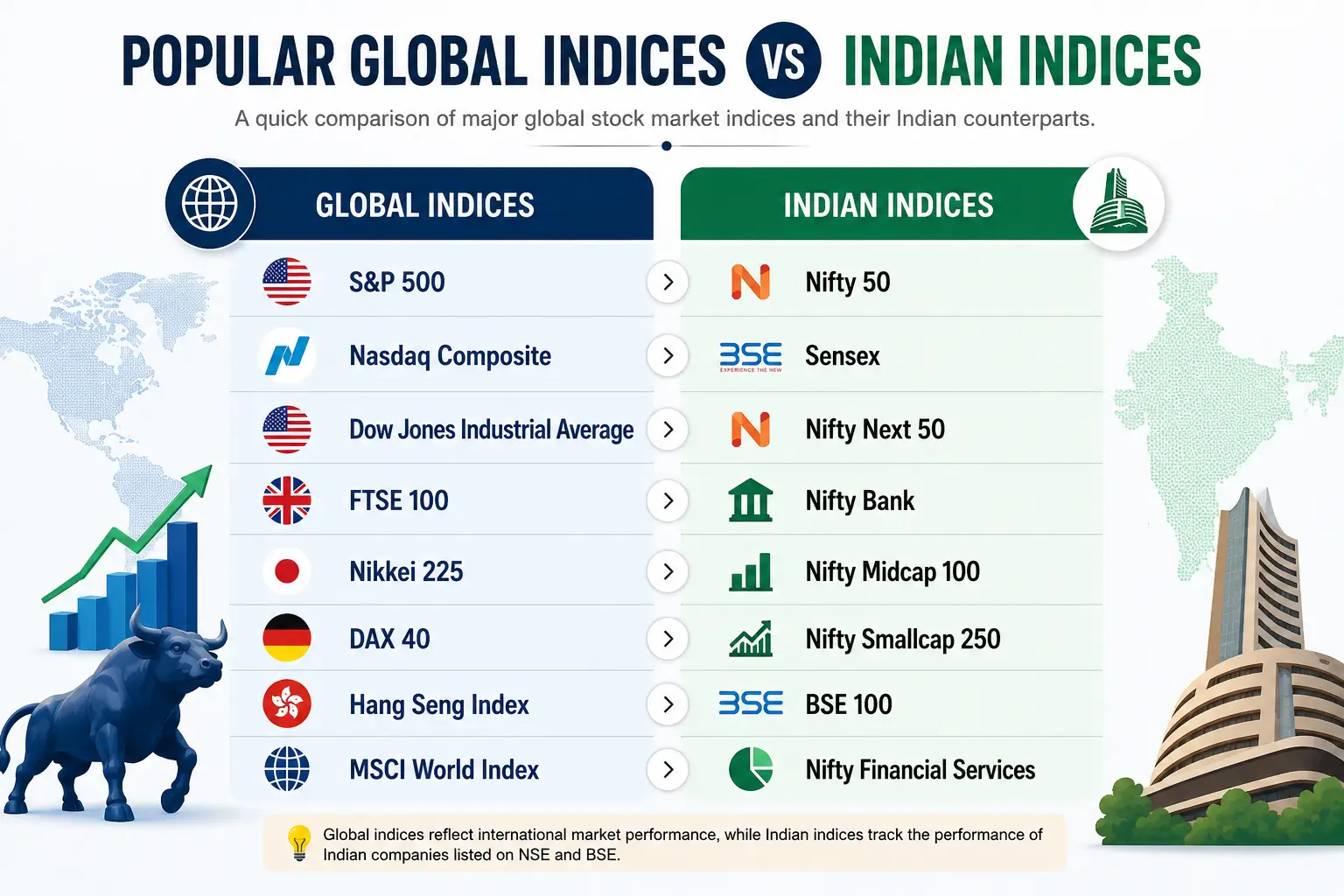
Examples | S&P 500, Nasdaq Composite, FTSE 100, Nikkei 225, MSCI World Index | Nifty 50, Sensex, Nifty Bank, Nifty Next 50 |
Companies Included | Foreign companies listed in global markets | Companies listed on NSE or BSE |
Currency | USD, GBP, JPY, EUR, or other currencies | Indian Rupees (Rs.) |
Main Purpose | Measures international market performance | Measures the performance of the Indian stock market |
Key Factors | Global economy, interest rates, and geopolitical events | Indian economy, RBI policies, corporate earnings, and government policies |
Best For | Investors seeking international exposure | Investors focused on the Indian market |
What Is a Global Index?
A global stock index is a benchmark at the global level. It measures the performance of a selected group of companies listed outside India. These indices help investors understand how a country's stock market works. It also shows how multiple international markets are performing over a period.
Here is a simple explanation to understand the same. Say the S&P 500 gained 2%. It means the value of 500 leading companies in the United States has increased. Similarly, if the FTSE 100 is another index. If this increases, then you can say that the best companies in the United Kingdom are now earning better.
Investors often look at these indices to understand the broader direction of a market. This helps with better investment calls.
Key Features of a Global Index
Represents companies listed in international stock markets.
Reflects the economic performance of a country or a group of countries.
Includes businesses from different industries depending on the index.
Acts as a benchmark for global mutual funds and ETFs.
Helps investors compare international market performance.

What Is an Indian Index?
An Indian index measures the performance of selected companies listed on Indian stock exchanges. This can be with the National Stock Exchange (NSE) or the Bombay Stock Exchange (BSE). It gives investors a snapshot of how the Indian stock market is performing on any given day.
You can understand this here. Nifty 50 tracks 50 of the largest companies listed on the NSE. At the same time, Sensex follows 30 established companies listed on the BSE. There are companies from all sectors, and following this can help you know the market trends.
Investors, analysts, and fund managers closely monitor these indices. This helps them to manage the plans better and ensure products work towards the goals set.
Key Features of an Indian Index
Tracks companies listed in India.
Reflects the performance of the Indian economy.
Serves as a benchmark for Indian mutual funds and ETFs.
Includes broad market, sectoral, and thematic indices.
Widely used by retail and institutional investors.
Detailed Difference Between Global and Indian Index
While you already have the snapshot of the difference, here is a detailed view that will help you analyse better.
1. Companies They Track
The biggest difference lies in the companies included.
An Indian index is one that tracks the local index of the businesses in India. These include companies like Reliance Industries, TCS, HDFC Bank, and Infosys.
A global index is one that tracks companies that are located outside of India. Depending on the index, these could include Apple, Microsoft, Amazon, Toyota, Samsung, or HSBC.
Simply put, the companies change because the markets are different.
2. Market Representation
Every stock index represents the market it belongs to.
The Nifty 50 and Sensex indicate how the Indian equity market is performing. Likewise, the S&P 500 reflects the US market. Then the Nikkei 225 represents Japan's stock market.
This is why a strong rally in the US market does not always mean Indian markets will also rise on the same day.
3. Factors That Influence Their Performance
Indian indices primarily react to domestic events such as:
RBI policy announcements
Union Budget
Inflation
Corporate earnings
Government reforms
Global indices are influenced by broader developments like:
US Federal Reserve decisions
Global inflation
International trade
Oil prices
Geopolitical conditions
Currency movements
While these factors are different, global events often have an indirect impact on Indian markets as well.
4. Diversification
Global indices provide exposure to companies across different countries and industries. This reduces dependence on the performance of a single economy.
Indian indices, however, are limited to companies listed in India. Although they cover multiple sectors, they remain linked to the country's economic performance.
For investors looking to spread risk geographically, global indices offer an added layer of diversification.
5. Investment Opportunities
Indian investors can directly invest in companies included in Indian indices. This is done through stocks, mutual funds, or index funds.
Global indices are not directly investable. This means the investors can gain exposure through international mutual funds, ETFs, or funds that replicate these benchmarks.
This way, the investors can invest better and even earn from the global companies.
6. Currency Exposure
Indian indices are measured in Indian Rupees (Rs.). Global indices are calculated in their respective currencies, such as the US Dollar, British Pound, Japanese Yen, or Euro.
This is why the companies have an impact of currency exchange as well.
7. Purpose for Investors
Indian indices help investors understand the performance of the domestic market and compare Indian investment products.
Global indices help investors monitor international markets, identify global trends, and evaluate overseas investment opportunities.
Many experienced investors follow both to get a complete picture of the financial markets.
Why Do Global Markets Affect the Indian Stock Market?
Major movements in global markets often influence investor sentiment in India. This impacts how the companies operate and even their investments and production as well. Simply take crude oil here. A rise in price can impact multiple sectors at the same time.
This is why investors frequently monitor both global and Indian indices before making investment decisions.
Can Indian Investors Invest in Global Indices?
Yes. Indian investors can invest in global markets through:
International mutual funds
Global ETFs
International brokerage platforms, where permitted
These investment options allow investors to gain exposure to global companies. This is without purchasing every individual stock.
Which One Should You Track?
If your investments are limited to Indian stocks and mutual funds, tracking the Nifty 50 or Sensex will usually be sufficient.
But if you are investing in international funds, then the global indices are important. Also, if you wish to stay ahead of the rest and understand which fund is better to select now based on global situations, you must know what is happening in the global market. All this will help you greatly.
Conclusion
Global and Indian indices may serve the same purpose, but they represent different markets and investment opportunities. Tracking them can help you invest better by understanding what is happening in the market. But this is true when you have the right partner on your side.
At Rupeezy, we believe informed investing starts with understanding the basics. So, if you are looking to invest better, register today and start your investment plans today.
FAQs
1. What is the difference between a global index and an Indian index?
A global index tracks companies listed in international stock markets. Then, the Indian index tracks companies listed on domestic stock exchanges such as the NSE and BSE.
2. Is the Nifty 50 a global index?
No. The Nifty 50 is an Indian benchmark index. It includes the top 50 companies based on market cap. These are listed on the NSE.
3. Which are the most popular global stock indices?
There are various important global indices. These include the S&P 500, Nasdaq Composite, Dow Jones Industrial Average, FTSE 100, Nikkei 225, and MSCI World Index.
4. Can Indian investors invest in global indices?
Yes. Indian investors can invest in global indices. They can do this through using the international mutual funds, exchange-traded funds (ETFs), Fund of Funds (FoFs), and other investment products that track overseas markets.
5. Should I follow both global and Indian indices?
Yes. Tracking both helps you understand domestic and international market trends. This helps you to analyse the market and then make better-informed investment decisions.
The content on this blog is for educational purposes only and should not be considered investment advice. While we strive for accuracy, some information may contain errors or delays in updates.
Mentions of stocks or investment products are solely for informational purposes and do not constitute recommendations. Investors should conduct their own research before making any decisions.
Investing in financial markets are subject to market risks, and past performance does not guarantee future results. It is advisable to consult a qualified financial professional, review official documents, and verify information independently before making investment decisions.
Investments in securities market are subject to market risks, read all the related documents carefully before investing. Rupeezy (SEBI RA Registration: INH000013332) provides this content for informational purposes; any securities quoted are for educational display and not as a recommendation. All charts and graphs are based on independent research and reliable sources for the period mentioned within the specific data set. Sometimes we take graphs from external sources. This communication does not promise or assure any fixed, guaranteed, or indicative returns to any client. For our complete registered office address, Member ID, and full SEBI registration details, please refer to our official website.
Open Rupeezy account now. It is free and 100% secure.
Start Stock Investment


All Category