
Open a Free Demat Account !
₹0 AMC & Account Opening Fee
How to Use MTF in the Stock Market! A 2026 View

 Last Updated: 03 September, 2026
 9 min read




00:00 / 00:00


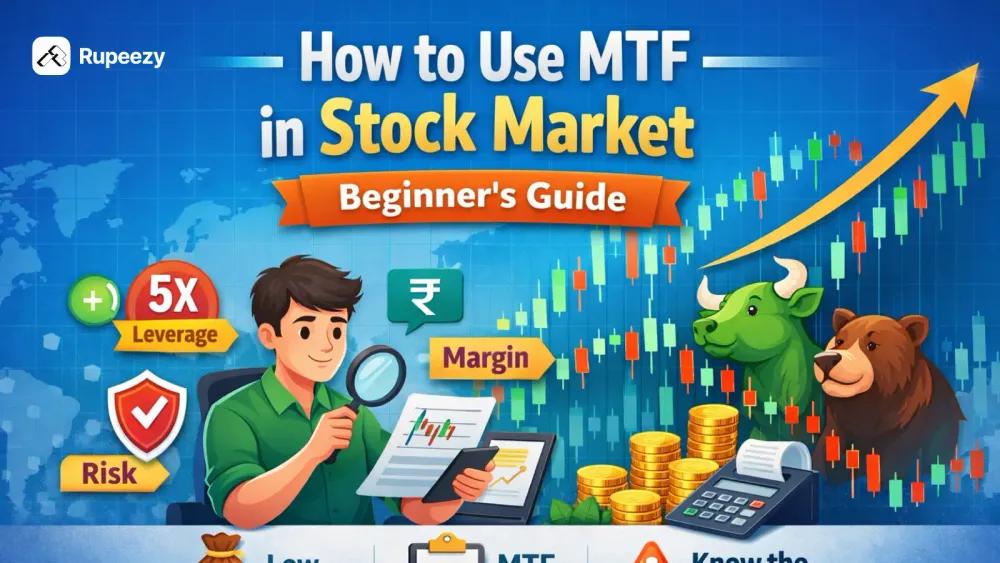
When I first used MTF (Margin Trading Facility), I thought it was an easy way to boost returns. But I gradually realized that MTF is a powerful tool, not a risk-free one. Today, the use of MTF is growing rapidly in India, and many brokers are offering the facility to buy shares with up to 50% margin. Used correctly, MTF can increase your buying power, but with a lack of understanding, it can also amplify losses. In this guide, I will share my experience and explain how to use MTF wisely and safely.

What Is MTF (Margin Trading Facility)?
MTF, or Margin Trading Facility, is a tool that allows you to buy stocks even if you don't have the full amount of money. With MTF, you only pay a portion of the total value (the margin) from your account, and your brokerage firm lends you the remaining amount. You are required to pay interest on this borrowed amount daily.
How MTF Works in the Indian Stock Market
In MTF (Margin Trading Facility), you don't pay the full price of the share. When I use MTF for a stock, I only invest a portion of the amount (the margin), and the brokerage firm lends me the rest. In return, I have to pay daily interest on the borrowed amount. The shares remain in my Demat account, but they are pledged until the full amount is repaid.
Understand MTF with an example
Particulars | Amount (Rs.) |
Total share price | 1,00,000 |
The money I invested (20% margin) | 20,000 |
Funds received from the brokerage | 80,000 |
Approximate Interest (10% p.a.) | Rs.22/day |
If the stock increases by 10% | Rs.10,000 |
My Gross Profit | Rs.10,000 |
Interest (assuming 10 days) | Rs.220 |
Net Profit | Rs.9,780 |
Similarly, if the share price falls by 10%, the loss will also be on the entire Rs.1,00,000.
How to Use MTF: Basic Structure Every Beginner Must Understand
To use MTF effectively, it's essential to understand what happens before, during, and after placing a trade.
Step 1: How to choose the right stock for MTF
First, check if the stock is on the MTF-eligible list.
Stocks considered suitable for MTF are those that have:
Good liquidity
Not too much volatility
Belong to the large-cap or strong mid-cap category
Stocks with high volatility carry a higher risk of margin calls.
Step 2: How to Place an MTF Order (Buy Process)
When buying in MTF:
Select the stock in the trading app.
Choose MTF as the order type (not Cash).
Enter the quantity.
The system will automatically display the required margin and broker-funded amount
Step 3: What happens to the shares after you buy them?
Shares are credited to the demat account.
The shares are automatically pledged.
The pledged shares remain with the broker as security.
The pledge remains in effect until the broker's money is repaid or the shares are sold.
Step 4: How is interest calculated in MTF?
The broker charges daily interest on the funded amount.
Example:
Funded amount = Rs.80,000
Interest ~10% per annum
Daily interest is approximately Rs.22 per day. The longer the holding period, the higher the cost.
Step 5: How is MTM (Mark-to-Market) calculated?
In MTF (Margin Trading Facility), profit and loss are calculated on a daily basis.
Example:
Buy price = Rs.1,000
Current price = Rs.950Loss = Rs.50 × quantity
The Mark-to-Market (MTM) calculation is done on the entire trade value, not just the margin.
Step 6: The margin and maintenance margin are calculated.
The most confusion in MTF arises regarding the margin. If this section is understood clearly, the risk of margin calls and forced losses can be controlled to a great extent.
What is Initial Margin?
Initial margin is the money that needs to be paid upfront when placing a trade.
This margin can vary depending on the stock and the broker's rules.
Typically, it's 20%, 25%, or 50%.
High-quality, stable stocks usually require a lower margin.
Volatile stocks require a higher margin.
What is the Maintenance Margin?
Maintenance margin is the minimum margin level that must be maintained in the account while a trade is open.
This margin changes daily with price movements.
Stock price falls ? margin level decreases
If the margin level falls below the required limit ? a margin call is issued.
Step 7: When does a margin call occur?
A margin call is a normal risk-management alert in futures trading, not an emergency, but ignoring it can be dangerous.
A margin call occurs when:
The stock price falls.
The account's available margin drops below the maintenance margin.
The broker believes the risk is increasing.
Available options upon receiving a margin call
1. Adding Additional Funds: The margin level can be restored by adding extra cash to the account.
This option is useful when the stock is strong, and price recovery is probable.
2. Selling a Partial Quantity: Risk can be reduced by selling a portion of the position.
This results in :
A lower funding amount
Reduced margin pressure
3. Exiting the Full Position: When the stock trend is clearly negative, or the loss tolerance limit has been exceeded, in this case, a full exit is better for capital protection.
Step 8: How to exit a trade on MTF Trade
The exit process for MTF trades is simple, but it's important to understand it clearly to avoid any confusion.
What Happens When a Sell Order is Placed?
A sell order is placed in the trading app (against the MTF position).
As soon as the order is executed, the shares are sold in the market.
The sale value is received by the broker from the exchange.
How Does the Broker Adjust the Amount?
After the sale, the broker performs an automatic settlement:
Funded Amount is Adjusted: The money funded by the broker through MTF is adjusted first.
Interest Charges are Deducted: Any interest accrued based on the holding period is automatically deducted.
Remaining Balance is Credited to the Account: If there is a profit, the net profit is credited, If there is a loss, the remaining amount after adjustment is credited.
Corporate Actions in MTF Trades
In MTF trading, the focus is mostly on price movement and margin, but ignoring corporate actions can be a big mistake. Since MTF is a leveraged position, the impact of corporate actions is more significant compared to normal delivery trades.
Bonus Shares: What Happens When Bonus Shares are Issued in MTF?
If a stock is held under MTF and the company announces bonus shares :
The benefit of bonus shares goes to the investor.
Just like the original shares are pledged, the bonus shares also become pledged.
The share quantity increases after the bonus issue, but the overall value remains the same.
After the bonus issue, the stock price adjusts, which affects the margin calculation. Therefore, it is important to monitor the margin level around the ex-bonus date.
Stock Split: What is the Effect on Margin?
In a stock split:
The quantity of shares increases.
The per-share price decreases.
In the case of MTF:
The total position value remains the same.
The margin requirement is recalculated.
The broker's system automatically adjusts the quantity and price.
Dividends: Who Receives Dividends in MTF?
There is an important confusion regarding dividends.
If the shares are in the demat account before the ex-dividend date, then the dividend goes to the investor, even if the shares are pledged. The dividend amount is credited directly to the bank account.
However:
The stock price adjusts after the dividend.
Due to the price adjustment, the MTM and margin level may be temporarily impacted.
Rights Issue: How are Rights Handled in MTF?
The rights issue is a somewhat sensitive topic in MTF:
The rights entitlement goes to the investor.
However, fresh funds are required to subscribe to the rights.
MTF funding is generally not available for rights shares.
How to Use MTF Safely
Using Full Margin Can Increase Risk :
Using a full margin in MTF (Margin Trading Facility) unnecessarily increases risk. Even a slight drop in price can quickly lead to margin pressure. Therefore, maintaining a margin buffer is always considered a safer approach.
Right Stock Selection Matters More in MTF :
Only stocks with controlled price movements and strong liquidity are suitable for MTF. Stocks with weak fundamentals or high volatility do not provide stability in leveraged positions and increase the chance of a margin call.
Speculative and News-Based Stocks Are Unsafe for MTF :
Stocks driven by news often experience sudden, sharp movements. Such movements can quickly damage capital in MTF, so it's crucial to avoid speculation when using MTF.
Position Size Should Be Smaller Than in Cash Trading :
Since leverage already increases risk in MTF, it's better to keep the position size smaller compared to cash trading. A controlled size keeps losses manageable and allows time for decision-making.
Discipline Provides Long-Term Safety in MTF :
Success in MTF comes not just from strategy, but from discipline. Following stop-losses, avoiding overtrading, and controlling emotions are essential to making this tool safe.
Common Beginner Mistakes While Using MTF
Treating MTF as Pure Leverage Trading :
Many beginners mistake MTF for futures or heavy leverage trading. This leads to increased position sizes, and even small price movements can result in significant losses. MTF should be used for support, not as a replacement for other trading methods.
Ignoring Interest and Holding Costs :
In MTF, profit is not solely determined by price movement, but also by the interest cost. Beginners often fail to calculate the daily interest and total holding cost, resulting in net returns that are significantly lower than expected.
Overconfidence After 1-2 Profitable Trades :
After a few profitable trades, confidence can suddenly soar. This is where the risk increases, as discipline is lost and margin is misused.
Not Tracking Daily Margin and MTM :
In MTF, the margin is not static. The margin level changes with price fluctuations. Failing to track daily MTM and margin status can lead to unexpected margin calls.
Since MTF margin levels can change with price fluctuations, traders can also track today’s market movement to understand broader Nifty, Sensex, and sector trends that may affect their positions.
Not Learning from Mistakes :
The biggest mistake is not reviewing the process after a loss. Only traders who understand their MTF mistakes and improve their approach can truly utilize this tool effectively in the long term.
Benefits of using MTF with Rupeezy
Rupeezy offers up to 5x margin facility on MTF
Trade by investing only 20% of the total share value
Daily interest rate of approximately 0.03% on MTF, keeping costs under control
Over 1800 stocks available for MTF trading
Clear and real-time information on margin, interest, and MTM
Simple platform, making it easy to use MTF safely and intelligently
Conclusion
To use MTF effectively, it's essential to understand what happens before, during, and after placing a trade, and review the SEBI MTF margin rules review to stay compliant.. When used with the right platform and a controlled strategy, MTF can make trading more efficient and balanced.
FAQs
Q1. What does MTF mean in the stock market?
MTF is a facility that allows you to buy shares of higher value with less money, with the remaining amount provided by the brokerage firm.
Q2. Is MTF good for beginners?
Yes, but only if the stock is strong and the margin is kept within limits.
Q3. How much margin is usually required in MTF?
Typically, 20% to 50%, depending on the stock and the brokerage firm.
Q4. Do brokers charge interest on MTF?
Yes, interest is charged daily on the funds provided by the brokerage.
Q5. What happens if the stock price falls?
If the share price falls, the margin decreases, and a margin call may be issued.

Anupam Shukla is a finance content writer and an NISM-certified research analyst with over Seven years of trading experience. With a passion for the stock market, he simplifies complex financial concepts, making investing and trading easier for everyone. His expertise helps readers stay ahead in the ever-changing world of finance, empowering them to make smarter money moves.
Did you like this blog?
Be the first to like this blog.
The content on this blog is for educational purposes only and should not be considered investment advice. While we strive for accuracy, some information may contain errors or delays in updates.
Mentions of stocks or investment products are solely for informational purposes and do not constitute recommendations. Investors should conduct their own research before making any decisions.
Investing in financial markets are subject to market risks, and past performance does not guarantee future results. It is advisable to consult a qualified financial professional, review official documents, and verify information independently before making investment decisions.




All Category