
Open a Free Demat Account !
₹0 AMC & Account Opening Fee
Margin Money: Meaning, Benefits & Risks Explained

 Last Updated: 22 September, 2026
 8 min read




00:00 / 00:00


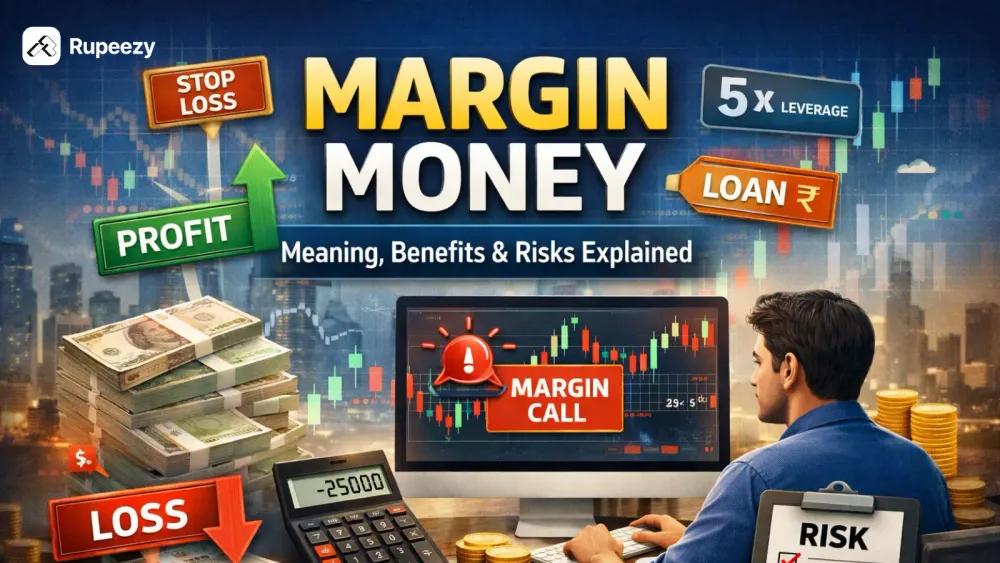
In today's stock market, many investors and traders seek big opportunities with limited capital. In this scenario, margin trading becomes a powerful tool, allowing them to take larger positions with less money. However, this power can amplify both profits and losses rapidly. Many people use margin but don't fully understand its true implications, the risks, pressures, and responsibilities involved. In this blog, we will explain in simple terms what margin money is, how it works in the stock market, and what precautions you should take when using it.

What Is Margin Money?
Margin money is the amount that an investor deposits with their broker in advance to open a trade in the stock market. This amount is only a portion of the total value of your trade; the remaining amount is lent to you by the broker so that you can take a larger trade than your own capital would allow. Essentially, margin money acts as collateral for your trade, protecting the broker against potential losses.
For example, if you want to buy shares worth ?1,00,000 and your broker offers a 50% margin, you only need to deposit ?50,000 upfront, and the remaining ?50,000 is provided by the broker. This means you can buy more shares with less money.
Margin Money in the share market
Margin money in the stock market provides leverage to the investor, allowing them to invest a larger amount than their available capital. However, it's important to remember that while using margin increases the profit potential, it also increases the potential for losses if the market moves against you.
Before using leverage, traders can also check today’s market movement to understand current Nifty, Sensex, and sector trends and assess the broader market environment.
How Margin Money Works in the Share Market?
When an investor uses margin money in the share market, the process is entirely system-driven and real-time. Every step aims to control the risk for both the broker and the investor.
Step 1: Placing the Trade Order
First, the investor places an order to buy or sell shares. When placing the order, the broker's trading system checks if the available balance and eligible margin in the account are sufficient for the trade.
Step 2: Blocking the Initial Margin
As soon as the order is accepted, the broker blocks the required initial margin from your account. This amount is a portion of the total trade value, which is mandatory to be kept upfront according to SEBI regulations.
Step 3: Application of Leverage
After the initial margin is blocked, the broker provides the remaining amount, allowing your total trade position to be larger than your deposited capital. This is called leverage, which is commonly used in intraday trading.
Step 4: Real-time Monitoring of the Position
While the trade is open, the broker's risk management system continuously monitors the value of your position and the maintenance margin. This calculation changes every moment with market fluctuations.
Step 5: Margin Call or Square-off Situation
If the market moves against you and the available margin falls below the required limit, the broker may issue a margin call, asking you to add additional funds. If funds are not added in time, the broker may automatically square off the position to protect themselves.
This is how margin money works in the share market through a systematic process—where significant opportunities exist, but risk management and discipline are paramount.
Types of Margin Money in the Share Market
1. Initial Margin :
Initial Margin is the amount you are required to deposit with the broker or exchange before opening a new position. It is a percentage of the total trade value, determined according to SEBI and exchange regulations, and can vary based on risk. Its purpose is to cover potential losses.
2. Maintenance Margin :
Maintenance Margin is the minimum balance that must be maintained in your account while a position is open. If the market value falls and your margin drops below this level, the broker may issue a margin call, requiring you to add more funds.
3. Exposure Margin / Additional Margin :
Exposure Margin and other non-upfront margins, such as Additional Margin, Extreme Loss Margin, etc., are additional security amounts that the broker or exchange may demand later, depending on risk and volatility. These are held in addition to the routine Initial Margin to mitigate risk during periods of extreme market fluctuations.
4. Intraday Margin :
Intraday Margin is specifically for trading within the same day. It allows investors to take positions far exceeding their available balance, making it easier to profit from small price movements. However, this leverage can also magnify losses quickly, so it should be used cautiously.
5. Delivery Margin :
Delivery Margin is the additional amount required when you intend to take actual delivery of shares into your account rather than selling them on the same day. The exchange or broker demands this margin to cover the risk associated with holding the shares for a longer period.
Example: Margin Money in Real Trading Life
Let's say a trader has their own capital of ?1,00,000 and the broker provides them with a 5x margin.
Description | Information |
Capital Invested | Rs 1,00,000 |
Margin provided by the broker | Rs 4,00,000 |
Total Position | Rs 5,00,000 |
Leverage used | 5x |
Trade type | Intraday / Short-term |
Profit Scenario (when the share price goes up by 5%) :
Point | Without Margin | With margin |
Total positions | Rs 1,00,000 | Rs 5,00,000 |
The stock is rising. | 5% | 5% |
Total revenue | Rs 5,000 | Rs 25,000 |
Return on your capital | 5% | 25% |
Loss Scenario (when the share price falls by 5%)
Point | Without Margin | With margin |
Total positions | Rs 1,00,000 | Rs 5,00,000 |
Share price decline | 5% | 5% |
Total loss | Rs 5,000 | Rs 25,000 |
Benefits of Using Margin Money
Higher Buying Power :
Margin money allows traders to take positions in high-value stocks with less capital. This provides the opportunity to trade in good and expensive stocks, which would not be possible with regular cash.
Capital Efficiency :
Using margin, traders can keep some cash in reserve instead of tying up all their capital in a single trade. This is why professional traders use capital more efficiently.
Short-Term Trading Opportunities :
In intraday and short-term trading, margin money helps generate profits even from small price movements, provided the trade is executed with discipline and the right strategy.
Flexibility in Trading :
Margin money gives traders the flexibility to participate in multiple opportunities. If an opportunity arises in a particular sector, it becomes easy to take a position quickly.
When margin is used to take positions based on sector opportunities, traders can first compare market movements using a market heatmap. This can help identify stronger and weaker sectors or stocks before considering a leveraged position.
Before taking a leveraged position, traders can explore different stock market sectors to understand sector-wise opportunities and trends.
Better Return Potential :
When the market moves in the right direction, margin money can significantly amplify returns. However, this benefit is sustainable only if the risks are kept under control.
Risks of Margin Money
Amplified Losses :
Just as margin trading amplifies profits, it also amplifies losses. In a volatile market, a small wrong move can wipe out a significant portion of your capital.
Pressure of Margin Calls :
When your account balance falls below a certain level, the broker immediately demands additional funds. Panic, haste, and poor decision-making are common in such situations.
Forced Square-Off :
If you fail to deposit the required funds on time, the broker will automatically close your position for their own protection, even if the market is about to reverse.
Psychological Pressure :
Trading with margin increases stress. Caught between fear and greed, traders often engage in over-trading, further increasing the likelihood of losses.
Risk of Capital Erosion :
Consecutive small losses, amplified by margin, quickly deplete the account balance, leading traders to take excessive risks in an attempt to recover their losses.
Common Myths About Margin Money
Myth 1: Margin money is free money
This is the biggest misconception. Margin money is actually a loan from the broker, which is used under specific terms and conditions. The trader is fully responsible for any losses incurred.
Myth 2: Losses in margin trading are limited
The reality is quite the opposite. Losses with margin trading can escalate rapidly because your position is much larger than your own capital. Even a small market movement can result in significant losses.
Myth 3: Only new traders lose money with margin trading
Losses don't discriminate based on experience. Many experienced traders also suffer heavy losses in margin trading due to overconfidence or poor risk management.
Myth 4: Margin always increases profits
Margin only increases the profit potential; it doesn't guarantee it. A trade that goes in the wrong direction becomes far more dangerous with margin.
Myth 5: Margin trading is easy
In reality, margin trading demands greater discipline, quick decision-making, and strong emotional control. Without proper preparation, it can lead to more losses than gains.
Conclusion
Margin trading is a powerful tool in the stock market that can amplify opportunities when used correctly, but it can also lead to significant losses if used carelessly. It magnifies both profits and losses rapidly, so it should only be used with understanding, discipline, and robust risk management. Remember, successful trading is not about borrowed money, but about making sound decisions and controlling your emotions. Margin trading is only beneficial if you fully understand its risks.
FAQs
Q1. What does margin money mean in the stock market?
Margin money is the amount you deposit with your broker to allow you to trade with a larger amount than your own capital.
Q2. Is margin trading good for new traders?
Generally, no. Margin trading is riskier for new traders because losses can escalate quickly.
Q3. What is a margin call?
A margin call is when your account balance falls below a certain level, and your broker asks you to deposit additional funds.
Q4. Can I lose more money with margin trading?
Yes, because with a margin, your position is larger, so losses can be greater than with regular trading.
Q5. Should margin money be used regularly?
No, margin money should be used cautiously and sparingly.

Anupam Shukla is a finance content writer and an NISM-certified research analyst with over Seven years of trading experience. With a passion for the stock market, he simplifies complex financial concepts, making investing and trading easier for everyone. His expertise helps readers stay ahead in the ever-changing world of finance, empowering them to make smarter money moves.
Did you like this blog?
Be the first to like this blog.
The content on this blog is for educational purposes only and should not be considered investment advice. While we strive for accuracy, some information may contain errors or delays in updates.
Mentions of stocks or investment products are solely for informational purposes and do not constitute recommendations. Investors should conduct their own research before making any decisions.
Investing in financial markets are subject to market risks, and past performance does not guarantee future results. It is advisable to consult a qualified financial professional, review official documents, and verify information independently before making investment decisions.

All Category