
Open a Free Demat Account !
₹0 AMC & Account Opening Fee
Coal Gasification In India: How It Can Reduce Energy Imports?
 Last Updated: 18 September, 2026
 8 min read




00:00 / 00:00


Summary
|
India spends billions of dollars importing crude oil, natural gas, fertilizers, and several other energy-linked raw materials every year.
Whenever global energy prices rise, the impact is eventually felt across the economy through higher fuel costs, industrial expenses, and inflationary pressures.
That is one reason why energy security has become a major priority for India.
While renewable energy remains an important focus area, policymakers are also exploring how India can create greater value from domestic resources already available within the country.
That naturally brings attention to coal.
India possesses some of the world's largest coal reserves. Traditionally, coal has mainly been used for electricity generation.
But policymakers and industries are now exploring whether coal can play a bigger role in reducing import dependence and strengthening India's industrial ecosystem.
That is where Coal Gasification enters the picture.
The technology is increasingly being viewed as part of India's broader long-term energy and industrial strategy.
Investors can also follow live market updates to see how the broader market and related sectors are performing as these themes develop.

What Exactly Is Coal Gasification?
The coal gasification process is very different from the traditional way coal is used.
Normally, coal is burned directly to generate electricity.
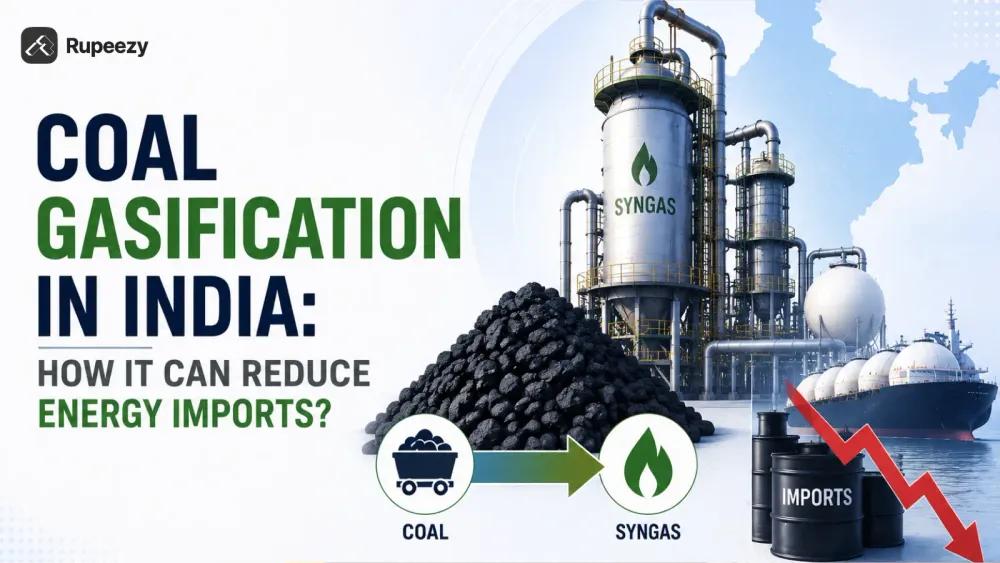
In gasification, coal is converted into a gas instead.
The process works by heating coal in a controlled environment instead of burning it like a normal fuel.
This converts coal into a gas known as syngas, or synthetic gas, which mainly contains hydrogen and carbon monoxide.
The gas can then be used in industries to produce products such as fertilizers, chemicals, methanol, and industrial fuels. These are sectors where India still depends heavily on imports in many areas.
This means coal is no longer being viewed only as a fuel for electricity generation. It is increasingly being explored as a resource that can support multiple industrial applications.
That is why the technology is receiving growing attention across India's energy and industrial sectors.
Why Is India Investing In Coal Gasification?
The answer once again comes back to imports and energy security.
India imports more than 80% of its crude oil requirements. The country also depends heavily on imported natural gas and several industrial feedstocks.
This high level of dependence means global energy market disruptions can directly affect India's economy.
Whenever crude oil prices rise sharply or supply chains face disruptions, industries and consumers often feel the impact through higher costs.
At the same time, India possesses some of the world’s largest coal reserves. As per the Ministry of Coal, the country has estimated coal resources of over 400 billion tonnes, making it one of the top coal-rich nations globally and providing a large domestic resource base for industries and power generation.
This creates an important opportunity.
If domestic coal can be converted into useful industrial fuels and raw materials, India may be able to reduce dependence on imports in sectors where demand continues to rise.
That is where coal gasification becomes important.
Instead of viewing coal only as a source of electricity, the technology allows it to support industries such as fertilizers, chemicals, and industrial fuels, areas where import dependence still remains significant in many cases.
Rather than depending entirely on imported natural gas or petroleum-linked feedstocks, industries could potentially use domestically produced syngas for specific applications.
The objective is not to completely eliminate imports overnight.
The focus is diversification.
By expanding the use of domestic resources, India can reduce vulnerability to global energy shocks while also supporting industrial growth.
Investors can also explore stock market sectors to compare the industries that could be affected by India’s energy and industrial expansion.
India's Rs 37,500 Crore Coal Gasification Push
India is not treating coal gasification as a small pilot initiative.
The Union Cabinet recently approved a Rs 37,500 crore scheme to support coal and lignite gasification projects, including infrastructure development, pilot projects, and large-scale adoption.
At the center of this initiative is a major target.
India has set a target to achieve 100 million tonnes of coal gasification capacity by 2030.
This target highlights how seriously policymakers are viewing the technology.
The objective is not only to improve energy security but also to reduce reliance on imported industrial feedstocks over the long term.
At a broader level, the government is trying to build an ecosystem around coal-based chemicals, fuels, and downstream manufacturing using domestic resources.
Several public sector organizations are expected to play important roles in this transition.
Coal India’s gasification initiatives are among the key projects supporting this vision. Organizations such as Coal India Limited, Bharat Heavy Electricals Limited (BHEL), GAIL India, and Engineers India Limited (EIL) are contributing through technology development, engineering support, and downstream industrial applications.
Brokerages and investment platforms such as Rupeezy allow investors to research and invest after completing the necessary KYC requirements. However, investors should always conduct their own research and evaluate business fundamentals before making investment decisions.
Together, they form the foundation of India's growing coal gasification ecosystem.

Why Syngas Matters
The real importance of coal gasification lies in what syngas can actually do.
Once produced, syngas can be used across multiple industries.
Some of its major applications include:
Fertilizer production
Chemical manufacturing
Methanol production
Industrial heating
Power generation
Various industrial fuel applications
This versatility makes syngas strategically important.
A single domestic resource can potentially support multiple industries that otherwise rely heavily on imported fuels or raw materials.
That becomes especially important for a growing economy like India, where demand for fertilizers, chemicals, and industrial fuels is expected to keep increasing over time.
For a country focused on improving energy security and reducing import dependence, that creates a significant long-term advantage.
The Bigger Economic Opportunity
Coal gasification is often discussed as an energy solution.
But it is also an industrial opportunity.
India's economy continues to expand, and so does demand for fertilizers, chemicals, fuels, and manufacturing inputs.
Meeting all of that demand through imports can become expensive and risky, especially during periods of global volatility.
Coal gasification offers an opportunity to build stronger domestic value chains.
Investors tracking companies benefiting from India's energy and industrial expansion can also evaluate eligible MTF Stocks. Before using margin, investors should check stock eligibility, liquidity, applicable MTF Interest Rate, funding costs, and the risks associated with leveraged positions.
Instead of depending entirely on imported raw materials, industries could increasingly use products derived from India's own coal reserves.
This could help improve domestic manufacturing linkages while also reducing exposure to volatile global energy and commodity markets.
Supporters argue that this could improve resource utilization, strengthen manufacturing capabilities, and enhance long-term economic resilience.
In other words, coal gasification is not just about producing gas.
It is about creating more value from resources India already possesses.
Investors tracking companies linked to energy, infrastructure, and industrial growth can use a stock market heatmap to compare sector and stock performance. This can provide a quick view of market trends before carrying out deeper research on individual companies. A goal-based investing approach can further help investors evaluate whether such sector opportunities align with their financial goals, investment horizon, and risk tolerance.
The Challenges Cannot Be Ignored
Despite its potential, coal gasification is not without challenges.
One of the biggest concerns is environmental impact.
Although gasification can be cleaner and more efficient than directly burning coal in some applications, the process can still generate substantial carbon emissions. As India works toward its climate goals, balancing industrial growth with environmental sustainability will remain a major challenge.
Future projects may increasingly require technologies such as carbon capture and cleaner processing systems to reduce emissions further.
Another challenge is the nature of Indian coal itself.
Indian coal generally contains high ash content. This makes the gasification process more technically complex and often more expensive compared to regions with lower-ash coal reserves.
Cost is another important factor.
Building large-scale gasification plants requires massive investments, advanced technology, reliable infrastructure, and long-term policy support.
For coal gasification to succeed at scale, projects must prove both technically feasible and economically viable.
Can Coal Gasification Reduce India's Import Bill?
This is perhaps the most important question.
Coal gasification alone will not eliminate India's dependence on imported oil and gas.
But that is not the objective.
The goal is to reduce dependence in sectors where syngas can act as an alternative to imported fuels, chemicals, or industrial feedstocks.
That distinction matters.
The focus is not complete replacement.
The focus is strategic reduction and diversification.
If implemented effectively, coal gasification could help India lower exposure to global energy price shocks while improving domestic industrial capabilities.
Even partial import substitution in sectors like fertilizers, chemicals, and methanol could have meaningful long-term economic benefits.
At the same time, the long-term success of coal gasification will depend on whether projects remain commercially viable, environmentally sustainable, and globally competitive over time. That is why investors and industry participants closely monitor policy support, technological advancements, and execution capabilities within the sector.
Conclusion
Coal gasification is emerging as part of India's broader effort to strengthen energy security and reduce dependence on imported industrial feedstocks.
By converting coal into syngas, India is trying to create greater value from its domestic coal reserves while supporting industries such as fertilizers, chemicals, and industrial fuels.
The government's push toward coal gasification also means investors and market participants are increasingly tracking companies connected to engineering, infrastructure, chemicals, and energy themes.
For investors looking to build long-term exposure to these sectors, a stock SIP can provide a disciplined way to invest a fixed amount regularly.
Did you like this blog?
Be the first to like this blog.
The content on this blog is for educational purposes only and should not be considered investment advice. While we strive for accuracy, some information may contain errors or delays in updates.
Mentions of stocks or investment products are solely for informational purposes and do not constitute recommendations. Investors should conduct their own research before making any decisions.
Investing in financial markets are subject to market risks, and past performance does not guarantee future results. It is advisable to consult a qualified financial professional, review official documents, and verify information independently before making investment decisions.

Open Rupeezy account now. It is free and 100% secure.
Start Stock Investment




All Category