
Open a Free Demat Account !
₹0 AMC & Account Opening Fee
Best FMCG Stocks in India: 2026

 Last Updated: 21 September, 2026
 13 min read




00:00 / 00:00


Summary:
| ||
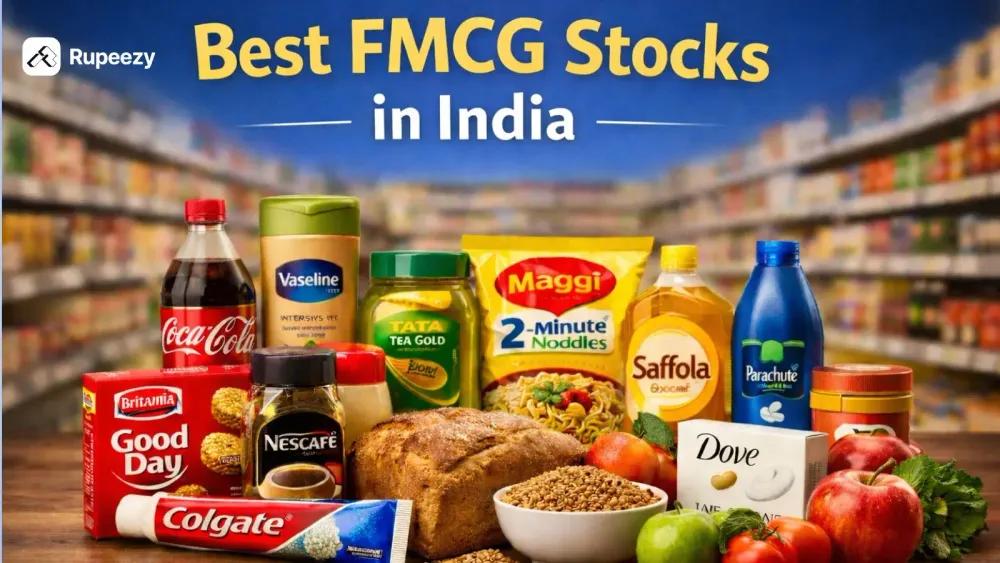
Think about this morning. You woke up, brushed your teeth with Colgate, made a cup of Tata Tea or Nescafé, and packed your lunchbox with a pack of Britannia biscuits before leaving home.
Every single product in that routine belongs to an FMCG company, a Fast-Moving Consumer Goods business. These are the companies that quietly power Indian households, day after day, rain or shine, recession or boom.
This is exactly why many investors track FMCG stocks and look for the best FMCG stocks to add stability to their portfolios.
Now here's the investing insight: if you use their products every day, why not own a small piece of these businesses?
This article lists the best FMCG stocks in India, covering leading FMCG sector stocks ranked by market capitalisation. Along with stocks list, you can know about those companies in an overview, the current industry outlook, and an understanding of how you can get started investing, even if you are a complete beginner.
Disclaimer: This article is for educational purposes only and is not investment advice. Please consult a SEBI-registered financial advisor before making any investment decisions. Market data is indicative and subject to change.

List of Best FMCG Stocks in India
The table below lists the top 10 FMCG companies on stock exchanges, ranked by approximate market capitalisation. These are companies that are part of the Nifty FMCG Index and are directly focused on the Indian consumer goods market.
Company | Current Market Price (Rs) | Market Capitalisation (Cr) |
2,085 | 4,89,561 | |
295 | 3,69,369 | |
1,216 | 2,34,155 | |
5,535 | 1,33,405 | |
401 | 1,35,605 | |
1,002 | 1,02,754 | |
1,055 | 1,04,300 | |
751 | 97,426 | |
414 | 73,537 | |
1,830 | 49,692 |
For investors comparing FMCG stocks and other sectors, a stock market heatmap can provide a quick visual view of market and sector performance. This can help identify which stocks and sectors are gaining or losing momentum before conducting deeper research.
Note: Market cap figures are approximate and indicative as of April 06, 2026. Always verify current data from NSE or BSE before investing. Rankings are based on market capitalisation only and do not represent a buy recommendation.
Company Overview of Best FMCG Stocks
Here is a brief look at what each of these companies does, what makes them stand out, and what investors generally track.
1. Hindustan Unilever Limited (HUL)
HUL is the largest FMCG company in India by both market capitalisation and revenue. Established in 1933, it is the Indian arm of the global giant Unilever. With over 50 trusted brands across 16 categories, including Dove, Lux, Surf Excel, Lifebuoy, Brooke Bond, and Horlicks, HUL reaches nearly every Indian household.
What makes HUL interesting for investors is its consistent dividend track record, strong rural distribution network, and the ability to pass on input cost increases to consumers without losing market share. Its FY25 revenue stood around Rs 63,121 crore with a net profit of Rs 10,671 crore, and it has a well-established presence in both urban and rural India.
Investors to watch out for: Volume growth trends, rural-urban demand split, and new product launches in premium categories.
2. ITC Limited
ITC is one of India's most diversified conglomerates and the largest cigarette company. However, its FMCG business spans packaged foods such as Sunfeast and Aashirvaad, personal care, stationery such as Classmate, and agribusiness.
The company has announced plans to invest Rs 20,000 crore in the FMCG segment. For investors, ITC is an attractive business because of its strong cash flows, consistent dividends, and the long-term potential of its non-cigarette FMCG portfolio.
Investors to watch out for: FMCG revenue share versus cigarettes, margin expansion in non-tobacco segments, and any regulatory changes on tobacco.
3. Nestle India Limited
Nestle India is famous for some of the most iconic food products in the country, comprising Maggi noodles, Nescafe coffee, KitKat, Munch, and Milkmaid. The company focuses on categories such as nutrition, health, and wellness and has consistently maintained strong margins, driven by brand loyalty.
With FY25 revenue of around Rs 20,202 crore and a net profit of Rs 3,314 crore, it has a history of steady earnings, as reflected in its share price, which has risen by around 366% over the last decade. The company has also been expanding into new categories such as premium chocolates and plant-based nutrition.
Investors to watch out for: Input cost pressures like milk, cocoa, wheat, new product pipeline, and any changes in health and wellness trends.
4. Varun Beverages Limited (VBL)
Varun Beverages is PepsiCo's largest bottling partner in India. It manufactures and distributes Pepsi, 7Up, Mirinda, Tropicana, and Sting across India and several international markets. The company has shown exceptional revenue growth, with 2025 revenue crossing Rs 21,500 crore.
VBL has been one of the fastest-growing FMCG-adjacent companies in recent years, benefiting from rising consumption of packaged beverages, particularly in tier-2 and tier-3 cities and rural markets. Its capital expenditure on new manufacturing plants makes it a high-growth story with corresponding risks.
Investors to watch out for: Capacity expansion, rural distribution reach, new product manufacturing segments, and PepsiCo's product pipeline in India.
5. Britannia Industries Limited
Britannia Industries is a household name in the Indian bakery; its Good Day, NutriChoice, Marie Gold, and Tiger biscuits are found in kitchens across the country. Beyond biscuits, the company has been expanding into dairy, croissants, and healthier snacking options.
Britannia has a strong margins profile and a wide distribution network. The company's push into rural markets and its focus on premiumisation make it a well-positioned FMCG bet for the long term.
Investors to watch out for: Raw material costs (wheat, palm oil, sugar), competitive pressure from regional brands, and dairy segment growth.
6. Tata Consumer Products Limited
Tata Consumer Products was created by merging the FMCG businesses of the Tata Group. It now holds iconic brands such as Tata Tea, Tata Salt, Tetley, Eight O'Clock Coffee, and Himalayan Water. The company has been actively expanding its portfolio through acquisitions, including Capital Foods (Ching's Secret, Smith & Jones) and Organic India in 2024.
Tata Consumer is a relatively new but fast-growing FMCG company, backed by the Tata brand and with a clear ambition to be a multi-category consumer company.
Investors to watch out for: Integration of acquisitions, international growth (Tetley in the UK), and margin improvement over the medium term.
7. Godrej Consumer Products Limited (GCPL)
GCPL specialises in home care, hair care, and personal wash products. Its key brands include Good Knight (mosquito repellents), Hit (insecticides), Cinthol, and Godrej Expert hair colour. The company has a strong presence in Africa, Indonesia, and India.
GCPL is a good example of an Indian FMCG company that has successfully expanded internationally. It has been focusing on the high-growth insecticide and air care categories, which benefit from rising health and hygiene awareness.
Investors to watch out for: International business performance, category growth in home care, and raw material costs for insecticides.
8. Marico Limited
Marico is best known for Parachute coconut oil and Saffola edible oil. Beyond these staples, the company has diversified into health and wellness foods, male grooming (Beardo, Set Wet), and digital-first brands. Marico's international business accounts for approximately 23%-25% of its revenue.
Marico is valued for its capital-light business model, strong cash conversion, and consistent return on equity. The company's pivot towards health and premium categories is an important growth driver to track.
Investors to watch out for: Copra (coconut) prices (key input for Parachute), volume trends, and D2C brand portfolio growth.
9. Dabur India Limited
Dabur is India's leading Ayurvedic and natural products company. Its brands include Real fruit juices, Dabur Honey, Dabur Chyawanprash, Vatika hair care, and a wide range of oral care products. The company has a strong rural distribution network and benefits from the rising preference for natural and herbal products.
Dabur CEO Mohit Malhotra had stated that growing affluence in India, rural demand, demographic dividend, and technological advancements are four major drivers reshaping consumption in the FMCG space. Dabur's natural or Ayurvedic positioning aligns well with post-pandemic consumer preferences.
Investors to watch out for: Healthcare segment growth, competition from Patanjali and other Ayurvedic brands, and international revenue contribution.
10. Colgate-Palmolive (India) Limited
Colgate-Palmolive is India's dominant oral care brand, with an estimated market share of over 50% in the toothpaste category. Its products include Colgate Strong Teeth, Colgate Vedshakti, Colgate Sensitive, and Palmolive personal care products.
Colgate India is known for consistently high margins, strong cash generation, and reliable dividend payouts, making it a favourite among dividend-seeking investors. The company has been expanding into adjacent categories, such as mouthwash and teeth whitening, to sustain growth.
Watch for: Market share trends versus Dabur, Pepsodent (HUL), and new natural-oral-care entrants, along with rural penetration growth.
Also Read: Top Capital Goods Stocks in India
India's FMCG Industry Outlook
The growth of FMCG sector stocks in India is driven by rising consumption, rural demand, and premiumisation trends. After understanding the leading FMCG stocks in India, it is important to look at the broader industry trends driving the sector's long-term growth.
Market Size: Driven by rising incomes, urbanization, and the surge in e-commerce and quick commerce, India’s FMCG market is set for massive growth. According to IMARC, the sector is projected to jump from USD 287.91 billion in 2025 to USD 1,150.21 billion by 2034, clocking a steady 16.64% CAGR.
Volume & Rural India Growth: NielsenIQ reports that India's FMCG sector recorded value growth of 7.8% year-on-year in the October–December 2025 quarter. Rural markets continued to outpace urban consumption for the eighth consecutive quarter. Quick commerce now contributes over three-fourths of all e-commerce FMCG sales.
Premiumization & Wellness: FMCG sales are now driven by premium products, as consumers shift from basic commodities to value-added offerings. This trend is particularly pronounced in the Personal Care and Cosmetics segment, driven by growing demand for mass-market and science-backed formulations. Consumers are increasingly willing to pay a premium for organic, protein-rich, and eco-friendly products, leading to double-digit growth in these niche wellness categories.
GST 2.0 Impact: Key household items like soaps, shampoos, biscuits, and toothpaste are now taxed at 5%, down from earlier rates of 12% to 18%. This makes daily essentials more affordable and supports volume-led growth across the sector. (source)
In short, the structural story for Indian FMCG remains strong; a young population, a growing middle class, and expanding digital commerce create a durable demand engine.
Investors can also track today's market movement to see how Nifty, Sensex, and FMCG-related sectors are performing alongside these longer-term industry trends.

How Can You Invest in These FMCG Stocks?
To invest in FMCG stocks in India, you must comply with SEBI regulations, which require every investor to hold a Demat and Trading account linked to their PAN and bank account.
For investors who want to build exposure to FMCG stocks gradually, a stock SIP can provide a disciplined way to invest a fixed amount regularly over the long term
The Step-by-Step Investment Process
Choose a SEBI-registered stockbroker like Rupeezy.
Complete your KYC verification by uploading your PAN, Aadhaar, bank details, and a photograph.
Once verified, your account is ready for use.
Using the search toggle in the app, you can search for any specific FMCG companies you desire to invest in, and later you can place a buy order.
There is no minimum capital required; you can start by purchasing just a single share.
Investors who want additional buying capacity can also consider MTF for eligible FMCG stocks, which allows eligible shares to be purchased by paying only a portion of the trade value upfront, subject to applicable margin requirements, interest, stock eligibility, and other charges.
For those considering their options, Rupeezy offers a fully digital, zero-cost account-opening process for trading Indian equities. The platform provides full market access, allowing users to research and trade FMCG stocks after completing the required KYC.
Key Factors to Consider Before Investing
FMCG stocks are often considered "defensive" investments because demand for everyday products does not decline during an economic slowdown. However, they are not risk-free. Here are a few things to keep in mind:
Valuations: Many top FMCG stocks trade at high price-to-earnings (P/E) ratios. This means you may be paying a premium for stability. Always compare a stock's current P/E with its historical average.
Input Cost Risk: FMCG companies are sensitive to the prices of raw materials such as crude oil, palm oil, wheat, milk, and packaging materials. A sharp rise in these costs can impact operating margins.
Rural vs. Urban Demand: Pay attention to whether both rural and urban volumes are growing. A single-engine growth story, like only rural or only urban, carries more risk.
Competition from D2C Brands: Emerging direct-to-consumer brands like Mamaearth and WickedGud are capturing market share in urban and premium segments. Established companies are responding with acquisitions and new launches.
Portfolio Diversification: FMCG is a strong defensive anchor for a portfolio, but avoid overconcentrating in a single stock or sector. Consider spreading investments across two to three FMCG stocks along with other sectors.
Investors can explore different stock market sectors to compare sector-wise opportunities and build a more diversified portfolio.
Investors should also align their FMCG allocation with their financial objectives, investment horizon, and risk tolerance. Goal-based investment planning can help determine how FMCG stocks fit into a broader portfolio designed around specific financial goals.
Conclusion
The products that fill your pantry, bathroom cabinet, and kitchen shelf all have stories behind them. These are businesses built over decades, serving billions of Indians consistently. That consistency is what makes them interesting from an investment standpoint.
Whether you are just starting your investment journey or looking to add stability to an existing portfolio, FMCG stocks have historically offered a dependable combination of growth, dividends, and resilience.
That said, no stock is guaranteed to be a winner. Do your own research, understand what you are buying, and have patience. Compounding takes time, but for the right businesses, it is worth the wait.
FAQs:
What are FMCG stocks in India?
FMCG stocks in India are shares of companies that produce everyday consumer goods such as food, beverages, personal care, and household products, sold quickly at low cost.
Why are FMCG stocks considered safe investments?
FMCG stocks are considered relatively safe because demand for daily-use products remains stable even during economic slowdowns.
Which are the top FMCG companies in India in 2026?
Top FMCG companies in India in 2026 include Hindustan Unilever, ITC, Nestle India, Britannia, and Tata Consumer Products based on market capitalisation.
How can beginners invest in FMCG stocks in India?
Beginners can invest in FMCG stocks by opening a Demat and trading account, completing KYC, and buying shares through a SEBI-registered broker.
What factors should you consider before investing in FMCG stocks?
Before investing in FMCG stocks, consider valuation, raw material costs, demand trends, competition, and portfolio diversification.

Santhosh is a Research Analyst at Rupeezy who transforms complex market data into actionable insights for investors. With five years of financial industry experience and an MBA in Finance from Jain University, he specializes in evaluating stock market dynamics, mutual fund performance, and ETF trends. Driven by a deep passion for business analysis, Santhosh focuses heavily on company fundamentals to help readers make informed, data-backed financial decisions.
Did you like this blog?
Be the first to like this blog.
The content on this blog is for educational purposes only and should not be considered investment advice. While we strive for accuracy, some information may contain errors or delays in updates.
Mentions of stocks or investment products are solely for informational purposes and do not constitute recommendations. Investors should conduct their own research before making any decisions.
Investing in financial markets are subject to market risks, and past performance does not guarantee future results. It is advisable to consult a qualified financial professional, review official documents, and verify information independently before making investment decisions.

Open Rupeezy account now. It is free and 100% secure.
Start Stock Investment




All Category