
Open a Free Demat Account !
₹0 AMC & Account Opening Fee
Active vs Passive Mutual Funds: Key Differences Every SIP Investor Should Know

 Last Updated: 22 September, 2026
 9 min read




00:00 / 00:00


Deciding to start a Systematic Investment Plan (SIP) is arguably the best financial move you can make. It’s the first step toward financial freedom. But as soon as you start researching, you reach various terminologies. Two of the biggest terms you'll encounter are Active and Passive mutual funds.
While navigating the landscape of mutual funds, we feel overwhelmed for many new investors. This article provides clarity on understanding active vs passive mutual fund concepts from the basics to the tax implications and the psychological traps of both styles.

Understanding Active and Passive Approaches
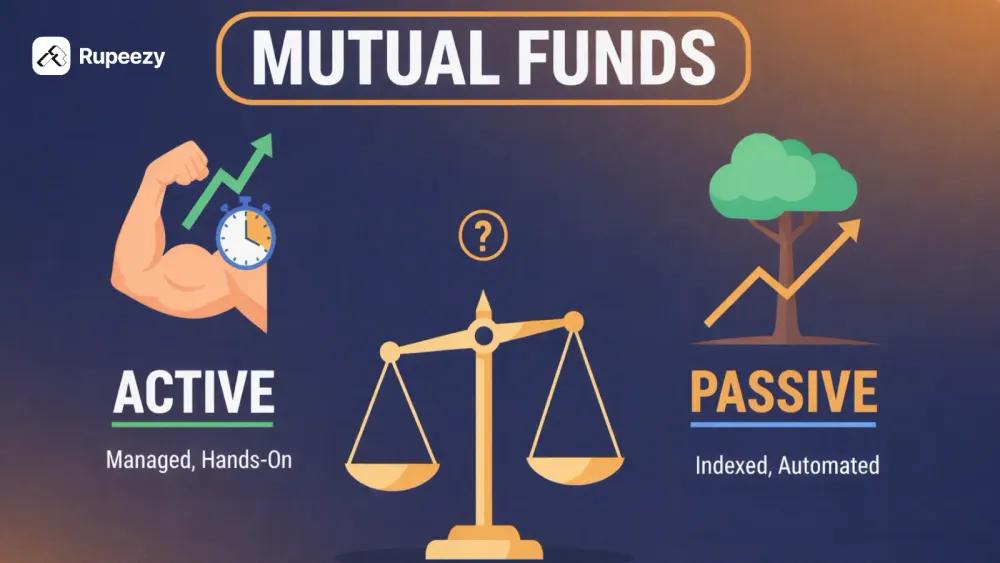
At its heart, the difference between active and passive investing is a difference in belief.
Aiming to Outperform the Market
Active investing is built on the belief that the market isn't always right. Active investors believe that with enough research, data, and human intuition, you can identify companies that are undervalued or poised for growth before everyone else does.
Imagine you are at a crowded fruit market. An active investor doesn't just buy a pre-packaged basket of fruit. They spend time inspecting every apple, checking for bruises, and trying to pick only the sweetest ones. They end up with a basket that tastes better than the average.
Aligning with Market Performance
Passive investing is built on the belief that the market is generally efficient. In 2026, information travels at the speed of light. If a company is doing well, everyone knows it instantly, and the stock price reflects that.
Instead of trying to outsmart millions of other investors, a passive fund creates a portfolio similar to the benchmark index. If you buy a Nifty 50 Index Fund, you own a piece of the 50 largest companies in India. You aren't trying to outperform the Nifty 50; you are happy to grow exactly as the index grows.
How do these Funds Work?
Active Mutual Fund
In an active fund, the Fund Manager is the decision maker. They are backed by a team of analysts who spend many hours a day reading financial statements, visiting factories, and interviewing company managements.
The fund manager has a Benchmark (Nifty 50 or Nifty Midcap 100). Their job is to perform better than that benchmark. If the Nifty goes up 10%, they want to go up 13%. If the Nifty falls 10%, they hope to only fall 7%.
In the world of finance, Alpha is the ultimate goal, the extra return a fund manager generates above the market.
Alpha = Fund Return - Benchmark Return
For example, if your fund returns 18% while the index returns 15%, your manager has generated 3% Alpha. Research teams, Bloomberg terminals, and high-profile managers aren't cheap. Active funds charge an Expense Ratio, which is an annual fee deducted from your investment. The Usual range is between 1% to 2.25%.
The impact of a 2% fee sounds small, but due to the way compounding works, a 2% fee over 20 years can reduce your final corpus. However, as long as your fund manager can outperform the index, it is worth sparing on it.
Passive Fund
A passive fund doesn't have a manager picking stocks. Instead, they use a computer algorithm to mirror an index. If the Nifty 50 changes, say, a tech company is replaced by a green energy company, the index fund automatically sells the tech company and buys the green energy company.
Another important factor to recognise when the fund incurs costs such as expense ratios, transaction fees, and cash holdings is that a small gap often exists between the fund's performance and the actual index. This gap is known as the Tracking Error
If the Nifty 50 delivers around 15% returns and the fund returns 14.8%, the 0.2% difference represents the tracking error. When choosing an index fund, always look for the one with the lowest tracking error.
Since there are no active fund managers to pay, the fees are low compared to actively managed funds, often between 0.05% to 1%. The low expense ratio is the primary reason why passive funds are often more popular compared to active funds, and it can benefit investors in the long run.
Market Reality
To understand the shifting landscape of Active vs Passive Mutual Funds in India, we must look at how market efficiency has evolved over the last decade.
Increased Efficiency: With more institutional investors and better technology, the hidden gems in the Large-Cap space or the top 100 companies have reduced.
The SPIVA India Data: When comparing the historical performance of active mutual funds vs passive mutual funds in India, the data reveals a significant shift in market efficiency. Recent data shows that over 5 years, nearly 70-80% of Indian Large-Cap Active Funds failed to beat their benchmarks.
Rise of Passive AUM: Indian investors have caught on. Passive Fund Assets Under Management (AUM) have skyrocketed to over Rs 14 Lakh Crore as of November 2025, thus growing at a much faster rate than active funds.

Taxation
Whether you choose Active or Passive, the income tax treats your equity gains the same way. However, understanding the tax rules is vital for an SIP investor.
Considering funds with an equity exposure of more than 65%.
Short-Term Capital Gains (STCG): If you sell your units within 12 months of buying them. The Tax Rate is 20% on the realised profit.
Long-Term Capital Gains (LTCG): If you hold your units for more than 12 months. The Tax Rate is 12.5% on the realised profit. There is an exemption for the first Rs 1.25 Lakh of total LTCG in a financial year.
Exit Loads
While the expense ratio is an ongoing fee, the exit load is a one-time fee charged if you leave too early.
Active Funds: Often have an exit load of 1% if you withdraw within 365 days. This is designed to discourage trading or short-term trades and encourage long-term investing.
Passive Funds: Many index funds have zero exit load or a very short window (like 7 days). This makes them slightly more "liquid" for investors who might need their money in an emergency.
The Core-Satellite Strategy
Let’s look at a scenario for ABC, an intermediate investor who wants to reach a goal of Rs 1.5 Crore for his retirement. He knows that choosing only one style is risky.
ABC’s Portfolio:
The Core (65% of the Portfolio): ABC puts 65% of his SIP into a Nifty 50 Index Fund and a Nifty Next 50 Index Fund. These are the Blue-Chip stocks of India. He wants the lowest fees possible here because he knows active managers can struggle to beat these giants.
Investors can also explore stock market sectors to understand sector-wise opportunities and diversify their equity exposure beyond individual stocks.
The Satellite (35% of the Portfolio): He puts the remaining 35% into Active Mid-Cap and Small-Cap funds. These two segments are more volatile and hold higher potential as well. A fund manager can add value by spotting a multibagger stock that holds good future.
Psychology of the SIP Investor
Why do most people fail at investing? It’s not because they picked the wrong fund. It’s because they panic.
In an Active Fund, when your fund underperforms for two quarters, you start blaming the fund manager. This can lead to constantly switching funds, which triggers taxes and exit loads.
In a Passive Fund, you know the fund is just mirroring the market. If the Nifty is down 10%, your fund is down 10%. There is no one to blame but the economy or other factors. Ironically, this can often help investors who can just keep their funds aligned with market indices and forget about finding the best funds, and they can just run their SIPs even during a market crash.
Investors can also check the share market today to understand current Nifty, Sensex, and broader market conditions when assessing how market movements may affect their active or passive fund investments.
Active vs Passive Mutual Funds
We will understand some of the primary active vs passive mutual funds differences mentioned below:
Feature | Active Mutual Funds | Passive Funds |
Strategy | Beat the Index | Match the Index |
Expense Ratios | 1.0% - 2.25% | 0.05% - 0.4% |
Effort | Track fund manager performance and Allocations | Periodic check on the index and tracking error |
Fund Manager Risk | High as the fund manager could be wrong about his picks | Low as the fund manager would just mimic the index |
Best For | Small-cap, Mid-cap, Alpha seekers | Large-cap, Long-term wealth, Low-cost |
How to Get Started?
Choosing between Active and Passive isn't only about finding the best fund. It should align with finding the best fit for your goals and help you in tracking investments.
Identify your Goal, like Retirement, House, or Education.
Determine your risk whether to invest in Passive or Active Funds based on your return expectation.
Whether you're looking for the stability of a low-cost Index fund or the aggressive growth potential of a managed Active fund, Rupeezy provides a powerful and reliable platform to manage both. You can easily compare funds, analyse expense ratios, and automate your SIPs in just a few clicks.
Conclusion
As we near the conclusion of the article, remember that choosing between active and passive styles is secondary to your discipline. For Large-Caps, low-cost passive funds offer stability, while active funds still hold potential in Mid and Small-Caps. Automate your SIP, manage your emotions, and let compounding build your wealth.
Frequently Asked Questions (FAQs)
Q1) Can I switch from an Active fund to a Passive fund?
Yes, but remember that a switch is technically a sale and a new purchase. This means you will have to pay Capital Gains Tax on the profits of your active fund and potentially an exit load if you’ve held it for less than a year.
Q2) Do Passive funds have a Fund Manager?
Yes, they have a Portfolio Manager, but their job is different. Instead of researching stocks, they use software to ensure the fund perfectly matches the index and manages the cash flow when people buy or sell units.
Q3) Are Passive funds Safer?
Not necessarily. They are safer from fund manager risk, but they are still subject to market risk. If the entire stock market crashes, both active and passive funds will go down.
Q4) Is there an Active-Passive Hybrid?
Yes, these are called Smart Beta funds. They are passive, but the rules are designed to pick stocks based on factors like low volatility or high dividends. This is an intermediate-to-advanced strategy.
Q5) Can I switch from active to passive mutual funds without any tax implications?
No, moving your money between funds is considered a redemption, which triggers capital gains tax and potential exit loads depending on your holding period.

Santhosh is a Research Analyst at Rupeezy who transforms complex market data into actionable insights for investors. With five years of financial industry experience and an MBA in Finance from Jain University, he specializes in evaluating stock market dynamics, mutual fund performance, and ETF trends. Driven by a deep passion for business analysis, Santhosh focuses heavily on company fundamentals to help readers make informed, data-backed financial decisions.
Did you like this blog?
Be the first to like this blog.
The content on this blog is for educational purposes only and should not be considered investment advice. While we strive for accuracy, some information may contain errors or delays in updates.
Mentions of stocks or investment products are solely for informational purposes and do not constitute recommendations. Investors should conduct their own research before making any decisions.
Investing in financial markets are subject to market risks, and past performance does not guarantee future results. It is advisable to consult a qualified financial professional, review official documents, and verify information independently before making investment decisions.





All Category