

Open a Free Demat Account !
₹0 AMC & Account Opening Fee
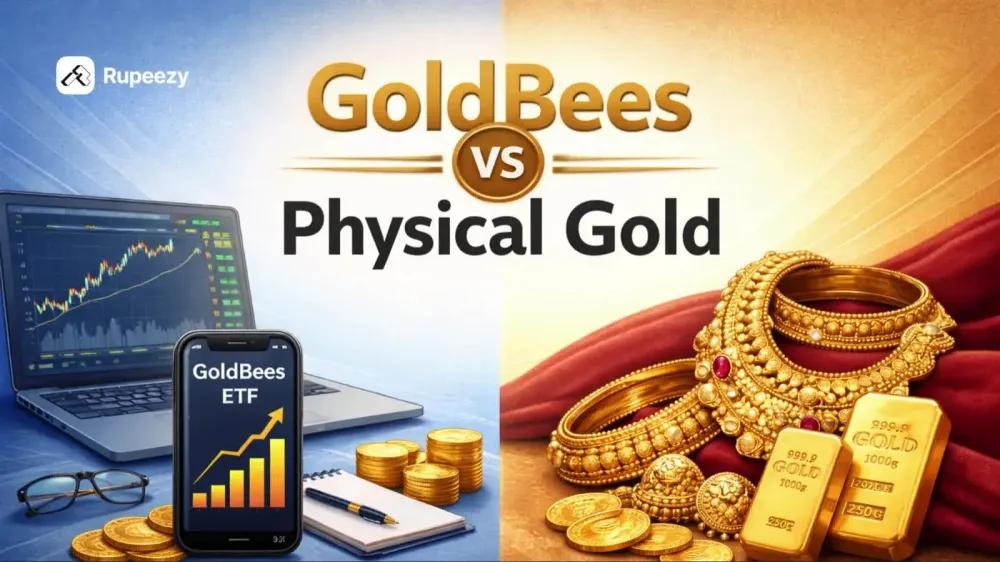
GoldBees vs Physical Gold: Key Differences

 Last Updated: 08 September, 2026
 10 min read




00:00 / 00:00


Summary :
|
Gold has always been considered a safe investment in India, but investing in it has changed significantly in 2026. Today, many investors are considering gold ETFs like GoldBees as an alternative to traditional gold. The biggest question then becomes: which is the better investment, gold bees versus physical gold? If you're looking to start investing in gold, this guide will explain the differences, benefits, and proper use of both options in simple language so you can make an informed decision.
Investors can also check the share market today to understand current Nifty, Sensex, and broader market conditions when assessing how gold may complement their equity portfolio.

Why Gold Remains a Popular Investment in India
In India, gold isn't just a metal; it has long been viewed as a safe investment and financial security. If you consider investments in any household, most people consider gold a reliable option. This is because, from time to time, whenever economic uncertainty, inflation, or market volatility increases, investors often turn to gold. This is why it is often referred to as a wealth protection asset.
The right allocation to gold can also depend on your financial objectives, investment horizon, and risk tolerance. Goal-based investment planning can help investors determine how much gold exposure may be appropriate for different financial goals while maintaining a diversified portfolio.
Gold as a Store of Value
Simply put, a store of value means an asset that can preserve the strength of your wealth over time. Gold is considered a strong asset for this reason. Historically, when economic tensions increase globally, such as a global recession, inflation, or a regional war, investors seek safe havens, and demand for gold increases. In 2026, rising tensions in the Middle East and geopolitical uncertainty globally are driving investors' attention to safe-haven assets. Simply put, when the market is volatile, many people view gold as a financial safety cushion.
Gold as a Portfolio Diversification Tool
Another major benefit of gold is portfolio diversification. Suppose you invest all your money solely in the stock market. If the market declines significantly for some reason, your entire portfolio could be affected.
This is where gold helps. Gold and equity markets often behave in ways that don't align. When uncertainty in the stock market increases, investors often shift to gold.
Example: If an investor has a total portfolio of ?5 lakh and invests a small portion of it in gold, it can make their overall investment a little more balanced. For this reason, many financial experts recommend that investors invest approximately 5% to 15% of their portfolio in gold.
What Is Physical Gold?
Physical gold refers to gold that you actually purchase and hold. This means that it's physically available, not digital or paper, but can be seen and touched. It can be sold or pledged for a gold loan if needed. This is a long-standing method of gold investment in India. Investors purchase and hold it directly, such as jewelry, gold coins, or gold bars. These are typically purchased from jewelers or authorized gold dealers, and the buyer receives physical delivery.
What Forms of physical gold are purchased?
Gold Jewelry: Such as chains, rings, bracelets, etc.
Gold Coins: Small coins, usually of 24-carat purity.
Gold Bars / Biscuits: Bars of pure gold purchased for investment purposes.
What Are GoldBees?
Simply put, GoldBees is a Gold Exchange Traded Fund (ETF). This means it's an investment instrument that tracks the price of gold, but doesn't require you to buy and store physical gold at home. When you invest in GoldBees, you don't actually buy gold, but rather units that represent gold. These units trade on the stock market, and their value typically fluctuates around the price of gold. Because GoldBees is backed by physical gold, stored in secure vaults by the fund house, it's considered a digital and convenient way to invest in gold.
How GoldBees Works
GoldBees units trade like shares on the stock exchange.
Investors can buy and sell them, just like buying shares in a company.
The price typically fluctuates with the market price of gold.
Example: Suppose you want to invest in gold, but you don't want to buy jewelry or gold coins and keep them at home. In this case, you can purchase GoldBees units through the stock market. This allows you to benefit from changes in gold prices without having to physically handle gold.
Where Investors Can Buy GoldBees?
To buy GoldBees, you need two things:
Demat Account
Stock Broker Platform
Because GoldBees are traded on the stock exchange, you must use a brokerage platform to purchase them. Investors can easily invest in Gold ETFs by opening a Demat account through a platform like Rupeezy. You can then search for GoldBees on the stock market and purchase units.

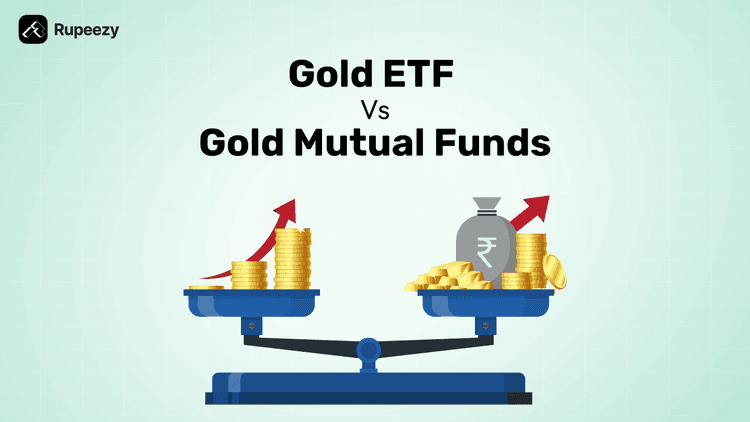
Gold Bees vs Physical Gold – Key Differences
Both are gold-related investments, but they differ in many aspects, like method of purchase, cost, security, tax, and liquidity.
Factor | Physical Gold | GoldBees (Gold ETF) |
Ownership | You buy physical gold like jewelry, coins, or bars | You buy units of an ETF that tracks gold |
Form | occurs in physical form | Remains in digital form in a Demat account |
Storage | It has to be kept at home or in a bank locker. | It is safe in the Demat account. |
Safety | May be at risk of theft or loss | No risk of theft due to being digital |
Making Charges | Jewellery has making charges | No making charges |
Price Transparency | Price may vary from jeweller to jeweller | Get live market prices on the stock exchange |
Liquidity | You have to go to a jeweler and sell it. | You can sell immediately when the market opens. |
Investment Amount | Usually requires a higher purchase amount | Investment can be started even with a small amount. |
Purity Concern | There may be concerns about purity, the BIS Hallmark is necessary | There is no purity risk in ETFs |
Extra Costs | GST, making charges, and locker charges may apply | Only a small expense ratio and brokerage |
Usage | Can also be worn as jewelry | For investment purposes only |
Convenience | Buying and selling can take time | Trade easily from a mobile or a trading app |
Portfolio Tracking | needs to be tracked separately | Easily visible in the Demat portfolio |
Loan Facility | Gold can be pledged for a loan | Not directly applicable to gold loans |
Best For | Jewellery, Tradition and Emergency Protection | Investments and portfolio diversification |
Returns Comparison – GoldBees vs Physical Gold
Factor | Physical Gold | GoldBees |
Price Movement | Depends on the price of gold | Tracks the price of gold |
Extra Costs Impact | Can reduce the making of charges and GST returns | Only a small expense ratio |
Price Transparency | Price may vary depending on the jeweller | Live market price on the exchange |
Long-Term Investment | Returns may be lower due to costs | Returns are usually close to the gold price |
Taxation on GoldBees vs Physical Gold in India
In India, tax on gold is mainly levied in the form of capital gains tax, that is, tax has to be paid when you make a profit by selling gold.
Tax Factor | Physical Gold | GoldBees (Gold ETF) |
Asset Type | Precious metal investment | Non-equity ETF (gold-backed fund) |
Short-Term Holding Period | Less than 24 months | less than 12 months |
Short-Term Capital Gains (STCG) | Tax as per the income tax slab of the investor | Tax as per the income tax slab of the investor |
Long-Term Holding Period | More than 24 months | More than 12 months |
Long-Term Capital Gains (LTCG) | Approximately 12.5% ??tax (without indexation) | Approximately 12.5% ??tax (without indexation) |
GST on Purchase | 3% GST is payable at the time of purchase. | No GST on buying ETFs |
Tax Trigger | Capital gains tax is applicable on the sale. | Capital gains tax is applicable on selling ETF units. |
Equity LTCG Exemption (?1.25 lakh) | Not applicable | Not applicable (as it is not an equity asset) |
How Beginners Can Start Investing in GoldBees
If you are looking to invest in gold for the first time and are thinking of investing through GoldBees (Gold ETF), the process is quite simple.
Step 1: Open a Demat Account
To invest in GoldBees, you first need a Demat and Trading Account. This is how you can buy and sell ETFs or shares in the stock market. A reliable stockbroker is required here. For example, Rupeezy is a stock broker platform where you can easily open a Demat account and start investing in stocks, ETFs, and Gold ETFs like GoldBees.
Generally, to open a Demat account, you need the following:
PAN Card
Aadhaar Card
Bank Account
Mobile number and email verification
Your account is activated after online KYC.
Step 2: Search for a Gold ETF
Once your Demat account is activated, you need to search for a Gold ETF in your trading app or platform.
For example, you can search for:
GoldBees
Other Gold ETFs
These ETFs trade on the stock exchange (NSE/BSE), so you can view them the same way you view company shares.
Step 3: Buy GoldBees Units
Once you find the GoldBees ETF, you can purchase its units. The process is similar to buying shares:
Search for the ETF
Select the number of units
Place a buy order
Your purchase will be finalized at the market price, and the ETF units will be credited to your Demat account.
While GoldBees itself is a Gold ETF, investors buying eligible equity stocks through their trading account can also consider MTF for eligible stocks to increase their buying capacity, subject to applicable margin requirements, interest, stock eligibility, and other charges.
Step 4: Track your Gold Investment
After purchasing the ETF, your GoldBees units are kept safe in your Demat portfolio.
You can always:
View your investment in the Trading app
Track gold price movements
Sell during market hours if needed
Risks of Physical Gold
Risk Factor | Explanation |
Theft or Loss Risk | Storing physical gold at home can be prone to theft or loss. Many people, therefore, use bank lockers, which can also incur additional expenses. |
Purity Concerns | If gold is not purchased from a reputable jeweler, there may be issues with purity. Therefore, it is always recommended to purchase gold with a BIS Hallmark. |
Making Charges Loss | The making charges paid while buying jewellery are usually not recovered when selling, which may reduce the actual returns. |
Resale Price Deduction | When you sell gold to a jeweler, sometimes some deduction is made from the market price. |
Storage Responsibility | The responsibility for the safety of physical gold lies entirely with the investor. |
Risks of GoldBees (Gold ETF)
Risk Factor | Explanation |
Tracking Error | GoldBees aims to track the price of gold, but due to expense ratios and fund management, the returns of the ETF may sometimes differ slightly from the gold price. |
Market Liquidity | ETFs are traded on stock exchanges, so their liquidity depends on market trading. However, this is usually less of a problem for larger, more popular ETFs. |
Market Timing Risk | GoldBees can be bought or sold only during stock market trading hours, so the price keeps changing according to market movements. |
Demat Dependency | A Demat account is necessary for investing in Gold ETF, hence investment in it cannot be made without a Demat account. |
Conclusion
Both intraday trading and delivery trading have their own advantages and risks. Intraday trading offers short-term profit opportunities but requires experience, discipline, and market monitoring. Delivery trading, on the other hand, is considered better for long-term wealth creation. If you're a beginner, starting with delivery investing is safer. You can easily open a Demat account on a platform like Rupeezy and start equity, intraday, and F&O trading all from one place.
FAQs
Q1. What is GoldBees?
GoldBees is a gold ETF that tracks the price of gold and is traded on the stock market.
Q2. What is physical gold?
Physical gold is actual gold purchased in the form of jewelry, coins, or bars.
Q3. Is GoldBees better than physical gold for investment?
Many people consider GoldBees an easy and cost-efficient option for investment.
Q4. Do I need a Demat account to buy GoldBees?
Yes, a Demat and trading account are required to buy GoldBees.
Q5. Can I sell GoldBees anytime?
Yes, you can sell it during stock market trading hours.
Q6. Is a gold ETF better than buying physical gold?
Gold ETFs don't involve storage, purity, or manufacturing charges, and can be easily bought and sold on the exchange.

Anupam Shukla is a finance content writer and an NISM-certified research analyst with over Seven years of trading experience. With a passion for the stock market, he simplifies complex financial concepts, making investing and trading easier for everyone. His expertise helps readers stay ahead in the ever-changing world of finance, empowering them to make smarter money moves.
Did you like this blog?
Be the first to like this blog.
The content on this blog is for educational purposes only and should not be considered investment advice. While we strive for accuracy, some information may contain errors or delays in updates.
Mentions of stocks or investment products are solely for informational purposes and do not constitute recommendations. Investors should conduct their own research before making any decisions.
Investing in financial markets are subject to market risks, and past performance does not guarantee future results. It is advisable to consult a qualified financial professional, review official documents, and verify information independently before making investment decisions.

All Category