
Open a Free Demat Account !
₹0 AMC & Account Opening Fee
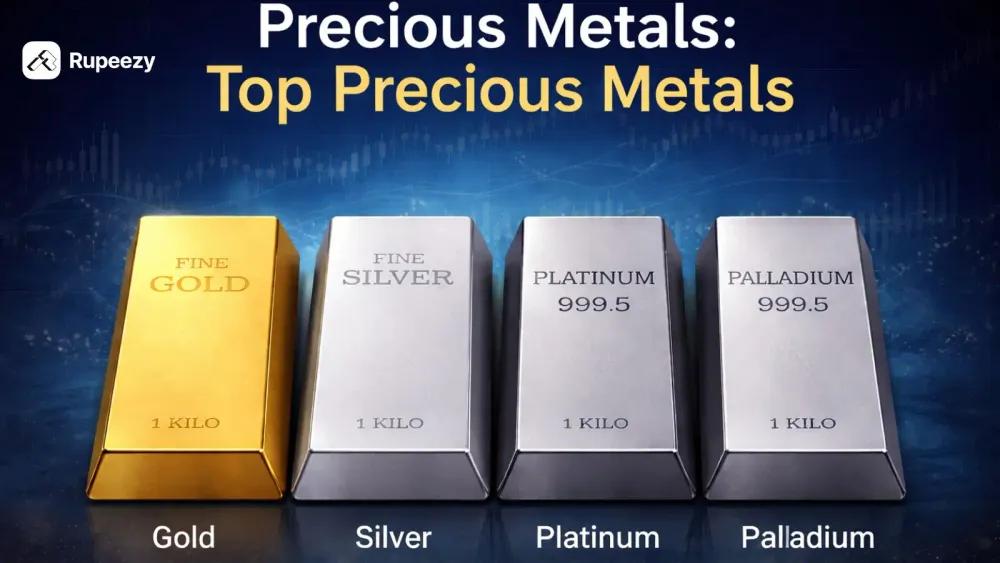
Precious Metals: Top 10 Precious Metals List

 Last Updated: 21 September, 2026
 12 min read




00:00 / 00:00


Summary:
| ||
India’s relationship with precious metals has traditionally been centered around gold jewellery, family savings, and wealth preservation. However, in 2026, the importance of precious metals goes far beyond gold ornaments and festive buying. These metals are now playing a major role in industries such as renewable energy, electric vehicles, semiconductors, electronics, aerospace, and telecommunications.
Gold and silver continue to attract the most attention from investors, but other metals like rhodium, platinum, palladium, and iridium are also becoming increasingly important because of their industrial uses. Many of these are among the most expensive metals in the world due to their rarity, limited supply, and growing demand from modern technologies.
The metals market has also seen significant price movement in recent months. Gold prices in India have reached Rs 1.5 lakh per 10 grams, while silver prices have moved above Rs 2 lakh per kg after experiencing sharp corrections and rebounds. This volatility has increased interest among both investors and traders looking to gain exposure to precious metals.
As India expands its focus on clean energy, electronics manufacturing, and digital infrastructure, the demand for a broader precious metals list is expected to grow further. This article explains what are precious metals, covers the top 10 precious metals list, explores where these metals are used in India, and discusses how to invest in precious metals through ETFs and commodity trading.

What are Precious Metals?
Precious metals are rare, naturally occurring metallic elements that possess high economic value. Unlike base metals such as iron, aluminum, or lead, these metals are resistant to corrosion and oxidation, making them durable and suitable for both long-term storage of value and industrial use.
A metal is generally considered precious based on several factors, including rarity, industrial demand, resistance to corrosion, historical value, and ease of trading in global markets. This is why metals such as gold, silver, platinum, and rhodium are considered precious, while more common metals are not.
Precious metals can broadly be divided into two categories. The first includes metals such as gold and silver, which are commonly used for investment, jewelry, and wealth preservation. The second includes metals such as platinum, palladium, rhodium, and indium, which are mainly used in industries like automobiles, electronics, semiconductors, and clean energy.
Top 10 Precious Metals List
Here are the top 10 precious metals and their major use cases across industries such as automobiles, clean energy, electronics, semiconductors, and jewelry.
Metal | Use Case |
Rhodium | Catalytic converters for Petrol and Hybrid Vehicles |
Iridium | Hydrogen electrolyzers |
Gold | Jewelry and electronics |
Platinum | Fuel cells and catalysts |
Palladium | Catalytic converters and electronics |
Osmium | Medical devices and electrical contacts |
Rhenium | Jet engines and turbines |
Ruthenium | Data storage and microchips |
Silver | Solar panels and batteries |
Indium | Touchscreens and LED panels |
Note: The precious metals listed above are based on a mix of rarity, industrial demand, investment relevance, and long-term economic importance rather than only market price.
Overview of the Top 10 Precious Metals
While gold and silver are the most familiar names, several other metals in the precious metals list are equally important because of their role in industrial growth, clean energy, technology, and infrastructure. Each metal has unique physical and chemical properties that make it useful in specific industries.
1. Rhodium (Rh)
Rhodium is one of the rarest and most expensive metals in the world. It is mainly used in catalytic converters that help reduce harmful vehicle emissions and is useful especially in petrol and hybrid vehicles.
A major reason rhodium is so expensive is that supply is limited and concentrated in only a few countries. Even small disruptions in mining output can cause major price swings.
Rhodium is also used in jewelry plating because of its bright reflective finish and resistance to corrosion.
2. Iridium (Ir)
Iridium is highly resistant to heat, corrosion, and chemical damage. It is mainly used in hydrogen production, spark plugs, medical devices, and satellite components.
Its biggest growth opportunity comes from Proton Exchange Membrane electrolyzers used in green hydrogen production.
3. Gold (Au)
Gold is the most widely recognized precious metal because of its use in jewelry, coins, bars, and investment products.
It is also widely used across industries especially in electronics, because it conducts electricity efficiently and does not rust or corrode. Smartphones, computers, medical devices, and advanced circuit boards often contain small amounts of gold.
Gold is often viewed as a safe-haven asset. During periods of inflation, currency weakness, or geopolitical tensions, investors often increase their allocation to gold.
4. Platinum (Pt)
Platinum is widely used in clean energy, automobiles, and industrial processes.
It is a key component in fuel cells, which are expected to become more important as hydrogen-powered vehicles can grow in popularity. Platinum is also used in petroleum refining, fertilizers, medical devices, and jewelry.
Compared to gold, platinum is more dependent on industrial demand, which means its prices can be more cyclical.
5. Palladium (Pd)
Palladium is mainly used in catalytic converters for petrol vehicles. It helps reduce harmful emissions and is therefore closely linked to automobile demand.
Apart from vehicles, palladium is also used in smartphones, laptops, multilayer ceramic capacitors, and dentistry.
Palladium prices can rise sharply during periods of supply shortages because global production is concentrated in only a few regions.
6. Osmium (Os)
Osmium is the densest naturally occurring metal and is valued for its hardness and durability.
It is mainly used in fountain pen tips, surgical instruments, medical implants, electrical contacts, and scientific equipment.
7. Rhenium (Re)
Rhenium is a strategic metal for aerospace and defense because it can withstand extremely high temperatures.
It is mainly used in jet engines, gas turbines, rocket systems, and petroleum refining.
Since rhenium is often produced as a by-product of copper mining, supply can be limited, making it one of the more valuable industrial metals.
8. Ruthenium (Ru)
Ruthenium is mainly used in semiconductors, hard disk drives, electrical contacts, and solar cells.
As semiconductor manufacturing expands globally, ruthenium is becoming more important in the technology sector.
9. Silver (Ag)
Silver has the highest electrical conductivity of any metal, which makes it highly valuable in modern technology.
It is widely used in solar panels, batteries, electrical wiring, medical devices, water purification systems, EVs, and 5G infrastructure.
Unlike gold, silver has strong industrial demand in addition to investment demand. This is why silver prices are often more volatile than gold prices.
10. Indium (In)
Indium is an essential metal for display technology and semiconductors.
It is mainly used to create indium tin oxide, which is required for touchscreens, flat-screen televisions, LED panels, tablets, and smartphones.
As demand for electronics and display technology increases, indium is likely to become even more important in the future.
Why Precious Metals Are Important for India
Precious metals are becoming increasingly important because they are used across multiple sectors of the economy.
Gold and silver remain popular as investment assets, while metals such as platinum, palladium, rhodium, and indium are becoming more important because of their role in clean energy, semiconductors, automobiles, aerospace, and electronics.
The growth of electric vehicles, solar energy, hydrogen production, and electronics manufacturing is expected to support long-term demand for these metals.
For example, platinum demand is linked to hydrogen fuel cells, palladium and rhodium are used in catalytic converters, indium is important for display panels and touchscreens, and ruthenium is increasingly used in semiconductors.
While the International Energy Agency expects solar installations to remain the fastest-growing energy segment, the Silver Institute notes that silver demand from the solar sector is actually projected to flatten or slightly decline through 2026. This is because solar manufacturers are aggressively using significantly less silver per cell to offset record-high silver prices and shift toward cheaper alternatives like copper.
Investors can explore different stock market sectors to understand how industries such as clean energy, automobiles, electronics, and technology are shaping investment opportunities.
However, softer industrial demand in one area can still be offset by stronger demand from investors and other industries.
Emerging Trends in the Precious Metals Market
One of the biggest trends in the precious metals market is urban mining. Since India imports a large share of its precious metals, there is growing interest in recovering valuable materials from electronic waste or e-waste.
Smartphones, laptops, batteries, and other devices contain small amounts of gold, silver, palladium, and other metals that can be extracted and reused.
This helps reduce import dependence, supports recycling, and strengthens the circular economy.
Another important trend is the Gold-Silver Ratio, which is often used by traders to compare the relative value of gold and silver.
Historically, a higher ratio suggests that gold is expensive compared to silver, while a lower ratio suggests silver may be relatively expensive.
Since silver is generally more volatile than gold, many traders use this ratio to identify potential trading opportunities.
Along with tracking individual metal prices, investors can use a market heatmap to quickly compare broader market movements and identify which sectors and stocks are showing strength or weakness. This can be useful when evaluating mining and metal companies alongside broader market trends.
How to Invest in Precious Metals?
How to Invest in Precious Metals?
Precious metals are attractive because they can act as a hedge against inflation, currency weakness, and economic uncertainty.
Gold is usually considered the safest option for beginners because it is less volatile and widely available. Silver offers higher growth potential because of its industrial demand, but it is generally more volatile than gold. Before choosing between physical metals, ETFs, mutual funds, or mining stocks, investors should consider their financial objectives, investment horizon, and risk tolerance. Goal-based investment planning can help align precious-metal investments with specific financial goals rather than investing solely based on market movements.
Other metals such as platinum, palladium, and rhodium are more closely linked to industrial sectors like automobiles, clean energy, and electronics. These metals can offer higher growth potential, but they are often harder to access and more volatile than gold or silver.
There are several ways to invest in precious metals:
Physical Precious Metals: Investors can buy physical gold, silver, platinum, and palladium in the form of coins and bars.
ETFs and Exchange-Traded Products: Gold and silver ETFs are the most common, but international markets also offer ETFs linked to platinum and palladium.
Gold Mutual Funds: Gold mutual funds invest in Gold ETFs and allow investors to start SIPs with small amounts.
Mining and Metal Companies: Investors can also buy shares of companies involved in mining, refining, or processing precious metals. This can provide indirect exposure to metals such as rhodium, palladium, platinum, and silver..
According to World Gold Council, investors often use precious metals as portfolio diversifiers because they usually behave differently from equities during uncertain economic periods.
Investors considering mining and metal companies can also check the share market today to understand how broader Nifty, Sensex, and sector movements are influencing market sentiment around these stocks.
How to Trade Precious Metals
In India, precious metals are mainly traded through the Multi Commodity Exchange (MCX).
Gold and silver futures are the most actively traded contracts because they are liquid and widely followed by investors.
Inflation, interest rates, global economic conditions, and industrial demand usually influence prices.
The exchange also offers trading in crude oil, natural gas, copper, aluminum, zinc, and lead.
Since commodity trading involves leverage, it is important to manage risk carefully.
Disclaimer: Commodity trading involves a high level of risk and may not be suitable for all investors. Prices can be volatile, and leverage can magnify both profits and losses.
Conclusion
Precious metals are no longer limited to jewelry and traditional wealth preservation. They are now deeply connected to the future of clean energy, electric vehicles, semiconductors, electronics, aerospace, and industrial manufacturing.
Gold and silver remain the most accessible choices for retail investors, but other expensive metals such as rhodium, platinum, palladium, ruthenium, and indium are becoming increasingly important because of their industrial applications.
This is what makes precious metals unique. They can serve both as investment assets during uncertain times and as growth opportunities linked to technological and industrial trends.
For investors, precious metals can provide diversification, inflation protection, and portfolio stability. For traders, they can offer opportunities through volatility, global macro trends, and commodity cycles.
Whether you choose physical metals, ETFs, mutual funds, mining stocks, or MCX futures, it is important to understand the unique role of each metal before investing.
As the world moves toward cleaner energy, smarter devices, and more advanced manufacturing, the long-term importance of precious metals is likely to grow even further.
Platforms like Rupeezy can help investors access gold and silver ETFs as well as commodity derivatives traded on the MCX, making it easier to participate in the growing precious metals market.
Disclaimer: This article is for educational purposes only and should not be considered investment advice. Investors should evaluate their financial goals and risk tolerance before investing in precious metals or commodity products.
Frequently Asked Questions:
Q1) What are precious metals?
Precious metals are rare metallic elements that have high economic value because of their scarcity, durability, corrosion resistance, and industrial demand.
Q2) Which is the most expensive metal in the world?
Rhodium is generally considered the most expensive metal because of its rarity and its use in catalytic converters.
Q3) Which precious metal is best for beginners?
Gold is often considered the best option for beginners because it is widely available, less volatile, and easier to access through ETFs, mutual funds, digital gold, and physical purchases.
Q4) Is silver better than gold?
Silver offers higher growth potential because of its industrial demand, especially from solar energy and electronics. However, it is usually more volatile than gold.
Q5) Can precious metals protect against inflation?
Gold and silver are often used as inflation hedges because they tend to hold value when currencies weaken or prices rise.
Q6) Which precious metals can retail investors easily invest in?
Gold and silver are the easiest metals for retail investors to access through physical purchases, ETFs, mutual funds, and commodity trading. Metals such as rhodium, palladium, and platinum are harder to access directly and are usually traded through global markets or mining stocks.

Santhosh is a Research Analyst at Rupeezy who transforms complex market data into actionable insights for investors. With five years of financial industry experience and an MBA in Finance from Jain University, he specializes in evaluating stock market dynamics, mutual fund performance, and ETF trends. Driven by a deep passion for business analysis, Santhosh focuses heavily on company fundamentals to help readers make informed, data-backed financial decisions.
Did you like this blog?
Be the first to like this blog.
The content on this blog is for educational purposes only and should not be considered investment advice. While we strive for accuracy, some information may contain errors or delays in updates.
Mentions of stocks or investment products are solely for informational purposes and do not constitute recommendations. Investors should conduct their own research before making any decisions.
Investing in financial markets are subject to market risks, and past performance does not guarantee future results. It is advisable to consult a qualified financial professional, review official documents, and verify information independently before making investment decisions.
All Category