
Open a Free Demat Account !
₹0 AMC & Account Opening Fee
Tax on SIP Explained: What Every Investor Should Know

 Last Updated: 03 September, 2026
 11 min read





00:00 / 00:00


Summary:
| ||
You invest in SIPs for years, watch your portfolio grow, and finally decide to withdraw your money for a goal like buying a house, funding a child’s education, or building an emergency fund.
Then comes the surprise.
A part of your returns may go towards taxes.
Many investors focus only on how much profit they have made, but very few calculate how much they will actually receive after paying tax. This is one of the biggest reasons why investors feel disappointed at the time of redemption.
Understanding the tax on SIP in advance can help you avoid this situation completely.
Before making a redemption decision, investors can also review today's market movement to understand the broader market environment alongside their SIP's tax and holding-period considerations
This article breaks down how SIP taxation works, how much tax you may pay, and more importantly, how you can plan your withdrawals better to keep more of your returns.

What is Tax on SIP?
The tax on SIP refers to the tax payable on the profits earned from mutual fund investments made through SIPs.
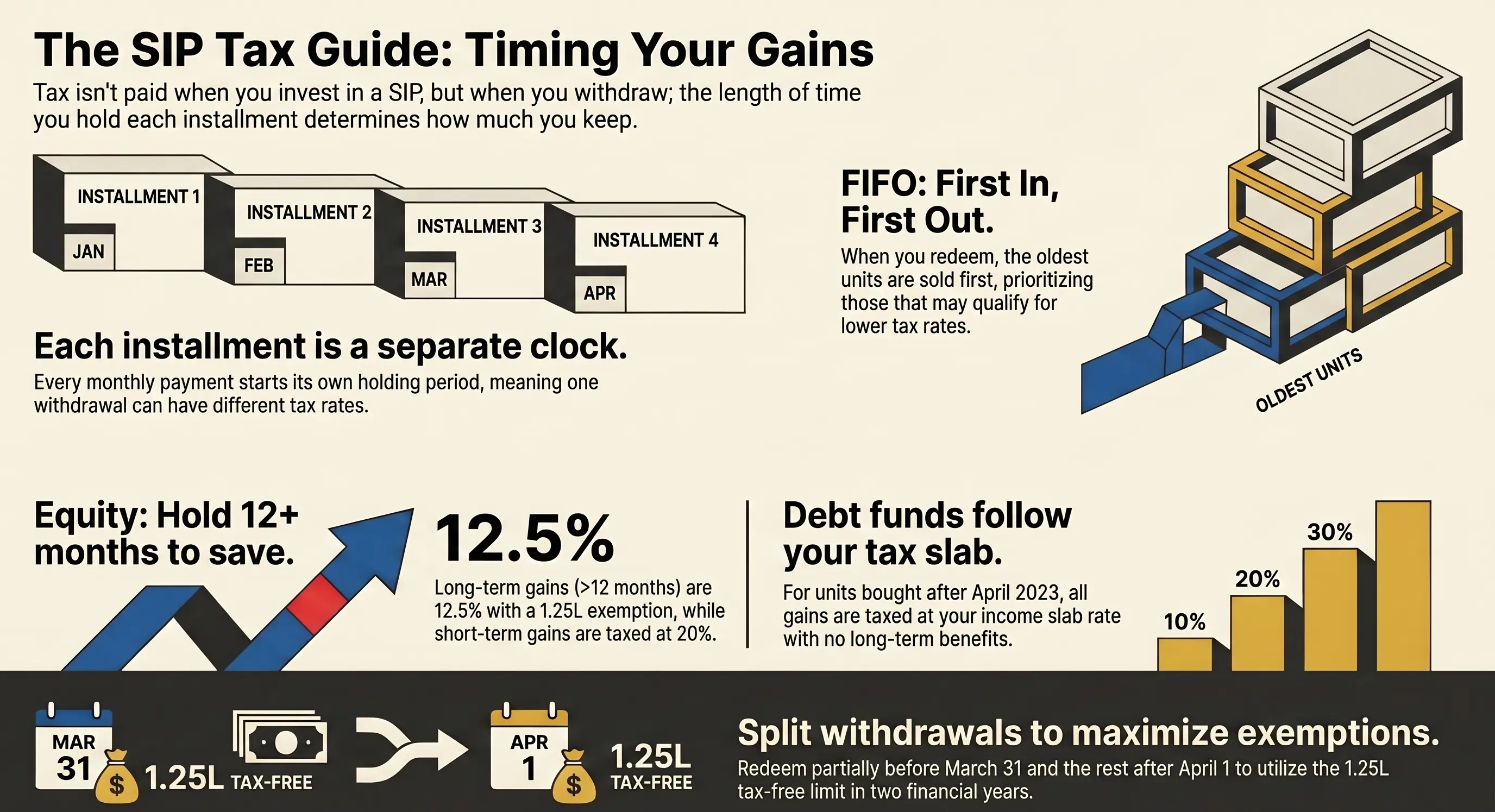
It is important to understand that you do not pay tax when you invest through a SIP. Tax is applicable only when you redeem or sell your mutual fund units.
For example, if you invest Rs 5,000 every month through SIP, there is no tax at the time of investing. But when you withdraw your money in the future, any profit earned on those units may be taxed.
The tax treatment depends on:
Whether the mutual fund is equity, debt, or hybrid
How long have you held the units
Whether the gains qualify as short-term or long-term capital gains
Whether you are redeeming all units or only a part of them
Now that you know when tax applies, the next step is understanding how SIP taxation works.
How SIP Taxation Works
One of the most important concepts investors must understand is that every SIP instalment is treated as a separate investment.
Suppose you invest Rs 10,000 every month in an equity mutual fund for one year. At the end of 12 months, you will have 12 different purchase dates. This means every instalment has its own holding period.
Because of this, when you redeem your SIP investments, some units may be taxed as short-term gains while others may be taxed as long-term gains. This is exactly why tax on SIP feels confusing to many investors.
Once this concept is clear, the next step is understanding how different types of mutual funds are taxed.
Tax on Equity Mutual Fund SIPs
Let’s break this down category-wise, because taxation changes depending on the type of mutual fund you invest in.
Equity mutual funds invest at least 65% of their assets in equities.
Short-Term Capital Gains (STCG)
Under Section 111A of the Income Tax Act, 1961 (now Income Tax Act, 2025), if units are redeemed within 12 months:
Gains are taxed at 20%
Long-Term Capital Gains (LTCG)
Under Section 112A of the Income Tax Act, 1961:
Gains above Rs 1.25 lakh are taxed at 12.5%
Gains below this limit are tax-free
This means holding investments longer can significantly reduce your tax. While equity funds have separate tax treatment based on holding period, debt funds follow a different rule altogether.
Tax on Debt Mutual Fund SIPs
Debt mutual funds invest in bonds, treasury bills, and other fixed-income instruments. However, taxation has changed significantly.
For investments made after April 1, 2023:
Gains are taxed as per your income tax slab
No long-term capital gains benefit
For example, if you fall under the 30% tax bracket, your gains will be taxed at 30%.
Because of this, investors should always compare the post-tax returns of debt funds with alternatives like fixed deposits.

Tax on Hybrid Mutual Fund SIPs
While equity and debt funds have clearly defined tax rules, hybrid funds fall somewhere in between.
Hybrid funds invest in both equity and debt instruments and have completely different tax treatment.
If equity exposure is above 65%, then it is taxed like equity
If equity exposure is below 65%, then taxed like debt
Equity vs Debt vs Hybrid SIP Taxation
This comparison can help investors quickly understand which type of SIP may be more tax-efficient.
Fund Type | Short-Term Tax | Long-Term Tax | LTCG Holding Period |
Equity | 20% | 12.5% above Rs 1.25 lakh | More than 12 months |
Debt | Taxed as per the slab rate | Taxed as per the slab | No LTCG benefit |
Hybrid | Depends on equity allocation | Depends on equity allocation | Depends on classification |
Understanding the FIFO Rule in SIP Taxation
Knowing the fund type is not enough. Another critical factor is how your units are sold during redemption.
FIFO stands for First In, First Out.
This means: The earliest SIP units are sold first
So older units may qualify for LTCG, while newer ones may still be taxed under STCG.
This plays a huge role in how much tax you actually pay.
Example of Tax on SIP Calculation
Suppose you invest Rs 10,000 every month for 18 months in an equity mutual fund.
Total investment = Rs 1.8 lakh
Let’s assume the value grows to Rs 2.5 lakh at the time of redemption
So, the total gain is Rs 70,000
Now, because each SIP instalment has a different holding period:
Units invested in the first 12 months are held for more than 1 year; then they qualify for LTCG
Units invested in the last 6 months are held for less than 1 year, which falls under STCG
Let’s assume:
Rs 50,000 of gains come from older units ? LTCG
Rs 20,000 of gains come from newer units ? STCG
Tax Calculation:
LTCG of Rs 50,000 -> Tax-free (within Rs 1.25 lakh limit)
STCG of Rs 20,000 -> Taxed at 20% = Rs 4,000
Final Outcome:
Total gain = Rs 70,000
Tax paid = Rs 4,000
Post-tax gain = Rs 66,000
STCG vs LTCG comparison
The difference between short-term and long-term tax treatment is significant, even on the same amount of gain. The example below uses Rs 50,000 in profit from an equity fund to show exactly what changes when you hold longer.
Scenario A - STCG (held under 12 months) | Scenario B - LTCG (held over 12 months) | ||
Total gain | Rs 50,000 | Total gain | Rs 50,000 |
Tax type | STCG at 20% | Tax type | LTCG at 12.5% |
Exemption | None | Exemption | Rs 1.25L/year |
Tax payable | Rs 10,000 | Tax payable | Rs 0 |
You receive | Rs 40,000 | You receive | Rs 50,000 |
Note: The Health and Education Cess (4%) has not been included. Figures are illustrative.
Both scenarios assume the same Rs 50,000 gain from an equity mutual fund. The only difference is the holding period. Rs 10,000 saved simply by waiting for 12 months.
This example shows why investors should not assume that the entire redemption amount will be taxed in the same way.
SIP Tax Planning Calendar for Beginners
Many investors redeem their entire investment at once without checking whether they can reduce taxes by spreading withdrawals across two financial years.
For example, if your equity mutual fund gains are expected to exceed the Rs 1.25 lakh LTCG exemption limit, you can consider redeeming some units before March 31 and the remaining units after April 1.
This may allow you to use the LTCG exemption in two separate financial years.
A simple SIP tax planning calendar may look like this:
January to March: Review expected gains and tax liability
March: Consider partial redemption if LTCG is nearing the exemption limit of Rs 1.25 lakh
April: Use the fresh exemption limit for the new financial year
Quarterly: Check the holding period of SIP instalments before redeeming
This strategy can help investors reduce their overall tax liability legally.
Reducing tax is important, but investors should also know how to measure their actual post-tax profit.
How to Estimate Your SIP Returns After Tax
Many investors focus only on absolute returns. However, the actual return you receive may be lower after tax.
For example, if your SIP generated a 12% annual return but you paid tax on short-term gains, your effective post-tax return could be lower.
This is why investors should calculate post-tax returns instead of only looking at portfolio value.
A simple formula is:
Post-Tax Return = Total Redemption Value – Tax Payable – Original Investment
Investors who hold equity SIPs for more than one year may enjoy better post-tax returns because long-term gains are taxed more efficiently compared to short-term gains.
Tax on ELSS SIP Investments
ELSS funds offer a tax deduction under Section 80C (up to Rs 1.5 lakh).
Each SIP instalment has a 3-year lock-in
After lock-in, it is taxed like equity funds
Equity Linked Savings Schemes (ELSS) are tax-saving mutual funds. Investments in ELSS qualify for deduction under Section 80C up to Rs 1.5 lakh in a financial year.
However, ELSS funds come with a lock-in period of three years.
For SIP investments in ELSS, every SIP instalment has its own three-year lock-in period.
For example:
January SIP can be redeemed only after three years from January
February SIP can be redeemed only after three years from February
Once redeemed, gains from ELSS are taxed like equity mutual funds under LTCG.
Apart from capital gains tax, investors should also understand how different payout options are taxed.
Tax on IDCW Option in SIP
Some investors choose the Income Distribution cum Capital Withdrawal (IDCW) option instead of the growth option. Under IDCW, mutual funds distribute payouts to investors from time to time.
These payouts are added to the investor’s taxable income and taxed according to their income tax slab.
In many cases, the growth option is more tax-efficient for long-term investors because it allows gains to compound without immediate taxation.
What Investors Should Check Before Redeeming SIPs
Before redeeming SIP investments, investors should ask themselves a few important questions:
How much of the gain is short-term and long-term?
Will this redemption cross the Rs 1.25 lakh LTCG exemption limit?
Can the redemption be split across two financial years?
Are the earliest units already eligible for lower tax treatment (LTCG)?
Is the fund classified as equity, debt, or hybrid for tax purposes?
Reviewing these points can help investors reduce tax legally. Investors with large SIP portfolios may benefit from speaking to a tax advisor before major redemptions. Even after understanding the rules, many investors still make mistakes that increase their tax burden.
How Beginners Can Start Investing Through SIPs
For beginners, SIPs remain one of the easiest ways to start investing because they offer discipline, affordability, long-term wealth creation, and flexibility in contribution amounts.
Investors can start with small amounts and gradually increase contributions as their income grows.
Today, many online platforms and brokerage companies make SIP investing more accessible. Investors can compare mutual funds, track their portfolio, access capital gains statements, monitor SIP performance, and invest digitally through platforms such as Rupeezy.
Conclusion
Understanding the tax on SIP investments is essential for every mutual fund investor. While SIPs are a convenient and disciplined way to invest, the taxation rules can affect your final returns.
Each SIP instalment is treated separately, and factors such as holding period, fund type, FIFO rules, and capital gains classification all play an important role. For beginners, the best approach is to stay invested for the long term, review tax implications before redeeming, and focus on post-tax returns rather than only headline returns.
Tax laws may change over time, so investors should also verify the latest mutual fund taxation rules before making major investment or redemption decisions.
Frequently Asked Questions (FAQs)
Q1) Is SIP investment tax-free?
No. There is no tax while investing, but gains are taxed when you redeem. Equity SIPs held less than 12 months are taxed at 20% and for over 12 months at 12.5% on gains above Rs 1.25 lakh per year. ELSS SIPs qualify for a Section 80C deduction under the old tax regime, but gains at redemption are still taxed at LTCG.
Q2) Do I need to pay tax if I switch from one mutual fund to another?
Yes. Switching from one mutual fund to another, including within the same fund house is treated as a redemption and a fresh investment. This means any gains on the units you switch are taxed based on the holding period.
Q3) Does every SIP instalment have a separate holding period?
Yes. Each monthly instalment is treated as an independent purchase. When you redeem, the FIFO rule applies, and your oldest units exit first. This means a single redemption can include both short-term and long-term units.
Q4) How are debt fund SIP gains taxed?
For investments made after April 1, 2023, debt fund gains are taxed at your income slab rate regardless of how long you held the units. There is no long-term benefit or exemption.
Q5) Can I reduce tax by timing my SIP redemption?
Yes. If your total LTCG is likely to exceed Rs 1.25 lakh, consider redeeming across two financial years, part before March 31 and the remainder after April 1. This allows you to use the annual Rs 1.25 lakh exemption in both years, potentially reducing your tax bill significantly.

Santhosh is a Research Analyst at Rupeezy who transforms complex market data into actionable insights for investors. With five years of financial industry experience and an MBA in Finance from Jain University, he specializes in evaluating stock market dynamics, mutual fund performance, and ETF trends. Driven by a deep passion for business analysis, Santhosh focuses heavily on company fundamentals to help readers make informed, data-backed financial decisions.
Did you like this blog?
Be the first to like this blog.
Disclaimer
Investments in the securities market are subject to market risks. Read all the related documents carefully before investing. Rupeezy (SEBI RA Registration: INH000013332) provides this content for informational purposes; any securities quoted are for educational display and not as a recommendation. All charts and graphs are based on independent research and reliable sources for the period mentioned within the specific data set. Sometimes we take graphs from external sources. This communication does not promise or assure any fixed, guaranteed, or indicative returns to any client. For our complete registered office address, Member ID, and full SEBI registration details, please refer to our official website.
The content on this blog is for educational purposes only and should not be considered investment advice. While we strive for accuracy, some information may contain errors or delays in updates.
Mentions of stocks or investment products are solely for informational purposes and do not constitute recommendations. Investors should conduct their own research before making any decisions.
Investing in financial markets are subject to market risks, and past performance does not guarantee future results. It is advisable to consult a qualified financial professional, review official documents, and verify information independently before making investment decisions.






All Category