

Open a Free Demat Account !
₹0 AMC & Account Opening Fee
What is the Seagull Option Strategy?

 Last Updated: 21 September, 2026
 6 min read





00:00 / 00:00


In options trading, not every strategy is about taking high risk for high reward. Some setups are designed to lower costs while ensuring traders earn well. The seagull option trading strategy is one such strategy that is used widely.
The seagull option strategy blends a call spread with a short put. Traders usually consider it when they expect prices to move slightly higher but not sharply. The idea is to reduce the overall option premium outflow while keeping good gains.
But if you are looking to understand this fully, then read this guide.

What is the Seagull Option Strategy?
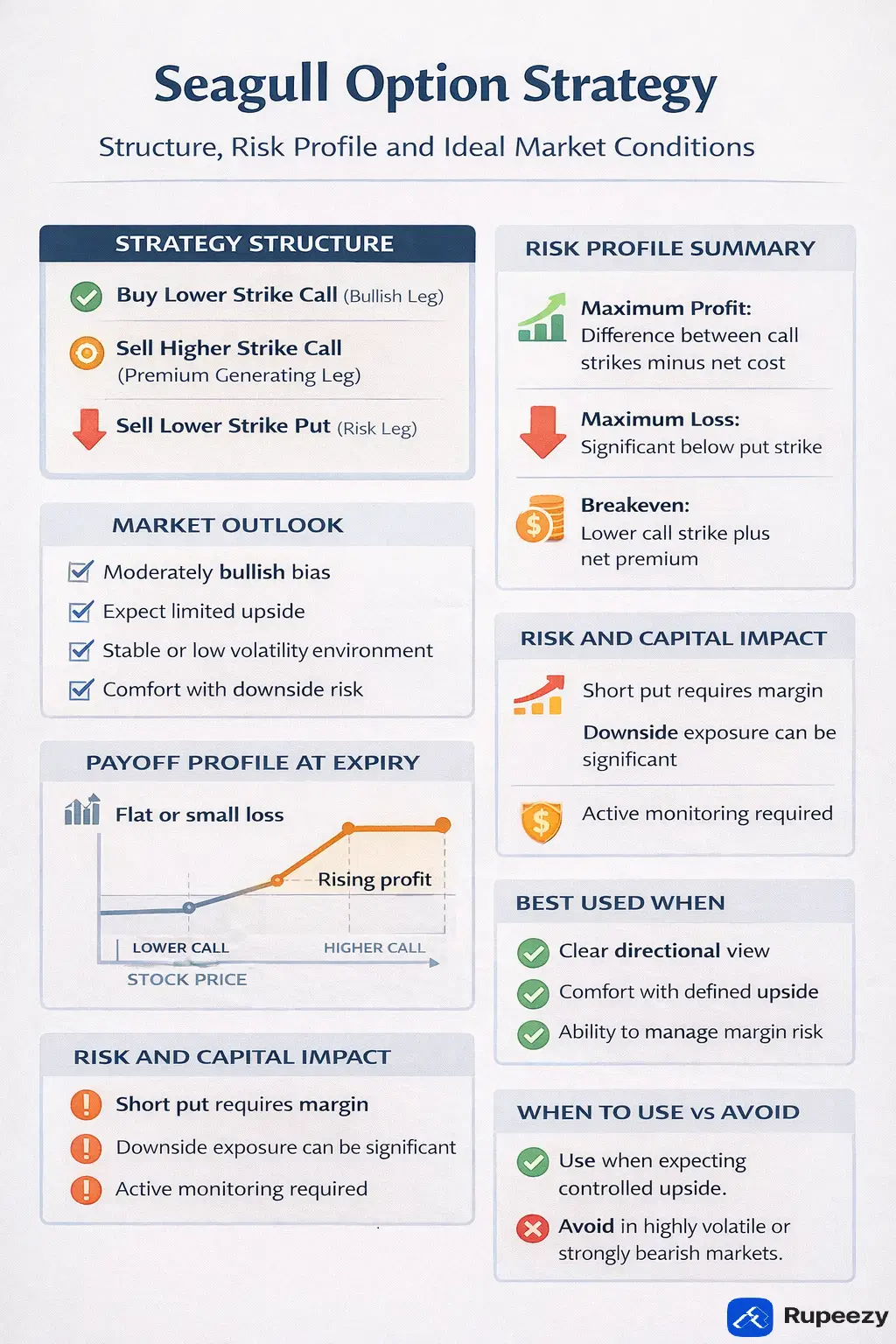
The seagull option strategy is a three-leg options setup. It is designed for traders who expect a moderately bullish move. It combines a bull call spread with a short put. The aim is to reduce the overall premium cost.
In simple terms, the premium that you receive by selling the options helps you offset the cost of buying. The amount that is left is the gain. It is important to note that it offers limited upside gains and also carries downside risk if the price falls sharply below the put strike.
Key Features of Seagull Option Strategy
To evaluate this strategy properly, you need clarity on how the structure is built. You must know how the payoff behaves at expiry. And for this, you must know the key features, which are as follows:
A three-leg combination involving both call and put options.
The bull call spread is created by buying a lower strike call and selling a higher strike call.
A short put added to generate additional premium income.
Designed for moderately bullish market expectations.
Limited maximum profit because of the high strike price.
Downside exposure begins below the strike price of the sold put.
Pros of Seagull Option Strategy
Most of the traders prefer the seagull option strategy due to lower risk and good returns. But there are other reasons as well that make it a suitable choice for many. The main pros of the same are as follows:
Lower initial premium outflow compared to a standalone long call.
Potential to structure the position at reduced cost or net credit.
Works effectively in range-bound or slightly rising markets.
Clearly defined profit zone between the call strike prices.
Flexible strike selection based on risk appetite and outlook.
Efficient use of premium to improve capital efficiency.

Cons of Seagull Option Strategy
The strategy is great in various ways, but carries risk. This is one of the reasons why you should understand the entire strategy before actually using it. The key risk points that you should know are:
Significant downside risk due to the uncovered short put.
Capped profit limits overall return potential.
Margin requirement increases capital commitment.
High losses when the market is falling.
Not suitable in highly volatile or strongly bearish conditions.
Requires continuous monitoring until expiry.
Since the strategy involves short options and margin requirements, traders should also check the F&O ban list before taking fresh positions in stock derivatives. This helps identify stocks where new F&O positions may be restricted due to applicable position-limit rules.
How Does the Seagull Option Strategy Work?
To fully understand this setup, it is important to see how each leg of the strategy works. This is what you need to understand the working at the time of expiry. This will be based on multiple conditions, like below:
Traders can also explore stock market sectors to compare sector-wise strength when choosing stocks for directional options strategies.
1. When the Price Stays Below the Lower Call Strike
If the underlying closes below the long call strike, both call options expire worthless. The overall result depends on the net premium received. If the price drops below the put strike, a short put can lead to losses.
2. When the Price Moves Between the Call Strikes
If the price rises above the lower call strike but stays below the higher call strike, the long call gains value. This is the most favorable zone. It is when the profit increases gradually.
3. When the Price Rises Above the Higher Call Strike
Say, the prices are now above the higher call strike. Here, the profit is capped. Gains from the long call are offset by losses from the sold call. Now, you are locking in the maximum profit.
4. When the Price Falls Below the Put Strike
If the market declines below the sold put strike, losses increase as the price falls further. This is the main risk area of the strategy.
Before applying an options strategy, traders can also assess the broader market direction and identify which stocks are showing strength or weakness. A market heatmap can help compare stock and sector performance at a glance before taking a directional position.
Seagull Option Strategy Example
Assume a stock is trading at Rs. 100. A trader creates the following setup:
Buy 100 calls at Rs. 5.
Sell 110 Call at Rs. 2.
Sell 90 Put at Rs. 3.
Net premium paid = Rs. 0.
If the stock expires at Rs. 105, profit is earned within the call spread range.
If it expires above Rs. 110, profit is capped. It is at Rs. 10 per share.
If it falls below Rs. 90, losses are incurred due to a short put. It increases as the price declines further.
Who Should Use the Seagull Option Strategy?
Traders are expecting limited upside rather than a sharp rally.
Investors are looking to reduce the option premium cost.
Market participants are comfortable managing short put risk.
Derivatives traders are active in equity, currency, or commodity markets.
Conclusion
The seagull option strategy balances cost efficiency with structured returns. This is why it is one of the most preferred strategies by traders. But before executing such strategies, use reliable tools, margin calculators, and risk analysis. Platforms like Rupeezy can help you in the process greatly.
FAQs
What is the main risk in a seagull option?
The primary risk comes from the short put as it can create high losses when the market falls sharply.
Can beginners use the seagull option strategy?
Yes. Beginners should use it when they understand options spreads and margin requirements clearly.
Is profit limited in a seagull option strategy?
Yes, profit is capped because the higher strike call sold limits the maximum upside gain.
Does the seagull option strategy require margin?
Yes, a margin is required because the strategy includes a short put position.
Is the seagull option strategy suitable in high volatility?
No. This strategy is generally not ideal in highly volatile markets.
Surbhi Bapna is a finance content writer at Rupeezy with more than six years of experience in the finance industry. She holds an MBA degree in Finance from the International Institute of Professional Studies. Surbhi is passionate about integrating finance into people’s daily lives through informative content. She brings in-depth expertise in stocks, personal finance, mutual funds, banking, and investments. Her experience, analytical insights, and commitment to financial research significantly contribute to Rupeezy's comprehensive financial content.
Did you like this blog?
Be the first to like this blog.
The content on this blog is for educational purposes only and should not be considered investment advice. While we strive for accuracy, some information may contain errors or delays in updates.
Mentions of stocks or investment products are solely for informational purposes and do not constitute recommendations. Investors should conduct their own research before making any decisions.
Investing in financial markets are subject to market risks, and past performance does not guarantee future results. It is advisable to consult a qualified financial professional, review official documents, and verify information independently before making investment decisions.





All Category