

Open a Free Demat Account !
₹0 AMC & Account Opening Fee
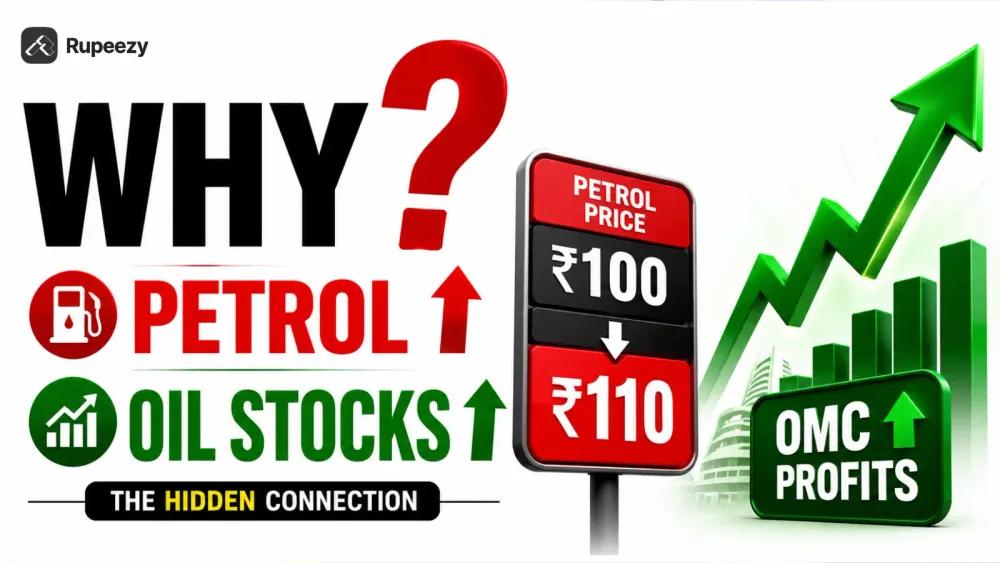
Why Oil Stocks Rally After Petrol Price Hikes?
 Last Updated: 18 September, 2026
 6 min read




00:00 / 00:00


Summary
|
Petrol prices are rising again, and most consumers are unhappy about it. Higher fuel costs increase transportation expenses, delivery charges, and overall household spending.
However, the stock market often reacts very differently. OMC stocks such as Indian Oil, BPCL, and HPCL rally after a petrol price hike. While this may seem surprising, the reason lies in how India's fuel pricing policy affects OMC profitability, marketing margins, and future earnings expectations.
At first glance, it may seem strange that something that hurts consumers can become positive news for investors. It all comes down to how crude oil costs affect pump prices and how fuel companies make up for losses when prices jump.

How Crude Drives Petrol Costs?
Crude oil is the primary raw material used to produce petrol and diesel. When global crude oil prices rise due to geopolitical tensions, supply disruptions, production cuts, or oil market volatility, fuel production costs increase.
In a perfectly free market, retail fuel prices would immediately rise to reflect these higher costs.
However, fuel pricing in India does not always move in line with global crude oil prices. Governments often try to prevent sharp increases in fuel prices to control inflation and protect consumers from sudden price shocks.
This creates a challenge for oil marketing companies. If retail fuel prices remain unchanged while crude oil prices continue to rise, OMC profitability comes under pressure as companies absorb part of the additional cost.
How Do OMCs Recover Their Losses?
Let's understand this with a simple example.
Now assume Brent crude prices rise sharply because of geopolitical tensions or supply disruptions. As a result, the actual cost of supplying that litre of petrol also increases significantly.
Ideally, retail fuel prices should immediately move higher to reflect the increased cost. However, the government may choose to delay price hikes to avoid adding pressure on inflation.
During this period, oil marketing companies such as Indian Oil, BPCL, and HPCL may have to absorb part of the higher fuel cost. This creates under-recovery losses and reduces marketing margins.
Over time, when petrol and diesel prices are gradually increased, these companies begin recovering those losses. The higher selling price allows them to improve margins and restore profitability.
This is the point investors closely watch. A petrol price hike improves earnings visibility, strengthens marketing margins, and increases the likelihood of corporate earnings. As a result, investors start buying OMC stocks, pushing share prices higher.
Why Are Fuel Prices Not Increased Immediately?
One reason oil stocks rally after a petrol price hike is India's fuel pricing mechanism. When crude oil prices rise sharply, retail fuel prices are not always increased immediately. Governments often try to control inflation and avoid sudden price shocks for consumers.
Similarly, when crude oil prices fall significantly, governments may increase excise duty instead of allowing the entire benefit to reach consumers. This helps generate revenue while keeping retail fuel prices relatively stable.
When crude oil prices move higher, the opposite challenge emerges. If fuel prices are not increased immediately, downstream oil companies such as Indian Oil, BPCL, and HPCL may have to absorb the additional cost.
This results in under-recovery losses and puts pressure on OMC profitability.
In some situations, the government may reduce excise duty to provide partial relief. However, oil marketing companies still rely on fuel price increases to fully recover lost marketing margins.
Over time, retail fuel prices are usually increased gradually rather than through one large hike. This allows the economy to absorb the impact more smoothly while helping OMCs recover losses and improve profitability.
Because investors understand this process, a fuel price increase is often viewed as a positive signal for future earnings growth, which can support BPCL, HPCL, Indian Oil, and other PSU oil stocks.

When Oil Prices Go Up, Do Oil Stocks Go Up?
The short answer is often yes, but not always.
Globally, rising crude oil prices can benefit oil producers because they earn more from selling oil. However, India's oil marketing companies operate differently.
Companies such as Indian Oil, BPCL, and HPCL are involved in refining, marketing, and fuel distribution. Their profitability depends not only on crude oil prices but also on marketing margins, refining margins, and fuel pricing policies.
In the early stages of a crude oil rally, higher input costs can hurt profits. But when fuel price increases allow companies to pass on those costs, the market begins pricing in future profit recovery.
That is why oil stocks often rally after a petrol price hike.
Investors can also explore stock market sectors to compare oil and gas stocks with companies across other industries and understand broader sector trends.
Why Do Marketing and Refining Margins Matter?
Many investors focus only on Brent crude prices or global oil market volatility.
However, investors pay close attention to both marketing margins and refining margins.
Marketing margins represent the difference between the retail selling price of fuel and the overall cost incurred by oil marketing companies. When fuel prices rise and costs are recovered, these margins improve.
Refining margins represent the difference between the cost of crude oil and the value of refined petroleum products such as petrol, diesel, and aviation fuel. Strong refining margins can provide additional support to earnings.
A company can face rising crude oil costs and still improve profitability if it can recover those costs through fuel price increases. This is why fuel pricing policy plays such an important role in determining OMC profitability.
In many cases, the market reacts more strongly to improving margins than to crude oil prices themselves.
Conclusion
The next time petrol prices rise, don't be surprised if OMC stocks move in the opposite direction.
While higher fuel prices increase costs for consumers, they can also improve profitability for oil marketing companies. Fuel price hikes allow companies such as Indian Oil, BPCL, and HPCL to recover under-recovery losses, strengthen marketing margins, and improve earnings visibility.
That is why a petrol price hike is often viewed as positive news by investors. In India's oil sector, rising fuel prices are not just about higher costs at the pump; they can also signal stronger financial health for OMC stocks.
For investors, understanding the relationship between crude oil prices, fuel pricing policy, refining margins, and OMC profitability can provide valuable insight into why oil stocks rally when petrol prices go up.
Investors looking to better understand market trends and sector-specific opportunities can also use educational resources and research tools available on platforms like Rupeezy to stay informed and make more confident investment decisions.
Investors comparing OMC stocks can use a stock market heatmap and today’s market movement to quickly assess how oil and gas stocks are performing relative to other sectors. This can complement fundamental analysis of crude prices, refining margins, and fuel pricing trends.
For investors looking to build long-term exposure to oil and gas stocks, a stock SIP can provide a disciplined way to invest a fixed amount regularly rather than relying on short-term price movements.
Did you like this blog?
Be the first to like this blog.
The content on this blog is for educational purposes only and should not be considered investment advice. While we strive for accuracy, some information may contain errors or delays in updates.
Mentions of stocks or investment products are solely for informational purposes and do not constitute recommendations. Investors should conduct their own research before making any decisions.
Investing in financial markets are subject to market risks, and past performance does not guarantee future results. It is advisable to consult a qualified financial professional, review official documents, and verify information independently before making investment decisions.
Open Rupeezy account now. It is free and 100% secure.
Start Stock Investment
All Category