
Difference Between Bankex and Sensex: A Simple Guide for Investors

 Last Updated: 13 June, 2026
 8 min read




00:00 / 00:00


Summary
| ||
There are times when banking stocks rally sharply while the broader stock market moves only marginally. On other occasions, the overall market performs well even though banking stocks remain under pressure.
This often leads investors to ask an important question: What is the difference between Bankex and Sensex?
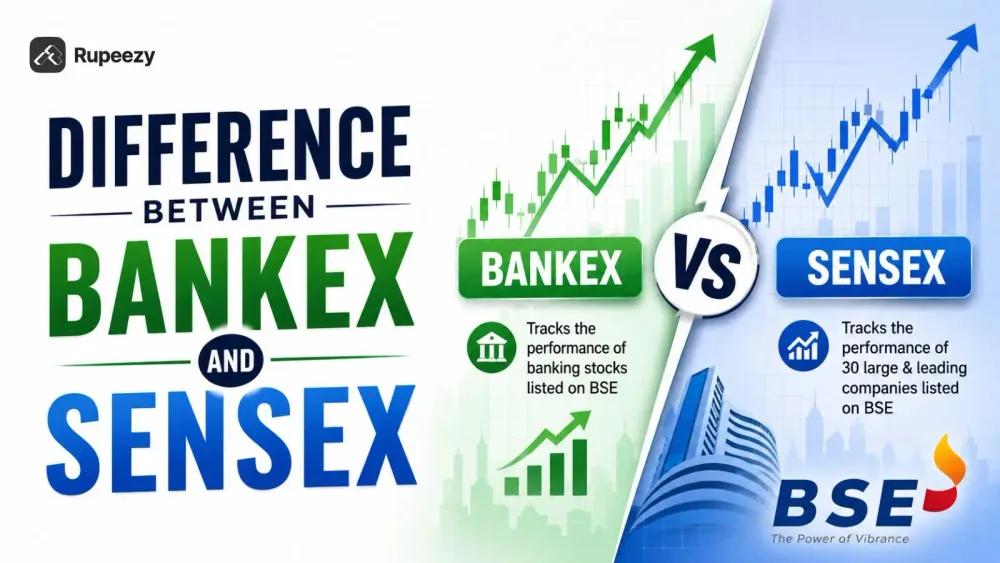
Although both are benchmark indices of the Bombay Stock Exchange (BSE), they serve different purposes. Sensex reflects the performance of leading companies across multiple sectors, while Bankex focuses exclusively on the banking sector.
Understanding how these indices differ can help investors interpret market trends, economic developments, and the impact of policy decisions more effectively.

What is Sensex?
Sensex, short for Sensitive Index, is one of India's oldest and most widely tracked stock market benchmarks.
Introduced in 1986, the index comprises 30 large, liquid, and financially strong companies listed on the BSE. These companies are selected from key sectors such as banking, information technology, automobiles, healthcare, energy, and consumer goods.
Because it includes businesses from different industries, the Sensex BSE index is widely regarded as an indicator of the overall Indian equity market.
Rather than representing a single sector, Sensex reflects the performance of Corporate India as a whole.
Key Features of Sensex
Tracks 30 leading companies listed on the BSE
Covers multiple sectors of the economy
Uses free-float market capitalization methodology
Acts as a benchmark for market performance
Reflects overall investor sentiment
What is Bankex?
Bankex is the flagship banking sector index of the Bombay Stock Exchange (BSE). It is designed to measure the performance of leading banking companies listed on the exchange.
Unlike Sensex, which captures the performance of multiple sectors, Bankex focuses exclusively on banks and financial institutions classified under the banking sector.
BSE introduced the Bankex on June 23, 2003. However, its benchmark performance is tracked back to its base date of January 1, 2002, starting at 1,000 points.
As of 12 June 2026, Bankex consists of 14 banking stocks, making it one of the most important sectoral indices for tracking the Indian banking industry. The Reconstitution frequency is done semiannually in June and December.
Since banks play a central role in lending, credit creation, liquidity management, and economic growth, Bankex is often viewed as a key indicator of the health of India's banking system.
Simply put, if Sensex shows how Corporate India is performing, Bankex shows how India's banking sector is performing.
Key Features of Bankex
Tracks 14 leading banking stocks listed on BSE
Focuses exclusively on the banking sector
Uses free-float market capitalization methodology
Started on January 1, 2002 with a value of 1,000 points
Rebalanced periodically to maintain sector representation
Sensitive to RBI policies, interest rates, and credit growth
Widely used as a benchmark for banking-sector performance
How Bankex and Sensex Have Evolved Over Time
Sensex was launched in 1986 and quickly became one of India's most important stock market benchmarks.
As India's economy expanded and capital markets matured, investors began seeking more focused ways to track specific industries. This led to the development of sector-specific indices such as Bankex.
The banking sector has undergone significant transformation since the early 2000s, driven by financial inclusion initiatives, digital banking adoption, private-sector bank expansion, and regulatory reforms.
As a result, Bankex has become an important benchmark for tracking the performance of one of India's most influential sectors.
Today, Sensex remains a benchmark for the broader market, while Bankex serves as an important indicator of the banking sector.
Together, these indices help investors understand both overall market trends and sector-specific developments.

How Are Sensex and Bankex Calculated?
Both Sensex and Bankex use the free-float market capitalization methodology.
Under this approach, only shares available for public trading are considered while calculating a company's weight in the index.
Shares held by promoters, governments, controlling shareholders, and strategic investors are generally excluded from the free-float calculation.
The formula broadly considers:
Free-Float Market Capitalization = Market Price × Total Shares Outstanding × Free-Float Factor
The aggregate free-float market capitalization of all constituent companies is then adjusted using an index divisor to arrive at the index value.
This methodology ensures that index movements better reflect the market value that is actually available to investors.
As a result, companies with larger free-float market capitalizations typically have a greater influence on index performance.
Difference Between Bankex and Sensex
Here are some of the key differences between Bankex and Sensex that can help investors understand what each index represents and how they are used to analyze market performance.
Feature | Sensex | Bankex |
Type of Index | Broad Market Index | Sectoral Index |
Objective | Track the broader Indian market | Track the banking sector |
Constituents | 30 companies across sectors | 14 banking stocks |
Market Representation | Corporate India and the economy | Banking industry |
Methodology | Free-float market capitalization | Modified free-float market capitalization |
Started With | 100 points | 1,000 points |
Launch Reference Date | 1978-79 | January 1, 2002 |
Sector Exposure | Diversified | Banking only |
Impact of RBI Policies | Moderate | High |
Economic Indicator | Overall economic activity | Banking and credit activity |
Best Used For | Understanding market trends | Understanding banking trends |
A Simple Example to Understand Bankex vs Sensex
Imagine that loan demand increases significantly and banks begin reporting strong earnings growth.
As investor confidence in the banking sector improves, banking stocks may rise sharply.
Since Bankex contains only banking stocks, it could deliver strong gains during this period.
However, if technology, consumer goods, or healthcare companies face challenges at the same time, Sensex may rise at a slower pace because it includes companies from multiple sectors.
This example shows why Bankex and Sensex can move differently despite both being BSE indices.
Why Bankex and Sensex Move Differently
Although both indices are influenced by market sentiment, several factors can cause them to perform differently.
Interest Rate Changes
Banking stocks are particularly sensitive to changes in interest rates. RBI policy decisions often have a more direct impact on Bankex than on Sensex.
Credit Growth
When lending activity increases, banks may benefit from higher business volumes, which can support Bankex performance.
Sector-Specific Challenges
A slowdown in the banking industry may affect Bankex significantly, even if companies in other sectors continue to perform well.
Broader Economic Trends
Sensex captures the performance of multiple sectors, making it a more comprehensive indicator of overall market conditions.
Why Investors Track Both Indices Together
Many investors rarely view Bankex and Sensex in isolation.
Tracking both indices can provide a more complete picture of market conditions.
What You Want to Measure | Index to Watch |
Overall market direction | Sensex |
Corporate India's performance | Sensex |
Banking sector strength | Bankex |
Impact of RBI policy decisions | Bankex |
Credit growth trends | Bankex |
Broad economic sentiment | Sensex |
Financial system health | Bankex |
Market leadership | Both |
By monitoring both indices, investors can better understand which sectors are driving market performance and where potential opportunities or risks may exist.
Does a Rising Bankex Mean the Entire Market Is Rising?
Not necessarily.
A rise in Bankex indicates strength in banking stocks. However, sectors such as information technology, healthcare, energy, or consumer goods may perform differently during the same period.
Similarly, Sensex can rise even when Bankex underperforms if non-banking sectors are driving market gains.
This is why investors often track both indices instead of relying on a single benchmark.
Bankex vs Nifty Bank
Many investors also compare Bankex with the Nifty Bank Index.
Although both indices track banking stocks, they belong to different stock exchanges.
Feature | Bankex | Nifty Bank |
Exchange | BSE | NSE |
Focus | Banking sector | Banking sector |
Methodology | Free-float market capitalization | Free-float market capitalization |
Constituents | 14 banking stocks listed on BSE | 14 banking stocks listed on NSE |
Primary Use | BSE banking benchmark | NSE banking benchmark |
Both indices help investors evaluate the performance of India's banking sector, but they operate within different exchange ecosystems.
How Rupeezy Can Help Investors Track Market Indices
Understanding indices such as Sensex and Bankex is an important part of becoming a more informed investor.
Platforms like Rupeezy provide access to market data, portfolio and position tracking, and other value-added tools that can help investors track benchmark and sector-specific indices more effectively.
By following both broad-market and sector-focused indices, investors can gain a deeper understanding of how different segments of the market respond to economic and business developments.
Conclusion
Although both Bankex and Sensex are important BSE indices, they serve different purposes.
Sensex provides a broad view of the Indian stock market by tracking leading companies across sectors, while Bankex offers a focused perspective on the banking industry.
Rather than viewing them as competing benchmarks, investors should consider them complementary tools. Together, they provide valuable insights into overall market conditions, banking sector trends, and the health of the Indian economy.
Understanding the difference between Bankex and Sensex can help investors interpret market movements more effectively and make more informed investment decisions.
Frequently Asked Questions (FAQs)
Q1) What is the main difference between Bankex and Sensex?
Sensex tracks companies from multiple sectors, while Bankex tracks only banking sector stocks.
Q2) Which index is more diversified?
Sensex is more diversified because it includes companies from different industries across the economy.
Q3) Is Bankex more sensitive to interest rate changes than Sensex?
Yes. Since Bankex consists of banking stocks, changes in interest rates and RBI policies generally have a greater impact on its performance.
Q4) Why do analysts monitor Bankex during economic recoveries?
Banks often play a crucial role in economic growth through lending and credit expansion. Strong banking performance may indicate improving economic activity.
Q5) Can Bankex outperform Sensex?
Yes. During periods of strong credit growth and favourable banking conditions, Bankex may outperform Sensex.
Q6) Which index should long-term investors track?
Many long-term investors track both. Sensex provides a broader market perspective, while Bankex offers insights into the banking sector.
The content on this blog is for educational purposes only and should not be considered investment advice. While we strive for accuracy, some information may contain errors or delays in updates.
Mentions of stocks or investment products are solely for informational purposes and do not constitute recommendations. Investors should conduct their own research before making any decisions.
Investing in financial markets are subject to market risks, and past performance does not guarantee future results. It is advisable to consult a qualified financial professional, review official documents, and verify information independently before making investment decisions.
Disclaimer
Investments in the securities market are subject to market risks. Read all the related documents carefully before investing. Rupeezy (SEBI RA Registration: INH000013332) provides this content for informational purposes; any securities quoted are for educational display and not as a recommendation. All charts and graphs are based on independent research and reliable sources for the period mentioned within the specific data set. Sometimes we take graphs from external sources. This communication does not promise or assure any fixed, guaranteed, or indicative returns to any client. For our complete registered office address, Member ID, and full SEBI registration details, please refer to our official website.
Open Rupeezy account now. It is free and 100% secure.
Start Stock Investment

All Category