

Open a Free Demat Account !
₹0 AMC & Account Opening Fee
What Is Repo Rate? Understanding Its Impact on the Economy

 Last Updated: 18 September, 2026
 7 min read




00:00 / 00:00


Summary
|
Banks have become an integral part of many of life's biggest financial decisions. Whether it's buying a house, purchasing a car, financing higher education, or simply depositing your savings, most of us interact with banks regularly. However, if you've ever taken a loan or tracked fixed deposit rates, you may have noticed that interest rates don't remain constant and tend to fluctuate over time.
These changes are not random. Just as individuals borrow money from banks, banks also borrow money from the Reserve Bank of India (RBI), the country's central bank. The interest rate charged on these borrowings is known as the Repo Rate, and it plays a crucial role in determining the interest rates on loans and deposits across the economy.
In this article, we will understand what the Repo Rate is, why the RBI changes it, and how it impacts your loans, savings, investments, and overall financial life.


What is Repo Rate?
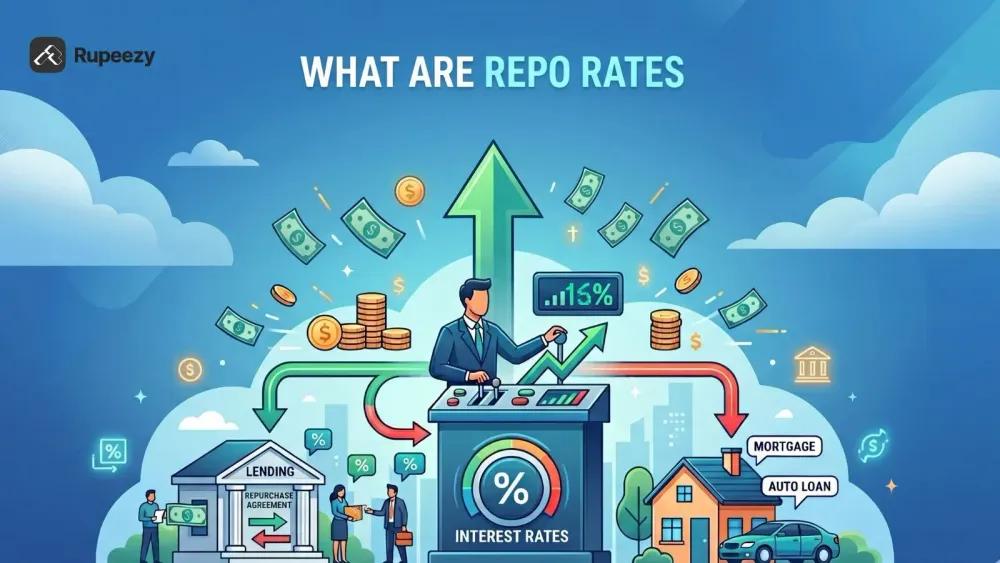
The term Repo Rate is derived from the phrase Repurchase Agreement. It is the rate at which commercial banks borrow money from the Reserve Bank of India (RBI) for a short period of time by pledging government securities as collateral.
In a repo transaction, banks sell government securities to the RBI in exchange for funds and agree to repurchase those securities at a later date. When the banks buy back these securities, they repay the borrowed amount along with an interest charge. This interest rate, determined by the RBI, is known as the Repo Rate.
Simply put, the Repo Rate is the cost that banks incur when borrowing money from the RBI.
Why do banks borrow from the RBI?
As most of you know, banks operate on a simple business model. They accept deposits from customers and pay them a certain rate of interest.
These funds are then lent to individuals and businesses in the form of home loans, car loans, education loans, and other forms of credit at a higher rate of interest. The difference between the interest earned and the interest paid forms a major part of a bank's income.
However, banks cannot lend out all of the money they receive as deposits. The RBI requires banks to maintain a certain percentage of their deposits as reserves in the form of the Cash Reserve Ratio (CRR), ensuring that banks have sufficient funds to meet their obligations.
Apart from this regulatory requirement, banks may also face situations where there is a sudden increase in loan demand or a temporary shortage of liquidity due to higher-than-usual withdrawals. In both these scenarios, banks may need additional funds to maintain smooth operations.
To meet these short-term funding requirements, banks can borrow money directly from the RBI through repo transactions whenever additional liquidity is needed to maintain smooth banking operations.
Why Does the RBI Charge a Repo Rate?
The Repo Rate is not just the interest rate charged by the RBI on loans given to commercial banks. It is also one of the RBI's most important monetary policy tools used to regulate liquidity, borrowing, spending, and inflation in the economy.
When there is too much money circulating in the economy, spending tends to increase, which can push prices higher and lead to inflation. On the other hand, if money becomes scarce, borrowing and spending slow down, which can negatively impact economic growth.
By increasing or decreasing the Repo Rate, the RBI can influence how much banks borrow and lend. This helps the RBI manage liquidity, control inflation, and support economic growth.

How Is the Repo Rate Decided?
The Repo Rate is not changed randomly by the RBI. It is decided by the Monetary Policy Committee (MPC), a six-member committee that meets every two months to review the country's economic conditions.
Before making a decision, the committee looks at several factors such as inflation, economic growth, liquidity in the banking system, consumer spending, and global economic trends.
If inflation is rising too quickly, the RBI may increase the Repo Rate. Higher borrowing costs generally reduce spending and help bring inflation under control.
On the other hand, if economic growth is slowing, the RBI may lower the Repo Rate. This makes borrowing cheaper for banks, businesses, and individuals, which can encourage spending, investment, and economic activity.
Impact of Repo Rate on Consumers and Businesses
As discussed earlier, banks earn a large part of their income by borrowing money at one rate and lending it at a higher rate. Since the Repo Rate determines the cost at which banks can borrow funds from the RBI, any change in the Repo Rate eventually affects both borrowers and savers across the economy.
Impact on Consumers
When the RBI increases the Repo Rate, borrowing becomes more expensive for banks. To offset this higher cost, banks often increase the interest rates on home loans, car loans, education loans, and other forms of credit. As a result, consumers end up paying higher EMIs, and borrowing becomes less attractive.
At the same time, higher Repo Rates often lead to better returns on fixed deposits and certain savings products. Conversely, when the Repo Rate is reduced, loans generally become cheaper, while returns on deposits may decline.
Impact on Businesses
The impact of Repo Rate changes extends beyond consumers and affects businesses as well. A higher Repo Rate increases the cost of business loans, making it more expensive for companies to fund expansion plans, purchase equipment, or manage working capital requirements.
Additionally, when consumers face higher borrowing costs, they often reduce discretionary spending. This can lower demand for products and services, particularly in sectors such as automobiles and real estate. On the other hand, lower Repo Rates encourage borrowing, spending, and investment, helping businesses grow and supporting overall economic activity.
Relationship between the repo rate and the stock market
Generally, there is an inverse relationship between the Repo Rate and stock market performance.
When the RBI increases the Repo Rate, borrowing becomes more expensive for both businesses and consumers. Higher borrowing costs can reduce corporate profitability, slow business expansion, and lower consumer spending. As a result, investor sentiment may weaken, putting downward pressure on stock prices.
Additionally, higher interest rates often make relatively safer investment options such as fixed deposits and government securities more attractive. This can lead some investors to shift their money away from equities, further affecting stock market performance.
On the other hand, when the RBI reduces the Repo Rate, borrowing becomes cheaper across the economy. Lower financing costs can support business growth, boost consumer spending, and improve corporate earnings. This generally creates a favorable environment for equities and can contribute to bullish sentiment in the stock market.
Investors can also track how different stocks and sectors are performing during changing interest-rate conditions using a stock market heatmap.This can make it easier to identify market-wide trends and compare which sectors or stocks are showing strength or weakness.
Investors can also explore stock market sectors to understand how changing interest rates can affect different industries and sector performance.
Investors can also track today’s market movement to see how Nifty, Sensex, and different sectors are responding to changing interest-rate conditions. This broader market view can complement the analysis of how Repo Rate changes influence stocks.
Conclusion
While the Repo Rate may seem like a technical financial term, its impact can be felt across the economy. From the EMIs you pay on loans to the returns you earn on deposits and even the performance of businesses and stock markets, changes in the Repo Rate influence several aspects of everyday financial life.
Understanding how the Repo Rate works can help you better understand the economy and make more informed borrowing, saving, and investment decisions.

Aaron Vas is a Research Analyst at Rupeezy with over four years of experience in the finance industry. He holds an M.Com. degree in Finance from St. Aloysius College. Aaron is passionate about options trading and brings in-depth expertise in stocks, technical analysis, futures and options, mutual funds, and ETFs.
Did you like this blog?
Be the first to like this blog.
The content on this blog is for educational purposes only and should not be considered investment advice. While we strive for accuracy, some information may contain errors or delays in updates.
Mentions of stocks or investment products are solely for informational purposes and do not constitute recommendations. Investors should conduct their own research before making any decisions.
Investing in financial markets are subject to market risks, and past performance does not guarantee future results. It is advisable to consult a qualified financial professional, review official documents, and verify information independently before making investment decisions.







All Category