

Open a Free Demat Account !
₹0 AMC & Account Opening Fee
Commodity vs Forex Trading: Key Differences Explained

 Last Updated: 17 September, 2026
 6 min read




00:00 / 00:00


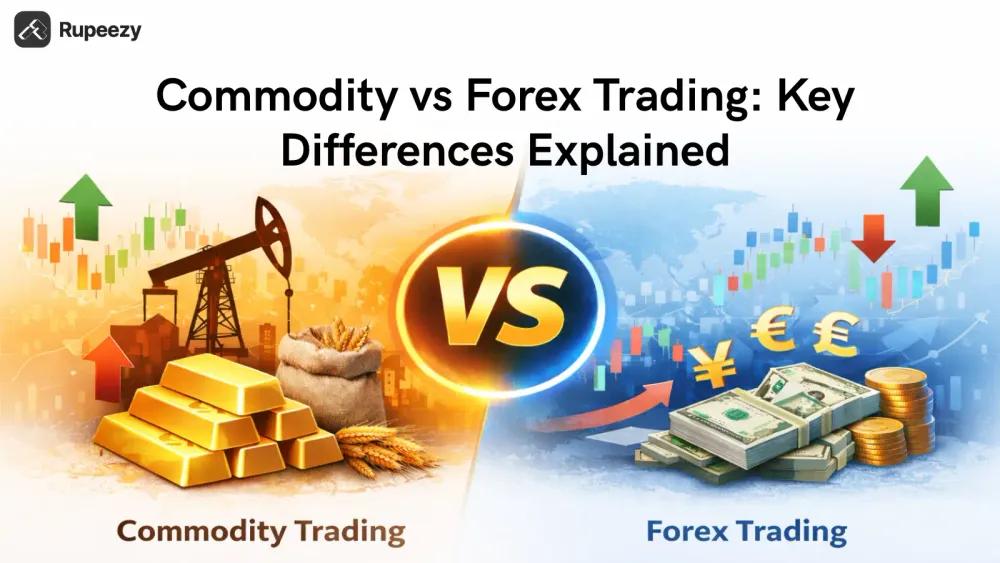
Financial markets offer several trading opportunities, but commodity and forex trading remain two of the most active segments globally. While both of these trading options give a great opportunity to gain from the price movements, both of them are quite different in nature.
The commodities involve the hard and soft commodities, which are actually the raw materials that are used by industries. On the other hand, forex trading focuses on the exchange of global currencies. But this is just the basic idea, and there is quite a bigger difference when it comes to investing.
So, if you are looking to start investing, then you must know the difference between commodity and forex trading. Knowing this will help you to make the right call and ensure that your investments grow as per your financial plans. So, let us explore the details here.

What Is Commodity Trading?
Commodity trading involves buying and selling raw materials such as gold, crude oil, natural gas, and agricultural products like wheat or cotton. In India, these trades usually happen through exchanges like MCX using futures and options contracts.
Traders participate in this market to benefit from price movements. But there is an impact of various factors like global conditions, policies, and others.
Key Features of Commodity Trading
Includes both soft and hard commodities like oil, cotton, metals, and others.
Prices are largely influenced by international demand and supply conditions.
Most commonly uses the futures and options for trading.
Both domestic and international factors impact the price movements.
Global influence and policies play an important role.
Standard exchange contracts with expiry dates and rules are used.
For traders using futures and options, it is also important to check the F&O ban list before placing fresh positions, as applicable trading restrictions can affect which securities are available for new F&O trades.
Pros of Commodity Trading
Commodities help diversify portfolios that are heavily focused on equities.
Precious metals are used for hedging against inflation.
Good commodities bring in liquidity and volumes.
Global demand creates regular price movements and trading opportunities.
Cons of Commodity Trading
Volatility increases when there is turmoil in any global event,
Knowing the production cycle, trends, and industry use is important for the traders.
Using leverage can help, but it can amplify profits and losses both.
Sudden geopolitical or economic developments can lead to sharp price swings.
What Is Forex Trading?
Forex trading is the buying and selling of currencies. All trades happen on the global platform. Instead of trading physical assets, traders exchange one currency for another. Some of the common pairs that you will find are USD/INR, EUR/USD, or GBP/USD.
The goal is to profit from changes in exchange rates. This is a large market and stays open 24 hours a day as it links global markets with one another.
Key Features of Forex Trading
Forex trading involves currency pairs where one currency is exchanged for another.
The largest financial market with high liquidity.
Works for 24 hours, allowing you to trade with ease.
Rates are influenced by various international factors.
Any geopolitical event will impact the price greatly.
Most forex trading is done through leveraged derivative contracts.
Pros of Forex Trading
High liquidity allows quick entry and exit from trades.
Flexible in nature because of 24-hour operations.
Major currency pairs offer low costs.
Spread can be tight, so proper knowledge is key.
A quick opportunity to trade might arise when there are swift movements.
Cons of Forex Trading
High leverage can increase the risk of significant losses.
Currency markets can react quickly to economic announcements.
Various macroeconomic factors are there which make it hard for new traders.
Price fluctuations can lead to unexpected losses as well.
Commodity vs Forex Trading: Key Differences
There is no doubt that these two are great options for traders. Both offer you an opportunity to gain profit with no need to own the underlying asset. But these are not the same in nature. The main differences between commodity trading and forex trading are as follows.
Basis | Commodity Trading | Forex Trading |
Asset Traded | Physical resources such as gold, crude oil, natural gas, and agricultural products. | Currency pairs such as USD/INR, EUR/USD, and GBP/USD. |
Market Size | Large market but smaller compared to the global forex market. | The largest financial market in the world. |
Price Drivers | Demand and supply, weather conditions, geopolitical tensions, and production levels. | Interest rates, economic indicators, central bank policies, and geopolitical events. |
Trading Hours | Limited trading hours depending on the exchange. | Works for 24 hours to help with better trades. |
Volatility | Highly volatile when there is a global issue or a new policy. | Generally, highly volatile daily as various news impacts these. |
Liquidity | High liquidity in major commodities like gold and crude oil. | Extremely high liquidity in major currency pairs. |
Contract Type | Mostly traded through futures and options contracts. | Traded through currency pairs in spot or derivative markets. |
Market Participants | Producers, manufacturers, hedgers, and traders. | Banks, financial institutions, governments, and retail traders. |

Who Should Consider Commodity vs Forex Trading?
Both markets attract different types of traders depending on their knowledge, risk tolerance, and trading strategy. But this is also true that each of these trading methods is good for a certain group of traders only. So, here are some points that would help you understand who should use which trading option.
Commodity Trading May Suit
Those who understand the global supply and demand work.
Who wants to diversify beyond the stocks and shares.
If you are looking to create a good inflation hedge.
Traders are comfortable analyzing geopolitical events and commodity cycles.
Forex Trading May Suit
If you work with global and interest rate decision conditions.
Those who can manage high fluctuations in real-time.
Traders who prefer flexible trading hours due to the 24-hour forex market.
Experienced traders who can manage risks associated with leveraged trading.
Conclusion
Both commodity and forex markets offer opportunities to trade based on price movements. But it is important to note that these work on very different fundamentals.
Where commodities are mostly driven by the greater demand, the forex can have fluctuations even on small news in the market. Knowing this difference can help you check which of these works for you the best.
This is where platforms like Rupeezy can help. You can use these to understand market trends, learn trading concepts, and make more informed investment decisions.
FAQs
What is the main difference between commodity and forex trading?
Commodity trading involves raw materials such as gold, crude oil, or agricultural products. But forex trading focuses on currency pairs like USD/INR or EUR/USD.
Which market is larger, commodities or forex?
The forex market is the largest financial market globally. It is one with high trading volumes on a daily basis, and so is even more liquid and volatile too.
Is forex trading riskier than commodity trading?
Both markets carry risks. Forex trading often involves higher leverage. But the commodity prices can be highly volatile due to supply disruptions and geopolitical events.
Can beginners trade commodities and forex?
Yes, beginners can participate in both markets. But to start with, you must know the markets well. Also, it is best to start small to avoid high losses.
Can traders participate in both commodity and forex markets?
Yes. There are many traders who trade in both markets. But it is good only when you understand the markets well.
Surbhi Bapna is a finance content writer at Rupeezy with more than six years of experience in the finance industry. She holds an MBA degree in Finance from the International Institute of Professional Studies. Surbhi is passionate about integrating finance into people’s daily lives through informative content. She brings in-depth expertise in stocks, personal finance, mutual funds, banking, and investments. Her experience, analytical insights, and commitment to financial research significantly contribute to Rupeezy's comprehensive financial content.
Did you like this blog?
Be the first to like this blog.
The content on this blog is for educational purposes only and should not be considered investment advice. While we strive for accuracy, some information may contain errors or delays in updates.
Mentions of stocks or investment products are solely for informational purposes and do not constitute recommendations. Investors should conduct their own research before making any decisions.
Investing in financial markets are subject to market risks, and past performance does not guarantee future results. It is advisable to consult a qualified financial professional, review official documents, and verify information independently before making investment decisions.

All Category