

Open a Free Demat Account !
₹0 AMC & Account Opening Fee
Client Risk Profiling Guide for Mutual Fund Distributors

 Last Updated: 08 September, 2026
 11 min read




00:00 / 00:00


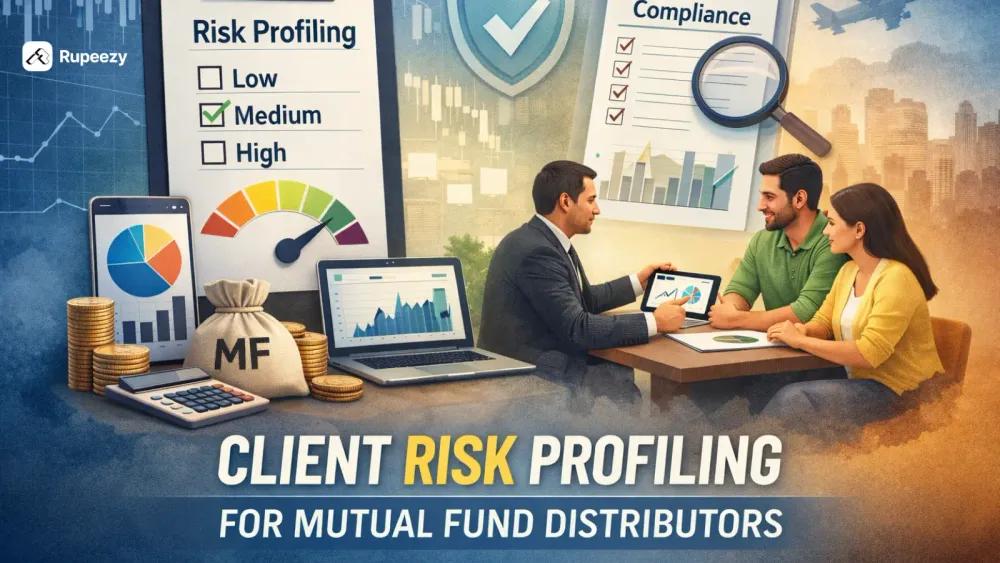
In today's environment, selling mutual funds solely based on past returns is neither ethical nor sustainable. Amidst changing markets and stricter regulations, client risk profiling has become the foundation of reliable and professional advice. It's not just about filling out a form, but about understanding the client, setting realistic expectations, and building a long-term relationship. In this blog, we will explore a simple, practical, and relevant approach to risk profiling for today's market.

Understanding Risk the Way Clients Experience It
Risk Tolerance :
Risk Tolerance refers to how comfortable a client is mentally during market fluctuations. Often, a client might say they can handle "high risk," but when the market drops by 15-20%, panic sets in. Therefore, it's crucial to understand not just the client's answer, but also their behavior.
Risk Capacity :
Risk Capacity is purely financial. It includes the client's income, expenses, loans, emergency funds, and future responsibilities. Someone might have a high income, but if they are highly dependent on that income, their risk capacity will be limited.
Risk Requirement :
Risk Requirement indicates the actual return a client needs to achieve their goals. Not every client needs aggressive investments; sometimes, simple and stable returns are sufficient to meet their objectives.
Why Does Incorrect Profiling Lead to Disputes?
When Risk Tolerance, Risk Capacity, and Risk Requirement don't align, unrealistic expectations are created. When the market falls, the client becomes dissatisfied, and trust erodes.
What is the Real Fear?
Clients fear uncertainty, not volatility itself. Today's professional financial advisors explain market risk in terms of "life impact" and how a downturn will affect their goals and life. This is the essence of modern and reliable risk profiling.
Step-by-Step Client Risk Profiling Process Used by Successful MFDs
Step 1: Don't focus on products, first understand the client's life goals
The biggest mistake in risk profiling is talking about equity or debt right from the start. This makes the client perceive the conversation as a "product sale." The correct approach is to first understand why the client wants to invest money for retirement, children's education, a house, or financial security.
When the goals are clear, the level of risk automatically becomes apparent. For example, money saved for retirement cannot be as risky as money saved for children's education.
Once financial goals are clearly identified, investments can be structured around the required amount, time horizon, and risk capacity. Goal-based investment planning can help investors align their investment strategy with specific objectives such as retirement, children's education, buying a house, or financial security.
Step 2: Use a Hybrid Risk Questionnaire (Data + Behavior)
Number-based questions alone prove insufficient in today's market. Therefore, modern MFDs use a hybrid questionnaire.
This includes three things:
Financial information such as the client's income, assets, and loans
Investment horizon and dependence on that money
The client's likely reaction if the market falls
Practical experience shows that 10-12 clear and simple questions are most effective, as clients complete them without getting tired.
Step 3: Assess Risk Capacity before Risk Appetite
Often, a client claims to be a high-risk taker, but their financial situation doesn't allow it.
When determining risk capacity, MFDs consider:
Whether an emergency fund is available
Stability of monthly expenses and income
Ongoing loans and future liabilities
If the client may need to withdraw the invested money prematurely, their risk capacity is considered limited regardless of how high their income is.
Step 4: Avoid guesswork, create a Composite Risk Score
Professional MFDs convert the client's information into a clear risk score.
The commonly used practical weighting is as follows:
Financial Capacity – 40%
Goal & Time Horizon – 30%
Behavioral Risk Tolerance – 20%
Liquidity Needs – 10%
It is essential to record this score in writing so that both the client and the distributor are protected in the future.
Step 5: Translate the Risk Profile into a Portfolio Strategy
A risk score only makes sense when it translates into the right asset allocation.
Experienced MFDs (Mutual Fund Distributors) adjust model portfolios according to the client's situation
Limiting equity exposure for clients nearing retirement
A more liquid structure for business owners
Different strategies for SIP and lump-sum investments
This approach brings the portfolio closer to real-life needs.
Step 6: Client Validation and Written Confirmation
In today's world, verbal consent alone is not enough. Professional MFDs confirm the risk profile and asset allocation via email, CRM, or written message. This small step prevents misunderstandings and disputes during market downturns and strengthens client trust.
Real Client Scenarios: How Risk Profiling Works on the Ground
Case 1: Young Investor – High Risk Appetite, but Low Risk Capacity
Situation : A young investor is confidently willing to take "high risks" and has a high allocation to small-cap funds in their portfolio. However, they lack sufficient emergency funds, and their income has only recently stabilized.
Common Mistake : Overly aggressive allocation based on age and enthusiasm, without considering the ability to withstand losses in case of unforeseen circumstances.
Professional Approach : Risk profiling revealed a high emotional willingness to take risks, but weak financial backup.
Portfolio Adjustment :
First, an emergency fund was created.
The allocation to small-caps was reduced, balancing it with large-cap/flexi-cap funds.
Phased investment through SIPs (Systematic Investment Plans)
This maintained investment discipline during market downturns.
Case 2: Business Owner – Large Surplus, but Uncomfortable with Volatility
Situation : A business owner has a lump sum available for investment, but their income is irregular. Even minor market fluctuations cause them mental discomfort.
Key Point : A high-volatility portfolio is not practical with irregular income, even if the investable amount is large.
Professional Solution :
Lump sum invested in phases (STP - Systematic Transfer Plan)
Balanced use of debt and conservative hybrid funds
Maintaining sufficient liquidity
This structure balanced both return expectations and peace of mind.
Case 3: Client Nearing Retirement – ??Aggressive Investments from the Past
Situation : Even a few years before retirement, the portfolio has a high equity exposure because the market had previously delivered good returns.
Key Risk : The Sequence of Returns Risk becomes crucial here—if the market falls just before retirement, the fund can be significantly impacted.
Impact of Re-profiling :
Re-assessment of time horizon and cash flow needs
Gradual shift from equities to more stable instruments
Goal-based asset allocation
This protected the retirement fund from unnecessary risk.
How to Ask Risk Questions Without Making Clients Uncomfortable
The success of risk profiling depends on how openly the client shares their thoughts and fears. If the questions are too technical or rigid, the client tends to give "correct-sounding" answers rather than genuine ones. Therefore, professional MFDs (Mutual Fund Distributors) keep risk-related conversations simple, trustworthy, and conversational.
Explaining Risk in Simple, Everyday Language :
Clients typically don't relate to financial jargon, but rather to situations that affect their lives. When risk is explained in terms of life events and potential impacts, the client feels more comfortable, and the conversation flows naturally.
Asking Questions that Reveal Behavior :
The right questions are those that reveal the client's behavior, not just their opinions. Understanding their reaction to market downturns or temporary losses helps in understanding their true risk profile and minimizes future misunderstandings.
Communicating with Empathy :
When a client expresses concerns about investments, it's crucial to first acknowledge their feelings. A professional approach recognizes that fear is natural and provides solutions that empower the client with a sense of control and clarity.
Handling Clients with Different Mindsets :
Some clients are overly confident, while others are excessively cautious. Finding a balance is essential in both cases. Gradually guiding the client towards an understanding of their true risk capacity through experience and real-world examples is part of modern and effective risk profiling.
Behavioral Risk Management: The Missing Layer in Most Profiles
Most risk profiling forms assume that the client will make rational decisions in every situation, while reality is quite different. The real challenge arises during market downturns or sharp rallies, when emotions override rational decision-making.
Why Clients Behave Differently in Real Markets
When the market falls, the fear of loss becomes stronger than logic. Conversely, during bull markets, recent returns lead to overconfidence. Experience shows that clients behave according to the emotions of the moment not according to what is written in the risk profiling form.
MFDs can also review today’s market movement to understand the broader market environment that may influence client reactions during periods of volatility, corrections, or strong rallies.
Panic Redemption : Wrong Decisions Made in Fear
During market corrections, many clients perceive temporary losses as permanent and hastily withdraw their investments. This behavior is most detrimental to long-term returns. Professional MFDs (Mutual Fund Distributors) educate clients beforehand that market downturns are a part of investing, to prevent panic decisions.
Performance Chasing: Chasing Yesterday's Returns
During bull markets, clients often want to invest in funds that have recently performed best. This behavior unbalances the portfolio and unnecessarily increases risk. Risk profiling without behavioral understanding fails here.
Bull Market Overconfidence: Excessive Confidence
With consistently good returns, many clients forget their actual risk tolerance. They begin to believe that the market will always go up. Experienced MFDs remind clients of the importance of balance and potential risks during this phase to prevent future shocks.
Practical Tools to Manage Behavioral Risk
Behavioral Risk Management is not about restricting the client, but about guiding them in the right direction. Disciplined investment habits like SIPs (Systematic Investment Plans), regular rebalancing, and pre-defined rules protect clients from making emotional decisions. When these things are clear from the outset, clients are more likely to stay invested even during market fluctuations.
Compliance, Documentation & Audit Readiness
What Regulators Actually Expect :
In today's regulatory environment, risk profiling is not just a formality but is considered proof of documented and reasoned advice. Regulators want to see that a client's profile has been created in line with their financial situation, goals, and risk tolerance. The "why" behind the advice is just as important as the "what."
What Essential Documents Every MFD Should Have :
Professional MFDs maintain clear and updated records in their files. This includes the risk questionnaire form filled out by the client, the logic used to determine the risk score, the rationale for the suggested portfolio, and the client's written consent. These documents collectively demonstrate that the advice was based on a process, not on speculation.
Why Portfolio Rationale is Crucial :
Simply listing the names of funds is not enough. It must be documented why a particular allocation of equity, debt, or hybrid funds was chosen for a client. When the portfolio rationale is clear, the advice is less likely to be questioned, even during market downturns.
The Real Importance of Client Confirmation :
Written confirmation whether via email, CRM notes, or digital message shows that the client understood and accepted the risk profile and strategy. This simple step significantly reduces the likelihood of misunderstandings and disputes in the future.
How This Provides Protection During Complaints or Audits :
If a complaint or audit ever occurs, proper risk profiling records become the MFD's greatest protection. Clear documentation demonstrates that the advice was given according to the client's profile, not based on promises of returns or under pressure. This is why professional MFDs view compliance not as a burden, but as long-term security.
Tools & Technology Used in Modern Risk Profiling
CRM-Based Risk Profiling :
Previously, risk profiling was limited to paper forms or PDFs, making updates and tracking difficult. Today, professional MFDs (Mutual Fund Distributors) use CRM systems where client profiles, risk scores, investment history, and communication are all recorded in one place.
Effective Use of Spreadsheets for Scoring and Audit Trail :
Many MFDs still use Excel or Google Sheets, and this is perfectly practical if done correctly. Spreadsheets allow for transparent risk scoring logic, weightages, and calculations.
Best Practices for Digital Consent and Record Retention :
In modern advisory services, digital confirmation has become crucial. Client consent on risk profiles, asset allocation, and investment strategies is obtained via email, CRM notes, or digital messages. It's also essential to securely store and regularly update these records.
How to Scale with Automation Without Losing the Personal Touch :
Automation doesn't mean the advice becomes impersonal. Professional MFDs use technology for routine tasks such as review reminders, profile update alerts, and document management so they can dedicate more time to quality interactions with their clients.
Conclusion
Risk profiling is not a one-time formal exercise, but rather a continuous process of understanding and guiding the client. When MFDs (Mutual Fund Distributors) conduct profiling based on realistic goals, behavior, and capacity, investment decisions become more stable and reliable. Accurate risk profiling not only optimizes returns but also builds strong and trusting client relationships over the long term.
FAQs
Q1. What is client risk profiling?
This process is done to understand the investor's income, goals, and risk tolerance.
Q2. Why is risk profiling important for MFDs?
It helps in providing the right advice and maintaining client trust during market downturns.
Q3. How often should risk profiling be reviewed?
Once a year or upon any major life event.
Q4. Does high income mean high risk capacity?
No, loans, expenses, and emergency funds are also important factors.
Q5. Can a client’s risk profile change?
Yes, it changes with time and circumstances.
Q6. What if risk profiling is ignored?
It increases the likelihood of incorrect investments, dissatisfaction, and disputes.

Anupam Shukla is a finance content writer and an NISM-certified research analyst with over Seven years of trading experience. With a passion for the stock market, he simplifies complex financial concepts, making investing and trading easier for everyone. His expertise helps readers stay ahead in the ever-changing world of finance, empowering them to make smarter money moves.
Did you like this blog?
Be the first to like this blog.
The content on this blog is for educational purposes only and should not be considered investment advice. While we strive for accuracy, some information may contain errors or delays in updates.
Mentions of stocks or investment products are solely for informational purposes and do not constitute recommendations. Investors should conduct their own research before making any decisions.
Investing in financial markets are subject to market risks, and past performance does not guarantee future results. It is advisable to consult a qualified financial professional, review official documents, and verify information independently before making investment decisions.

100% commission sharing for one year, Rs. 0 registration fee, and earn Rs. 2 Lakhs+ per month from home.
Explore Now





All Category