

Open a Free Demat Account !
₹0 AMC & Account Opening Fee
Strangle vs Straddle Option Strategy: Which One Should You Use?

 Last Updated: 21 September, 2026
 6 min read




00:00 / 00:00


Markets do not move in straight lines. Some days they trend smoothly, and other days they swing sharply in either direction. For traders, these sudden moves create opportunities. But the real challenge is this: what if you expect volatility but are unsure about the direction?
This is where the debate around the straddle vs strangle option strategy becomes important. Both strategies are designed to benefit from strong price movement. At the same time, their structure, cost, and risk profile are quite different.
But choosing between long strangle vs long straddle or short straddle vs short strangle depends on how confident you are about volatility and how much capital you are willing to deploy. So, read this guide to know all the details you need.

What Is a Strangle in Options Trading?
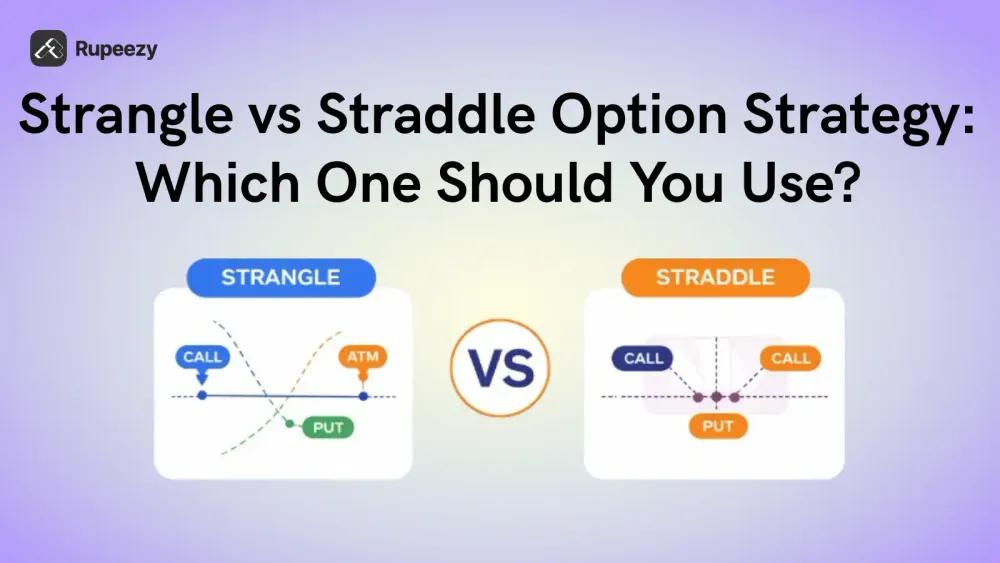
A strangle is an options strategy. It is one where the trader buys or sells one call option and one put option with the same expiry date but different strike prices. Both options are usually out-of-the-money. The call strike is placed above the current market price. But here the put strike is placed below it.
Because the strikes are different, a strangle generally costs less than a straddle. However, the underlying asset must move more significantly for the strategy to turn profitable.
Let us understand both variations in detail.
Long Strangle
A long strangle is used when you expect high volatility but are uncertain about the direction of the move. In this strategy, you purchase an out-of-the-money call and an out-of-the-money put with the same expiry.
Key features of a long strangle include:
Lower option premium for the trader.
Limited risk as per the premium paid only.
High potential to make profits.
Strong profit potential if the price falls significantly.
Wider break-even points due to out-of-the-money strikes.
This strategy works well before major events such as earnings announcements, budget releases, or policy decisions. The total cost is relatively lower. However, the price must move beyond either break-even level to generate meaningful profit.
Short Strangle
It is suitable when you expect the market to remain stable. This is where there is limited price movement. In this setup, you sell an out-of-the-money call and an out-of-the-money put with the same expiry.
Key features of a short strangle include:
Income generation through premium collection.
Maximum profit is limited to the total premium received.
Unlimited risk if the price rises sharply.
Significant downside risk if the price falls heavily.
Requires margin and active risk management.
This strategy performs best in range-bound markets. This is where the volatility is expected to decline. If the underlying price stays between the two strike prices until expiry, both options expire worthless, and the trader keeps the entire premium.
What Is a Straddle in Options Trading?
A straddle is an options strategy. It is the one where the trader buys or sells a call and a put option at the same strike price and the same expiry date. Unlike a strangle, both options are typically at the money. Because of this, a straddle is more sensitive to price movement from the very beginning.
Since both options are at the same strike, the premium is higher compared to a strangle. However, the strategy requires a relatively smaller move to reach break-even.
Long Straddle
A long straddle is used when you expect strong volatility but are unsure about the direction. In this setup, you buy one at-the-money call. Once that is done, you buy an at-the-money put. Now, both of these have the same expiry.
Key features of a long straddle include:
Higher premium to be paid.
Risk is limited as per the premium paid.
Unlimited profit potential on the upside.
Significant profit potential on the downside.
Break-even levels are closer to the current market price.
This strategy is commonly used before major announcements when a sharp move is expected. Since both options are at-the-money, even a moderate move can start generating gains. But a flat market and time decay can quickly reduce the premium value.
Short Straddle
It is used when you expect minimal price movement. At the same time, you expect a falling volatility. In this strategy, you sell one at-the-money call and one at-the-money put with the same expiry.
Key features of a short straddle include:
Maximum profit is limited to the premium received.
Profit if the market remains near the strike price.
Unlimited risk on the upside.
Substantial downside risk.
Highly sensitive to sudden volatility spikes.
This strategy works best in stable markets. If the underlying asset closes near the strike price at expiry, both options expire worthless. This is where the trader keeps the premium. However, a strong directional move helps with risk control.
Now that both strangle and straddle are clear individually, the real comparison becomes easier.
Strangle vs Straddle Option Strategy: When to Use Which
When comparing the strangle vs straddle option strategy, the real difference lies in cost, break-even levels, and how much movement is required. Both target volatility, but they behave differently depending on whether you are buying or selling options.
Before taking fresh F&O positions, traders can check the F&O ban list for applicable trading restrictions.
Before choosing between these strategies, traders can also assess broader market movements and sector trends using a stock market heatmap. This can provide a quick visual view of which stocks and sectors are showing stronger or weaker price action.
Traders can also explore stock market sectors to understand sector-wise trends when assessing potential underlying stocks for options strategies.
Long Strangle vs Long Straddle
Choose a long straddle when:
You expect an immediate sharp move.
You want break-even levels closer to the current price.
You are comfortable paying a higher premium.
Choose a long strangle when:
You expect a very large move.
You want a lower upfront cost.
You are fine with wider break-even levels.
Short Straddle vs Short Strangle
Choose a short straddle when:
You believe the price will stay very close to a specific level.
You want higher premium income.
You are able to manage high-risk exposure.
Choose a short strangle when:
You expect the price to stay within a wider range.
You want slightly more room for error.
You prefer lower immediate risk compared to a short straddle.

Conclusion
Choosing between the strangle and straddle option strategy is not easy. It depends on how you view volatility. If you expect sharp movement and want faster reaction, a straddle may suit you. If you prefer a lower premium with a wider range of expectations, a strangle can be better.
But ensure to do proper analysis. This is where Rupeezy can help you. Ensure to analyze options data, compare premiums, and make informed trading decisions with clarity.
FAQs
What is the key difference between a strangle and a straddle option strategy?
A straddle uses the same strike price for both call and put, while a strangle uses different strike prices placed above and below the current price.
Which is more affordable, a long strangle vs long straddle?
A long strangle is generally cheaper because both options are out of the money, reducing the premium cost.
Is a short straddle riskier than a short strangle?
Yes, because the strikes are at the money, a short straddle is more sensitive to price movement.
When should traders avoid these strategies?
They should avoid them when volatility expectations are unclear or when risk management is weak.
Do both strategies benefit from volatility?
Long strategies gain from high volatility, while short strategies work better in stable markets.
Surbhi Bapna is a finance content writer at Rupeezy with more than six years of experience in the finance industry. She holds an MBA degree in Finance from the International Institute of Professional Studies. Surbhi is passionate about integrating finance into people’s daily lives through informative content. She brings in-depth expertise in stocks, personal finance, mutual funds, banking, and investments. Her experience, analytical insights, and commitment to financial research significantly contribute to Rupeezy's comprehensive financial content.
Did you like this blog?
Be the first to like this blog.
The content on this blog is for educational purposes only and should not be considered investment advice. While we strive for accuracy, some information may contain errors or delays in updates.
Mentions of stocks or investment products are solely for informational purposes and do not constitute recommendations. Investors should conduct their own research before making any decisions.
Investing in financial markets are subject to market risks, and past performance does not guarantee future results. It is advisable to consult a qualified financial professional, review official documents, and verify information independently before making investment decisions.



All Category