

Open a Free Demat Account !
₹0 AMC & Account Opening Fee
Nifty 500 Explained: Everything You Need to Know

 Last Updated: 21 September, 2026
 6 min read




00:00 / 00:00


The Nifty 500 is one of the broadest stock market indices in India. Unlike the Nifty 50, it covers a larger number of companies, which helps with a better understanding of the market movements and trends.
But if you are trying to understand what is Nifty 500, you first need to understand which companies it includes and how this decision is made. So, let us explore all the key details here in this guide.

What Is Nifty 500?
The Nifty 500 is a broad market index. It is created by the National Stock Exchange of India. It tracks the performance of the top 500 listed companies. The selection is based on free float market capitalization.
It includes stocks from multiple sectors and companies of various sizes. This includes large, mid, and small-cap stocks. This helps you to get a broader view of the market to make the right investment decision.
The key points to know are as follows:
Consists of 500 companies listed on the NSE.
Selection is based on free float market capitalization and liquidity.
Companies from all sectors, like IT, FMCG, banking, and others.
Represents about 95% of the free float market capitalization of NSE-listed stocks.
Periodical rebalancing to ensure there is the right representation.
The index helps investors understand the overall direction of the market. This is why it is often used as a benchmark for diversified investment strategies.
Key Highlights of Nifty 500
Particular | Details |
Index Name | Nifty 500 |
Launched By | National Stock Exchange (NSE) |
Number of Companies | 500.00 |
Coverage | Large-cap, mid-cap, and small-cap companies |
Selection Criteria | Free float market capitalization and liquidity |
Market Coverage | Around 95% of the NSE-listed free float market capitalization |
Base Year | 1995.00 |
Base Value | 1000.00 |
Rebalancing | Periodically reviewed and adjusted |
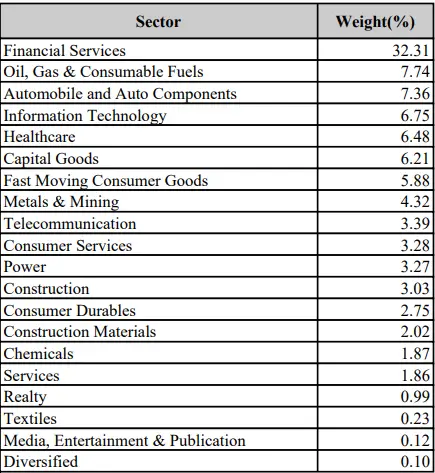
Top Nifty 500 Sectors
The Nifty 500 includes companies from a wide range of sectors such as banking, IT, energy, pharma, FMCG, automobiles, and infrastructure, offering diversified market exposure.

Nifty 500 Top Companies
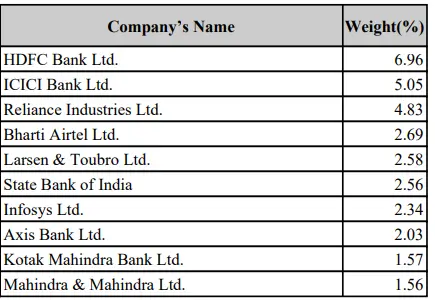
While 500 companies make the Nifty 500, only a few of them are on the top charts based on their weightage. The top companies are:
Investors looking to build positions in eligible Nifty 500 stocks with additional buying capacity can also consider MTF for eligible Nifty 500 stocks, subject to applicable margin requirements, interest, stock eligibility, and other charges.
Investors can explore stock market sectors to understand the different industries represented in the Nifty 500 and compare sector-wise opportunities.
Nifty 500 Valuation Indicators
There are various key indicators that you need to focus on. But the key ones that you must know are:
P/E (Price to Earnings) Ratio
Investors are paying about Rs. 23.50 for every Rs. 1 of earnings generated by companies in the index. This suggests moderate to slightly premium valuations depending on market conditions.
P/B (Price to Book) Ratio
The index is trading at 3.6 times the book value of the companies. This indicates a higher than expected net asset value (NAV). This is mainly due to growth expectations.
Dividend Yield
Investors receive around 1.12% of the index value as dividends annually, showing that the index focuses more on growth than income returns.

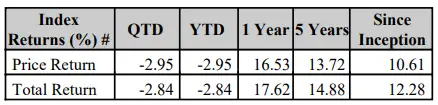
How the Nifty 500 Index Has Given Returns Since Inception
The returns that the index offered are as follows:
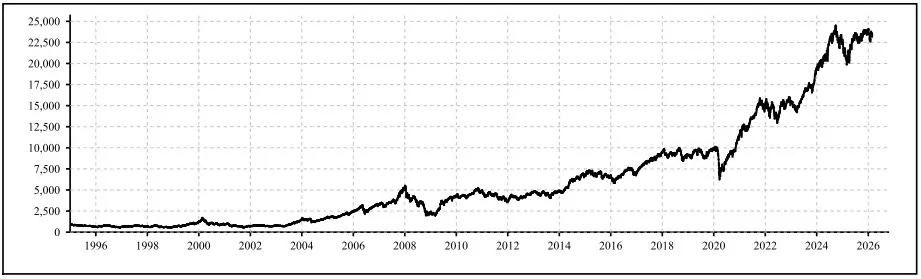
Interpretation and Analysis
The Nifty 500 provides a clear picture of how a diversified portfolio across large, mid, and small-cap companies can perform over time. Two things that you can understand here are:
Short-term returns may fluctuate due to market cycles.
Long-term data shows steady growth and broader market exposure.
The recent trend suggests that there is a decline in performance to the tune of around -2.95% in QTD and YTD. But at the same time, the index has given about 16.53% price return and 17.62% total return. So, there is a recovery period, and the decline was mainly due to volatility.
Investors can also check the share market today to understand current Nifty, Sensex, and broader market movements alongside the Nifty 500’s recent performance.
For long-term investors, the 5-year return of around 13% to 15% annually. Overall, if you are investing in a fund that follows this index, a long-term perspective is what you need. This will help you to gain better returns.
What Investors Need to Understand from Nifty 500 Data
For investors, the Nifty 500 is useful because it reflects the performance of the broader Indian equity market. But there are some other things that you must understand when you are planning to use this data to base your investment decisions:
The Nifty 500 represents the overall Indian stock market, not just a few large companies.
Short-term market movements are normal and should not drive long-term decisions.
Long-term investors benefit more as the index has historically delivered steady returns.
Valuation indicators help judge market pricing before investing.
The index can be used as a benchmark to track portfolio performance.
Long-term investors should also consider their financial objectives, investment horizon, and risk tolerance when deciding how the Nifty 500 fits into their portfolio. Goal-based investment planning can help align investments with specific financial goals while maintaining a suitable long-term strategy.
Conclusion
The Nifty 500 offers one of the most comprehensive views of the Indian equity market. It is mainly because it includes companies of all sizes and sectors, which represent more than 90% of market capitalisation. This makes it a great index to use for analysis and tracking.
For investors, it serves as a useful benchmark for long-term planning. But if you are looking to invest by following the right data and insights, use Rupeezy. Get all the details, tools, and insights you need to make the right call.
Since the Nifty 500 covers companies across multiple sectors, investors can use a Nifty 500 stock market heatmap to quickly compare market performance and identify which sectors and stocks are gaining or losing momentum.
FAQs
What is Nifty 500?
The Nifty 500 is a broad market index. It tracks the performance of 500 companies listed on the NSE. These are from multiple sectors based on market cap.
What sectors are included in the Nifty 500?
The index includes companies from various sectors. Some of the top ones are banking, IT, energy, healthcare, consumer goods, automobiles, and infrastructure.
Can investors invest directly in Nifty 500?
No. Investors cannot invest directly in the index. But they can invest in ETFs and mutual funds that track the Nifty 500 index.
How is Nifty 500 different from Nifty 50?
The Nifty 50 is narrow and tracks only the top 50 large-cap companies. The Nifty 500 includes 500 companies, on the other hand. This gives a broader view.
Why is Nifty 500 important for investors?
Nifty 500 offers a good view of the overall equity market. It can help you understand trends and movements.
Surbhi Bapna is a finance content writer at Rupeezy with more than six years of experience in the finance industry. She holds an MBA degree in Finance from the International Institute of Professional Studies. Surbhi is passionate about integrating finance into people’s daily lives through informative content. She brings in-depth expertise in stocks, personal finance, mutual funds, banking, and investments. Her experience, analytical insights, and commitment to financial research significantly contribute to Rupeezy's comprehensive financial content.
Did you like this blog?
Be the first to like this blog.
The content on this blog is for educational purposes only and should not be considered investment advice. While we strive for accuracy, some information may contain errors or delays in updates.
Mentions of stocks or investment products are solely for informational purposes and do not constitute recommendations. Investors should conduct their own research before making any decisions.
Investing in financial markets are subject to market risks, and past performance does not guarantee future results. It is advisable to consult a qualified financial professional, review official documents, and verify information independently before making investment decisions.


All Category