

Open a Free Demat Account !
₹0 AMC & Account Opening Fee
Difference Between G-Sec and T-Bill: How to Buy in India

 Last Updated: 07 September, 2026
 8 min read




00:00 / 00:00


Key Highlights
|


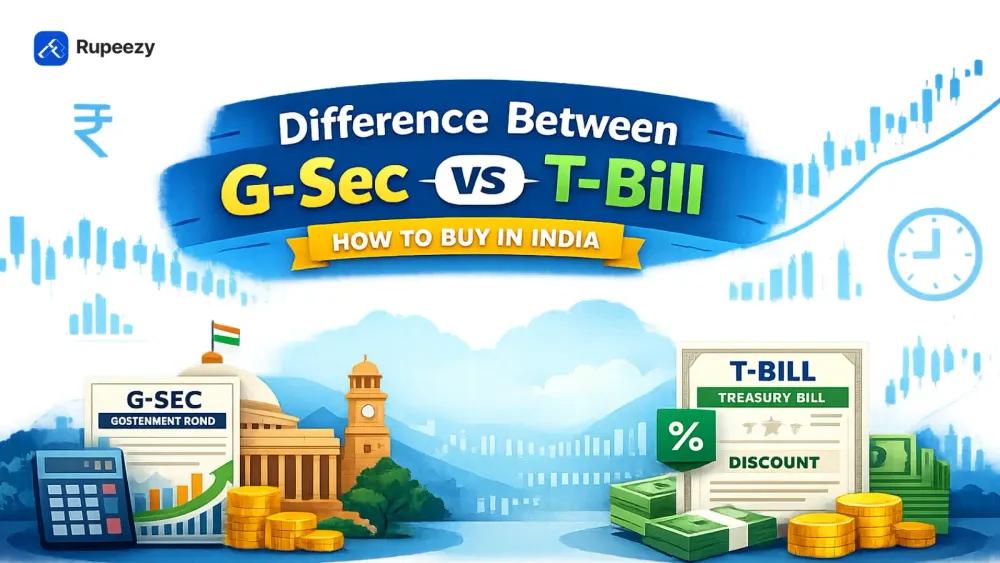
The main difference between G-Sec and T-Bill lies in their tenure. The G-Secs are long-term government securities that pay regular interest. On the other hand, T-Bills, also known as treasury bills, are short-term government securities issued at a discount and redeemed at face value.
Now, it is clear that both of these are government securities in India. Considered to be safe investment options, both of these allow investor to earn from their investment passively. But still, this is not complete yet. There are more GSec vs T-Bill differences that you must understand as an investor.
So, if you are planning to start your investment journey in government securities, this is your guide. Read to know the differences and start with the right decision.
GSec vs T-Bill: A Quick Snapshot
When you plan to invest in government securities in India, you first need to understand their working well. The same is applicable for the GSec and T-Bill. So, before we dive in deep to understand the GSec vs T-Bill, let us have a quick difference snapshot here.
Feature | G-Sec | T-Bill |
Meaning | Long-term debt security issued by the Government of India | Short-term debt security issued by the Government of India |
Full-Form | Government Security Bonds | Treasury Bills |
Maturity Period | Usually 1 year to 40 years | 91 days, 182 days, or 364 days |
Interest Payment | Pays regular coupon interest | No interest payment |
Return Generation | Through coupon payments and possible capital gains | Through the difference between the purchase price and the face value |
Issue Method | Issued at face value or through auctions | Issued at a discount to face value |
Investment Horizon | Medium to long term | Short term |
Price Volatility | Higher due to longer maturity | Lower due to shorter maturity |
Suitable For | Investors seeking regular income and long-term stability | Investors looking to park funds for a short period |
Liquidity | Tradable in the secondary market | Tradable in the secondary market |
Risk Level | Very low | Very low |
Issuer | Government of India | Government of India |
Minimum Investment | Generally starts from Rs. 10,000 in RBI auctions for retail investors | Generally starts from Rs. 10,000 in RBI auctions for retail investors |
What Is a G-Sec?
A G-Sec is also known as a Government Security Bond. It is a debt instrument issued by the Government of India. The G-sec bonds help the government to borrow funds from the public. This is for a fixed time.
The government pays the interest on these bonds at regular intervals. Investors will get the invested amount during maturity. These securities are backed by the sovereign guarantee of the Government of India.
Features of G-Secs
Issued by the Government of India.
Available with maturities ranging from 1 year to 40 years.
Pays fixed or floating-rate interest, known as a coupon.
Interest is generally paid every six months.
Principal amount is repaid on maturity.
Can be bought and sold in the secondary market.
Low credit risk associated.
Suited for long-term investment plans.
Perfect for low-risk seekers.

What Is a T-Bill?
The Treasury Bills in India are known as T-Bills. These are short-term government securities issued by the Government of India. These bills aim to help the government to meet short-term funding requirements.
The T-Bills do not pay regular interest. But these are the instruments that are issued a discount on the face value. Then, during maturity, they are redeemed at face value. This difference is the earnings of the investors. This makes T-bill investing a secure and predictable option.
Features of T-Bills
Issued by the Government of India.
Available in 91-day, 182-day, and 364-day maturities.
Does not pay periodic interest.
Issued at a discount and redeemed at face value.
Offers returns through the discount earned at maturity.
Highly liquid and actively traded.
Reduced credit risk.
Offers proper sovereign backing.
Good for short-term investment plans.
Perfect if there is a quick cash management need.
How to Buy GSec in India?
Investing in G-Secs has become much easier for retail investors in recent years. There are certain ways through which you can invest in these. The same is discussed in the section below.
Through RBI Retail Direct
The RBI Retail Direct Scheme allows individual investors to buy government securities directly from the Reserve Bank of India. The steps to follow are:
Open a Retail Direct account on the RBI Retail Direct portal.
Go for KYC. and its verification.
Log in to your account.
Look for the G-Sec auctions. You can buy here.
Hold the securities until maturity. You can even sell them before maturity if needed.
Through a Demat and Trading Account
You can also purchase G-Secs through stock exchanges using a registered broker. The basic steps that you would need to follow are:
Open a demat and trading account.
Search for available government securities on the exchange.
Look for the same in the secondary market.
Find the one that you need and place the buy order.
The securities will be credited to your demat account after settlement.
Note: Margin Trading is generally applicable to eligible equity shares rather than G-Secs or T-Bills. Investors using a demat and trading account should understand the difference between investing in government securities and using margin for eligible stocks, as margin trading involves additional costs and market risks.
Through Mutual Funds and ETFs
Investors who do not want to buy individual securities can gain exposure through:
Gilt Funds
Target Maturity Funds
Government Bond ETFs
How to Buy T-Bills in India?
The steps that you would need to buy the T-Bills are quite similar to those of G-Sec. There are multiple methods as well. The details are in the steps below.
Through RBI Retail Direct
This is the most direct way to invest in Treasury Bills. This is quite simple, and you would need to follow the steps below:
Register for an RBI Retail Direct account.
Submit the KYC.
Get the same verified.
Select the desired T-Bill auction (91-day, 182-day, or 364-day).
Submit your bid.
Upon allotment, the T-Bills will be credited to your account.
Through a Demat and Trading Account
Investors can buy listed T-Bills from stock exchanges. The process would need you to follow the steps below:
Log in to your trading account.
Search for available Treasury Bills.
Place a purchase order.
You can hold it till maturity. Sell in between if you need funds.
Through Debt Mutual Funds
Many debt funds invest in Treasury Bills as part of their portfolio. This provides indirect exposure to the bills. There is no need to hold or buy them directly. The methods are as follows:
Money Market Funds
Ultra Short Duration Funds
These options allow you to gain all the benefits of short-term funds with no need to manage on your own. Mutual fund managers manage these funds and ensure you a better outcome.
Government Bonds Vs T-Bills: Which Should You Choose?
The choice between government bonds and T-Bills depends on certain important points, like:
Investment horizon
Income requirements
Financial goals
You would need to compare and evaluate all these to ensure that you make the right choice. Since both are government-backed, the safety is at its best.
The choice between government bonds and T-Bills depends on certain important points, like investment horizon, income requirements, and financial goals. You would need to compare and evaluate all these to ensure that you make the right choice. Since both are government-backed, the safety is at its best. A goal-based investment planning approach can help you select between short-term and long-term investments based on your specific financial goals, time horizon, and risk preferences.
Choose Government Bonds (G-Secs) If You are:
Looking for long-term investment.
Want regular interest payments.
Goal is wealth building or retirement.
Long-term lock-in of funds is fine.
Choose Treasury Bills (T-Bills) If You are:
Looking for short-term investment.
Want to park your surplus funds.
Do not want any regular payment.
Looking for lower returns in the short term with safety.
Quick Comparison
Even when you have all the details, selecting between government securities and T-Bills can be hard at times. So, here is a quick snapshot to help you make decisions.
If You Want To | Better Option |
Earn a regular income | G-Secs |
Invest for less than one year | T-Bills |
Build a long-term fixed-income portfolio | G-Secs |
Park short-term surplus funds | T-Bills |
Reduce interest rate volatility | T-Bills |
Lock in yields for several years | G-Secs |
Conclusion
Understanding the difference between G-Sec and T-Bill can help you choose the right government-backed investment for your financial goals. G-Sec is good if you wish for long-term investing, while T-Bills are good if the investment needs are short-term.
But before investing in any of these, you would need to plan, compare, and find the perfect solution to continue. This is where platforms Rupeezy can help you out. You can find the details you need to invest and can get expert support.
Open your demat account and start investing!
FAQs
1. Is it good to invest in GSEC?
Yes, G-Secs are a good investment. These offer long-term investment and safe returns. The credit risk is low, which adds to the overall value.
2. Are T-bills a good investment?
Yes. T-Bills are a great investment. You can invest in these for the short term and earn stable returns. These are issues at discount, which is great.
3. Are treasury securities the same as T-bills?
No. Treasury securities are a broader category. These include Treasury Bills (T-Bills), Government Bonds, and other government-issued debt instruments. T-Bills are one type of treasury security.
4. Can I sell GSEC before maturity?
Yes, G-Secs can be sold before maturity through the secondary market. The price you get will be based on the market conditions.
5. What are the three types of treasury bills?
There are three types of Treasury Bills in India. These are the 91-Day Treasury Bill, 182-Day Treasury Bill, and 364-Day Treasury Bill.
Surbhi Bapna is a finance content writer at Rupeezy with more than six years of experience in the finance industry. She holds an MBA degree in Finance from the International Institute of Professional Studies. Surbhi is passionate about integrating finance into people’s daily lives through informative content. She brings in-depth expertise in stocks, personal finance, mutual funds, banking, and investments. Her experience, analytical insights, and commitment to financial research significantly contribute to Rupeezy's comprehensive financial content.
Did you like this blog?
Be the first to like this blog.
Investments in securities market are subject to market risks, read all the related documents carefully before investing . Rupeezy (SEBI RA Registration: INH000013332) provides this content for informational purposes; any securities quoted are for educational display and not as a recommendation. All charts and graphs are based on independent research and reliable sources for the period mentioned within the specific data set. Sometimes we take graphs from external sources. This communication does not promise or assure any fixed, guaranteed, or indicative returns to any client. For our complete registered office address, Member ID, and full SEBI registration details, please refer to our official website.
The content on this blog is for educational purposes only and should not be considered investment advice. While we strive for accuracy, some information may contain errors or delays in updates.
Mentions of stocks or investment products are solely for informational purposes and do not constitute recommendations. Investors should conduct their own research before making any decisions.
Investing in financial markets are subject to market risks, and past performance does not guarantee future results. It is advisable to consult a qualified financial professional, review official documents, and verify information independently before making investment decisions.


All Category