

Open a Free Demat Account !
₹0 AMC & Account Opening Fee
What Are Government Securities and How Do They Work?

 Last Updated: 07 September, 2026
 7 min read




00:00 / 00:00


Summary
|
Government securities stand out for their safety and stability in the investment strategy. Backed by the government, these instruments are known to offer predictable returns that reduce risk to a certain extent.
But at the same time, you would come across multiple options, ranging from treasury bills to long-term bonds, which makes selection a lengthy process. If you are looking to make that choice now, read this guide. Explore the top government securities and their details.
With the right insights and a detailed comparison, ensure that you make the right investment call. Learn everything you need in a well-structured manner here.


What Are Government Securities?
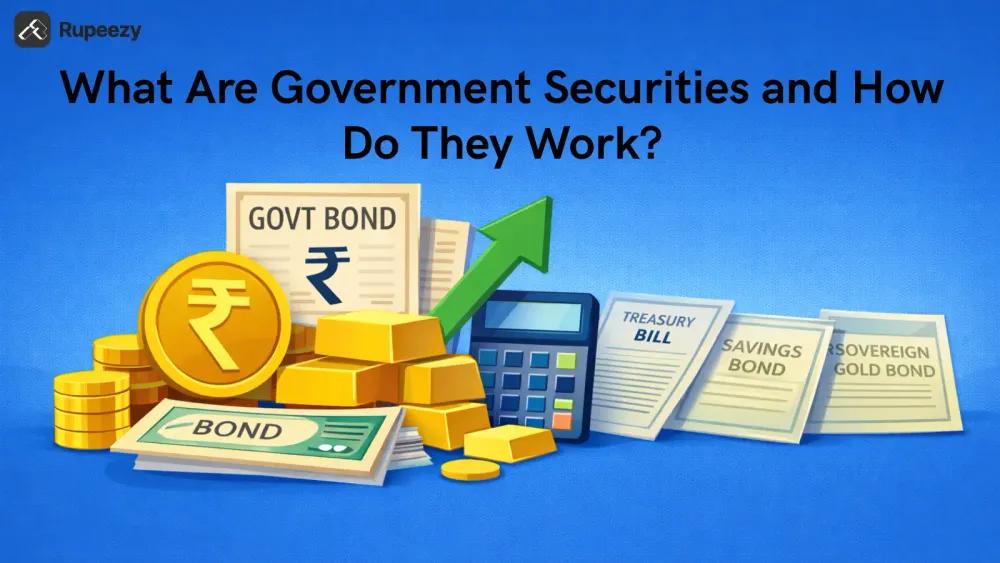
Government securities are debt instruments issued by the Government of India. The primary reason for their issuance is to raise capital from investors. So, when you invest in these, you lend money to the government for a fixed period.
Now, in return for the amount you lend, the government pays interest or offers returns in the form of discount-based gains, depending on the type of security. Since there is no market element, these instruments are considered the safest options and also help reduce the risk of default.
These instruments allow banks, institutions, and even individuals to make an investment.
Pros of Government Securities
Top-level of safety, as these are backed by the government.
Stable and predictable returns.
There is quite a low level of risk and uncertainty involved.
Offers a fixed time for investment.
Both short and long-term choices are available.
Support portfolio diversification and risk reduction.
Cons of Government Securities
Lower returns when compared to other equity options.
Interest income is taxed as per the investor's income tax slab.
Fluctuations in the secondary market can impact interest rates.
Long-term fund blocking, which might not suit everyone.
Not good for high-growth seekers.
Categories of Government Securities in India
Government securities in India are classified based on their tenure and return structure. You must know these to make the right call. These are:
1. Short-Term Government Securities
These manage funds over a short duration with high safety and liquidity. These do not provide interest to the investor. The key points to know are:
Includes Treasury Bills and Cash Management Bills.
Tenure is less than one year.
Issued at a discount and redeemed at face value.
Suitable for parking surplus funds.
2. Long-Term Government Securities
These are suitable for investors seeking stable income. These funds offer long-term capital preservation and periodic interest payouts. Their features include:
Includes Fixed Rate Bonds, Floating Rate Bonds, Inflation-Indexed Bonds, and State Development Loans.
Tenure ranges from 5 years to 40 years.
Interest is paid semi-annually in most cases.
Supports income generation.
3. Specialized Government Securities
These are structured for specific investment needs. If you see, these have a unique returns structure as well. The details are:
Includes Sovereign Gold Bonds, STRIPS, and Floating Rate Savings Bonds.
Returns may be linked to gold prices, benchmarks, or issued as zero-coupon instruments.
Some instruments may be non-tradable or have limited liquidity.
Suitable for diversification.
Types of Government Securities
When you plan to invest in government securities, you will find multiple choices at once. Some of these are short-term investments that you would need to hold for a year or less. But there will be others where the investment term will be locked for 5-years or so. This is where the contrast lies for comparison.
Security | Issuer | Tenure | Return Type | Interest / Coupon | Key Feature | Retail Investment |
Treasury Bills (T-Bills) | Central Govt | ? 1 year (91, 182, 364 days) | Discount | No coupon. Issued below face value and redeemed at ?100. | Highest liquidity. Auctioned every Wednesday by the RBI. | Yes |
Cash Management Bills (CMBs) | Central Govt | < 91 days | Discount | No coupon. Issued at a discount like T-Bills. | Ad-hoc issuance to manage temporary cash mismatches. | No |
Fixed Rate Bonds | Central Govt | 5 – 40 years | Fixed Coupon | Fixed percentage paid semi-annually. | Most common G-Sec. Example: 7.17% GS 2028. | Yes |
Floating Rate Bonds (FRBs) | Central Govt | Varies | Variable Coupon | Linked to 182-day T-Bill yield. Reset semi-annually. | Coupon resets at pre-defined intervals. | Yes |
Inflation-Indexed Bonds (IIBs) | Central Govt | Varies | Real Return | Fixed real coupon + inflation adjustment on principal and interest. | Protects against inflation using CPI or WPI linkage. | Yes |
Capital Indexed Bonds | Central Govt | Varies | Real Return | Fixed coupon. Only principal is inflation-adjusted. | Largely historical. Coupon not inflation-linked. | Yes |
Bonds with Call / Put Options | Central Govt | Varies | Fixed Coupon | Fixed interest paid semi-annually. | Govt can call back. The investor can exit via a put option. | Yes |
Special Securities (Oil, Fertiliser, Food, Bank Recap Bonds) | Central Govt | Long-term | Fixed Coupon | Slightly higher than standard G-Secs. | Issued to PSUs instead of cash subsidies. Not SLR eligible. | No |
STRIPS | Central Govt | Any maturity | Zero Coupon | No periodic interest. Issued at a deep discount. | Coupons and principal are traded separately. | Yes (Limited) |
State Development Loans (SDLs) | State Govt | ~10 years | Fixed Coupon | Semi-annual interest. Slightly higher yield than G-Secs. | Auctions on Tuesdays. Eligible for SLR. | Yes |
Sovereign Gold Bonds (SGBs) | RBI / Govt | 8 years | Interest + Price Gain | 2.5% fixed interest paid semi-annually. | Linked to the gold price. Exit allowed after 5 years. | Yes |
Floating Rate Savings Bonds 2020 (FRSB) | RBI / Govt | 7 years | Floating Interest | NSC rate + 35 bps. Reset every 6 months. | Non-tradeable. No maximum investment limit. | Yes |

How to Invest in Government Securities in India
Government securities can be purchased through multiple routes, depending on how directly you want to participate. The details of these are as follows:
1. RBI Retail Direct Scheme
Open an RBI Retail Direct account online.
Complete KYC and link your bank account.
Participate in primary auctions.
Hold securities directly in your account.
2. Via Demat Account
Use your trading app or platform.
Log in using credentials.
Select available government securities or T-Bills.
Place an order as you would for a regular stock purchase.
Securities are credited to your demat account.
3. Investing via Mutual Funds
Invest in mutual funds, like debt or gilt funds.
Suitable for beginners.
Managed by professional fund managers.
4. With the Banks
Apply through your bank’s investment services.
Choose available securities.
Complete the purchase process.
Holdings are maintained in accordance with the bank's structure.
Tax-Free Government Securities in India
Not all government securities are tax-free, even though they are considered safe investments. Understanding taxation helps you evaluate actual returns and choose the right option based on your financial planning.
Aspect | Tax Treatment | Applicable To | Key Note |
Interest Income | Taxed as per the income slab | G-Secs, SDLs, FRBs, Savings Bonds | Added under “Income from Other Sources”. |
Discount Income | Taxed as per the income slab | Treasury Bills, CMBs | The difference between the purchase price and the face value is taxable. |
Capital Gains (Before Maturity) | STCG as per the slab. LTCG as per rules with indexation (if applicable). | Listed government securities | Applies only if sold in the secondary market. |
Sovereign Gold Bonds (Interest) | Taxable as per the slab | SGBs | 2.5% interest is taxable. |
Sovereign Gold Bonds (Maturity) | Capital gains tax exempt | SGBs | Only if held till maturity (8 years). |
Fully Tax-Free Securities | Not generally available | NA | Most G-Secs are not fully tax-free. |
Not all government securities are tax-free, even though they are considered safe investments. Understanding taxation helps you evaluate actual returns and choose the right option based on your financial planning. A goal-based investment planning approach can further help you select government securities based on your financial goals, investment horizon, income requirements, and risk tolerance.
Conclusion
Government securities offer a balance of safety, stability, and predictable returns. Adding these to your portfolio will help you strike a balance and bring in a predictable component. Though these might support high wealth creation like other options, they allow you to ensure the safety of your capital.
But before investing, it is important that you thoroughly analyse and research your options. This is where Rupeezy comes in. The platform offers insights and trend analysis with tools to help you plan. This allows you to create a strategy that aligns well with your financial goals.
FAQs
Are government securities safe investments?
Yes. These government securities carry low default risk. That's why these are considered safe.
What returns can you expect from government securities?
Returns are generally stable but moderate and predictable in nature, based on the instrument you invest in.
Can you sell government securities before maturity?
Yes. There are many government securities that you can sell in the secondary market before maturity.
Do government securities provide regular income?
Some securities, like bonds and SDLs, provide periodic interest payments, while others, like Treasury Bills, offer returns through discounted pricing.
What is the minimum investment period required?
The minimum investment period is based on the instrument. This can range from a few days to over a year, so make the right call based on your plan.
Surbhi Bapna is a finance content writer at Rupeezy with more than six years of experience in the finance industry. She holds an MBA degree in Finance from the International Institute of Professional Studies. Surbhi is passionate about integrating finance into people’s daily lives through informative content. She brings in-depth expertise in stocks, personal finance, mutual funds, banking, and investments. Her experience, analytical insights, and commitment to financial research significantly contribute to Rupeezy's comprehensive financial content.
Did you like this blog?
Be the first to like this blog.
Investments in the securities market are subject to market risks. Read all the related documents carefully before investing. Rupeezy (SEBI RA Registration: INH000013332) provides this content for informational purposes; any securities quoted are for educational display and not as a recommendation. All charts and graphs are based on independent research and reliable sources for the period mentioned within the specific data set. Sometimes we take graphs from external sources. This communication does not promise or assure any fixed, guaranteed, or indicative returns to any client. For our complete registered office address, Member ID, and full SEBI registration details, please refer to our official website.
The content on this blog is for educational purposes only and should not be considered investment advice. While we strive for accuracy, some information may contain errors or delays in updates.
Mentions of stocks or investment products are solely for informational purposes and do not constitute recommendations. Investors should conduct their own research before making any decisions.
Investing in financial markets are subject to market risks, and past performance does not guarantee future results. It is advisable to consult a qualified financial professional, review official documents, and verify information independently before making investment decisions.





All Category